 Memorizing Quran
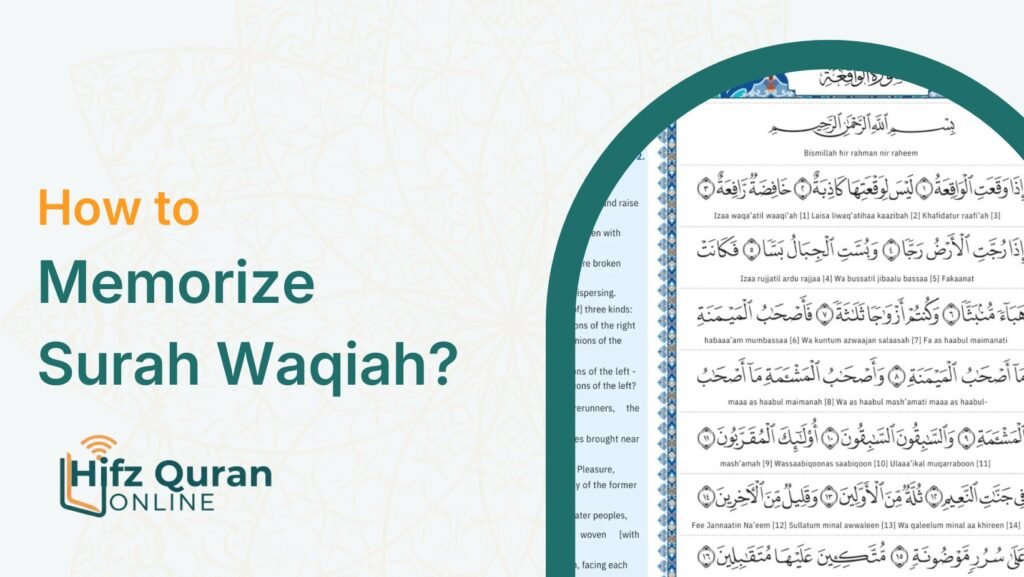
Most people open Surah Al-Waqiah, look at its 96 verses, and close the mushaf again. The chapter feels long, and the wording seems unfamiliar at first read. Learning how to memorize Surah Waqiah does not require a special gift for memorization — it requires breaking the surah into small pieces and repeating each one until it holds on its own.
This guide explains how to memorize Surah Waqiah step by step, how to structure your daily practice, avoid common causes of forgetting, and use teacher-guided revision to build stronger, lasting retention.
1. Learn The Meanings Behind Surah Al-Waqiah Before You Memorize It
Surah Al-Waqiah is the 56th chapter of the Quran, revealed in Mecca before the Prophet’s migration to Medina, with a small number of verses classified as Medinan.
It contains 96 verses, and it sits in the 27th juz, directly after Surah Ar-Rahman and before Surah Al-Hadid. The name “Al-Waqiah” — meaning “The Inevitable Event” — comes from its opening verse, which uses this word as one of the names of the Day of Judgment.
Knowing the structure of the surah before memorizing it makes the process easier, because the surah is not one continuous stream of similar-sounding verses.
It divides into clear sections: the description of the three groups of people on Judgment Day (the foremost, the companions of the right, and the companions of the left), a detailed picture of paradise and punishment, four proofs of Allah’s power drawn from creation, rainfall, seeds, and fire, and a closing statement on the sanctity of the Quran itself.
Recognizing these sections as you go gives your memory natural landmarks to hold onto, rather than 96 verses that all blend together.
Read also: How to Memorize Surah Duha? – A Step-by-Step Guide
why does the surah’s structure matter for memorization?
Because the surah moves through distinct themes rather than repeating one idea, each section has its own vocabulary and rhythm. Once you know a section is about paradise, or about the three groups of people, or about proofs of creation, the verses inside it become easier to place in order — you’re recalling a theme, not just sounds.
2. Reason for the Revelation of Surah Al-Waqi’ah
There is no single specific reason for the revelation of Surah Al-Waqi’ah as a whole. It is a Makkan surah revealed primarily to affirm the belief in resurrection, the Day of Judgment, and the reward and punishment that follow,However, specific reports mention circumstances connected to some of its later verses, particularly verses 75–82.
It was reported that after rain fell during the time of the Prophet ﷺ, some people attributed it to Allah’s mercy, while others attributed it to the stars, saying that a particular star or constellation had caused the rain. These verses were then revealed to correct this belief and affirm that rain and provision come from Allah alone.
Another report from Jabir ibn Abdullah mentions that when the verses initially stated, “a multitude of the former peoples and a few of the later ones,” Umar ibn Al-Khattab رضي الله عنه became concerned that the “few” might refer to the Muslims. Later, the verses “a multitude of the former peoples and a multitude of the later ones” were revealed, reassuring the believers. This report is also transmitted from Amr ibn Ruwaym in mursal form.
Read also: How Long Does It Take To Memorize Juz Tabarak?
3. Break Surah Waqiah Into Small Parts
The most common mistake in memorizing this surah is trying to absorb it as one long block. The surah’s own structure — three groups of people, then descriptions of the afterlife, then proofs of creation — already gives you a natural way to divide it.
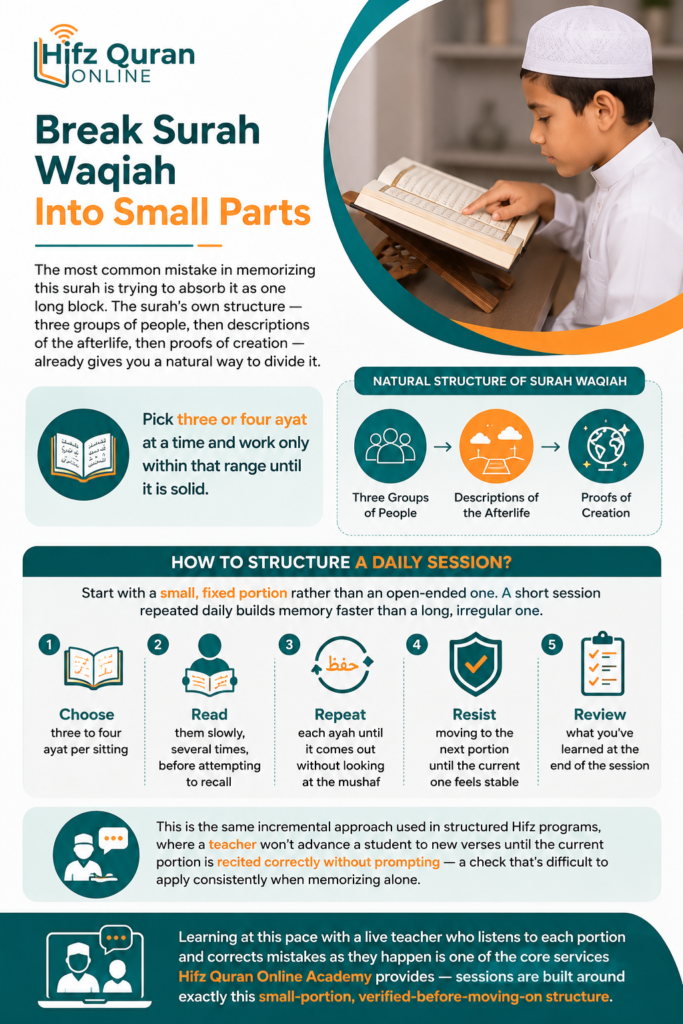
Pick three or four ayat at a time and work only within that range until it is solid.
How to structure a daily session?
Start with a small, fixed portion rather than an open-ended one. A short session repeated daily builds memory faster than a long, irregular one.
- Choose three to four ayat per sitting
- Read them slowly, several times, before attempting to recall
- Repeat each ayah until it comes out without looking at the mushaf
- Resist moving to the next portion until the current one feels stable
This is the same incremental approach used in structured Hifz programs, where a teacher won’t advance a student to new verses until the current portion is recited correctly without prompting — a check that’s difficult to apply consistently when memorizing alone.
Learning at this pace with a live teacher who listens to each portion and corrects mistakes as they happen is one of the core services Hifz Quran Online Academy provides — sessions are built around exactly this small-portion, verified-before-moving-on structure.
Read also: How To Memorize Juz 29? 7-Step For Non-Arabic Speakers
4. Prioritize Repetition for Stronger Retention
Reading a verse two or three times and expecting it to stay in memory is a common assumption, and it is usually wrong. Verses that are only read a handful of times are recognized when seen, but not recalled independently — which is the actual test of memorization.
Say each ayah aloud repeatedly until you can produce it comfortably with your eyes closed. This is not a shortcut you can skip; it is the mechanism that moves a verse from short-term recognition into stored memory.
Read also: How to Memorize a Surah in One Day
5. Choose One Consistent Time Each Day
Try to memorize at the same time every day. A fixed schedule trains your mind to expect Quran study during that period, which can make it easier to begin without procrastinating. Many learners find that early morning works well because the mind is fresh and distractions are usually limited, but the best time is the period that you can realistically protect every day.
Consistency is more important than choosing a supposedly “perfect” time. If mornings are difficult because of school, work, or family responsibilities, choose another quiet period and make it part of your daily routine.
6. Memorize During a Low-Distraction Period
Avoid treating memorization as something you simply fit into random gaps throughout the day. When possible, choose a dedicated period where you can sit comfortably, put your phone away, and focus only on the verses.
Even a 20–30 minute session can be productive when your attention is fully engaged. Constant notifications, background conversations, and switching between tasks can make memorization slower because your attention is repeatedly interrupted.
Read also: How to Memorize Surah An-Nazi’at? – A Step-by-Step Guide
7. Listen to One Reciter Consistently
Listening to the same reciter can give your memorization a familiar rhythm and pronunciation pattern. When the same style is repeated regularly, your ears become accustomed to the pauses, verse endings, and flow of the passage.
This does not mean you can never listen to another reciter. However, while actively memorizing a surah, keeping one primary recitation can reduce unnecessary variation and help you build stronger auditory associations with the verses.
8. Review Yesterday’s Portion Before Learning Something New
Do not begin every session by immediately adding new verses. Start by reciting the portion you memorized during your previous session.
This short review serves two purposes: it checks whether yesterday’s memorization has actually settled into your memory, and it gives you a chance to correct weak spots before they become reinforced. If you struggle with a particular verse, spend additional time reviewing it before moving forward.
A useful principle is simple: strengthen what you learned yesterday before increasing what you need to remember today.
9. Connect New Verses to What You Already Know
When adding new verses, avoid treating each verse as an isolated piece of information. Pay attention to how the new passage connects with the verses immediately before it.
Read the transition several times and notice repeated words, themes, sentence structures, and verse endings. These connections create mental signposts that can help you remember what comes next instead of relying entirely on raw repetition.
10. Recite Memorized Verses in Your Prayers
Once a portion is sufficiently solid, recite it during your prayers. This gives you an opportunity to retrieve the verses without looking at the Mushaf and places your memorization in a real-life context.
Prayer can also reveal weaknesses that are easy to miss when you are reading from the page. If you repeatedly hesitate at a particular verse or forget what comes next, make a note of it and review that section later.
11. Keep Your Daily Target Realistic
A smaller amount memorized consistently is usually more sustainable than an ambitious target that causes you to miss sessions. Choose a daily amount that allows enough time for repetition and revision rather than using all your study time to chase new verses.
For one learner, this may mean a few verses a day. For another, it may be half a page or more. The important point is to choose a target that you can maintain while still protecting revision time.
12. End Each Session With a Quick Recall Test
Before finishing, close the Mushaf and try to recite the day’s portion from memory. This helps you distinguish between recognizing a verse while looking at it and actually recalling it independently.
If you make mistakes, do not simply look at the answer and move on. Return to the difficult section, repeat it carefully, and test yourself again.
None of these habits is complicated on its own. The real difference comes from combining them consistently: a fixed study time, fewer distractions, consistent listening, daily revision, realistic targets, and regular recall practice. Together, these habits create a routine that makes memorization more organized and helps turn newly learned verses into lasting Quran memory.
Structured routines like this are difficult to maintain without external accountability, which is one reason many learners memorize faster inside a scheduled program with a dedicated teacher than through self-study alone. Hifz Quran Online Academy builds each student’s memorization plan around a fixed weekly schedule and one consistent teacher, specifically to support this kind of routine.

How Long Does It Take to Memorize Surah Waqiah?
There is no fixed timeline, because memorization speed depends on prior Quran memorization experience, daily consistency, and how much time is available each day. Some learners complete the surah in around two weeks with focused daily sessions. Others need a month or longer, particularly if sessions are irregular or short.
The completion date is a less useful measure of progress than retention. A learner who finishes in three weeks but forgets half the surah within a month has not actually memorized it. A learner who takes six weeks but can recite it accurately months later has.
what actually determines the timeline?
Consistency matters more than session length. Fifteen focused minutes every day produces stronger retention than an hour once a week, because spaced repetition — reviewing material across multiple days rather than in one sitting — is what moves information into long-term memory. This is a well-established principle in memory research generally, and it applies directly to Quran memorization.
Read also: Memory Bridge Method for Quran Memorization
Step Inside Our Virtual Classrooms
Don’t just take our word for it—see how our interactive sessions work! Watch the short clips below to experience our engaging teaching methods, live teacher-student interactions, and the supportive learning environment we bring to every student.
Memorize the Quran at Your Own Pace
Join our expert tutors and begin your Hifz journey with a personalized plan.
Start Your Free TrialIs Surah Waqiah Hard to Memorize?
Surah Al-Waqiah is not unusually difficult compared to other 90-plus verse surahs, but it does feel harder in the first few days than it does afterward. The wording is unfamiliar, the verse endings don’t yet have a rhythm in your ear, and progress feels slow.
This changes once your ear adjusts to the surah’s pattern, particularly the recurring rhyme in verse endings across each section. Many learners describe the same experience: a difficult first week followed by a noticeably smoother second and third week.
Common Mistakes That Make Quran Memorization Feel Harder Than It Is
Quran memorization does not always become difficult because the verses themselves are difficult. Often, the challenge comes from small mistakes in the way the memorization process is approached. These mistakes can slow progress, weaken retention, and create errors that become harder to correct over time.
Trying to Memorize Without Listening First
One common mistake is starting memorization without first listening carefully to a skilled reciter. Reading the verse yourself may help you recognize the words, but listening gives you an accurate model for pronunciation, rhythm, pauses, and verse endings.
Before memorizing a new passage, listen to it several times while following along in the Mushaf. Pay particular attention to words that are difficult to pronounce and to places where the reciter pauses. This gives your mind and tongue a reliable pattern to follow before you begin repeating the verses independently.
Skipping Tajweed During Memorization
Another mistake is treating Tajweed as something to learn after memorizing the Quran. If a verse is memorized with incorrect pronunciation, incorrect elongation, or improper application of a Tajweed rule, that mistake can become deeply attached to the memorized passage.
Correcting it later may require considerable repetition because you are not simply learning the verse again—you are trying to replace an established habit with a correct one. For this reason, aim to memorize each verse correctly from the beginning, even if that means progressing more slowly.
Adding New Verses Too Quickly
It can be tempting to measure progress by how many new verses you add each day. However, memorizing more does not necessarily mean memorizing better.
If yesterday’s portion is still unstable, adding several new verses can increase the amount of material you are trying to maintain without giving your memory enough time to consolidate what you already learned. Before moving forward, recite the previous portion without looking and check whether you can recall it accurately.
A smaller amount of strong memorization is more valuable than a larger amount that quickly becomes forgotten.
Memorizing Silently
Reading silently can create a sense of familiarity with the verses, but familiarity is not the same as reliable recall. Quran memorization requires you to retrieve the words, pronounce them correctly, and maintain the sequence without depending on the page.
Reciting aloud engages your auditory and verbal memory as well as your visual memory. It also makes pronunciation mistakes easier to notice. Regularly closing the Mushaf and reciting from memory helps you discover whether the verses are genuinely memorized or simply look familiar when you see them on the page.
Moving Forward Despite Repeated Mistakes
Another mistake is continuing to add new material while repeatedly struggling with the same verse. A recurring hesitation, forgotten phrase, or repeated pronunciation error is a signal that the section needs additional attention.
Instead of rushing past the problem, isolate the difficult verse, repeat it carefully, connect it to the verse before and after it, and test yourself again. Solving the weakness early prevents it from becoming part of your long-term recall pattern.
Why Teacher Feedback Matters?
A teacher who listens to your recitation in real time can identify problems that you may not notice yourself. They can catch mispronunciation, weak Tajweed, hesitation between similar verses, and progression that is happening too quickly.
This immediate feedback is especially valuable during early memorization because mistakes are easier to correct before they become automatic. With consistent guidance, the learner can build the habit of memorizing accurately first, then progressing confidently.
The goal is not simply to memorize verses quickly. It is to build a strong foundation in which pronunciation, Tajweed, recall, and revision develop together. Avoiding these common mistakes can make the entire Hifz process more manageable and help turn new memorization into lasting retention.
Read also: Rote Memorization Method for Quran
Why People Forget What They Already Memorized?
The most common reason for forgetting is insufficient revision — not a weak memory. Memorizing a verse is only the first half of the process; keeping it requires ongoing review even after it feels solid.
A portion memorized last week and never reviewed again will fade, regardless of how well it was learned initially. This is why structured Hifz programs always include a revision cycle — reviewing older portions on a rotation — rather than treating memorization as a one-time task.
how much revision is actually needed?
Before adding new verses each day, review the portion learned in the previous session. Once a week, revisit the full amount memorized so far, even briefly. This rotation is what separates verses that are genuinely retained from verses that were only ever recognized once.

What the Surah Itself Teaches About Remembrance?
Part of what makes Surah Al-Waqiah worth memorizing carefully is its own content. A sound hadith reports that the Prophet ﷺ said, “Surah Hud, Al-Waqiah, Al-Mursalat, ‘Amma yatasa’aloon, and Idha ash-shamsu kuwwirat have made my hair turn grey” (narrated by Tirmidhi, authenticated by Al-Albani) — a reference to the surah’s vivid description of the Day of Judgment and the fate awaiting each group of people.
A separate report, narrated by Al-Bayhaqi, states that reciting the surah nightly protects a person from poverty.
The majority of hadith scholars have classified this narration as weak, so it should not be relied on as an established religious ruling. Reciting the surah with reflection, hoping for the sustenance and blessing Allah promises more broadly in the Quran, remains encouraged — the distinction is between what is authenticated as a specific virtue and what is a general, permissible hope.
See Our Classes in Action
Curious about what a 1-on-1 Hifz session looks like? Take a look at these real-time snippets from our daily classes to see our student-centered approach, Tajweed correction techniques, and online whiteboard tools in action.
Start Your Hifz Journey With Guided Support Today
Memorizing Surah Al-Waqiah on your own is possible, but a teacher who checks your pronunciation, tajweed, and retention at every step removes most of the trial and error described above.
Hifz Quran Online Academy pairs you with a dedicated teacher, a fixed weekly schedule, and a revision system built into every session — so new verses stick instead of fading a month later.
[Book Your Free Trial Class Today]
Our Quran Courses
- Quran Memorization Course
- Quran Memorization and Hifz Course for Kids
- Online Quran Memorization Courses for Adults
- Quran Hifz Course for Ladies
- Quran Memorization Course for Men
- Saudi-Based Quran Memorization Courses
- Hifz Teachers
Memorize the Quran at Your Own Pace
Join our expert tutors and begin your Hifz journey with a personalized plan.
Start Your Free Trial
Conclusion
Learning how to memorize Surah Waqiah comes down to a few unglamorous fundamentals: breaking the surah into small portions, repeating each one until it is stable without looking, reviewing old portions before adding new ones, and keeping a consistent daily schedule.
There is no fixed timeline — some learners finish in two weeks, others take a month or more — and that difference matters far less than whether the surah is retained afterward. The surah typically feels harder in the first few days and becomes noticeably smoother once your ear adjusts to its rhythm.
Most forgetting comes from skipped revision, not weak memory. With steady daily practice, and ideally a teacher checking your progress along the way, Surah Al-Waqiah is fully within reach to memorize and retain.
FAQs
How long does it take to memorize Surah Waqiah?
Most learners take between two weeks and one month, depending on daily consistency and prior memorization experience. Retention matters more than speed — a shorter timeline is not useful if the verses fade a month later.
Is Surah Waqiah hard to memorize?
It is not unusually difficult, but it typically feels harder during the first few days before your ear adjusts to its rhythm and rhyme pattern. Most learners find it becomes noticeably smoother after the first week.
What is the best way to memorize Surah Waqiah?
Break the surah into small portions of three to four ayat, repeat each one until it can be recited without looking, and review the previous day’s portion before adding new verses. This incremental approach is more effective than attempting the full surah at once.
Why do people forget verses they already memorized?
The main cause is insufficient revision, not a weak memory. Verses that are memorized but not reviewed on a regular rotation will fade over time, regardless of how well they were initially learned.
Does Surah Waqiah protect from poverty if recited nightly?
A hadith narrated by Al-Bayhaqi mentions this benefit, but the majority of hadith scholars classify it as weak. It should not be treated as an established ruling, though reciting the surah with reflection remains encouraged.
Can a teacher help speed up memorization?
Yes. A teacher checks pronunciation, tajweed, and retention in real time, catching mistakes before they become habits — something that’s difficult to monitor consistently when memorizing alone.







Leave a Reply