 Memorizing Quran
The rote memorization method is a learning technique based on repeating the same material until you can reproduce it accurately from memory. For Quran students, this sounds immediately familiar: listen to an ayah, recite it repeatedly, close the Mushaf, recall it, and repeat until the wording becomes stable.
But Quran memorization should not become repetition without attention. The strongest approach combines rote repetition with listening, active recall, understanding, Tajweed correction, and scheduled Muraja’ah — repetition as one part of a complete Hifz system, not the whole system.
This distinction matters because being able to repeat an ayah today is not the same as retaining it accurately weeks later.
What Is the Rote Memorization Method for Quran Learning?
The rote memorization method is a technique in which information is rehearsed repeatedly until it can be recalled accurately without looking at the original material.
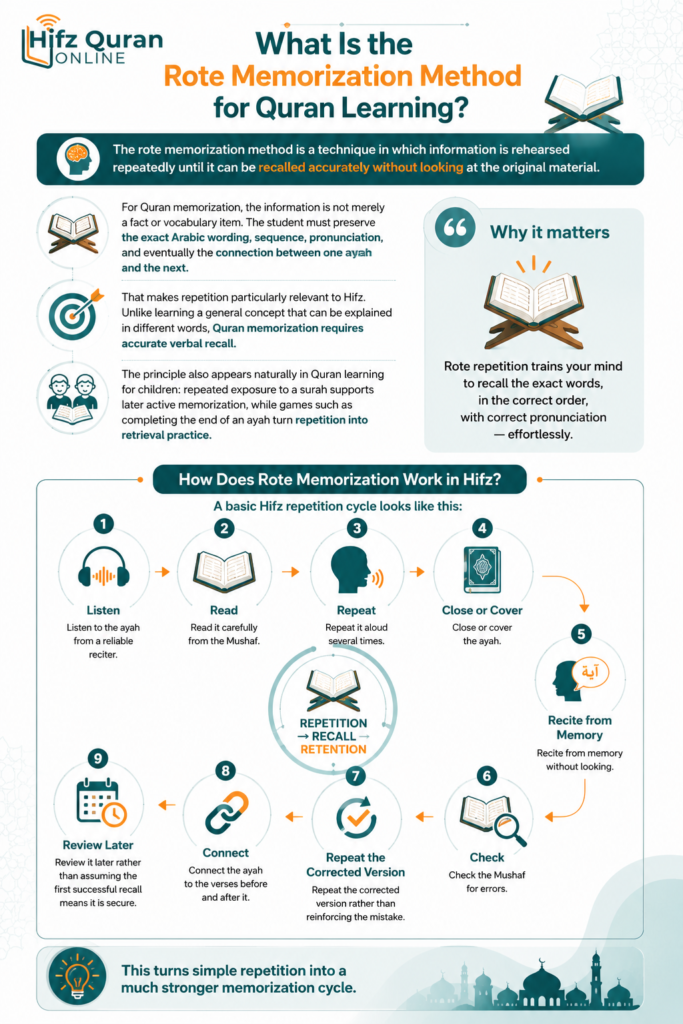
For Quran memorization, the information is not merely a fact or vocabulary item. You must preserve the exact Arabic wording, sequence, pronunciation, and eventually the connection between one ayah and the next.
That makes repetition particularly relevant to Hifz. Unlike learning a general concept that can be explained in different words, Quran memorization requires accurate verbal recall.
The principle also appears naturally in Quran learning for children: repeated exposure to a surah supports later active memorization, while games such as completing the end of an ayah turn repetition into retrieval practice.
How Does Rote Memorization Work in Hifz?
A basic Hifz repetition cycle looks like this:
- Listen to the ayah from a reliable reciter.
- Read it carefully from the Mushaf.
- Repeat it aloud several times.
- Close or cover the ayah.
- Recite from memory without looking.
- Check the Mushaf for errors.
- Repeat the corrected version rather than reinforcing the mistake.
- Connect the ayah to the verses before and after it.
- Review it later rather than assuming the first successful recall means it is secure.
This turns simple repetition into a much stronger memorization cycle.
Why Should Listening Come Before Heavy Repetition?
Repetition strengthens whatever you repeat — including mistakes.
If you mispronounce a letter, miss a Madd, or use the wrong stopping point and then repeat that version dozens of times, you are training yourself to reproduce the error automatically.
Listening first gives your brain a correct auditory model. Quran learning resources also emphasize training the ear through reliable recitation before attempting independent recitation.
This is especially important because Tajweed governs details such as pronunciation, pauses, and elongation; even Madd requires precise control rather than simply remembering the written words.
Practitioner note: When you repeatedly make exactly the same error, increasing the number of repetitions is rarely the first solution. Stop, correct the source error, then begin repeating the corrected form.
Rote Memorization Techniques You Can Apply to Quran Hifz
Not every conventional memory technique transfers cleanly to the Quran. Flashcards may help with vocabulary, for example, but memorizing a surah requires continuous, ordered recitation.
The most useful rote memorization techniques are therefore those that preserve the Quran’s wording and sequence while making repetition more deliberate.
1. Repeat Each Ayah Until It Becomes Familiar and Easy to Recall
Read one ayah while looking at the Mushaf and repeat it aloud until the wording and flow become familiar.
Then begin alternating between looking and recalling.
The important distinction is that repetition should eventually become retrieval. Reading an ayah repeatedly while looking at it can create familiarity without proving that you actually know it.
2. Break Longer Ayat Into Smaller Chunks for Easier Memorization
Chunking is the practice of dividing a large piece of information into smaller units that can be learned separately and then connected.
Instead of attacking a long ayah as one continuous block, divide it by phrases or natural stopping points.
For example:
Phrase A → Phrase B → Phrase C
Memorize A first. Then B. Recite A+B together. Learn C, then recite A+B+C.
The same principle scales upward:
words → phrases → ayah → group of ayat → page → daily portion
This is especially useful when you reach long verses or passages with similar wording.
3. Test Your Memory With Active Recall After Repetition
Active recall means retrieving information from memory without looking at the answer first.
After several repetitions, close the Mushaf and recite the ayah.
If you become stuck, identify exactly where the failure occurred. Look at that section, correct it, repeat it, and test yourself again.
This is far more informative than completing another round of passive reading.
4. Linking Prevents “I Know Every Ayah but Cannot Recite the Surah”
You may sometimes memorize individual verses successfully but hesitate between them.
That is a sequencing problem.
After learning a new ayah, repeatedly recite the previous ayah directly into the new one:
Ayah 1 → Ayah 2
Then:
Ayah 1 → Ayah 2 → Ayah 3
The transition itself becomes something you memorize.
Read also: How to Memorize Surah Waqiah? – A Step-by-Step Guide
5. Space Your Repetition to Make Quran Memorization Last
Distributed practice means returning to memorized material across separate sessions instead of completing all repetition in one sitting.
A verse that feels effortless immediately after repeated practice may become surprisingly difficult several hours later.
Therefore, test the passage again later in the day, the following day, and during subsequent Muraja’ah.
For Quran Hifz, the useful question is not simply, “Can I recite this now?”
It is:
“Can I retrieve it correctly after I have stopped thinking about it?”
6. Listen, Imitate, and Strengthen Your Auditory Memory
Choose one reliable reciter while learning a passage and listen carefully to pronunciation, rhythm, pauses, and transitions.
Then imitate the recitation while following the Mushaf before attempting it independently.
Repeated listening is already used effectively in Quran education because familiarity with a surah’s sound can support later memorization.
If you struggle to identify pronunciation errors independently, personalized teacher correction becomes especially useful. Hifz Quran Online Academy can help you combine repetitive practice with direct feedback instead of allowing recurring errors to become part of your memorization.
Step Inside Our Virtual Classrooms
Don’t just take our word for it—see how our interactive sessions work! Watch the short clips below to experience our engaging teaching methods, live teacher-student interactions, and the supportive learning environment we bring to every student.
Memorize the Quran at Your Own Pace
Join our expert tutors and begin your Hifz journey with a personalized plan.
Start Your Free Trial7. Write Difficult Ayat to Strengthen Your Recall
You may benefit from writing a difficult ayah after memorizing it orally.
This forces closer attention to word order and can reveal omissions that fluent-sounding recitation hides.
However, writing should support Quran recitation rather than replace listening and oral repetition.
Turn repetition into lasting memorization with structured guidance and personalized teacher feedback. Hifz Quran Online Academy’s Online Quran Memorization Courses for Adults help you memorize the Quran step by step, strengthen your Muraja’ah, correct recitation mistakes, and build a consistent Hifz routine around your schedule.

Rote Learning vs Meaningful Learning in Quran Memorization
Rote learning focuses on reproducing information accurately, while meaningful learning connects new information to meaning, context, relationships, and existing knowledge. They should not be treated as competitors in Quran memorization.
| Rote Learning | Meaningful Learning |
| Repeats the exact Arabic wording | Studies what the ayah means |
| Strengthens verbal recall | Creates semantic memory anchors |
| Preserves sequence | Helps distinguish themes and passages |
| Useful for exact Hifz | Useful for comprehension |
| Can become mechanical alone | Can leave wording imprecise even with understanding |
| Answers “What comes next?” | Answers “What is this passage saying?” |
You need both. Understanding a verse does not automatically mean you can recite its Arabic wording precisely, and reciting every word correctly does not necessarily mean you understand its message.
The most productive sequence is often:
Understand → Listen → Repeat → Recall → Connect → Review
This combination is particularly valuable when memorizing longer surahs containing multiple themes.
Read also: Memory Bridge Method for Quran Memorization
Meaning Can Become a Retrieval Cue
Imagine that you forget what comes next during a passage. If you understand the sequence of ideas, the meaning itself can help point you toward the next verse. Without that semantic map, you may have only sound patterns available as retrieval cues.
That is why you should at least read a brief translation or Tafsir before or during memorization, particularly for passages you find difficult.
For non-Arabic speakers, developing Quranic Arabic adds another layer because understanding Arabic allows you to engage directly with the words rather than depending entirely on translation.
Is Rote Memorization Effective Learning for Quran?
Yes — Quran memorization requires exact recall, so rote memorization has a natural role to play. What makes it work is combining it with the other layers already covered: active recall, understanding, correction, and spaced review.
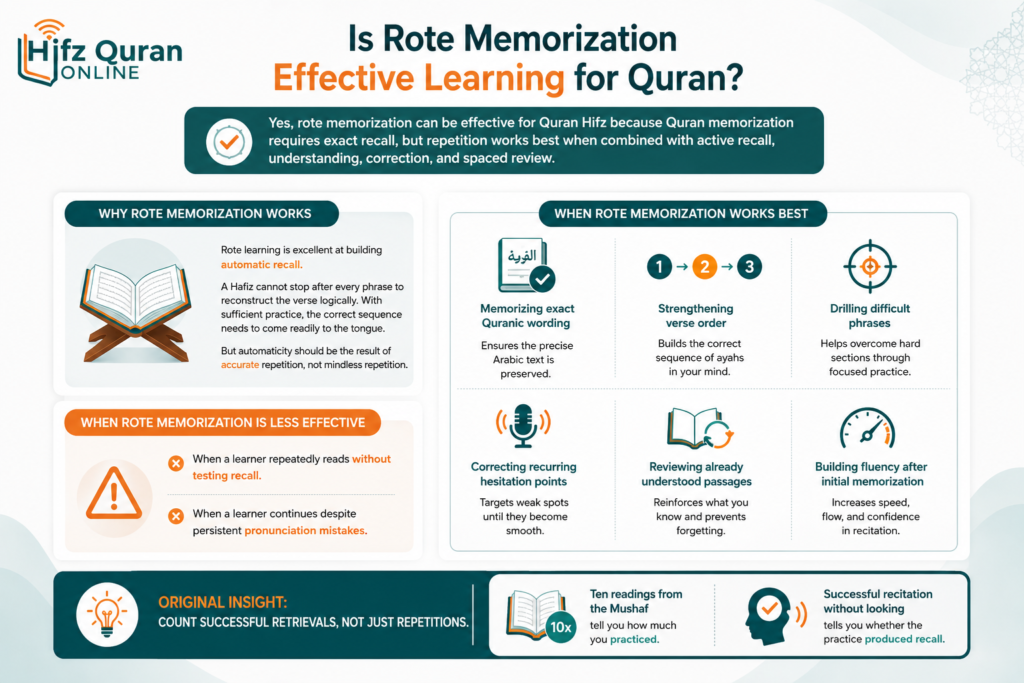
It is excellent at building automatic recall. A Hafiz cannot stop after every phrase to reconstruct the verse logically; with sufficient practice, the correct sequence needs to come readily to the tongue. But that automaticity should be the result of accurate repetition, not mindless repetition.
When Rote Memorization Works Best
Rote practice is particularly useful when:
- memorizing exact Quranic wording;
- strengthening verse order;
- drilling difficult phrases;
- correcting recurring hesitation points;
- reviewing already understood passages;
- building fluency after initial memorization.
It becomes less effective when you repeatedly read without testing recall or continue despite persistent pronunciation mistakes.
Original insight: Count successful retrievals, not just repetitions. Ten readings from the Mushaf tell you how much you practiced; successful recitation without looking tells you whether the practice produced recall.
What Is a Drawback of Rote Memorization for Quran Students?
The main drawback is that you can reproduce material temporarily without deeply understanding it or retaining it reliably over time — which can create the illusion of progress. You may repeat one page intensively, recite it successfully immediately afterward, and assume it has been memorized. The real test comes after several hours or the next day.
Mechanical Repetition Can Hide Weak Recall
Reading directly from the Mushaf feels increasingly easy after repeated exposure. But recognition is not recall. To detect this problem, close the Mushaf earlier in the session and attempt the ayah independently.
Repetition Can Reinforce Tajweed Errors
Incorrect repetition is especially dangerous in Hifz. Once an error becomes automatic, correcting it requires replacing an established verbal pattern rather than simply learning the right pronunciation once. This is where teacher feedback has an advantage: a qualified instructor can detect pronunciation, Tajweed, and stopping errors you may not hear independently.
Similar Ayat Can Become Confused
Repetition based primarily on sound can make similar Quranic passages easier to confuse. Instead of simply repeating each passage more, compare them deliberately. Identify the exact word where they diverge and connect each version with its surrounding meaning.
Crammed Hifz Can Fade Quickly
A large number of repetitions in one day does not eliminate the need for Muraja’ah — new memorization needs to reappear after the initial learning session.
A useful rule is simple: do not measure Hifz only by what you memorized today. Measure it by what you can still recite later without assistance.
Combine Rote Memorization With a Complete Quran Hifz System
In practice, this means running a fuller cycle each time you sit down to memorize:
- Read the meaning of the passage.
- Listen to correct recitation.
- Divide the passage into manageable chunks.
- Repeat one chunk carefully.
- Recite it without looking.
- Correct mistakes immediately.
- Connect it with the previous chunk.
- Recite the complete passage.
- Return to it later the same day.
- Include it in scheduled Muraja’ah.
This also solves a common Hifz problem: you may spend enormous effort acquiring new verses while giving insufficient attention to retaining yesterday’s verses. A good Hifz system treats new memorization and revision as two separate jobs — if your previous assignment cannot be recalled reliably, strengthening it may be more valuable than adding another weak page.
Read also: How to Memorize Surah An-Nazi’at? – A Step-by-Step Guide
See Our Classes in Action
Curious about what a 1-on-1 Hifz session looks like? Take a look at these real-time snippets from our daily classes to see our student-centered approach, Tajweed correction techniques, and online whiteboard tools in action.
Start Building Stronger Hifz With Expert Guidance
Repeating Quran verses is easy. Knowing what to repeat, when to test yourself, how to correct errors, and when a passage is genuinely secure requires a structured method.
Hifz Quran Online Academy helps students build Quran memorization around accurate recitation, personalized assignments, consistent Muraja’ah, and teacher feedback — so repetition produces lasting Hifz rather than short-term familiarity.
Our Quran Courses
- Quran Memorization Course
- Quran Memorization and Hifz Course for Kids
- Online Quran Memorization Courses for Adults
- Quran Hifz Course for Ladies
- Quran Memorization Course for Men
- Saudi-Based Quran Memorization Courses
- Hifz Teachers
Memorize the Quran at Your Own Pace
Join our expert tutors and begin your Hifz journey with a personalized plan.
Start Your Free Trial
Conclusion
Rote memorization can be a powerful foundation for Quran Hifz, but repetition becomes far more effective when every repetition has a purpose. Listen carefully, repeat accurately, test yourself without looking, correct mistakes early, connect each ayah to the next, and return to what you have memorized through consistent Muraja’ah.
The goal is not to memorize an ayah for one session, but to make it available accurately, fluently, and confidently when you need to recite it later. Combine repetition with understanding, active recall, correct recitation, and regular review, and rote practice becomes part of a complete system for building strong and lasting Hifz.
Read also: How to Memorize a Surah in One Day— A Practical Step-by-Step Method
FAQs
What is the rote memorization method?
The rote memorization method involves repeatedly rehearsing information until it can be recalled without looking at the source. In Quran Hifz, it usually involves repeated listening and recitation followed by testing the ayah from memory.
What is a rote memorization method example for Quran Hifz?
A simple example is to listen to one ayah, read and repeat it several times, close the Mushaf, recite it from memory, correct mistakes, and then connect it with the next ayah before reviewing the passage later.
What are the best rote memorization techniques for the Quran?
Useful techniques include careful repetition, chunking long verses, listening and imitation, active recall, connecting consecutive ayat, writing difficult passages, and distributed review. These techniques work best when pronunciation is corrected before errors become habitual.
What is a drawback of rote memorization?
A major drawback is that repeated material can feel familiar without being securely retained or understood. For Quran students, rote repetition can also reinforce Tajweed mistakes if the original recitation is inaccurate.
What is the difference between rote learning vs meaningful learning?
Rote learning builds exact recall through repetition, while meaningful learning connects information with meaning and context. You benefit from combining both: repetition preserves exact Arabic wording, while understanding provides stronger mental anchors.
Is rote memorization effective learning for Quran students?
Yes. Rote memorization is useful for exact Quranic recall, but it becomes substantially more practical when paired with listening, understanding, active recall, teacher correction, and regular Muraja’ah.
Related Articles
Memorizing Quran







Leave a Reply