 Memorizing Quran
The memory bridge method is a memorization technique that connects new information to something already familiar, creating a mental pathway that makes the new material easier to retrieve.
Although the term is used in several unrelated fields, its most useful meaning for Quran memorization comes from associative memory: instead of trying to remember every ayah as an isolated unit, you deliberately create connections between meanings, verse openings, locations on the Mushaf page, and the transition from one ayah to the next.
For Hifz students, this can solve a very specific problem: you may know two ayahs perfectly on their own but repeatedly forget what comes next when reciting them together.
The memory bridge method can help with that transition. However, it should support traditional Quran memorization through repetition, listening, revision, and teacher correction — not replace them.
What Is the Memory Bridge Method for Quran Memorization?
The memory bridge method for Quran memorization is a technique in which a student deliberately links one ayah or memorized section to the next using a meaningful retrieval cue.
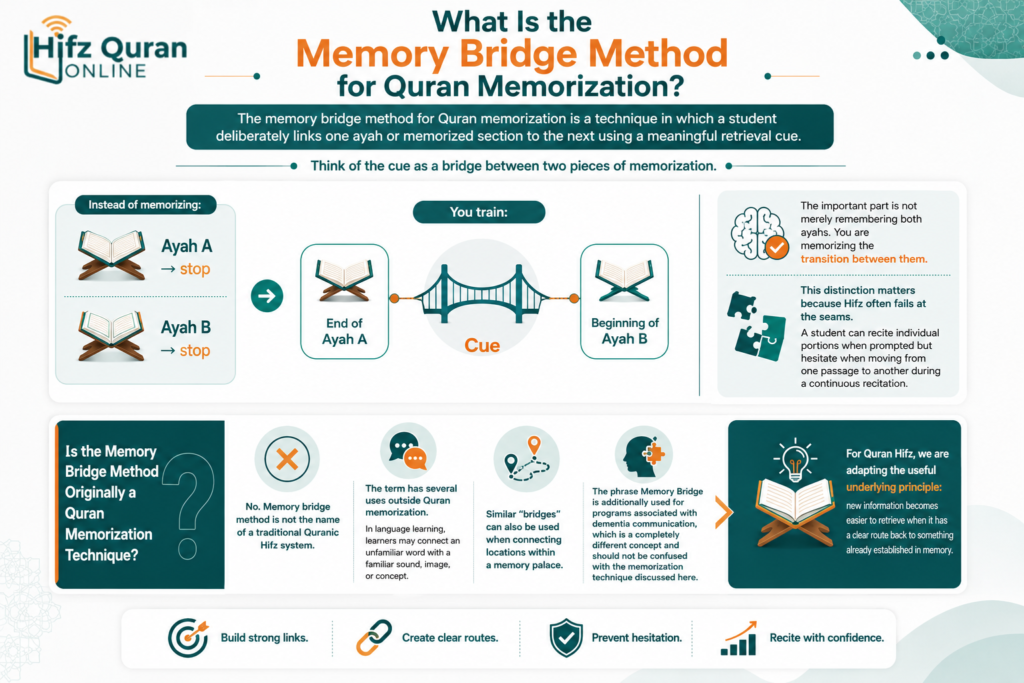
Think of the cue as a bridge between two pieces of memorization.
Instead of memorizing:
Ayah A → stop
and later:
Ayah B → stop
you train:
End of Ayah A → cue → beginning of Ayah B
The important part is not merely remembering both ayahs. You are memorizing the transition between them.
This distinction matters because Hifz often fails at the seams. A student can recite individual portions when prompted but hesitate when moving from one passage to another during a continuous recitation.
Is the Memory Bridge Method Originally a Quran Memorization Technique?
No. Memory bridge method is not the name of a traditional Quranic Hifz system.
The term has several uses outside Quran memorization. In language learning, for example, learners may connect an unfamiliar word with a familiar sound, image, or concept. Similar “bridges” can also be used when connecting locations within a memory palace.
The phrase Memory Bridge is additionally used for programs associated with dementia communication, which is a completely different concept and should not be confused with the memorization technique discussed here.
For Quran Hifz, we are adapting the useful underlying principle: new information becomes easier to retrieve when it has a clear route back to something already established in memory.
How Does the Memory Bridge Method Work for Quran Hifz?
The method works by giving your mind an additional answer to the question: “What comes next?”
Ordinary repetition strengthens the ayah itself. A memory bridge specifically strengthens the route between one unit and the next.
For Quran memorization, you can build that route through several types of cues rather than depending on imaginative mnemonic stories alone.
1. Build an Ayah-to-Ayah Transition Bridge
The simplest bridge is also one of the most useful: deliberately practice the end of one ayah together with the beginning of the next.
Suppose you have memorized Ayah 1 and Ayah 2 independently.
Do not immediately move to Ayah 3.
Instead:
- Recite Ayah 1 independently.
- Recite Ayah 2 independently.
- Recite the final phrase of Ayah 1.
- Continue immediately into the opening phrase of Ayah 2.
- Repeat the transition until it comes without hesitation.
- Recite both complete ayahs together from memory.
You are effectively treating the handoff as its own memorization unit.
This becomes particularly valuable in longer Surahs, where a learner may memorize several blocks on different days and later discover that each block is strong while the connections between them are weak.
2. Create a Meaning Bridge Between Related Ayahs
A meaning bridge connects one ayah to the next through the progression of its message.
Before memorizing a passage, read a reliable translation or brief Tafsir and ask:
Why does this ayah come after the previous one?
Perhaps one verse states a principle and the next gives an example. One verse may describe an event and the next its consequence. A command may be followed by a warning, promise, explanation, or exception.
Turn that relationship into a short mental cue:
command → consequence
question → answer
story event → response
warning → outcome
The cue should remain extremely simple. You are not trying to memorize an elaborate explanation alongside the Quran.
Understanding can also provide useful context for retention; Quran-learning material in the supplied content similarly emphasizes practicing comprehension directly within Quranic text rather than treating the words only as disconnected sounds.
3. Use the First Words as Retrieval Bridges
Sometimes the problem is not remembering an entire ayah. It is retrieving its first few words.
In that situation, create an opening-word bridge.
After memorizing a passage, test yourself only on transitions:
End of Ayah 1 → first words of Ayah 2
End of Ayah 2 → first words of Ayah 3
End of Ayah 3 → first words of Ayah 4
This is different from repeatedly reciting the whole passage.
It isolates the precise point where sequence memory breaks.
Practitioner note: if you consistently pause at exactly the same place, do not respond by repeating the entire page another twenty times. Drill the weak transition directly.
4. Build a Visual Bridge Using One Mushaf
Visual memory can provide another useful bridge.
When you consistently memorize from the same Mushaf, an ayah gradually becomes associated with its physical location: near the top or bottom of the page, beside a distinctive verse ending, or immediately before a page turn.
For example, your mental sequence may become:
lower part of page → final ayah → page turn → opening line
That spatial relationship becomes an additional retrieval cue.
Avoid constantly switching between different Mushaf layouts while establishing new Hifz. The goal is to allow stable visual familiarity to develop alongside auditory and verbal memory.
Read also: Rote Memorization Method for Quran
5. Use Sound as an Auditory Memory Bridge
Quran memorization is deeply auditory, so the sound of one ayah can naturally cue the next.
Listen repeatedly to the same passage from one clear reciter before and during memorization.
Pay particular attention to:
- verse endings,
- rhythm changes,
- repeated expressions,
- the sound beginning the following ayah,
- and pauses between verses.
Then reproduce the sequence yourself.
Repeated listening is especially useful because familiarity with Quranic sound and rhythm can support later active memorization. The supplied Quran-learning material likewise recommends consistent recitation exposure rather than constantly changing the learner’s auditory reference.
If you need structured correction rather than practicing transitions alone, Hifz Quran Online Academy can help you identify whether the real problem is memory, sequencing, Tajweed, or insufficient revision.
Step Inside Our Virtual Classrooms
Don’t just take our word for it—see how our interactive sessions work! Watch the short clips below to experience our engaging teaching methods, live teacher-student interactions, and the supportive learning environment we bring to every student.
Memorize the Quran at Your Own Pace
Join our expert tutors and begin your Hifz journey with a personalized plan.
Start Your Free TrialHow to Apply the Memory Bridge Method ? Step by Step
To use the memory bridge method for Quran memorization, memorize small units first, identify the connection between them, rehearse the transition, and then test the complete sequence without looking.
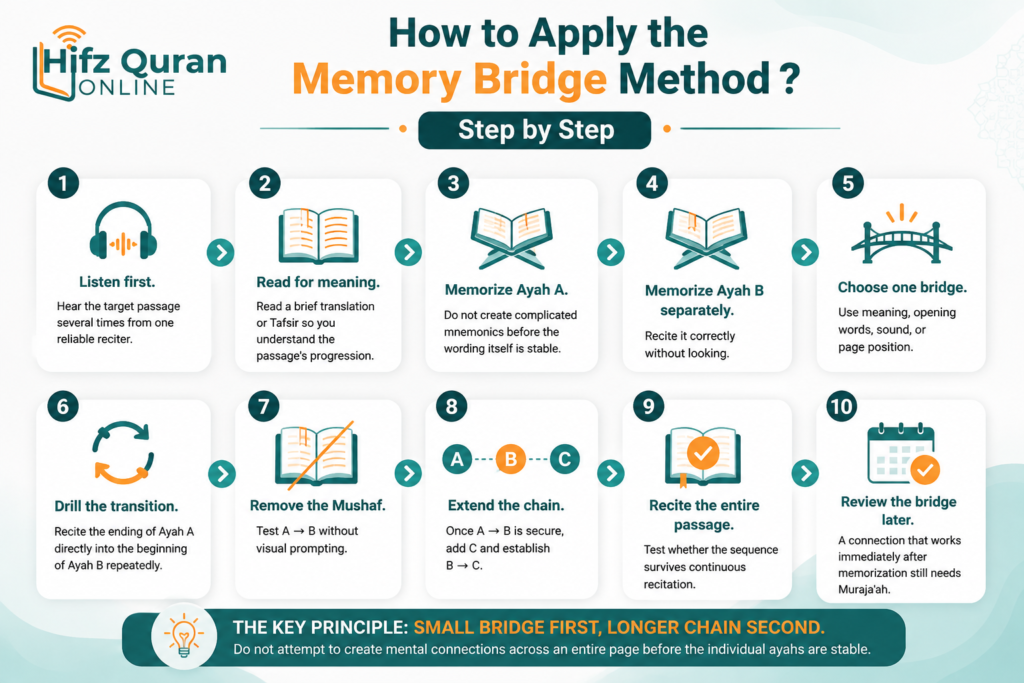
Here is a practical Hifz workflow:
- Listen first. Hear the target passage several times from one reliable reciter.
- Read for meaning. Read a brief translation or Tafsir so you understand the passage’s progression.
- Memorize Ayah A. Do not create complicated mnemonics before the wording itself is stable.
- Memorize Ayah B separately. Recite it correctly without looking.
- Choose one bridge. Use meaning, opening words, sound, or page position.
- Drill the transition. Recite the ending of Ayah A directly into the beginning of Ayah B repeatedly.
- Remove the Mushaf. Test A → B without visual prompting.
- Extend the chain. Once A → B is secure, add C and establish B → C.
- Recite the entire passage. Test whether the sequence survives continuous recitation.
- Review the bridge later. A connection that works immediately after memorization still needs Muraja’ah.
The key principle is small bridge first, longer chain second.
Do not attempt to create mental connections across an entire page before the individual ayahs are stable.
When Is the Memory Bridge Method Most Useful?
The technique is particularly useful when a student says:
“I know the ayah, but I forget what comes next.”
That statement signals a retrieval-sequence problem rather than necessarily a failure to memorize the verses themselves.
Memory bridges can therefore be particularly helpful for:
- connecting daily Hifz assignments,
- memorizing longer Surahs,
- repairing repeated hesitation points,
- distinguishing the sequence around similar verses,
- connecting pages,
- and rebuilding forgotten transitions during Muraja’ah.
For students who forget the actual wording inside every ayah, however, bridges are not the first solution. More foundational repetition and correction are needed.
Read also: How to Memorize Surah An-Nazi’at? – A Step-by-Step Guide
Common Mistakes When Using Memory Bridges for Quran
Memory bridges should simplify retrieval. If maintaining the mnemonic becomes harder than remembering the Quran, the technique has failed.
Creating Complicated Imaginary Stories
Associative-memory systems sometimes encourage bizarre or exaggerated mental imagery because unusual images can be memorable.
That may work for vocabulary lists, but Quran Hifz requires more care.
Prefer bridges grounded in the actual text, meaning, sound, sequence, and Mushaf position rather than inventing unnecessary fictional scenes around sacred verses.
Remembering the Cue but Forgetting the Ayah
A mnemonic is only scaffolding.
If you remember “warning → consequence” but cannot recite the Arabic accurately, the bridge has not accomplished its purpose.
The Quranic wording remains the target.
Using Bridges Instead of Repetition
Memory bridges are retrieval aids, not replacements for Takrar (repetition).
You still need repeated correct recitation, active recall, Muraja’ah, and cumulative review.
Building Bridges Before Correcting Recitation
Do not strengthen an incorrect version of an ayah.
If your pronunciation, word sequence, or Tajweed is wrong, repeatedly retrieving it can reinforce the error alongside the memory.
Teacher correction should therefore happen early enough that you are consolidating an accurate recitation.
Read also: How to Memorize Surah Waqiah? – A Step-by-Step Guide
See Our Classes in Action
Curious about what a 1-on-1 Hifz session looks like? Take a look at these real-time snippets from our daily classes to see our student-centered approach, Tajweed correction techniques, and online whiteboard tools in action.
Start Building Stronger Quran Connections With a Hifz Teacher
A memory technique becomes much more useful when you know why your recitation is breaking down.
Hifz Quran Online Academy’s Online Quran Memorization Course gives you teacher-guided memorization, correction, structured Muraja’ah, and personalized support so you can strengthen both individual ayahs and the transitions connecting them.
Our Quran Courses
- Quran Memorization Course
- Quran Memorization and Hifz Course for Kids
- Online Quran Memorization Courses for Adults
- Quran Hifz Course for Ladies
- Quran Memorization Course for Men
- Saudi-Based Quran Memorization Courses
- Hifz Teachers
Memorize the Quran at Your Own Pace
Join our expert tutors and begin your Hifz journey with a personalized plan.
Start Your Free Trial
Conclusion
The memory bridge method can be adapted effectively to Quran memorization when “bridge” means creating a reliable retrieval connection between one ayah, phrase, page, or Hifz block and the next.
For Quran Hifz, the most useful bridges are usually simple: ayah endings to next openings, meaning to meaning, sound to sound, and one section to the next.
Use these cues alongside repetition, listening, active recall, Muraja’ah, and teacher correction. The goal is eventually to need no conscious bridge at all — the Quranic sequence itself becomes the cue.
Read also: How to Memorize a Surah in One Day— A Practical Step-by-Step Method
FAQs
What is the memory bridge method?
The memory bridge method connects unfamiliar or newly memorized information to an established retrieval cue. In Quran memorization, it can be adapted by connecting one ayah to the next through wording, meaning, sound, or visual position.
Can the memory bridge method be used to memorize Quran?
Yes, the memory bridge method can support Quran memorization when used as a retrieval technique rather than a replacement for repetition. It is especially useful when you know individual ayahs but struggle to remember their sequence.
What is the best memory bridge for Quran memorization?
The most practical bridge is usually the end-to-beginning transition: connect the final phrase of one ayah directly to the opening phrase of the next. Meaning, auditory patterns, and Mushaf location can provide additional cues.
Can memory bridges help with similar Quran verses?
Yes, but the bridge should emphasize the exact distinguishing words and context of each verse. For Mutashabihat, compare the similar passages directly and identify what changes rather than depending only on a generic visual mnemonic.
Do memory bridges replace repetition in Hifz?
No. Memory bridges do not replace repetition, Muraja’ah, listening, or teacher correction. Their role is to strengthen retrieval routes between portions you have already memorized accurately.
When should I stop using a memory bridge?
Stop consciously relying on the bridge once the next ayah comes automatically during continuous recitation. A successful memory bridge is temporary scaffolding; eventually, the Quranic sequence itself should trigger recall.






Leave a Reply