 Memorizing Quran
To memorize Surah Al-Humazah, start with its story and its meaning, then split it into three short scenes. Next, learn how its verses rhyme and practice the hard sounds. After that, memorize it verse by verse, keep it apart from similar surahs, and review it in your prayers. The steps below explain each part.
Surah Al-Humazah (سورة الهمزة) is the 104th surah of the Quran. It has 9 short verses and sits in Juz Amma, between Surah Al-Asr and Surah Al-Fil. Its short length makes it a good choice for beginners, children, and anyone working through the last part of the Quran.
But a short surah can still slip away. Many people learn this surah in one sitting, then lose parts of it a week later. Most guides only say “repeat each verse.”
This guide goes further. It gives you the story, a simple tafsir, memory tricks, and the sound rules you need, so the surah stays with you. It works for adults, for parents teaching their children, and for people who do not read Arabic yet.
Step 1: Learn the Story Behind the Surah
A story gives your mind a picture to hold on to. Pictures are much easier to remember than plain words. Surah Al-Humazah came down in Makkah, in the early days of Islam. At that time, some rich leaders of Quraysh made fun of the Prophet ﷺ and the believers. Many of the believers were poor.
These leaders mocked them to their faces and talked about them behind their backs. They were proud of their money and acted as if it made them better than everyone else.
Scholars name a few of these men, such as al-Akhnas ibn Shariq, Umayyah ibn Khalaf, and al-Walid ibn al-Mughirah. You can read these views in Tafsir al-Baghawi. No single report proves which man it was. Most scholars say the lesson is for anyone who acts this way, in any time or place.
Keep this scene in mind as you learn: a proud rich man in Makkah, laughing at poor believers and counting his money.
Step 2: Understand Each Verse With A Simple Tafsir
TTafsir means explaining what the verses mean. When you know what each verse says, you will know what comes next without guessing. Read this once or twice before you start memorizing.
Verse 1: The Warning to Those Who Mock People
Allah starts the Surah with a warning.
وَيْلٌ لِّكُلِّ هُمَزَةٍ لُّمَزَةٍ
(wailul-likulli humazatil-lumazah)
“Woe to every slanderer and fault-finder.”
The word وَيْلٌ is a strong warning of punishment. A هُمَزَة is someone who puts people down. A لُمَزَة is someone who finds faults in people, with words, looks, or by talking behind their backs. Scholars explain the two words in slightly different ways, but both describe the same hurtful person.
Ibn Kathir reports that Ibn Abbas explained these two words as the slanderer and the one who finds fault in others. Some scholars say one word means hurting people with the tongue, and the other means hurting them with actions, like a mocking look or a hand gesture. You can read this explanation in Tafsir Ibn Kathir on Surah Al-Humazah.
Verse 2: The Man Who Lives to Count His Money
This verse shows the warning for whom.
ٱلَّذِى جَمَعَ مَالًا وَعَدَّدَهُۥ
(alladhee jama’a maalan-wa ‘addadah)
“Who gathers money and keeps counting it.”
The word جَمَعَ means he gathers, and عَدَّدَهُ means he counts it again and again. Collecting money is his main goal, and he does not give others what he owes them.
Islam does not blame a person for earning money, but it blames him for hoarding it and holding back what is due, like zakat. This verse also links back to verse 1, because his pride in his wealth is what makes him look down on others.
Verse 3: The False Hope That Money Brings Life Forever
The verse explains more about one trait of the person whom Allah is warning in the verse.
يَحْسَبُ أَنَّ مَالَهُۥٓ أَخْلَدَهُۥ
(yahsabu anna maalahooo akhladah)
“He thinks his money will make him live forever.”
The word يَحْسَبُ means he thinks, and أَخْلَدَهُ means it made him last forever. He acts as if money can protect him from death. The verb أَخْلَدَهُ is in the past tense, as if he is already sure his wealth has made him safe forever.
The Prophet ﷺ taught that the only wealth a person truly keeps is what he ate, what he wore, and what he gave in charity, which he sends ahead for the Hereafter (Sahih Muslim 2958).
Verse 4: Thrown Into al-Hutamah, the Crushing Fire
This verse is about the punishment of this person warned by Allah
كَلَّا ۖ لَيُنۢبَذَنَّ فِى ٱلْحُطَمَةِ
(kallaa, layumbadhanna fil-hutamah)
“No! He will be thrown into al-Hutamah.”
The word كَلَّا means “No, it is not like that.” The word لَيُنبَذَنَّ means he will be thrown away, like something with no value.
ٱلْحُطَمَة is a name for the Fire. It comes from a word that means to crush and break into pieces.
Scholars point out that the punishment matches the sin: he broke people down with his words and treated them as worthless, so he is thrown away and crushed. When you recite لَيُنۢبَذَنَّ, notice the small م above the ن, which tells you to say the “n” as an “m” (layumbadhanna), a tajweed rule called iqlab.
Verse 5: A Question That Shows How Terrible the Fire Is
The Verse highlights what this punishment is exactly
وَمَآ أَدْرَىٰكَ مَا ٱلْحُطَمَةُ
(wa maaa adraaka mal-hutamah)
“And what will tell you what al-Hutamah is?”
This question shows how great and terrible this Fire is. It does not ask for an answer from the reader. Instead, it tells us that al-Hutamah is beyond anything we can imagine.
The Quran uses the phrase وَمَآ أَدْرَىٰكَ (wa maaa adraaka) for other great matters too, such as the Day of Judgment in Surah Al-Qari’ah and the Night of Power in Surah Al-Qadr.
Each time, Allah gives the answer right after the question. Here, the answer comes in the next verses, which describe the Fire one detail at a time. Knowing this pattern helps you memorize, because a وَمَآ أَدْرَىٰكَ question is always followed by its answer.
Verse 6: The Fire That Allah Keeps Burning
The verse defines the punishment in simple words, which is fire.
نَارُ ٱللَّهِ ٱلْمُوقَدَةُ
(naarul-laahil-mooqadah)
“It is the fire of Allah, burning.”
The word ٱلْمُوقَدَة means lit and kept burning. It is not like any fire in this world. Calling it “the fire of Allah” shows how great and serious this punishment is. The Prophet ﷺ said that the fire we know is only one part out of seventy parts of the fire of Hell (Sahih al-Bukhari 3265).
When you recite this verse, say the “l” in ٱللَّهِ with a full, heavy sound, because it comes after a “u” vowel in نَارُ. Like every verse in this surah, it ends with an “-ah” sound, which helps you hear that you are still on the right path.
Verse 7: The Fire That Reaches the Heart
The verse mentions what this fire does.
ٱلَّتِى تَطَّلِعُ عَلَى ٱلْأَفْـِٔدَةِ
(allatee tattali’u ‘alal-af’idah)
“It reaches up to the hearts.”
The word تَطَّلِعُ means it rises and reaches, and ٱلْأَفْئِدَة means the hearts. The heart is where his pride and love of money lived, and the punishment reaches that same place. The word تَطَّلِعُ can also mean “to look into,” so some scholars say the Fire knows what is inside each heart. It reaches the people who earned it because of what their hearts held.
The verse begins with ٱلَّتِى, meaning “which,” and it points back to the fire in verse 6, so the two verses read as one sentence. When you say ٱلْأَفْـِٔدَةِ, make the small stop in the middle clear (af-‘idah), because dropping it is a common mistake.
Verse 8: Shut In With No Way Out
The verse points out the description of this fire, as there is no escape from it.
إِنَّهَا عَلَيْهِم مُّؤْصَدَةٌ
(innahaa ‘alaihim mu’sadah)
“It will be shut over them.”
The word مُّؤْصَدَة means closed shut, with no way out. No door is left open, so there is no hope of escape or rest. The same word appears in Surah Al-Balad (90:20), so if you have memorized that surah, you already know it.
Notice that the surah moves from “he” in the first verses to “them” here, showing that everyone who acts like this person shares the same end. In عَلَيْهِم مُّؤْصَدَةٌ, the two “m” sounds join into one held “m” with a nasal sound for about two counts, a tajweed rule called idgham mithlayn.
Verse 9: Held by Long Columns
The last verse confirms the idea that there is no way out of this fire.
فِى عَمَدٍ مُّمَدَّدَةٍۭ
(fee ‘amadim-mumaddadah)
“In long columns.”
The word عَمَد means columns or pillars, and مُّمَدَّدَة means stretched long. Scholars explain that they are held in by long columns, so there is no escape. Some say the columns lock the doors of the Fire, while others say the people are tied to them. The surah ends with this picture, leaving a clear lesson: mocking others and loving money cannot save anyone.
In عَمَدٍ مُّمَدَّدَةٍ, the “n” sound at the end of عَمَدٍ blends into the “m” that follows, so you say “‘amadim-mumaddadah” with a light nasal hold. Once this last verse is solid, recite the whole surah from verse 1 to verse 9 in one go, so the ending stays tied to the start.
For a fuller tafsir in Arabic, see the Islamweb library page on Surah Al-Humazah.
Step 3: Split The Surah Into Three Scenes
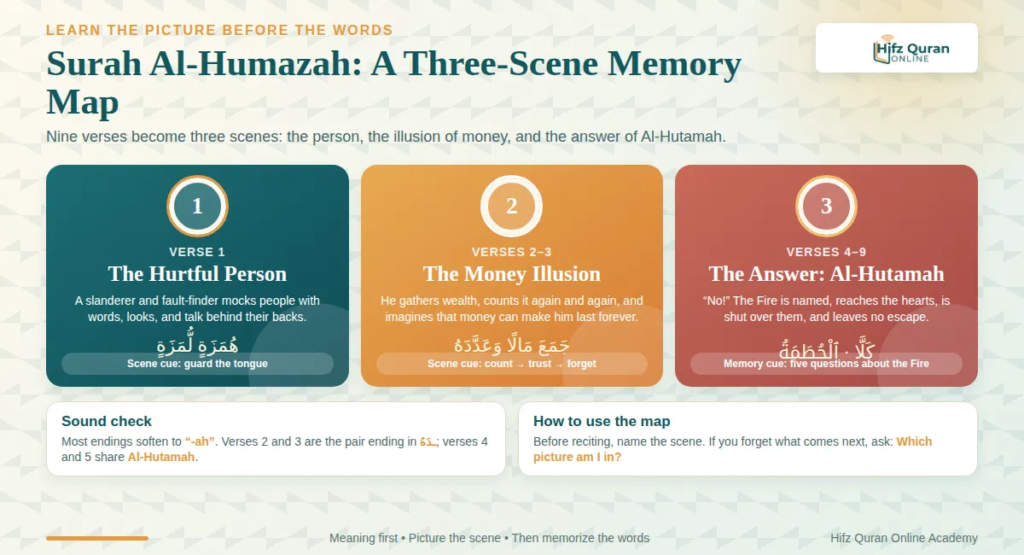
Divide the 9 verses into three scenes, and learn the scenes before you learn the words. Three scenes are easier to remember than nine separate verses.
- Scene 1 is verse 1,It shows the person who mocks others. Remember it with the words هُمَزَةٍ لُّمَزَةٍ.
- Scene 2 is verses 2 and 3, It shows what this person wrongly believes about money. The word مَال (money) is in both verses, so think of them as one scene.
- Scene 3 is verses 4 to 9. It starts with كَلَّا (“No!”) and then describes the Fire. The description answers five questions, always in this order:
- What is it? مَا ٱلْحُطَمَةُ (verse 5)
- Whose fire is it? نَارُ ٱللَّهِ (verse 6)
- How far does it reach? عَلَى ٱلْأَفْـِٔدَةِ (verse 7)
- Is there a way out? مُّؤْصَدَةٌ (verse 8)
- How are they held in? فِى عَمَدٍ مُّمَدَّدَةٍ (verse 9)
Say the three scenes and the five questions out loud before you move on. Later, if you forget what comes next, ask yourself which scene you are in. The five questions also stop you from mixing up verses 7 and 8, which is a very common slip.
Step 4: Learn How The Verses End
Listen to the last sound of each verse, and use it as a check while you recite. The endings follow a pattern your ears can learn. When you stop at the end of a verse, most verses end with the letter ة, which you say as a soft “-ah” sound: لُمَزَة، ٱلْحُطَمَة، ٱلْمُوقَدَة، ٱلْأَفْئِدَة، مُؤْصَدَة، مُمَدَّدَة. If a verse you just said ends with a different sound, stop and check it.
Verses 2 and 3 are the only ones that end differently. Both end with ـدَهُ: عَدَّدَهُ and أَخْلَدَهُ. Learn them as a pair. When you say one, the other will come to you.
Verses 4 and 5 end with the same word, ٱلْحُطَمَة. Verse 4 names the Fire, and verse 5 asks what it is. Use this shared word to jump from verse 4 to verse 5.
Step 5: Practice The Hard Sounds First
Before you memorize, practice the words that are easy to say wrong. If you memorize a word the wrong way, the mistake stays with you every time you recite. Look at the words while you practice, and copy your reciter.
Start with the throat sound. The letter ع in عَدَّدَهُ and عَمَدٍ comes from the middle of the throat. Many learners drop it and say “addadah” or “amad.” Say these two words slowly until the ع is clear.
Next, practice the long sounds. In مَالَهُۥٓ أَخْلَدَهُۥ, stretch the “hoo” for four or five counts, because أ comes right after it. In وَمَآ أَدْرَىٰكَ, stretch the “maa” for four or five counts too. Count on your fingers if it helps.
Then practice the nose sounds. Hold a nose sound for two counts in أَنَّ، لَيُنۢبَذَنَّ، and إِنَّهَا. In لَيُنۢبَذَنَّ, the نْ comes before ب, so it turns into a soft “m” sound. This rule is called iqlab. You also use a nose sound in مَالًا وَعَدَّدَهُ، عَمَدٍ مُّمَدَّدَةٍ، عَلَيْهِم مُّؤْصَدَةٌ، and مُّؤْصَدَةٌ فِى (when you join verses 8 and 9).
Now practice the places with no nose sound. In وَيْلٌ لِّكُلِّ and هُمَزَةٍ لُّمَزَةٍ, the “n” sound blends fully into the “l.” Say it cleanly, without any nose sound.
Finally, practice the bounce. In أَدْرَىٰكَ, the دْ gets a small bounce, called qalqalah. The letters in جَمَعَ and يَحْسَبُ do not bounce, because they have vowels. Say each of these words five or six times on its own. Move to Step 6 only when they feel easy.
Step 6: Memorize One Verse at a Time
Now memorize the surah verse by verse, and join each new verse to all the verses before it. Before you start, listen to the full surah a few times from one reciter. Keep the same reciter, because each one has their own speed and stopping points.
Start with verse 1. Say it until you can repeat it three times in a row with no mistakes. If you make a mistake, start the count again. Then learn verse 2 on its own. When you know it, say verses 1 and 2 together three times. When you join them, link the end of verse 1 to the start of verse 2 with a short “i” sound: lumazatin-illadhee.
Keep going the same way until verse 9. Learn the new verse alone, then say it together with every verse before it, starting from verse 1. If you get stuck, it will usually be where two verses meet. Don’t restart the whole surah. Practice only the last words of one verse and the first words of the next, then go back to the full verses.
As you recite, think about what each verse means. Tell yourself, “Now he counts his money,” or “Now the Fire reaches the hearts.” This keeps the verses in order.
When you reach the end, close the mushaf. Say all 9 verses out loud, three times in a row. If you can, record yourself once and compare it to your reciter. Small mistakes are easier to hear on a recording. To do all of this in one study session, see our guide on how to memorize a surah in 1 hour.
Step 7: Don’t Mix It Up With Similar Surahs
Compare Al-Humazah with the surahs that sound like it, so you don’t jump from one to another. Do this right after you memorize it, while it is still fresh.
First, compare it with Surah Al-Qari’ah (سورة القارعة). Both surahs ask a question with وَمَآ أَدْرَىٰكَ and then answer with the word “fire.”
- Al-Qari’ah says وَمَآ أَدْرَىٰكَ مَا هِيَهْ, then نَارٌ حَامِيَةٌۢ (“a blazing fire”).
- Al-Humazah says وَمَآ أَدْرَىٰكَ مَا ٱلْحُطَمَةُ, then نَارُ ٱللَّهِ ٱلْمُوقَدَةُ (“the fire of Allah, burning”).
Say both pairs side by side a few times. Remember that only Al-Humazah says نَارُ ٱللَّهِ, “the fire of Allah.”
Next, keep it apart from Surah At-Takathur (سورة التكاثر). It also talks about wanting more, and it begins أَلْهَىٰكُمُ ٱلتَّكَاثُرُ (“Competing for more distracts you”). Think of it this way: At-Takathur is about competing for more, and Al-Humazah is about mocking people and counting money.
Last, join it to the surahs around it. Recite Surah Al-Asr (سورة العصر), then Al-Humazah, then Surah Al-Fil (سورة الفيل). This way, the end of one surah leads you to the start of the next.
Step 8: Review It And Live By Its Meaning
Review the surah on a simple schedule, and think about its message during your day. These two habits keep the surah in your memory for a long time.
Follow this review schedule:
- Tonight: say the surah once before you sleep.
- Tomorrow morning: say it again before you learn anything new.
- This week: recite it in your extra prayers. You can’t look at the words in prayer, so it is a strong test.
- After that: add it to your regular Juz Amma review.
Also bring the meaning into your life. Before you joke about someone, remember هُمَزَةٍ لُّمَزَةٍ. When you think about money, remember جَمَعَ مَالًا وَعَدَّدَهُۥ. A surah you live by is much harder to forget. For a full review plan, read our guide on how to memorize Quran without forgetting.
Want a clear plan for all of Juz Amma? Our Quran memorization course at Hifz Quran Online Academy gives you a step-by-step plan and a teacher who listens to you. Your teacher also helps you review. Book a free trial class and start with Surah Al-Humazah.
Step Inside Our Virtual Classrooms
Don’t just take our word for it—see how our interactive sessions work! Watch the short clips below to experience our engaging teaching methods, live teacher-student interactions, and the supportive learning environment we bring to every student.
How To Teach Surah Al-Humazah To Children
The 8 steps above work for children too, but kids need a different approach to get through them. They have shorter attention spans, they learn through play, and they need a lesson to feel like their own. A method that works well for an adult can feel boring or hard for a child if it isn’t adjusted.
These steps show you how to adapt the method for your child. You don’t need to be a teacher or an expert in tajweed to use them. You only need a little time each day, some patience, and a willingness to make the lessons fun. Go at your child’s pace.

Step 1: Turn the Story Into a Bedtime Story
Use the story from Step 1 above, but tell it the way you would tell a bedtime story. Sit close to your child, use a calm and warm voice, and keep the story short. Leave out the names of the men from Quraysh. Young children don’t need names or dates. They need a clear picture they can imagine.
You might tell it like this: “A long time ago, in the city of Makkah, there were some rich men. They had lots of money, but they were not kind. They laughed at people who were poor. They said mean things about them, sometimes to their faces and sometimes behind their backs. They thought their money made them better than everyone else. So Allah sent a surah to tell them that what they were doing was wrong.”
After the story, ask your child, “How do you feel when someone laughs at you?” Give them time to think and answer, and really listen. They may tell you about something that happened at school, at the park, or with a cousin. Don’t rush past this moment, and don’t correct their feelings. Simply say something like, “That sounds like it hurt. Allah doesn’t like it when people make others feel that way.”
You can also turn the question around: “Have you ever laughed at someone? How do you think they felt?” Ask it gently, so your child doesn’t feel blamed. The goal is to help them see the lesson from both sides. When a child connects a surah to their own feelings, they stop seeing it as words to memorize and start seeing it as a lesson for them.
You can tell the story more than once over the following days. Children love hearing the same story again, and each time it helps the meaning sink in a little deeper.
Read also: How To Memorize Surah Al-Fajr
Step 2: Decide How Much to Say About the Fire
Verses 4 to 9 describe the punishment in the Fire. For adults, knowing the full meaning helps with memorization. For children, too much detail can be frightening, and fear doesn’t help a child learn. So decide ahead of time how much you will share, based on your child’s age and nature.
With young children, one simple sentence is enough. You might say, “Allah does not like it when people hurt others. People who keep hurting others and never say sorry will be punished.” Then move quickly back to the positive lesson: “So we always try to be kind with our words, and if we make a mistake, we say sorry.”
With older children, you can explain more of the meaning from Step 2 above, one verse at a time. Older children often ask good questions, like “Why is the fire so strong?” or “What if someone says sorry?” Welcome these questions. They show your child is thinking about the surah, not just repeating it.
As you talk, watch your child’s face and body. If they look worried or go quiet, pause. Remind them that Allah is Most Merciful, that He loves people who are kind, and that He forgives people who say sorry and try to do better. This keeps the surah’s warning in balance with hope, which is how children should first come to know the Quran.
Every child is different. Some sensitive children may need you to keep this part short for longer, even when they are older. Trust your own sense of what your child can handle.
Step 3: Make Listening Part of Your Daily Routine
Children don’t need to sit still to listen. In fact, many learn best when listening happens in the background of things they already do. Play the surah during moments your child already has every day, like the drive to school, breakfast, bath time, coloring time, or the last few minutes before sleep.
Don’t ask your child to repeat anything yet, and don’t quiz them. Just let the sound become familiar, the same way they pick up songs without trying. The less pressure there is at this stage, the more naturally the sounds settle in.
You can also listen together on purpose for a minute or two. Sit with your child, play one verse, and say, “Listen to how beautiful this sounds.” Then move on with your day. Short, relaxed moments like this tell your child that the Quran is something enjoyable, not a chore.
Over a few days, watch for signs that the sound has stuck. Your child may start humming along, mouthing some words, or saying the last word of a verse before the reciter does. Some children will even start reciting bits of it on their own while they play. These are the signs your child is ready to start learning out loud.
Step 4: Keep Lessons Short and at the Same Time Every Day
Children learn best in short bursts. Long lessons tire them out, and a tired child doesn’t remember much. Short daily lessons work much better than one long session on the weekend.
Choose one time each day for the lesson and keep to it. Good times are right after the afternoon prayer, right after dinner, or just before the bedtime routine starts. Pick a time when your child is fed, rested, and not in the middle of something they love. A fixed time turns memorizing into a habit your child expects, instead of a task they have to be talked into.
Make the space calm, too. Sit together on the couch or at a small table, with the TV off and toys put away. Some families keep a special cushion or mat just for Quran time. Small rituals like this help a child’s mind switch into learning mode.
Keep each lesson short, and stop while your child is still happy and wants more. If you notice signs of tiredness, like looking around, wiggling, yawning, or giving silly answers, end the lesson right away. Say something kind like, “You did great today. Let’s do more tomorrow.” Ending on a good note makes your child look forward to the next lesson, while ending on a struggle makes them dread it.
If you miss a day, don’t worry. Just pick up again the next day at the usual time. Consistency over weeks matters more than being perfect every single day.
Step 5: Break the Verses Into Smaller Pieces
Young children often can’t repeat a full verse at once, even a short one. Their working memory is still growing, and long strings of new sounds can overwhelm them. So break each verse into two or three small pieces.
For example, say وَيْلٌ لِّكُلِّ and let your child repeat it. Then say هُمَزَةٍ لُّمَزَةٍ and let them repeat that. When both pieces feel easy, join them and say the whole verse together. You can do the same with longer verses. For verse 3, try يَحْسَبُ أَنَّ first, then مَالَهُۥٓ أَخْلَدَهُۥ, and then put them together.
Use your voice to help. Say each piece slowly and clearly, and keep a steady rhythm. Some parents tap gently on the table for each piece, which helps children feel the beat of the verse.
Older children can usually handle a full verse at a time. As they grow more confident, switch roles. Let your child say the verse first, and you repeat after them. Children love being the teacher, and it builds their confidence. It also shows you how well they really know the verse, because they can’t lean on your voice.
If your child keeps getting stuck on one piece, don’t push through it again and again. Leave it for the day and come back to it tomorrow. A fresh mind often gets it right on the first try.
Step 6: Turn Practice Into a Game
Games keep children interested long after plain repetition gets boring. They also let your child practice many more times without feeling like they are working. Here are a few games that work well with this surah.
The first is a picture card game. Make three simple cards, one for each of the three scenes from Step 3 above. For example, draw a laughing face with a big cross over it for scene 1, a pile of coins for scene 2, and a closed door for scene 3. Let your child help draw or color them, so the cards feel like theirs. Mix up the cards, then ask your child to put them in the right order and recite the part that matches each card.
The second is a “missing word” game. Recite a verse but stop before the last word, and let your child finish it. Then switch roles, and let your child stop so you can finish it. Children love catching a parent who “forgets” a word, so you can pretend to make a mistake now and then and let them correct you.
The third is a turn-taking game. You say verse 1, your child says verse 2, you say verse 3, and so on until the end. Then start again, but this time your child goes first. This game is great for practicing how the verses connect.
You can also invite siblings to join. Children often try harder when a brother or sister is listening, and older siblings can help younger ones. Just keep the mood friendly, so it never turns into a contest that leaves anyone upset.
Step 7: Correct Gently and Praise Often
Children make mistakes, and that is a normal part of learning. How you correct them matters as much as what you correct. A harsh correction can make a child afraid to try. A gentle one teaches them that mistakes are just steps along the way.
If your child says a word wrong, avoid saying “No, that’s wrong.” Instead, say, “Good try! Let’s listen to it once more,” and play the reciter or say the word slowly yourself. Then let your child try again. If they still don’t get it, leave it for another day rather than repeating it until they feel frustrated.
Praise effort, not only results. Tell your child you are proud of how hard they are trying, even on days when they forget a verse. Be specific when you can, like “I love how carefully you said that word” or “You remembered verse 4 all by yourself today.” Specific praise shows your child exactly what they did well.
Children who feel safe making mistakes are more willing to keep trying. Over time, this makes them stronger learners, not just with this surah but with every surah after it.
If your child doesn’t read Arabic, getting the sounds right takes extra patience. Our guide for non-Arabic speakers explains how to build correct sounds before memorizing.
Step 8: Let Your Child Show What They Learned
When your child finishes the surah, give them a chance to share it. Ask them to recite it for a grandparent on a video call, for a sibling, or for the whole family after dinner. Clap for them when they finish. Being proud of what they learned gives children a strong reason to keep it.
A simple reward chart can help keep that pride going. Draw a chart with a box for each day, and add a sticker every time your child recites the surah.
When they fill a row, celebrate with something small, like letting them choose the next family activity or a favorite meal. The reward should feel like a celebration, not a payment, so keep it simple and warm.
You can also tie the surah back to real life. When you see your child being kind to someone, or choosing not to laugh at another child, mention it: “That’s just what Surah Al-Humazah teaches us!” Moments like this help the meaning grow alongside the words.
The biggest moment comes when your child recites the surah in their own prayer for the first time. Tell them how special that is.
They are now using the words of Allah to speak to Allah. Let them know you are proud of them, and that every time they recite it in prayer, they are earning reward. That feeling often stays with a child for years, and it makes all the practice worth it.
Curious what learning with us is like? Read what our students and parents say about learning Juz Amma with our teachers at Hifz Quran Online Academy. Their reviews show how the classes work for real families.

Memorize the Quran at Your Own Pace
Join our expert tutors and begin your Hifz journey with a personalized plan.
Start Your Free TrialWrong Ideas About Surah Al-Humazah
Some ideas about this surah are shared online, on social media, and in some books, but they have no real proof. Knowing the truth helps you learn the surah with the right understanding. It also protects you from spending time on practices that have no basis in Islam.
Wrong Idea 1: Reading It 21 Times Solves Problems
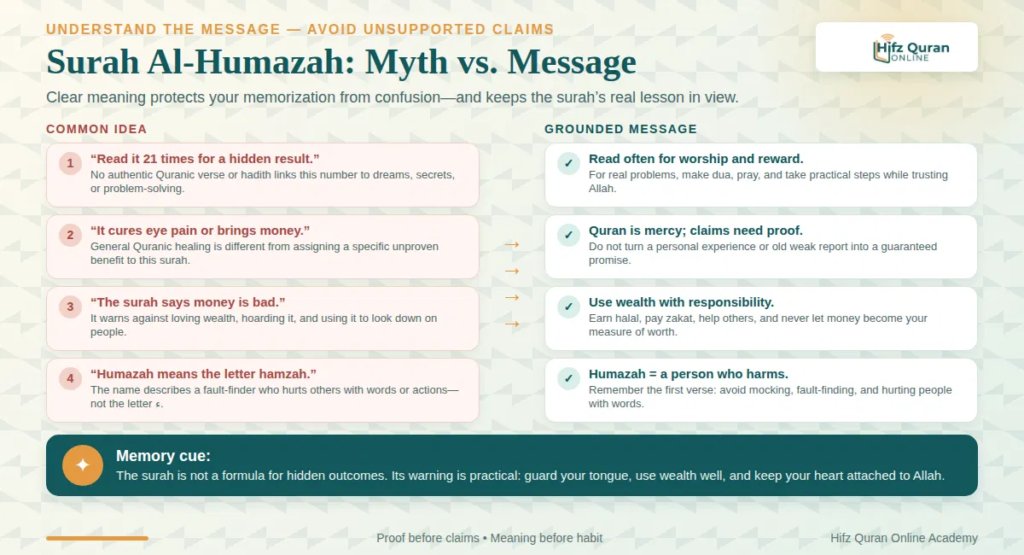
You may see posts that say if you read Surah Al-Humazah 21 times, it will show you secrets in a dream, uncover who harmed you, or solve a hard problem in your life. There is no real proof for any of this. No verse of the Quran and no authentic hadith links this surah to a set number of readings or to these results.
In Islam, when someone says a certain act brings a certain result, that claim needs proof from the Quran or the authentic Sunnah.
Some surahs do have special virtues that come from authentic hadith. Surah Al-Ikhlas, for example, is described by the Prophet ﷺ as equal to a third of the Quran. But no such report exists for reading Surah Al-Humazah 21 times.
This does not mean you shouldn’t read the surah often. You can read it any time you like, as many times as you like.
Every time you read the Quran, you earn reward for each letter. The problem is only with believing that a set number of readings will bring a special, hidden result. If you are facing a real problem, the better path is to make dua, pray, and take practical steps, while trusting Allah.
Wrong Idea 2: It Cures Eye Pain or Brings Money
Some books and websites list special “benefits” for this surah. They say it heals eye pain, brings more money, keeps poverty away, or protects a person from a bad death. Authentic hadith do not support these claims. Most of them come from old books of “special powers” of surahs, which mix weak reports with personal experiences.
It is true that the Quran is a source of healing and mercy in general. Reciting the Quran and making dua for a sick person is a good and accepted practice. But saying that one specific surah cures one specific illness, or brings money, is a different claim. That kind of claim needs clear proof, and there is none for Surah Al-Humazah.
There is also something odd about these claims. This surah warns against loving money too much. Using it as a way to get more money goes against its own message. The real value of Surah Al-Humazah is what it teaches: be kind with your words, don’t put people down, and don’t trust money as if it can save you.
Wrong Idea 3: The Surah Says Money Is Bad
Some people read verses 2 and 3 and think the surah is against money or against being rich. That is not what it says. The surah does not blame money itself. It blames a certain attitude toward money.
Look closely at what the man in the surah does. He gathers money, counts it again and again, and thinks it will make him live forever. He makes money the center of his life. He also holds back what he owes, like zakat and helping people in need. And he uses his wealth as a reason to look down on others and mock them.
The Quran praises the right use of money in many places. It praises people who earn in a halal way, spend on their families, pay zakat, and give charity to the poor.
Many of the Prophet’s companions were wealthy and used their money to help others. So the lesson is not “money is bad.” The lesson is: don’t love money more than Allah, don’t hold back what you owe, and don’t think money makes you better than other people.
Wrong Idea 4: Humazah Means the Letter Hamzah
Many learners, especially children, think the name of the surah refers to the Arabic letter hamzah (ء). The two words look and sound alike, so the mix-up is easy to make. But the surah’s name describes a kind of person, not a letter.
A humazah (هُمَزَة) is someone who often finds faults in others, puts them down, and hurts them with words or actions. The surah is named after the first verse, which warns this kind of person: وَيْلٌ لِّكُلِّ هُمَزَةٍ لُّمَزَةٍ, “Woe to every slanderer and fault-finder.”
The two words come from the same Arabic root, which carries the idea of pressing or poking. That is why they sound alike.
But their meanings are very different. When you teach this surah to a child, make this clear from the start. You can say, “This surah is not about the letter hamzah. It is about a person who hurts others with words.” This small step prevents confusion and helps your child understand the surah’s real message.
Hear a live Quran recitation lesson in action
Online Quran learning works across time zones, as shown in this recitation lesson where Fuad from the USA recites Surah Al-Zalzalah with his Hifz Quran Online teacher. Watch the video below to hear his recitation and see how a live, interactive lesson corrects pronunciation step by step.
Memorize the Quran at Your Own Pace
Join our expert tutors and begin your Hifz journey with a personalized plan.
Start Your Free TrialMemorize The Quran With Hifz Quran Online Academy
You can learn a short surah like Al-Humazah on your own. Learning all of Juz Amma, and then more, is easier with a teacher who hears every word you say. When you join Hifz Quran Online Academy, you get:
- A focus on Hifz only. Memorizing the Quran is our main goal, and all our courses and teachers focus on it.
- Teachers with real experience. Our teachers have guided many students through Hifz. They spot mistakes and fix them before they become habits.
- A review system that works. Your lessons mix new verses with review of recent verses and older surahs. Huffaz have used this method for hundreds of years.
- Help for non-Arabic speakers. We teach you the right sounds first, so every word you memorize is correct.
- Live online classes. Learn from home with a teacher who corrects you right away.
- A free trial class. Try a lesson before you decide.
Try a free class today. Start with Surah Al-Humazah, or with any surah you are learning now.

Our Quran Courses
Browse our Quran courses, choose the one that suits you, and book your free trial class.
- Quran Memorization Course
- Quran Memorization and Hifz Course for Kids
- Online Quran Memorization Courses for Adults
- Quran Hifz Course for Ladies
- Quran Memorization Course for Men
- Saudi-Based Quran Memorization Courses
- Hifz Teachers
Conclusion
Memorizing a surah is not only about repeating words. It is about giving your mind something to hold on to. With Surah Al-Humazah, that means a real story from Makkah, clear meanings for every word, three scenes, and a rhyme you can hear. When those are in place, memorizing verse by verse becomes the easy part.
You can use these steps for every surah in Juz Amma: learn the story and the words, find the pattern, then memorize and review. After one surah, the next one gets easier.
This surah also teaches us two things. Be careful with your words about others. And remember that money cannot keep anyone alive forever. Living by these lessons is a good way to keep the surah in your heart. And if you want help along the way, a good teacher can help you learn faster and recite correctly from the start.
FAQs
Need to know more about Surah Al-Humazah, have a look at these questions and answers.
How Long Does It Take To Memorize Surah Al-Humazah?
It depends on how well you read Arabic and how used you are to the sounds. Because it is only 9 short verses, many people can learn it in one or a few study sessions. Keeping it depends on regular review.
Can I Memorize Surah Al-Humazah If I Can’t Read Arabic?
Yes. You can use the transliteration and listen to a reciter many times. But English letters can’t show some sounds, like ع, correctly. A teacher is the safest way to avoid mistakes.
Can I Recite Surah Al-Humazah In My Prayers?
Yes. You can recite it after Surah Al-Fatihah in any prayer, like any other surah. Reciting it in prayer is also a great way to review it.
What Is The Best Time Of Day To Memorize A Surah?
Choose a time when you are rested and your mind is quiet. Many people find the early morning works well. What matters most is studying at the same time every day.
What Should I Do If I Forget The Surah After A Week?
Don’t start from zero. Recite what you remember, find the exact spot where you stop, and practice that spot with the verse before it. Then go back to the review schedule in Step 8.
Can I Use An App To Memorize Surah Al-Humazah?
Yes, an app can help you memorize Surah Al-Humazah, especially one that repeats a single verse many times. Apps are great for listening and self-testing. But an app can’t hear you recite, so it won’t catch your pronunciation mistakes the way a teacher can.
Related Articles
Memorizing Quran






Leave a Reply