 Memorizing Quran
Most people who try to memorize Surah An-Nazi’at approach it the same wrong way — reciting the whole surah from start to finish, hoping repetition alone will make it stick. It doesn’t. The surah’s 46 verses span four distinct themes, and without a structured, segment-based plan, similar-sounding verses blur into each other, retention stays shallow, and frustration builds fast.
This guide gives you a complete, practical method: how to break the surah into memorable thematic blocks, what mistakes to avoid, and how to lock in your memorization so it holds.
1. Learn The Lessons Behind Surah An-Nazi’at Before You Memorize It
The most reliable shortcut to Surah An-Nazi’at memorization is understanding what the surah is actually saying — and in what order. When your memory has a logical map to follow, it retrieves verses far faster than rote repetition alone can achieve.
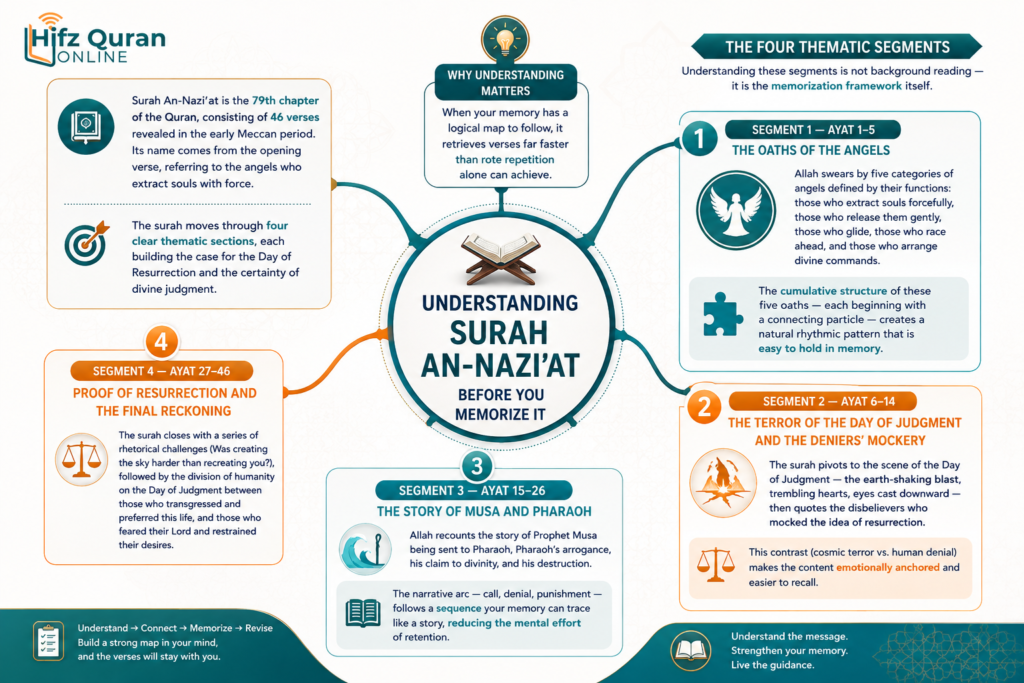
Surah An-Nazi’at is the 79th chapter of the Quran, consisting of 46 verses revealed in the early Meccan period. Its name comes from the opening verse, referring to the angels who extract souls with force. The surah moves through four clear thematic sections, each building the case for the Day of Resurrection and the certainty of divine judgment.
2. Learn The Four Thematic Segments of Surah An-Nazi’at
Understanding these segments is not background reading — it is the memorization framework itself.
Segment 1 — Ayat 1–5: The Oaths of the Angels
Allah swears by five categories of angels defined by their functions: those who extract souls forcefully, those who release them gently, those who glide, those who race ahead, and those who arrange divine commands. The cumulative structure of these five oaths — each beginning with a connecting particle — creates a natural rhythmic pattern that is easy to hold in memory.
Segment 2 — Ayat 6–14: The Terror of the Day of Judgment and the Deniers’ Mockery
The surah pivots to the scene of the Day of Judgment — the earth-shaking blast, trembling hearts, eyes cast downward — then quotes the disbelievers who mocked the idea of resurrection. This contrast (cosmic terror vs. human denial) makes the content emotionally anchored and easier to recall.
Segment 3 — Ayat 15–26: The Story of Musa and Pharaoh
Allah recounts the story of Prophet Musa being sent to Pharaoh, Pharaoh’s arrogance, his claim to divinity, and his destruction. The narrative arc — call, denial, punishment — follows a sequence your memory can trace like a story, reducing the mental effort of retention.
Segment 4 — Ayat 27–46: Proof of Resurrection and the Final Reckoning
The surah closes with a series of rhetorical challenges (Was creating the sky harder than recreating you?), followed by the division of humanity on the Day of Judgment between those who transgressed and preferred this life, and those who feared their Lord and restrained their desires.
3. Learn The Reason for the Revelation of Surah An-Nazi’at
No specific reason for the revelation of Surah An-Nazi’at as a whole has been reported in the books of Tafsir and Quranic sciences. It is a Makki Surah revealed to establish the belief in the Resurrection and life after death, and to remind people of the reality and seriousness of the Day of Judgment.
However, a specific reason for the revelation of its final verses has been mentioned. Allah says: “They ask you about the Hour: When is its arrival? What have you to do with mentioning it? To your Lord is its final determination. You are only a warner for those who fear it.”
These verses were revealed because the disbelievers of Quraysh repeatedly asked the Prophet Muhammad ﷺ about when the Day of Judgment would occur, asking out of denial and disbelief. The verses clarify that the knowledge of the exact time of the Hour belongs to Allah alone, while the Prophet ﷺ was sent to warn those who fear it and prepare them for its coming.
4. Learn The Virtue of Surah An-Nazi’at
There is no authentic hadith that specifically establishes a particular virtue for reading Surah An-Nazi’at alone. Reports that mention a specific reward for reciting it, such as having an easy reckoning or being given to drink on the Day of Judgment, are considered weak or unauthentic.
However, its virtue falls under the general virtue of reciting and reflecting upon the Quran. Surah An-Nazi’at is among the Al-Mufassal, the group of shorter Quranic surahs with which Allah favored Prophet Muhammad ﷺ.
Reciting it brings the general reward of Quran recitation, with a good deed for every letter and each good deed multiplied tenfold. Reflecting on its verses can also strengthen faith in the Resurrection and the Hereafter, while inspiring fear of Allah and awareness of the عظِيم events of the Day of Judgment.
5. Begin Your Hifz Journey with a Sincere Intention
Begin each Hifz session with a sincere niyyah to memorize the Quran for the sake of Allah. Remind yourself of your purpose before you begin, and approach each session with sincerity, focus, and the intention to strengthen your connection with the Quran.
6. Create a Quiet and Consistent Space for Memorization
Choose a quiet place and a consistent time for your daily memorization. The period after Fajr can be especially effective because your mind is fresh and distractions are often minimal.
7. Build Familiarity by Listening First
Before memorizing any segment, listen to a qualified reciter performing that segment at least five times while following along in the mushaf. Reciters like Sheikh Mishary Rashid Alafasy or Sheikh Mahmoud Khalil Al-Husary are suitable references. Your ear needs to encode the correct melody and pronunciation before your tongue begins working independently.
This step is not optional. Attempting to memorize without an auditory model leads to self-generated errors that become difficult to undo once they are set in memory.
Read also: How to Memorize Surah Waqiah? – A Step-by-Step Guide
8. Break the Surah into Manageable Verses
Focus on one verse at a time rather than trying to memorize several verses at once. Make sure you can recite each verse accurately and fluently from memory before moving on to the next one. This approach gives you a stronger foundation and makes it easier to build the Surah gradually.
Memorize Segment 1 (Ayat 1–5)
Read Ayah 1 aloud ten times while looking at the text. Then recite it ten times from memory with the mushaf closed. Add Ayah 2 using the same process, then recite Ayat 1–2 together. Continue verse by verse until you can recite all five ayat of the first segment fluently without looking.
The five opening verses share a parallel grammatical structure — each begins with Wal- (And by those who…) — which makes them easier to chain together once you have the first two locked in.
Memorize Segment 2 (Ayat 6–14)
This segment contains one of the most common confusion points in Surah An-Nazi’at: learners frequently transpose Ayat 11 and 12, both of which feature the disbelievers’ speech. A practical fix is to memorize the content sequence of this segment explicitly before beginning:
- The Blast (Ayah 6–7)
- Trembling hearts and humbled eyes (Ayah 8–9)
- The disbelievers’ first objection — “Will we be returned?” (Ayah 10)
- The disbelievers’ second objection — “Even as decayed bones?” (Ayah 11)
- Their verdict — “That would be a losing return” (Ayah 12)
- The answer — just one shout, and they are suddenly on the surface (Ayah 13–14)
Memorize the logic sequence first, then fill in the Arabic. You will almost never transpose these verses again.
After completing this segment, connect it to Segment 1 and recite Ayat 1–14 from memory as one continuous unit before moving forward.
Memorize Segment 3 (Ayat 15–26)
The story of Musa and Pharaoh spans twelve verses and follows a tight narrative arc. Use the story sequence as your memorization scaffold:
- The divine call in the sacred valley (Ayah 15–16)
- The command to go to Pharaoh (Ayah 17)
- Musa’s invitation to Pharaoh to purify himself (Ayah 18–19)
- The sign shown (Ayah 20)
- Pharaoh’s denial and disobedience (Ayah 21)
- Pharaoh’s arrogance and false claim (Ayah 22–24)
- Allah’s punishment, first and last (Ayah 25)
- The lesson for those who fear Allah (Ayah 26)
The closing verse of this segment — “Indeed in that is a lesson for whoever fears Allah” — is an important anchor. Memorize it as the conclusion of the Pharaoh narrative, not as a standalone verse.
Connect Segment 3 to Segments 1 and 2. Recite Ayat 1–26 continuously from memory before proceeding.
Step Inside Our Virtual Classrooms
Don’t just take our word for it—see how our interactive sessions work! Watch the short clips below to experience our engaging teaching methods, live teacher-student interactions, and the supportive learning environment we bring to every student.
Memorize the Quran at Your Own Pace
Join our expert tutors and begin your Hifz journey with a personalized plan.
Start Your Free TrialMemorize Segment 4 (Ayat 27–46)
This segment contains the most internally similar verse pairs in the surah. Ayah 40–41 and Ayah 42–43 mirror each other in structure, describing the two types of people and their destinations. A learner who has not noted this symmetry will frequently get lost here.
Memorize these contrasting pairs explicitly as a pair — not individually. “He who transgressed and preferred this world → Hellfire. He who feared his Lord and restrained his soul → Paradise.” Then memorize the Arabic of each pair with that contrast fully in mind.
The surah closes with three ayat about the Hour — that its timing is unknown even to the Prophet ﷺ, that knowledge of it belongs only to Allah, and that the Prophet’s role is only to warn those who fear it. These three verses (44–46) are short and thematically unified; they memorize quickly once you understand they are a single answer to the question in Ayah 43.
Read also: Memory Bridge Method for Quran Memorization
9. Connect Each New Verse to the Previous One
After memorizing all four segments individually, recite the full surah from memory five times consecutively. Any verse where you hesitate or pause is a weak point — return to that segment, isolate the problematic verse, and apply the repetition method again before your next full recitation.
10. Recite Surah An-Nazi’at in your daily prayers.
Using it in Salah embeds it in an act of worship and activates a retention mechanism that desk study cannot replicate — the physical posture, the presence required for prayer, and the daily repetition all reinforce recall far beyond what isolated sessions achieve.
11. Practice with a Study Partner or Qualified Quran Teacher
Recite your memorized verses to a reliable study partner or, preferably, a qualified Quran teacher who can listen carefully and correct your mistakes. Regular feedback helps you identify weaknesses in memorization and maintain accurate Tajweed, while structured guidance can keep your progress consistent.
For a more structured Hifz journey, Hifz Quran Online Academy provides online Quran memorization courses with teacher-guided practice and personalized support. Working with a qualified teacher can help you correct mistakes early, strengthen your daily revision, and stay consistent throughout your memorization journey.

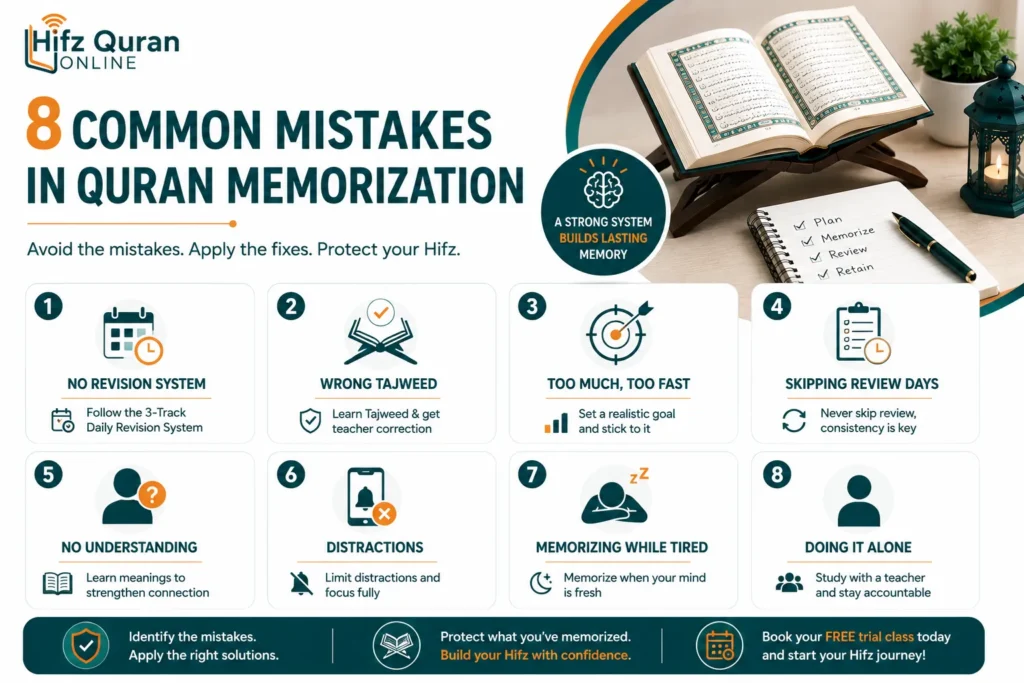
Common Mistakes When Memorizing Surah An-Nazi’at
Memorizing Surah An-Nazi’at becomes much easier when you know which challenges are most likely to interrupt your recall. Similar verse endings, unfamiliar meanings, incorrect pronunciation, and moving ahead too quickly can all weaken memorization if they are not addressed early. Recognizing these common mistakes allows you to adjust your method and build stronger, more reliable Hifz.
Confusing Similar Verse Endings
Surah An-Nazi’at has several verse endings that rhyme or share the same root pattern — “الْكُبْرَىٰ,” “دَحَىٰهَا,” “مُرْسَاهَا,” “مُنتَهَاهَا.” Learners frequently substitute one for another. The fix: memorize each verse together with the one before it as a pair, not as individual isolated units.
Memorizing Without Understanding the Meaning
Attempting to memorize unfamiliar words in a language you don’t speak without understanding what they mean creates purely phonetic memory — which is fragile. Even a basic thematic understanding (“this ayah is about Pharaoh claiming to be god”) gives your memory an additional anchor that pure sound alone cannot provide.
Skipping the Auditory Model
Many learners open the mushaf and begin reading aloud immediately, without first listening to a qualified reciter. This produces self-taught pronunciation errors that are notoriously difficult to correct once embedded — because your own voice becomes the incorrect auditory reference.
Advancing Too Quickly
Moving to the next segment before the current one is fully stable is the single most common cause of weak Hifz. A useful test: recite the segment to someone else — a family member, a friend, anyone — without the mushaf. If you cannot do this, you are not ready to advance.
Read also: Rote Memorization Method for Quran
See Our Classes in Action
Curious about what a 1-on-1 Hifz session looks like? Take a look at these real-time snippets from our daily classes to see our student-centered approach, Tajweed correction techniques, and online whiteboard tools in action.
Start Your Hifz Journey with Expert Guidance
Memorizing Surah An-Nazi’at on your own is entirely possible with the right method — but having a qualified teacher listen, correct, and guide your progress makes the difference between fragile memorization and solid, lasting Hifz.
At Hifz Quran Online Academy, our certified Quran teachers provide personalized one-on-one sessions designed around your schedule, your pace, and your level. Whether you are beginning with Juz ‘Amma or working through longer surahs, your teacher corrects Tajweed in real time and ensures each segment is locked before you move forward.
Our Quran Courses
- Quran Memorization Course
- Quran Memorization and Hifz Course for Kids
- Online Quran Memorization Courses for Adults
- Quran Hifz Course for Ladies
- Quran Memorization Course for Men
- Saudi-Based Quran Memorization Courses
- Hifz Teachers
Memorize the Quran at Your Own Pace
Join our expert tutors and begin your Hifz journey with a personalized plan.
Start Your Free Trial
Conclusion
Memorizing Surah An-Nazi’at becomes significantly more manageable when you approach it as four distinct thematic segments rather than 46 individual verses. Work through the angels’ oaths, the Day of Judgment scene, the story of Musa and Pharaoh, and the final reckoning — one block at a time, connecting backward before moving forward.
Apply the four key Tajweed rules that shape this surah’s sound. Avoid the common pitfalls of advancing too quickly, memorizing without meaning, and skipping the auditory model. And use your daily prayers as your primary retention tool — Salah embeds Hifz in a way no amount of desk study can match.
The goal is not just to memorize words. It is to carry this surah with you in your prayer and in your heart.
Read also: How to Memorize a Surah in One Day— A Practical Step-by-Step Method
Frequently Asked Questions
How long does it take to memorize Surah An-Nazi’at?
Most students with a daily practice of 20–30 minutes can memorize Surah An-Nazi’at in 7 to 14 days using the segment method. Age, focus level, and prior Tajweed knowledge all affect the timeline — but the structured four-segment approach consistently reduces the time compared to reciting the full surah from start to finish each session.
What is the best time of day to memorize Surah An-Nazi’at?
The period after Fajr prayer is consistently recommended by Hifz scholars for new memorization. The mind is rested, the environment is quiet, and the time carries spiritual weight. Evening sessions before Isha work well for revision of what was memorized earlier in the day.
Do I need to learn Tajweed before I start memorizing?
You do not need to master all of Tajweed first, but you should have a basic grounding in Madd, Qalqalah, Ghunnah, and Idgham before beginning — all four appear heavily in Surah An-Nazi’at. Memorizing with incorrect pronunciation fixes errors into your memory, making them much harder to correct later.
Why do I keep mixing up verses near the end of the surah?
Ayat 40–43 of Surah An-Nazi’at describe two contrasting groups using mirrored structure — this is intentional in the Quran’s style but is a common confusion point for memorizers. The solution is to memorize these as explicit contrasting pairs with their meanings in mind, not as individual verses in sequence.
How do I retain Surah An-Nazi’at after I’ve memorized it?
Recite it in your voluntary daily prayers (Nawafil) consistently for at least 40 days after completing memorization. This is the critical retention window — the memorization remains vulnerable to loss until it has been recalled consistently across this period. After 40 days of daily recitation in Salah, retention becomes significantly more durable.






Leave a Reply