 Memorizing Quran
If you’re wondering how to memorize Surah Duha, you’re starting with one of the most comforting chapters in the Quran. Surah Duha is the 93rd chapter, made up of just 11 verses, which makes it one of the most accessible surahs for beginners to commit to memory.
This guide walks you through the background of the surah, a verse-by-verse breakdown with Tajweed notes, a practical memorization method, and the mistakes most learners make along the way. By the end, you’ll have a clear, realistic plan to memorize Surah Duha with proper pronunciation.
What you’ll learn in this article:
- Why Surah Duha was revealed and what it means for your recitation
- A verse-by-verse guide with transliteration and translation
- A 7-step memorization method you can start today
- Common pronunciation and Tajweed mistakes to avoid
- How long memorization typically takes
Why Was Surah Duha Revealed?
Surah Duha is a Makki surah, meaning it was revealed in Mecca before the Prophet Muhammad ﷺ migrated to Medina. Understanding its helps you recite it with the right feeling, not just the right sounds.
The surah was revealed after a pause in revelation. For several days, Jibreel (Angel Gabriel) did not come to the Prophet ﷺ with new revelation. This silence left the Prophet ﷺ deeply saddened, unsure of what it meant.
The disbelievers in Mecca noticed the pause and used it against him. According to reports, a woman from among the polytheists — said by some narrations to be Umm Jameel, the wife of Abu Lahab — mocked him, saying something to the effect of “your Lord has abandoned you.”
Allah revealed Surah Duha directly in response, opening with an oath by the morning light and stating plainly: “Your Lord has not forsaken you, nor does He hate you” (93:3).
This context matters when you memorize Surah Duha, because the surah isn’t abstract comfort — it’s a direct answer to a real moment of doubt and mockery, and reciting it with that in mind changes how the words land.
Read also: How Long Does It Take To Memorize Juz Tabarak?
Surah Duha Verse by Verse Text, Transliteration, and Meaning
This section answers: what does each verse of Surah Duha say, and how is it pronounced?
Before memorizing the full surah, it helps to go through it verse by verse. Read the Arabic, sound it out with the transliteration, and check the meaning so you’re not memorizing sounds without understanding.
Verses 1–5: The Oath and the Promise
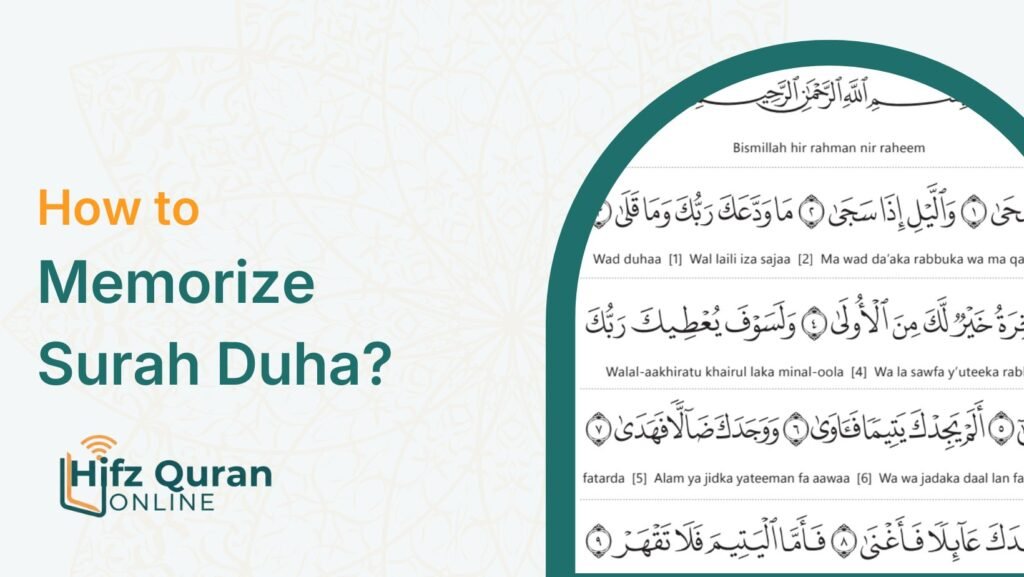
Ayah 1: وَالضُّحَىٰ — Wa-dh-Duha — “By the morning brightness”
Ayah 2: وَاللَّيْلِ إِذَا سَجَىٰ — Wal-layli iza sajaa — “And by the night when it grows still”
Ayah 3: مَا وَدَّعَكَ رَبُّكَ وَمَا قَلَىٰ — Ma wadda’aka rabbuka wa ma qalaa — “Your Lord has not forsaken you, nor does He hate you”
Ayah 4: وَلَلْآخِرَةُ خَيْرٌ لَّكَ مِنَ الْأُوْلَىٰ — Wa l-akhiratu khayrun laka mina l-ula — “And the Hereafter is better for you than this life”
Ayah 5: وَلَسَوْفَ يُعْطِيكَ رَبُّكَ فَتَرْضَىٰ — Wa lasawfa yu’tika rabbuka fatarda — “And your Lord will give you until you are satisfied”
Notice the rhyme pattern ending in “-aa” across these verses. That rhyme is one of the easiest memorization anchors in the surah — once you have it, wrong-verse-order mistakes drop sharply.
Verses 6–11: Reminders and Instructions
Ayah 6: أَلَمْ يَجِدْكَ يَتِيمًا فَآوَىٰ — Alam yajidka yatiman fa’awa — “Did He not find you an orphan and give you shelter?”
Ayah 7: وَوَجَدَكَ ضَالاًّ فَهَدَىٰ — Wa wajadaka dallan fahada — “And He found you lost and guided you”
Ayah 8: وَوَجَدَكَ عَائِلًا فَأَغْنَىٰ — Wa wajadaka ‘ailan fa’aghna — “And He found you in need and made you self-sufficient”
Ayah 9: فَأَمَّا الْيَتِيمَ فَلَا تَقْهَرْ — Fa’amma al-yatima fala taqhar — “So as for the orphan, do not oppress him”
Ayah 10: وَأَمَّا السَّائِلَ فَلَا تَنهَرْ — Wa amma as-sa’ila fala tanhar — “And as for the one who asks, do not repel him”
Ayah 11: وَأَمَّا بِنِعْمَةِ رَبِّكَ فَحَدِّثْ — Wa amma bini’mati rabbika fahaddith — “And as for the favor of your Lord, speak of it”
Verses 9–11 follow a distinct three-part structure — “as for X, do this” — repeated with a different subject each time. Recognizing this pattern in advance means you’re memorizing one grammatical shape three times, not three unrelated sentences.
At Hifz Quran Online Academy, our teachers walk students through exactly this kind of pattern recognition during live sessions — it’s often the difference between a student who memorizes mechanically and one who retains the surah for years.
Read also: How To Memorize Juz 29? 7-Step For Non-Arabic Speakers

A 7-Step Method to Memorize Surah Duha
what is a practical, structured way to memorize this surah from start to finish?
Memorizing a surah is not about willpower alone — it’s about a repeatable process. Here’s a method that works well for a short surah like this one.
Step 1: Set Your Intention and Remove Distractions
Start each session with a clear intention (niyyah) and a quiet space. A noisy room or a half-focused mind will double the time this takes.
Step 2: Listen to a Qualified Reciter First
Before you attempt a verse yourself, listen to it recited correctly. Reciters such as Sheikh Mishary Rashid Alafasy or Sheikh Mahmoud Khalil Al-Husary are widely used for this because their pacing is clear and their Tajweed is precise. Listening first trains your ear before your tongue has to work.
Step 3: Break the Surah Into Small Chunks
Don’t attempt all 11 verses in one sitting. Take one verse at a time. Understand its meaning, then focus purely on getting the pronunciation right before moving to memorization.
Step 4: Use the 20-20 Repetition Technique
Read the verse aloud 20 times while looking at the Arabic text. Then recite it 20 times from memory without looking. This repetition count isn’t arbitrary — it’s roughly what’s needed to move a short verse from short-term to long-term recall for most learners.
Step 5: Link Verses Together Gradually
Once two verses are memorized individually, recite them back to back until they flow as one unit. Add a third, then a fourth. This is how you avoid the common problem of memorizing verses as isolated islands that fall apart when strung together.
Read also: 11 Tips to Memorize Surah Al-Mulk Easily
Step Inside Our Virtual Classrooms
Don’t just take our word for it—see how our interactive sessions work! Watch the short clips below to experience our engaging teaching methods, live teacher-student interactions, and the supportive learning environment we bring to every student.
Memorize the Quran at Your Own Pace
Join our expert tutors and begin your Hifz journey with a personalized plan.
Start Your Free TrialStep 6: Recite It in Your Prayers
Once you’ve memorized even the first few verses, start using them in your daily Salah. Praying with newly memorized verses is one of the most effective reinforcement tools available, because it forces recall under mild pressure and repeats it daily without extra study time.
Step 7: Get Feedback From a Teacher
Self-review has a ceiling — you can’t hear your own mistakes in real time the way a trained ear can. A teacher checking your Tajweed, your stops, and your letter articulation catches errors that would otherwise become permanent habits.
If you don’t have regular access to a qualified teacher, this is exactly the gap Hifz Quran Online Academy is built to close — live, one-on-one correction from a certified instructor, from wherever you are.

Common Mistakes When Reciting Surah Duha
which specific pronunciation and Tajweed errors do learners make in this surah, and how do you fix them?
1. Mispronouncing the Letter ض
The ض in “وَالضُّحَىٰ” and “ضَالاًّ” requires a heavy, emphatic articulation from the side of the tongue. English speakers often substitute a plain “d” sound. The fix is deliberate: practice the letter in isolation, pressing the tongue against the upper side teeth, before attaching it to the rest of the word.
2. Over-Stressing the س in “السَّائِلَ”
Some learners give this letter an exaggerated hissing sound. It should stay light and natural — over-emphasis actually distorts the word rather than clarifying it.
3. Softening ق Into an English “K”
The ق in “قَلَىٰ” is pronounced deep in the throat, not at the front of the mouth like an English K. Confusing the two changes the letter’s identity, which matters in Tajweed even when the general sound seems close enough to a non-Arabic ear.
4. Getting Qalqalah Wrong
Letters like ق, ط, ب, ج, and د carry a slight “bounce” when they appear with sukoon at the end of a word or phrase, known as Qalqalah. The mistake is making this bounce too sharp and percussive. It should be subtle — barely noticeable rather than a hard tap.
5. Confusing Idgham and Ikhfa
These two Tajweed rules get mixed up often. Idgham means fully merging two letters together with no separation. Ikhfa means a lighter, nasal blending where the letter is partially hidden, not fully merged. Mixing the two changes how smoothly — or sharply — a word transitions into the next.
6. Dropping the Shaddah
In words like “تَقْهَرْ,” a missed Shaddah (doubling mark) means the letter isn’t held long enough. Since Shaddah can change meaning in Arabic, this isn’t a stylistic detail — it’s a correctness issue worth fixing early.
Read also: How to Memorize Surah Al Kahf? – A Practical Step-by-Step Hifz Guide
Read also: How to Memorize a Juz in a Week? 8 Steps to Follow
How Long Does It Take to Memorize Surah Duha?
Most learners memorize Surah Duha’s 11 verses within a few days to two weeks, depending on daily consistency. A learner practicing 15–20 minutes a day, using the repetition method above, typically moves faster than someone who studies in longer but irregular sessions.
Speed isn’t the goal, though. A surah memorized in three days with shaky Tajweed will need re-correction later, which usually costs more time than getting it right slowly the first time.
See Our Classes in Action
Curious about what a 1-on-1 Hifz session looks like? Take a look at these real-time snippets from our daily classes to see our student-centered approach, Tajweed correction techniques, and online whiteboard tools in action.
Start Memorizing Surah Duha With Guided Support
Trying to self-correct Tajweed from written guides has a real limit — you can’t hear your own articulation the way an outside ear can. Book a free trial class with Hifz Quran Online Academy and get one-on-one feedback from a certified instructor on exactly the verses covered in this guide.
Our teachers specialize in walking beginners through short surahs like Duha with structured correction, proper Tajweed rules, and a memorization pace suited to your schedule — whether you’re a working adult or teaching a child at home.
[ “Book Your Free Trial Class”]
Our Quran Courses
- Quran Memorization Course
- Quran Memorization and Hifz Course for Kids
- Online Quran Memorization Courses for Adults
- Quran Hifz Course for Ladies
- Quran Memorization Course for Men
- Saudi-Based Quran Memorization Courses
- Hifz Teachers
Memorize the Quran at Your Own Pace
Join our expert tutors and begin your Hifz journey with a personalized plan.
Start Your Free Trial
Conclusion
Surah Duha is one of the most approachable surahs to memorize, both because of its short length and its rhythmic, rhyme-anchored verses. Learning how to memorize Surah Duha comes down to a repeatable process: listen first, break it into small chunks, repeat deliberately, link verses gradually, and use it in your prayers to lock it in.
Where most learners fall short isn’t motivation — it’s Tajweed correction they can’t give themselves. Pairing the method in this guide with feedback from a qualified teacher is what turns a memorized surah into one you’ll recite correctly for the rest of your life.
Read also: Surah Yaseen Memorization – A Step-by-Step Plan to Learn Surah Yaseen Easily
Frequently Asked Questions
How long does it take to memorize Surah Duha?
Most learners memorize Surah Duha within a few days to two weeks with consistent daily practice of 15–20 minutes. Accuracy matters more than speed, since fixing embedded mistakes later takes longer than learning correctly from the start.
Should I use transliteration or the Arabic text first?
Use transliteration only as a support alongside the Arabic text, never as a replacement. Your ear needs to learn the actual Arabic sounds from a qualified reciter, since transliteration cannot represent every Arabic letter accurately.
What is the best time to memorize Quran verses?
Many scholars recommend early morning before Fajr, when the mind is rested and distractions are minimal. That said, consistency at any fixed time daily matters more than the specific hour you choose.
Can I learn Tajweed correctly without a teacher?
A written guide can teach you the rules, but a teacher is necessary to correct sounds you cannot hear in your own recitation. Self-study alone often embeds small errors that become harder to fix the longer they go uncorrected.
Why was Surah Duha revealed?
Surah Duha was revealed after a pause in revelation left the Prophet ﷺ distressed, and disbelievers mocked him by claiming Allah had abandoned him. The surah directly refutes that claim, opening with an oath by the morning light and affirming that Allah had neither forsaken him nor hated him.







Leave a Reply