 Memorizing Quran
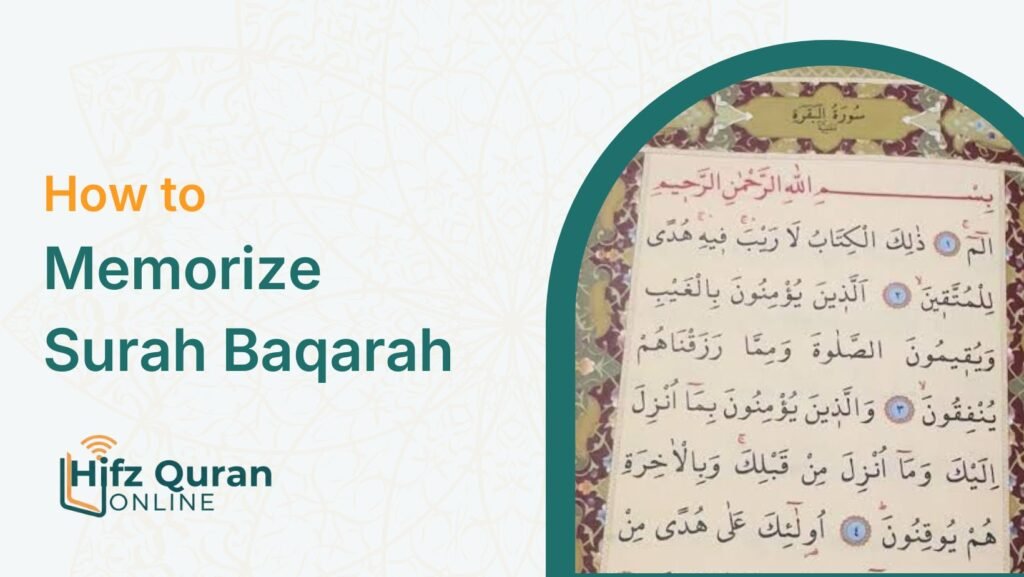
Learning how to memorize Surah Baqarah can feel intimidating because it is the longest Surah in the Quran, containing 286 verses. The solution is not to treat all 286 verses as one memorization project, but to turn them into small daily assignments supported by systematic revision.
Surah Al-Baqarah is especially suited to structured Hifz because its passages contain recognizable themes, stories, rulings, and repeated patterns. Understanding where you are in the Surah gives your memory another anchor besides sound alone.
The most effective approach combines small portions, listening, accurate repetition, verse linking, active recall, and permanent revision. If you want to memorize it quickly, increase the daily workload only after proving that you can retain the previous portions.
What You’ll Learn
- How to memorize Surah Al-Baqarah step by step
- How to divide the Surah into manageable sections
- How to build a daily memorization and revision routine
- How to memorize Surah Baqarah fast without sacrificing retention
- How an intensive one-month plan would need to work
How to Memorize Surah Baqarah Step by Step
Memorizing Surah Al-Baqarah is the process of learning its 286 verses in small connected portions while continuously revising earlier passages.
Do not measure progress only by how many new verses you can recite today. For a Surah this long, the better measure is how much you can still recite accurately after several days or weeks.
1. Divide Surah Al-Baqarah Into Smaller Sections
Never sit down thinking, “I need to memorize 286 verses.” Decide only what today’s portion will be.
A practical thematic overview is:
| Verses | Major themes |
| 1–141 | Faith, guidance, Adam, Bani Israel, Ibrahim |
| 142–253 | Qiblah, Muslim identity, worship, laws, prophetic accounts |
| 254–286 | Ayat Al-Kursi, financial and family rulings, the debt verse, closing verses |
Within these larger sections, divide your actual Hifz into much smaller daily portions.
For example, a learner may work on only a few verses at a time. Long verses should be divided by phrases rather than treated as single memorization units.
This becomes especially important with Ayah 282, the longest verse in the Quran. Memorize it phrase by phrase, then connect those phrases until you can recite the complete verse.
2. Use the Same Mushaf Throughout Your Hifz to Strengthen Visual Memory
Choose one Mushaf and keep using it.
Your memory gradually becomes familiar with where verses begin, end, and appear on the page. Constantly switching layouts removes this useful visual reference.
Keep the Mushaf open in front of you during your initial repetitions and pay attention to both the words and their position.
3. Listen Before You Memorize to Build Correct Recitation Patterns
Listen to your target passage from a skilled Qari before attempting to memorize it yourself.
Using the same reciter consistently makes pronunciation, rhythm, pauses, and verse endings more predictable. Listening-first Quran study is particularly useful because repeated exposure trains the ear before independent recitation.
Listen actively rather than leaving the audio running unnoticed. Follow the words in your Mushaf and pay attention to pronunciation, Madd, stops, and transitions.
4. Memorize One Verse or Phrase at a Time to Prevent Overload
Take the first verse and read it repeatedly while looking at the Mushaf.
Then close or cover the text and recite it without looking.
If you hesitate or make a mistake, look again, correct the exact problem, and repeat it. Do not repeatedly practice an incorrect version hoping that accuracy will eventually appear.
For long verses, use the same process with one meaningful phrase at a time.
5. Connect Every New Verse to the Previous Verse
Knowing individual verses does not automatically mean you can recite the Surah continuously.
Suppose you have memorized verses A, B, and C. Your practice should gradually become:
A → B
Then:
B → C
Finally:
A → B → C
This transition practice is particularly important in Al-Baqarah because a memorizer may know both verses perfectly yet repeatedly hesitate at the point where one moves into the next.
6. Test Yourself Without Looking to Strengthen Active Recall
Active recall is reciting the passage from memory without relying on the Mushaf or audio for prompts.
After completing your new portion, close the Mushaf and recite everything from beginning to end.
Mark every hesitation, substituted word, forgotten ending, and incorrect transition. Then reopen the Mushaf and work specifically on those weaknesses rather than restarting the entire passage after every mistake.
This creates a useful mistake map. If the same transition fails repeatedly, it deserves more repetition than the verses you already know confidently.
7. Use Different Quran Memorization Methods for Different Parts of the Surah
A Surah may contain different themes, stories, repeated phrases, and similar verses, so one memorization method may not work equally well for every section. Choose the technique that best matches the passage you are learning:
- Memory Training Method:
Memory Training Method is Divide the Surah into thematic sections and create mental anchors for each one. This is especially helpful when the Surah moves from one topic or story to another.
- Repetitive Memorization Method:
Repetitive Memorization Method is Repeat each verse or small passage several times until you can recite it confidently without looking. Use this for difficult wording or verses that do not stick easily.
- Visual Quran Memorization Technique:
Visual Quran Memorization Technique is Use the same Mushaf and pay attention to where each verse appears on the page. Over time, the position of verses can become an additional recall cue.
- Written Quran Memorization Techniques:
Written Quran Memorization Techniques is Write difficult verses or phrases from memory, then compare what you wrote with the Mushaf. This helps expose missing words, sequencing mistakes, and passages that need more review.
You do not need to choose only one method. Combine techniques according to the difficulty and structure of each section to make memorization more accurate and manageable.
8. Recite Memorized Verses in Salah
Use your memorized portions regularly in Salah.
New verses can be practiced in Sunnah or Nafl prayers, while older passages can be rotated through different prayers for continuing revision.
This gives you another form of active recall and prevents your Hifz from becoming something you can reproduce only during a dedicated study session.
Read also: How To Re-Memorise Quran When You’ve Forgotten It
Build a Daily Surah Al-Baqarah Memorization Routine
A good routine separates new memorization from revision. As your memorized portion becomes larger, revision should occupy an increasingly important part of the schedule.
A simple routine can look like this:
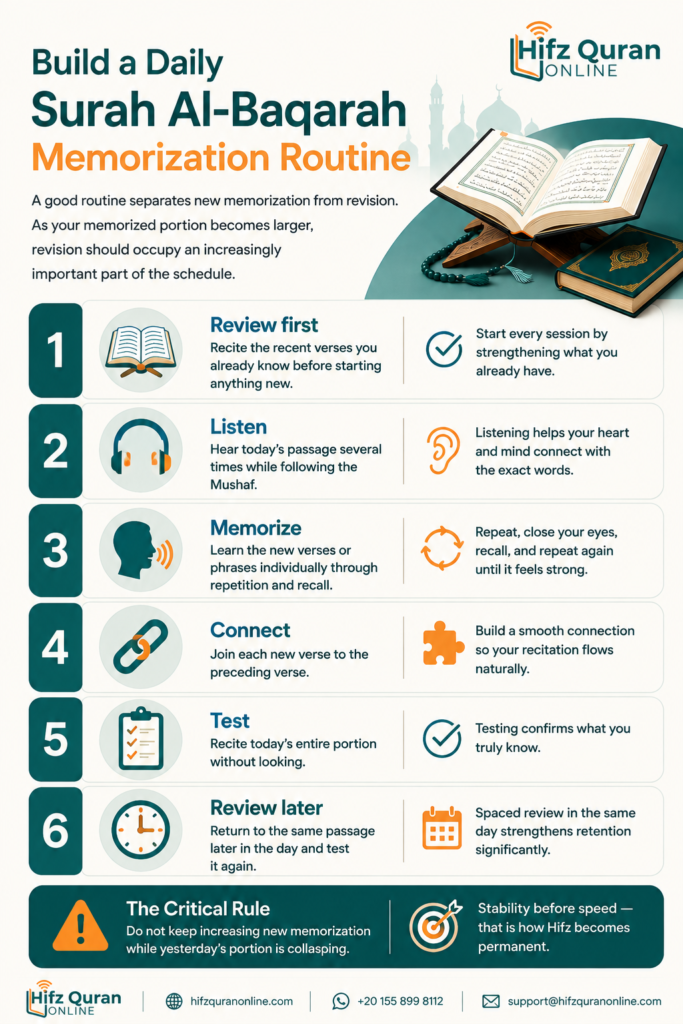
- Review first: Recite the recent verses you already know before starting anything new.
- Listen: Hear today’s passage several times while following the Mushaf.
- Memorize: Learn the new verses or phrases individually through repetition and recall.
- Connect: Join each new verse to the preceding verse.
- Test: Recite today’s entire portion without looking.
- Review later: Return to the same passage later in the day and test it again.
The critical rule is simple: do not keep increasing new memorization while yesterday’s portion is collapsing.
If retention weakens, temporarily reduce the new portion instead of sacrificing revision.
A qualified teacher can also hear errors you may repeatedly overlook yourself. Hifz Quran Online Academy can provide structured teacher-guided memorization and revision rather than leaving you to determine your pace and corrections alone.
How to Memorize Surah Baqarah Fast Without Forgetting It?
If you are searching for how to memorize Surah Baqarah fast, remember that faster Hifz should mean improving the efficiency of your system—not simply forcing more verses into each session.
The fastest useful pace is the fastest pace at which yesterday’s memorization remains stable.
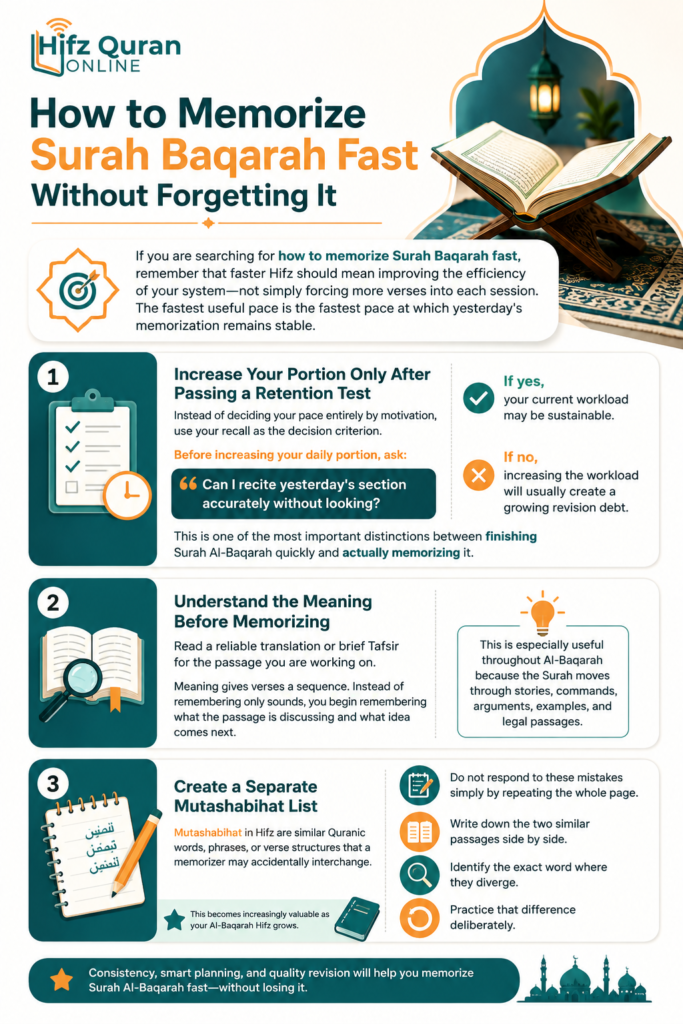
Increase Your Portion Only After Passing a Retention Test
Instead of deciding your pace entirely by motivation, use your recall as the decision criterion.
Before increasing your daily portion, ask:
Can I recite yesterday’s section accurately without looking?
If yes, your current workload may be sustainable.
If no, increasing the workload will usually create a growing revision debt.
This is one of the most important distinctions between finishing Surah Al-Baqarah quickly and actually memorizing it.
Understand the Meaning Before Memorizing
Read a reliable translation or brief Tafsir for the passage you are working on.
Meaning gives verses a sequence. Instead of remembering only sounds, you begin remembering what the passage is discussing and what idea comes next.
This is especially useful throughout Al-Baqarah because the Surah moves through stories, commands, arguments, examples, and legal passages.
Create a Separate Mutashabihat List
Mutashabihat in Hifz are similar Quranic words, phrases, or verse structures that a memorizer may accidentally interchange.
Do not respond to these mistakes simply by repeating the whole page.
Write down the two similar passages side by side. Identify the exact word where they diverge, then practice that difference deliberately.
This becomes increasingly valuable as your Al-Baqarah Hifz grows.
Read also: 10 Tips to Memorize Long Surahs Fast and Retain Them for Life
Step Inside Our Virtual Classrooms
Don’t just take our word for it—see how our interactive sessions work! Watch the short clips below to experience our engaging teaching methods, live teacher-student interactions, and the supportive learning environment we bring to every student.
Memorize the Quran at Your Own Pace
Join our expert tutors and begin your Hifz journey with a personalized plan.
Start Your Free TrialGive Difficult Verses Extra Repetitions
Not every verse deserves equal practice.
If one verse repeatedly causes problems, isolate it and repeat it 15–20 times, especially the troublesome phrase or transition.
Easy verses can then receive less attention while your study time goes toward actual weaknesses.
If you want to memorize Surah Al-Baqarah efficiently without allowing weak portions to accumulate, Hifz Quran Online Academy’s Online Quran Memorization Courses for Adults can give you the structure you need. Learn with an experienced Quran teacher who can set a suitable daily portion, correct your recitation, identify weak verses, and build revision into your Hifz plan so that new memorization does not come at the expense of retention.

How to Memorize Surah Baqarah in One Month?
Memorizing Surah Baqarah in one month requires an intensive Hifz schedule because 286 verses must be learned while previous portions are simultaneously revised.
Dividing 286 verses across 30 days gives an average of roughly 9–10 verses per day, although verse length varies dramatically. For that reason, pages or lines can sometimes be more useful planning units than verse counts.
It is better suited to learners with strong Quran reading foundations and ample daily study time.
Use Multiple Sessions Instead of One Marathon Session
| Time | Focus | What to Do |
| Morning | New Memorization — Part 1 | Memorize the first 4–5 verses of the daily target. Listen first, repeat each verse, then recite it from memory. |
| Afternoon / Later in the Day | New Memorization — Part 2 | Memorize the remaining 4–5 verses, then connect them with the morning portion. |
| Evening | Daily Consolidation | Recite all 9–10 verses memorized that day without looking, correct mistakes, and repeat difficult transitions. |
| Before Sleep | Light Revision | Listen to or recite the day’s complete portion once more and briefly review verses memorized on previous days. |
Protect Revision During the One-Month Challenge
The biggest danger is reaching Day 20 while remembering the latest verses but losing the passages memorized during Days 1–10.
New memorization therefore cannot replace revision.
Start each study day by testing older material. If your accumulated Hifz becomes too weak, pause or reduce new memorization until it stabilizes.
A slower completion with strong recall is more valuable than reaching verse 286 with the first half of the Surah already unstable.
Use Weekly and Monthly Consolidation to Protect Your Hifz
Consolidation is focused revision that strengthens previously memorized material without adding new verses.
For a Surah as long as Al-Baqarah, consolidation days are not interruptions to progress. They are part of progress.
Keep One Weekly Review Day
Set aside one day each week for revision without adding new material.
Use it to:
- Recite everything memorized that week.
- Test transitions between passages.
- Identify recurring mistakes.
- Compare difficult Mutashabihat.
- Revisit weaker older sections.
If your weekly review exposes major weaknesses, repair them before accelerating again.
Perform a Monthly Consolidation
At the end of each month:
- Recite all the verses you have memorized.
- Correct mistakes using the Mushaf.
- Mark recurring errors.
- Repeat difficult verses 15–20 times.
- Give weak sections additional revision before starting the next block.
This slower consolidation work is what turns short-term recall into dependable Hifz.
Read also: Which Surah to Memorize First? A Practical Beginner’s Order
Common Mistakes When Memorizing Surah Al-Baqarah
Surah Al-Baqarah exposes weaknesses in a memorization system that may remain hidden when learning short Surahs. Avoiding these mistakes early can save weeks of corrective work later.
Memorizing Too Much New Material
A large daily target feels productive until accumulated revision becomes impossible.
Choose the amount you can retain, not merely the amount you can memorize once.
Learning With Tajweed Errors
Repeatedly reciting a pronunciation mistake reinforces it.
Listen carefully before memorizing and have your recitation checked whenever possible. A teacher is especially valuable because independent learners may not recognize their own recurring articulation or Tajweed mistakes.
Always Restarting From the Beginning
If you make a mistake near the end of a page, repeatedly returning to its first verse can make the beginning exceptionally strong while leaving later transitions weak.
Isolate the problem and drill it directly.
Neglecting Old Pages
One of the biggest mistakes is assuming a memorized page is “finished.”
Every page added to your Hifz creates a permanent revision responsibility. Your revision system therefore needs to grow as your memorization grows.
See Our Classes in Action
Curious about what a 1-on-1 Hifz session looks like? Take a look at these real-time snippets from our daily classes to see our student-centered approach, Tajweed correction techniques, and online whiteboard tools in action.
Start Memorizing Surah Al-Baqarah With a Structured Hifz Plan
You do not need to manage 286 verses, difficult transitions, Tajweed correction, new memorization, and long-term revision alone.
Hifz Quran Online Academy provides structured Quran memorization support with teacher-guided correction and a Hifz plan that can be adjusted to your current ability and available study time. Instead of simply chasing a completion date, you can work toward accurate, stable memorization that remains with you.
Our Quran Courses
- Quran Memorization Course
- Quran Memorization and Hifz Course for Kids
- Online Quran Memorization Courses for Adults
- Quran Hifz Course for Ladies
- Quran Memorization Course for Men
- Saudi-Based Quran Memorization Courses
- Hifz Teachers
Memorize the Quran at Your Own Pace
Join our expert tutors and begin your Hifz journey with a personalized plan.
Start Your Free Trial
Conclusion
Learning how to memorize Surah Baqarah becomes manageable when you stop seeing it as one enormous Surah and start seeing it as a sequence of small, connected Hifz assignments.
Memorize a realistic portion, listen before reciting, connect verses immediately, test yourself without the Mushaf, and protect old material through daily, weekly, and monthly revision.
Most importantly, judge your progress by retention and accuracy, not just the verse number you have reached.
FAQs About Memorizing Surah Al-Baqarah
How long does it take to memorize Surah Al-Baqarah?
There is no single timeline for everyone. Your reading fluency, Tajweed, available study time, daily portion, and revision strength determine how quickly you can memorize its 286 verses.
How can I memorize Surah Baqarah fast?
Memorize small daily portions, listen to one skilled Qari, repeat difficult passages, connect consecutive verses, and revise old material every day. Increase your daily target only when you can retain the current workload.
How can I memorize Surah Baqarah in one month?
To cover 286 verses in 30 days, the mathematical average is about 9–10 verses daily, but verse lengths vary significantly. Such an intensive plan requires multiple daily memorization and revision sessions and is better suited to learners with strong Quran reading and Tajweed foundations.
Should I understand Surah Al-Baqarah before memorizing it?
Understanding the main meaning of each passage is highly useful because it creates semantic cues for recall. Read a reliable translation or brief Tafsir alongside your Hifz without allowing study time to replace repetition and recitation.
How do I stop forgetting the beginning of Surah Al-Baqarah?
Keep earlier verses in a permanent revision rotation instead of reviewing only your newest pages. Use weekly consolidation sessions and periodically recite your complete memorized portion to identify sections that are weakening.
Do I need a teacher to memorize Surah Al-Baqarah?
You can practice independently, but a qualified Quran teacher is highly valuable for correcting Tajweed, identifying unnoticed mistakes, managing similar passages, and maintaining a sustainable balance between new memorization and revision.
Related Articles
Memorizing Quran






Leave a Reply