 Memorizing Quran

Most people who try to memorize the Quran hit the same wall: they can recite a page fluently one week and lose half of it the next. Written Quran memorization techniques exist to solve exactly this problem. Instead of relying on repetition through sound alone, you engage your hand, your eyes, and your memory together — a combination that has been used for centuries and is now backed by modern research on how the brain processes handwriting.
This article explains what written Quran memorization techniques are, how they work, the exact steps to apply them, and what the science says about why writing sticks better than typing or listening alone.
What Are Written Quran Memorization Techniques?
Written Quran memorization techniques are a memorization method that combines listening, reading, handwriting, and recitation to fix Quranic verses in long-term memory. Rather than repeating a verse silently or aloud until it sticks, the student physically writes it out, which adds a tactile and visual layer that supports recall.
This approach is not new. It reflects how the Quran itself was preserved during revelation — companions wrote down verses as they were revealed over 23 years, alongside memorizing them by heart. Writing and memorization have been paired since the earliest days of Islam, not introduced as a modern shortcut.
The method works because it forces active engagement rather than passive repetition. When you copy a verse by hand, you cannot skim it. You have to look at each word, reproduce its shape, and check it against the mushaf — a process that naturally slows you down enough to notice details that repetition alone would let you skip past.
Read also: Visual Quran Memorization Technique – A Step-by-Step Guide
How to Memorize the Quran by Writing Step-by-Step?
This section answers: what are the exact steps to memorize Quran verses using writing?
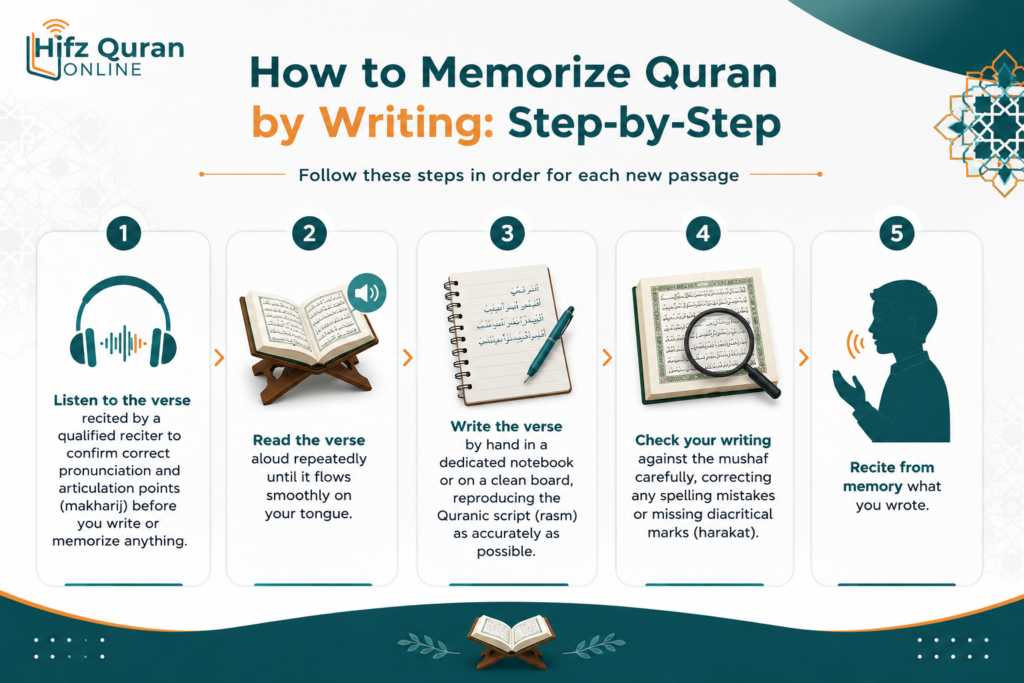
Follow these steps in order for each new passage:
- Listen to the verse recited by a qualified reciter to confirm correct pronunciation and articulation points (makharij) before you write or memorize anything.
- Read the verse aloud repeatedly until it flows smoothly on your tongue.
- Write the verse by hand in a dedicated notebook or on a clean board, reproducing the Quranic script (rasm) as accurately as possible.
- Check your writing against the mushaf carefully, correcting any spelling mistakes or missing diacritical marks (harakat).
- Recite from memory what you wrote, then confirm against your notebook or the mushaf directly.
Learners following the classical daily-line method take this one step further: they write and memorize a single line each day, then add each new line to a cumulative review the next day. In a 15-line mushaf (609 pages), there are roughly 8,901 lines total — which averages to about 1.1 lines a day across 23 years, mirroring the pace of revelation itself.
A common mistake at this stage is trying to memorize a fragment that cuts off mid-meaning because it falls awkwardly at the end of a line. When this happens, read and write the complete verse first, even if you only commit the single line to memory that day. Memorizing broken meaning is harder to retain and easier to confuse with similar verses later.
Step Inside Our Virtual Classrooms
Don’t just take our word for it—see how our interactive sessions work! Watch the short clips below to experience our engaging teaching methods, live teacher-student interactions, and the supportive learning environment we bring to every student.
Memorize the Quran at Your Own Pace
Join our expert tutors and begin your Hifz journey with a personalized plan.
Start Your Free TrialRead also: The Best Way to Memorize the Quran for Non-Arabic Speakers?
The Mauritanian Luh Method A Distinct Approach to Written Memorization
This section answers: how does the traditional MauritanianHifz Method use writing differently from a standard notebook approach?
In the Mauritanian method, students write Quranic verses on a wooden tablet called a luh, using a handmade reed pen. This is not a notebook you fill and set aside — it is a tool you write on, recite from, and often wash clean before the next lesson.
Mauritanian scholars are known for exceptional Quran retention, with many children completing memorization by age 6 or 7. Their method combines constant oral repetition — hearing the Quran while walking, sitting, and going about daily tasks — with this structured writing practice on the luh.
A Quran teacher at one of the largest mosques in the Netherlands, who still uses this tablet-and-reed-pen method with his students, estimates that roughly half of the memorization work happens simply through the act of writing the verse on the board before any formal recitation drilling begins.
Similar board-writing traditions are documented in Egypt, Syria, Sudan, Senegal, Mali, Somalia, and across much of North Africa. These methods typically involve far more repetition than the daily-line notebook approach — students in some regions repeat a single page by writing and reciting it several hundred times before moving on.
At Hifz Quran Online Academy, teachers trained in both classical and structured modern methods can guide you through whichever writing-based approach fits your pace, whether that’s the daily-line system or a more intensive board-repetition style adapted for online learning.

Read also: Visual Quran Memorization Technique – A Step-by-Step Guide
What Does Handwriting Do to the Brain During Memorization?
This section answers: what does brain research show about why writing improves memory retention?
Handwriting activates brain regions tied to focus, learning, and memory retrieval more broadly than typing does. When you write a word by hand, your brain does not just copy it — it processes the shape, meaning, and sequence of the letters, which makes the information easier to retrieve later.
A study of children in Indiana (James & Engelhardt, 2012) found that writing letters by hand activated more brain regions — including visual processing centers central to letter recognition — than tracing or typing the same letters. Based on this and related findings, occupational therapists Stevenson and Just (2014) concluded it is better to delay keyboard instruction until children are 10 to 12 years old, after handwriting skills are fully developed.
A more recent study of Japanese university students and recent graduates found that writing on physical paper produced more brain activity when recalling information an hour later, compared to typing. Researchers attribute this to the unique, complex, spatial, and tactile information involved in handwriting on paper — details a keyboard simply does not generate.
Handwriting also connects muscle movement to cognitive processing, activating broad neural networks tied to learning and memory consolidation. This is the mechanism behind why writing improves retention compared to purely digital or purely auditory memorization: your brain has to slow down and reconstruct the word rather than select it from a screen.
Contrary to the assumption that digital tools are always faster, one study found that volunteers using paper completed a note-taking task 25% faster than those using tablets or smartphones — suggesting paper is not just more retentive, but often more efficient too.
If you’re working through memorization with a structured teacher rather than alone, a personalized study plan can help you decide how many lines to write and review each day based on your pace. That kind of guidance is one of the things a dedicated Quran teacher provides that a self-taught schedule usually can’t.
Memorize the Quran at Your Own Pace
Join our expert tutors and begin your Hifz journey with a personalized plan.
Start Your Free TrialPractical Tips for Writing-Based Quran Memorization
This section answers: what practical habits protect the process and the pages themselves?
Keep these habits in mind as you build a writing practice:

- Maintain physical and ritual cleanliness of the paper or notebook you use to write Quranic verses.
- Never discard written pages carelessly. Store them respectfully or dispose of them through proper Islamic methods once you no longer need them.
- Dedicate one notebook or board solely to this purpose rather than mixing it with other notes — many students now use printed Quran-tracing notebooks made specifically for this method.
- Write each passage once with full focus, rather than scribbling it repeatedly without attention. If you make a mistake, rewrite the line correctly rather than leaving the error in place.
A structured hifz program with a qualified teacher makes this process far more consistent, since a teacher can catch small tajweed and script errors in your writing before they become memorized mistakes.
How to Get the Most Out of the Written Quran Memorization Method?
The written Quran memorization method becomes far more effective when it is paired with consistent habits that strengthen understanding, recall, and daily revision. Writing the verses is only one part of the process. Combining it with the right routine helps transfer what you memorize from short-term memory to long-term retention.
Set a Fixed Time for Writing and Memorization
Choose a specific time every day for your memorization session and stick to it as much as possible. Many students find that the time after Fajr is ideal because the mind is fresh, distractions are minimal, and concentration is naturally higher. Begin your session by writing the verses, then recite them several times before testing yourself without looking. Following the same schedule each day builds a lasting habit and makes memorization easier over time.
Learn the Meaning of the Verses Through a Simple Tafsir
Understanding what you are memorizing creates a stronger mental connection with each verse. Before writing the passage, read a brief and reliable tafsir that explains the main meanings and context. Knowing the message behind the words helps you remember the sequence of verses more naturally and allows you to reflect on the Quran while memorizing it, rather than repeating sounds without comprehension.
Recite What You Have Memorized During Your Salah
One of the best ways to reinforce new memorization is to use it in your daily prayers. Reciting recently memorized verses during Salah gives you repeated practice in a focused setting, helping you identify any weak points that need additional review. This regular application strengthens confidence, improves fluency, and helps make the verses a permanent part of your memory.
Use Writing Apps to Practice Quran Memorization
Several digital apps now allow learners to practice writing Arabic letters and Quranic words on a tablet or smartphone. These tools provide unlimited writing practice without wasting paper and help improve letter formation, spelling, and recall. They can also be a convenient way to review your memorization while traveling or whenever you have a few spare minutes during the day.
Use Reusable Quran Writing Mushafs
Special Quran writing Mushafs are now available with pages designed for repeated practice. They allow you to write the verses with a special pen, erase them, and write them again as many times as needed. This makes them an excellent option for students who want the benefits of handwritten memorization without constantly printing worksheets or filling multiple notebooks. Rewriting the same verses several times reinforces visual memory and helps fix the words more firmly in your mind.
See Our Classes in Action
Curious about what a 1-on-1 Hifz session looks like? Take a look at these real-time snippets from our daily classes to see our student-centered approach, Tajweed correction techniques, and online whiteboard tools in action.
Memorize the Quran at Your Own Pace
Join our expert tutors and begin your Hifz journey with a personalized plan.
Start Your Free TrialStart Your Hifz Journey With a Structured Writing-Based Method
You don’t have to figure out the daily-line pace, the luh method, or the review schedule on your own. Hifz Quran Online Academy pairs you with qualified teachers who build a personalized memorization plan around proven techniques like these — combining writing, listening, and recitation in the order that works for your schedule.
Book your first session today and start building a memorization habit that actually holds up over time.
Choose the program that fits your needs:
- Quran Memorization Course (comprehensive Hifz for all ages)
- Quran Memorization and Hifz for Kids
- Online Quran Memorization Courses for Adults
- Quran Hifz for Ladies.
[Enroll in Your Free Trial Lesson Today]

Memorize the Quran at Your Own Pace
Join our expert tutors and begin your Hifz journey with a personalized plan.
Start Your Free TrialConclusion
Written Quran memorization techniques work because they force multiple senses to engage with the same verse at once: hearing it recited, reading it aloud, writing it by hand, and checking it against the mushaf. This is not a modern shortcut — it echoes how the Quran was preserved during 23 years of revelation, and it remains the backbone of methods like the Mauritanian luh tradition that produce exceptionally strong memorizers.
The research on handwriting supports what these traditions already knew: writing by hand engages the brain more deeply than typing or passive listening, which is why it reduces forgetting and strengthens long-term retention.
Whether you follow a daily-line system, a board-based method, or a notebook approach, the core principle stays the same — active, careful writing beats passive repetition every time.
If you want this process guided rather than self-taught, a structured program built around written Quran memorization techniques can help you keep pace and catch mistakes early.
Frequently Asked Questions
What are written Quran memorization techniques?
Written Quran memorization techniques are methods that combine handwriting with listening, reading, and recitation to memorize Quranic verses. The physical act of writing engages visual and motor memory alongside auditory memory, which reduces forgetting compared to memorization by sound alone.
Is it permissible to write the Quran to help memorize it?
Yes, writing the Quran for memorization is permissible and has scholarly support, provided the pages are treated with appropriate respect and cleanliness. Many classical memorization traditions, including the Mauritanian luh method, are built entirely around this practice.
How many lines should I write per day using the daily-line method?
The classical daily-line method suggests writing and memorizing about one line per day, based on the Quran’s 23-year revelation period across roughly 8,901 lines in a 15-line mushaf. This pace is slow by design, since it prioritizes long-term retention over speed.
Does writing by hand really improve memory more than typing?
Yes, multiple studies show handwriting activates more brain regions involved in learning and recall than typing does. Research also shows people recall handwritten information more strongly after time has passed, likely due to the spatial and tactile detail involved in forming each letter.
What should I do with pages once I’ve finished memorizing from them?
Written Quranic pages should never be discarded carelessly. Store them in a respectful place or dispose of them through proper Islamic methods, since the verses themselves retain their sanctity regardless of the paper they’re written on.
Can I use a tablet or app instead of writing by hand?
Digital tools can support listening and review, but they do not replace the cognitive benefits of handwriting shown in memory research. For the writing component specifically, physical paper or a board produces stronger recall than typing on a screen or tablet.
Related Articles
Memorizing Quran







Leave a Reply