 Memorizing Quran
Long surahs like Al-Baqarah, Al-Kahf, or Ya-Sin intimidate even dedicated students of the Quran. The verses run for pages, the themes shift mid-passage, and one missed line can unravel weeks of work. If you want to know how to memorize long surahs without losing months to frustration, the answer isn’t more hours — it’s a repeatable system.
This guide breaks down 10 practical tips used in structured Hifz programs, covering preparation, active memorization, and the review habits that make new verses stick. Each tip is a piece of a single method: small blocks, controlled repetition, and consistent review.
What You’ll Learn in This Article
- How to prepare a long surah before you start active memorization
- A counted repetition method for locking in each verse block
- How to bridge new sections onto what you’ve already memorized
- The two daily review windows that prevent forgetting
- Common mistakes that slow down long-surah memorization
1- Prepare Your Intention and Clear Your Mind Before You Start Memorizing
What should a student do before opening the Mushaf to memorize?
Begin by renewing your intention (niyyah) and reminding yourself that memorizing the Quran is an act of worship done sincerely for Allah. Then clear your mind of distractions, put aside unrelated worries and tasks, and choose a quiet place where you can give the verses your full attention.
Starting with a calm mind and sincere intention helps you approach each memorization session with greater focus, patience, and consistency.
2- Pre-read the Section the Night Before
Read the target verses the night before your memorization session, without trying to memorize anything yet. This first pass familiarizes your eyes with the sentence structure and unfamiliar words, so the next day’s session starts with recognition instead of decoding.
3- Stick to One Mushaf to Build Stronger Visual Memory
Use a single physical or digital mushaf for the whole surah. Your visual memory maps where each verse sits on the page — top-left, middle of a line, start of a new page — and switching between different print editions or apps breaks that spatial anchor. This is one of the most overlooked techniques in long-surah memorization, since students often blame their memory when the real issue is an inconsistent page layout.
4- Listen to One Reciter to Reinforce Rhythm and Accurate Recall
Play an audio recitation of the passage several times before you say a single word aloud. This locks in correct tajweed and rhythm first, so you’re not reciting incorrect pronunciation into your memory and having to unlearn it later.
Keep this one reciter consistent for the entire surah — switching voices mid-memorization changes the pacing and pause points you’ve been training your ear to expect.
5- Read a Brief Tafsir First to Understand the Meaning and Strengthen Recall
Read a short translation or tafsir of the section before memorizing it. Long surahs often shift between narrative, legal rulings, and warnings within the same page; understanding these shifts gives your memory a logical map to follow instead of forcing you to memorize disconnected sentences.
Learn Quran online with certified tutors who structure this preparation step into every Hifz session — [Book Your Free Trial Class].
6- Chunk the Surah Into Small Verse Blocks
how should a long surah be divided for memorization?
Chunking means dividing a long surah into small, manageable verse blocks instead of trying to absorb a full page at once. For most surahs, this means two to five verses per block; for exceptionally long individual verses (common in Al-Baqarah), split the verse itself into two halves.
The rule for moving forward is simple: don’t advance to the next block until you can recite the current one fluently, without hesitation, and without looking at the page.
Rushing this step is the single most common reason students re-memorize the same section multiple times — a shaky block collapses under the weight of new material stacked on top of it.
7- Apply Counted Repetition Instead of Random Reading
how many times should you repeat a verse to memorize it?
Counted repetition removes the guesswork of “how much is enough.” A defined count gives your memory a clear target and prevents both under-practicing and wasted over-repetition.
The structure:
- Read the chunk 10 to 15 times while looking directly at the mushaf.
- Recite the same chunk 8 to 10 times completely from memory, without looking.
- If you make an error during the memory recitation, return to the mushaf and repeat the reading step before trying again.
This counted approach is what separates fast, reliable memorization from open-ended repetition that never quite locks the verse down. Students following a fixed count typically reach fluency in a block within one sitting rather than dragging the same lines across several days.
8- Bridge New Blocks to What You Already Know to Strengthen Sequence and Recall
how do you connect newly memorized sections without losing the earlier ones?
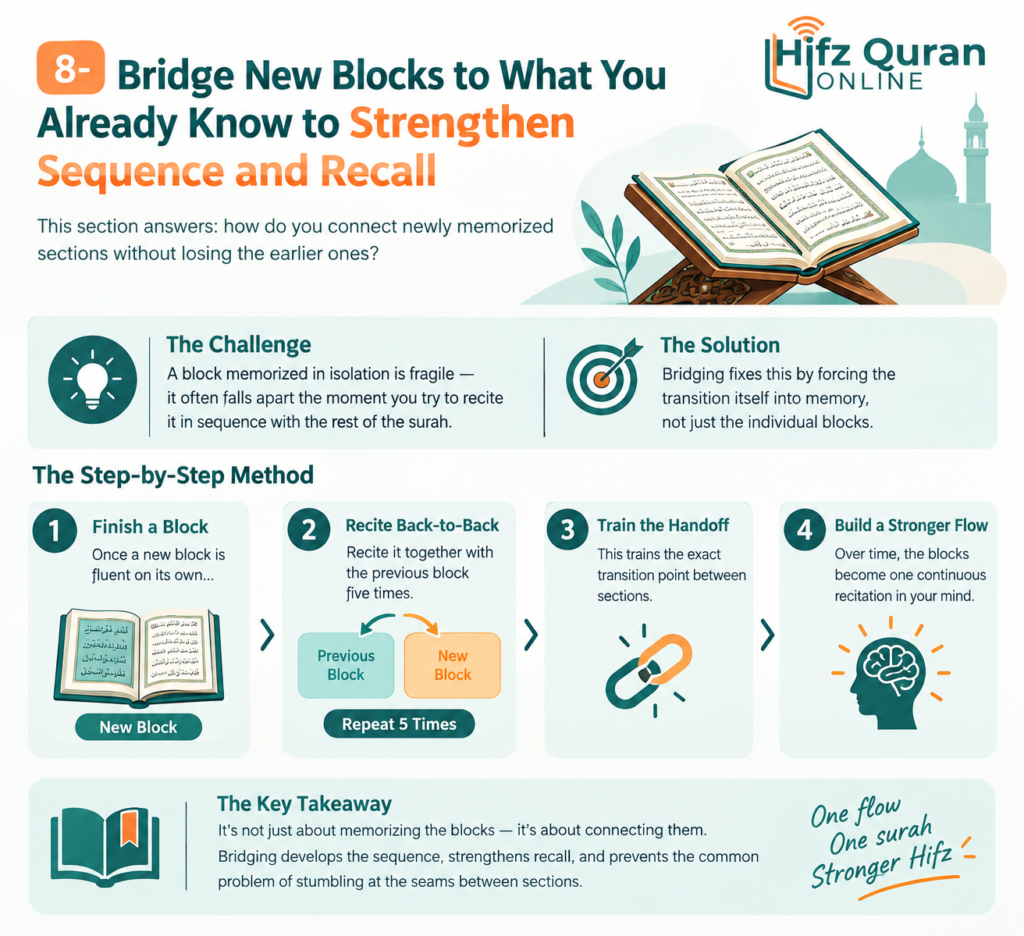
A block memorized in isolation is fragile — it often falls apart the moment you try to recite it in sequence with the rest of the surah. Bridging fixes this by forcing the transition itself into memory, not just the individual blocks.
Once a new block is fluent on its own, recite it back-to-back with the previous block five times. This trains the exact handoff point between sections, which is usually where students stumble during a full recitation — not in the middle of a block, but at the seam between two blocks memorized on different days.
Read also: How to Memorize Surah Baqarah – A Practical Step-by-Step Hifz Plan
9- Use Active Recall in Prayer to Strengthen Long-Term Retention
why does reciting new verses in salah help memorization?
Reciting newly memorized verses during your daily prayers forces active recall under mild pressure, with no mushaf in hand. This is a harder test than reviewing at your desk, and it’s exactly why it works faster than passive review — active recall consistently outperforms passive rereading for long-term retention across memory research in general, not just Quran memorization.
Start using a new block in salah as soon as you can recite it cleanly from memory. Mistakes surface immediately in this setting, and correcting them here — while the material is still fresh — is far easier than discovering the gap weeks later during a full-surah test.
Step Inside Our Virtual Classrooms
Don’t just take our word for it—see how our interactive sessions work! Watch the short clips below to experience our engaging teaching methods, live teacher-student interactions, and the supportive learning environment we bring to every student.
Memorize the Quran at Your Own Pace
Join our expert tutors and begin your Hifz journey with a personalized plan.
Start Your Free Trial10- Review Twice a Day to Keep Your Memorization Strong and Consistent
when during the day should you review memorized verses?
Two windows carry the most weight for retention: right after Fajr and right before sleep. Morning review tests what survived the night, catching weak spots while your mind is clear. Night review primes the material for memory consolidation, which research on sleep and memory associates with the hours immediately following study.
Never skip the review portion of a session to fit in more new material. Every session should open with review of older sections before a single new line gets added — a session that only pushes forward and never looks back is how previously solid surahs quietly erode over a few months.
If maintaining a consistent balance between new memorization and revision is difficult, Hifz Quran Online Academy’s Quran Memorization Course provides a structured Hifz plan with guided memorization, regular revision, and teacher feedback to help you retain what you learn while continuing to progress.
[Join the Quran Memorization Course]

Read also: Which Surah to Memorize First? A Practical Beginner’s Order
Common Mistakes That Slow Down Long-Surah Memorization
Long-surah memorization often becomes difficult not because students cannot memorize new verses, but because certain habits gradually weaken retention and make it harder to connect one section to the next. Recognizing these mistakes early can help you maintain steady progress and build stronger long-term recall.
Moving to New Verses Before the Current Section Is Fluent
One of the biggest mistakes is rushing the block-fluency check. Reading a section several times successfully does not mean it has been memorized. Before moving forward, you should be able to recite the current block from memory without repeatedly looking at the Mushaf or relying on prompts.
Switching Reciters During the Same Surah
Changing reciters midway through a long surah can disrupt the rhythm, pronunciation patterns, and pause points your memory has started associating with the verses. Using the same reciter throughout the memorization process creates a more consistent auditory pattern and can make transitions between verses easier to remember.
Treating Daily Review as Optional
New memorization should never completely replace revision. When students continually add new verses without reviewing previous sections, older portions gradually become weaker. A daily routine should therefore include both new memorization and structured review, especially when working through a long surah.
Memorizing Without Understanding the Meaning
Memorizing only the sounds of the verses can make it harder to remember their correct sequence. Understanding the general meaning, themes, and transitions between passages provides additional memory cues. Before memorizing a new block, briefly read its meaning and identify how it connects with the verses before and after it.
Adding New Material When Yesterday’s Block Is Still Weak
Use a simple decision rule at the beginning of each session: if you cannot recite yesterday’s new block confidently from memory, do not add new verses that day.
Instead, dedicate the session to strengthening and reviewing what you have already memorized. Continuing to add verses onto an unstable section can create a cycle in which you repeatedly forget the same parts of the surah. A smaller amount of secure memorization is more valuable than moving quickly through a surah that you cannot reliably recall.
Start Memorizing With Guided Structure
Building a personal system from scratch works, but it takes trial and error most students don’t have time for. A tutor who checks your tajweed on the first reading, tracks your review schedule, and tests your recall regularly cuts that trial-and-error phase down significantly — and catches small pronunciation errors before they become memorized mistakes.
Hifz Quran Online Academy pairs each student with a certified tutor who builds a memorization plan around the surah you’re working on and the time you have available each day, whether that’s 15 minutes or a full hour.
See Our Classes in Action
Curious about what a 1-on-1 Hifz session looks like? Take a look at these real-time snippets from our daily classes to see our student-centered approach, Tajweed correction techniques, and online whiteboard tools in action.
Read also: How To Re-Memorise Quran When You’ve Forgotten It
Start Your Hifz Journey Today
Get a personalized memorization plan, one-on-one correction from a certified tutor, and a review schedule that actually fits your day — no guesswork, no wasted repetition.
Our Quran Courses
- Quran Memorization Course
- Quran Memorization and Hifz Course for Kids
- Online Quran Memorization Courses for Adults
- Quran Hifz Course for Ladies
- Quran Memorization Course for Men
- Saudi-Based Quran Memorization Courses
- Hifz Teachers
Memorize the Quran at Your Own Pace
Join our expert tutors and begin your Hifz journey with a personalized plan.
Start Your Free TrialConclusion
Memorizing long surahs comes down to a repeatable sequence: prepare with a single mushaf and one reciter, chunk the text into small verse blocks, use counted repetition to lock each block in, bridge new sections onto the old ones, and test everything through prayer and twice-daily review.
None of these steps require extra hours — they require doing the same small process consistently instead of relying on long, unstructured reading sessions.
Students who follow this order typically notice fewer relapses into forgotten sections, because the review habit is built into the plan rather than added as an afterthought. If you’re planning to memorize a long surah, start with the surah itself and the amount of time you can realistically commit each day — the method above scales to both.
FAQs
How long does it take to memorize a long surah like Al-Baqarah?
This depends on daily study time and consistency rather than a fixed number of days. Students memorizing 15-20 minutes daily with consistent review typically progress through a long surah over several months, while those with more daily time and a tutor’s structure move faster because errors get corrected immediately instead of compounding.
Is it better to memorize a whole page or small verse blocks?
Small verse blocks of two to five verses work better than whole pages for long surahs. Full-page memorization often produces shaky recall at the seams between verses, while block-by-block memorization with bridging builds a more stable full recitation.
Should I memorize the meaning of the verses too?
Understanding the meaning through a brief tafsir isn’t required, but it significantly helps recall in long surahs where the themes shift across the passage. Knowing why a section moves from a story to a ruling gives your memory a logical structure to hold onto, beyond the sound of the words alone.
What if I keep forgetting a surah I already memorized?
Forgetting a previously memorized surah almost always points to a gap in the review schedule rather than a memory problem. Reintroduce it into your daily prayers and dedicate a fixed weekly slot to reviewing it alongside new material, rather than treating it as finished and moving on.
Can I memorize a long surah without a teacher?
Self-study is possible using audio recitation and counted repetition, but a teacher catches tajweed errors on the first reading, before they become memorized habits that are far harder to correct later. For long surahs especially, this early correction saves significant time over the full memorization period.
Related Articles
Memorizing Quran







Leave a Reply