 Memorizing Quran
If you are wondering how to re-memorise Quran when you’ve forgotten it, start with one important truth: you probably have not lost everything. Some portions may be weak, some may return with a small reminder, and some may need to be rebuilt almost from the beginning.
Forgetting parts of your Hifz can feel painful, especially when you remember how confidently you once recited them. But forgetting does not mean your previous effort was wasted. It means your revision system needs to be rebuilt.
The best approach is not to rush through everything you once memorized. Instead, assess what remains, identify your weakest portions, rebuild them in manageable sections, and create a revision routine that protects them from fading again.
A structured Hifz program follows this same principle: memorization is paired with continuous revision, teacher feedback, and a pace that matches the student’s ability.
1- Start With an Honest Assessment
Before you begin re-memorizing, assess what you actually remember. An honest assessment is a simple test of your existing memorization without looking at the Mushaf.
Many students say, “I have forgotten the whole Quran,” when the reality is different. Some Surahs may still be strong, others may be partially remembered, and only certain passages may be completely blank.
Sit with your Mushaf and recite aloud, Surah by Surah or Juz by Juz. Do not look at the page before trying to remember.
Create three categories:
| Status | What It Means | What To Do |
| Strong | You can recite without meaningful hesitation | Maintain with regular revision |
| Partial | You remember the general flow but need prompts | Rebuild with focused review |
| Weak/Blank | You cannot continue without looking | Re-memorize systematically |
Be strict with yourself. If you need to look at the first word of an Ayah before remembering the rest, do not mark it as strong.
This assessment becomes your starting point. A good Hifz plan should be based on your current retention, not on how much you remember having memorized in the past. Structured Hifz programs similarly begin by evaluating the student’s current level before creating a personalized memorization and revision plan.
If you’re unsure how much of your old Hifz you still remember, Hifz Quran Online Academy can help you assess your current level and identify exactly where to restart. With guidance from a qualified Quran teacher, you can build a personalized revision plan and focus your time on the portions that need the most attention.
2- Prepare Your Mind and Heart Before Re-Memorising
Re-memorizing Quran requires more than repeating words. A healthy Hifz mindset is the decision to return without allowing guilt to stop you.
You may feel disappointed because you stopped revising, became busy, or allowed months to pass without opening the Mushaf. Do not let that feeling become another reason to stay away from the Quran.
Renew your intention and ask Allah for help. Your goal is not to prove that you never forgot. Your goal is to return to the Quran and build a stronger relationship with it.
Remember the Quranic encouragement:
وَلَقَدْ يَسَّرْنَا الْقُرْآنَ لِلذِّكْرِ فَهَلْ مِن مُّدَّكِرٍ
“And We have certainly made the Quran easy for remembrance, so is there any who will remember?”
Surah Al-Qamar 54:17
Approach your return with patience rather than punishment. A difficult first week does not mean you cannot recover your memorization.
Why Should You Avoid Trying To Recover Everything at Once?
Trying to revise dozens of Surahs immediately can create mental pressure and make the Quran feel like an impossible task.
Instead, choose a manageable starting point. Your first goal should be restoring consistency, not completing a huge amount of revision in a few days.
A student who returns to the Quran for a short, focused session every day is building something more valuable than a single long revision session followed by another long break.
3- Rebuild Forgotten Quran in Small Sections
Section-based re-memorization means breaking a forgotten passage into small connected portions instead of attacking an entire Surah at once.
Choose one Surah that you once knew reasonably well. If it is completely forgotten, divide it into short sections.
For each section:
- Read the passage carefully from the Mushaf.
- Listen to a reliable reciter.
- Read while listening.
- Recite along with the reciter.
- Close the Mushaf and recite from memory.
- Check your mistakes.
- Repeat the difficult part before moving forward.
Do not move to the next section simply because you have read the current one several times. Move forward when you can recall it with reasonable confidence.
This approach is especially useful when a Surah contains difficult transitions. A student may know each individual Ayah but struggle when moving from one passage to another.
When that happens, isolate the transition. Recite the final few Ayat of one section together with the beginning of the next until the connection becomes natural.
The goal is not merely to recognize the words. The goal is to make the sequence accessible without looking.
4- Use Listening to Help You Re-Memorise Forgotten Surahs
Listening is repeated exposure to Quranic recitation through the ear, and it can support active memorization when combined with personal recitation.
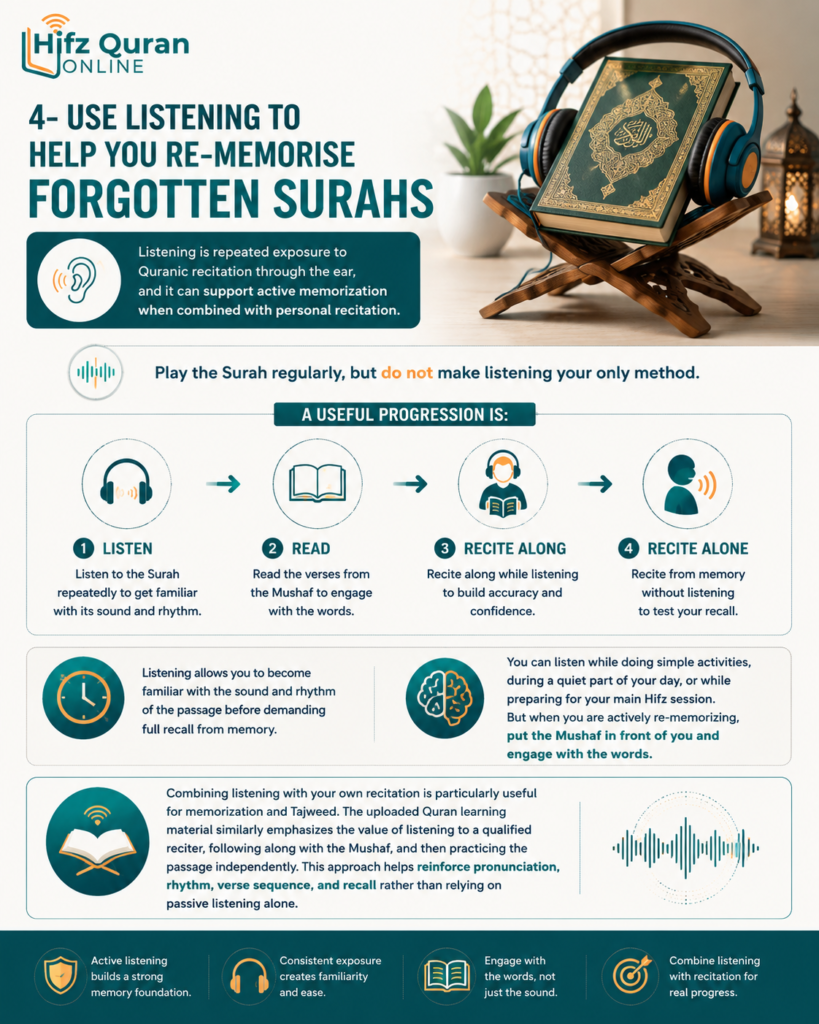
Play the Surah regularly, but do not make listening your only method.
A useful progression is:
Listen → Read → Recite Along → Recite Alone
Listening allows you to become familiar with the sound and rhythm of the passage before demanding full recall from memory.
You can listen while doing simple activities, during a quiet part of your day, or while preparing for your main Hifz session. But when you are actively re-memorizing, put the Mushaf in front of you and engage with the words.
Combining listening with your own recitation is particularly useful for memorization and Tajweed. The uploaded Quran learning material similarly recommends reading with listening
If you have forgotten a large portion of your previous Hifz, Hifz Quran Online Academy can help you rebuild from your current level with a personalized approach. Our Quran Memorization Course provides structured guidance from expert Hifz teachers, helping you strengthen forgotten portions, improve your retention, and return to consistent Quran memorization at a manageable pace.

Read also: How to Memorize Surah Al Kahf? – A Practical Step-by-Step Hifz Guide
5- Use Active Recall Instead of Just Reading
Active recall is the practice of trying to produce the Ayat from memory before checking the Mushaf.
This is one of the most important changes you can make when re-memorizing Quran.
Reading the same page ten times can make it feel familiar without proving that you can actually recite it independently.
Instead, close the Mushaf and test yourself.
For example:
- Recite the first Ayah without looking.
- Continue to the next Ayah.
- If you get stuck, try to recover it before checking.
- Look at the Mushaf only when necessary.
- Identify exactly where the mistake occurred.
- Repeat that weak point.
You can also ask someone to give you the beginning of an Ayah and see whether you can complete it.
This distinction between recognition and recall is important. Recognizing a verse when you see it is not the same as being able to retrieve it during Salah or when someone asks you to recite it.
Read also: Which Surah to Memorize First? A Practical Beginner’s Order
How Should You Use a Spaced Revision Schedule?
Spaced revision is a system of reviewing memorized material at repeated intervals rather than leaving it untouched for long periods.
After you successfully rebuild a passage, do not consider the job finished.
Newly recovered memorization is still vulnerable to forgetting. It needs more frequent revision at first, followed by continued maintenance.
A simple framework can look like this:
| Review Period | Main Goal |
| Same day | Strengthen the newly recovered section |
| Next day | Test recall without looking |
| Several days later | Check whether the passage still flows |
| Following weeks | Add it to your wider Muraja’ah rotation |
| Long term | Continue reviewing it with older Hifz |
The exact schedule should depend on how strong the passage is. A section that repeatedly disappears needs more attention than one that remains fluent.
The important principle is simple: do not wait until you forget a Surah again before reviewing it.
Structured Hifz systems use this same idea by combining new memorization with recent and older revision instead of treating revision as an optional activity.
6- How Should You Balance New Memorization With Old Hifz?
If you are re-memorizing forgotten Quran, your priority should temporarily shift toward recovery and retention, not constant new memorization.
A useful session can contain three parts:
1. Recovered Memorization
Work on the section you are currently rebuilding.
2. Recent Review
Test the passages you recovered during the last few days.
3. Older Review
Recite stronger Surahs that you do not want to lose again.
This creates a continuous cycle:
Recover → Strengthen → Maintain
One of the most common Hifz mistakes is focusing so heavily on new material that previously memorized portions receive too little attention. Structured Hifz programs address this by including revision alongside memorization in regular lessons.
How Can You Re-Memorise One Surah at a Time?
One-Surah recovery means completing the restoration of one manageable Surah before moving your main focus to another.
Do not randomly jump between ten forgotten Surahs.
Choose one.
Ideally, start with a Surah that:
- You memorized well in the past
- You enjoy reciting
- You use frequently in Salah
- Is short enough to make the goal realistic
- Has weaknesses you can clearly identify
You can divide the Surah into sections and work through them one at a time.
Once the full Surah becomes reasonably fluent, test yourself from beginning to end without looking.
Then move it into your regular revision rotation rather than abandoning it.
This gives you a visible sense of progress. Instead of thinking, “I have forgotten so much Quran,” you can say, “I have recovered this Surah, and now I am protecting it.”
Read also: Surah Yaseen Memorization – A Step-by-Step Plan to Learn Surah Yaseen Easily
7- Strengthen Your Re-Memorised Quran Through Salah
Using recovered Surahs in Salah turns memorization into regular retrieval practice.
If you have re-memorized a Surah but rarely recite it, the opportunity to strengthen it is limited.
Use appropriate portions in your voluntary prayers and, where suitable, in your daily Salah.
You can also choose one weaker Surah and make a conscious effort to recite it regularly instead of always choosing the Surahs you already find easy.
The key is not to turn Salah into a stressful memory test. If you become stuck, remain calm and continue appropriately, then review the weak passage later outside the prayer.
This makes your recovered Hifz part of your daily worship rather than something you only practice during a formal study session.
8- Track Your Weakest Ayat to Strengthen Your Hifz
A Hifz mistake tracker is a simple record of the Ayat, words, or transitions where you repeatedly make errors.
Do not simply write, “Surah X is weak.”
Be more specific.
For example:
- Surah: Al-Baqarah
- Ayat: 25–27
- Problem: I confuse the beginning of Ayah 26 with Ayah 27
- Action: Repeat the transition and test again tomorrow
This turns a vague problem into a practical task.
You may notice that your mistakes follow a pattern. Perhaps you regularly forget similar endings, confuse adjacent Ayat, or lose your place when two passages have similar wording.
Once you know the pattern, you can target it directly.
A tracker also gives you evidence of progress. A section that was marked “weak” three weeks ago may now be “strong.”
That is worth celebrating.
Read also: 10 Tips to Memorize Long Surahs Fast and Retain Them for Life
Step Inside Our Virtual Classrooms
Don’t just take our word for it—see how our interactive sessions work! Watch the short clips below to experience our engaging teaching methods, live teacher-student interactions, and the supportive learning environment we bring to every student.
Memorize the Quran at Your Own Pace
Join our expert tutors and begin your Hifz journey with a personalized plan.
Start Your Free Trial9- Build Daily Habits That Help Protect Your Quran Memory
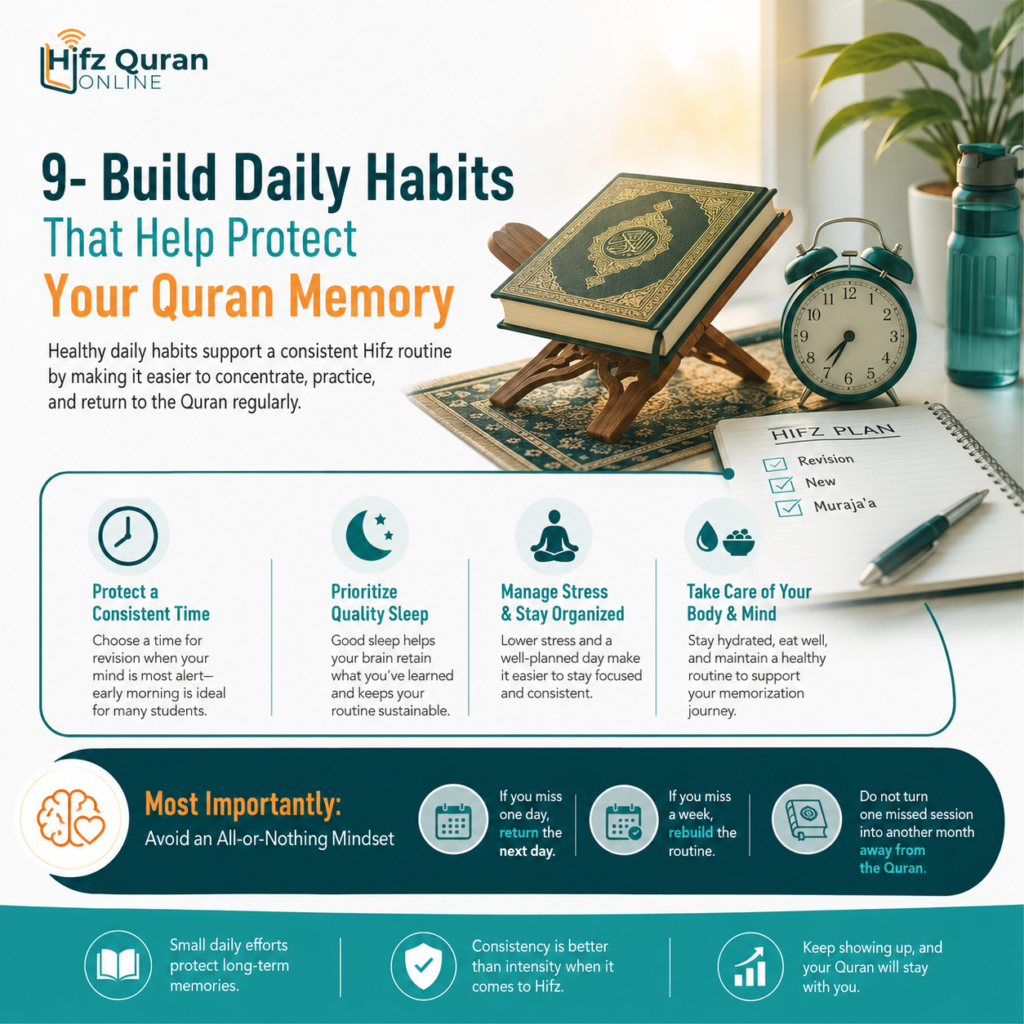
Healthy daily habits support a consistent Hifz routine by making it easier to concentrate, practice, and return to the Quran regularly.
Your Quran routine does not exist separately from the rest of your day.
Try to protect a consistent time for revision. Many students prefer early morning or another period when distractions are low.
Sleep also matters for maintaining a sustainable learning routine. If you repeatedly stay awake late and then attempt difficult memorization while exhausted, consistency becomes harder.
Pay attention to your stress level, organization, hydration, food, and daily routine as well. These are not replacements for revision, but they can make it easier to maintain the habits that revision requires.
Most importantly, avoid an all-or-nothing mindset.
If you miss one day, return the next day.
If you miss a week, rebuild the routine.
Do not turn one missed session into another month away from the Quran.
10- Get Help From a Quran Teacher to Enhance Your Hifz
A Quran teacher provides external correction, accountability, and a structured plan for rebuilding memorization.
Self-study can work for some students, but it has an obvious weakness: you may not notice every mistake you make.
A teacher can listen to your recitation and identify:
- Repeated memorization mistakes
- Weak transitions between Ayat
- Tajweed errors
- Pronunciation problems
- Portions that are not yet stable
- An unrealistic revision pace
One-on-one instruction is particularly useful because the teacher can adjust the daily target according to your actual performance. A structured online Hifz class can also include testing of previous memorization and older portions, rather than focusing only on what you learned that day.
What Should You Look For in a Hifz Teacher?
Do not choose a teacher only because they promise fast memorization.
Ask how they handle revision.
A good Hifz system should have a clear answer to questions such as:
- How is forgotten Hifz assessed?
- How often are older Surahs tested?
- How are repeated mistakes recorded?
- How is the daily target adjusted?
- How are Tajweed mistakes corrected?
- How will progress be measured?
The strongest sign is not how quickly you can add new pages. It is whether the system helps you retain what you recover.
If you can hear a passage correctly but still struggle to recite it from memory, Hifz Quran Online Academy can help you identify the problem and rebuild your confidence. Our Expert Hifz Teachers provide live correction, personalized guidance, and focused revision to help you strengthen weak Ayat, improve your recitation, and retain what you re-memorise.
as a strong combination for memorization and recitation correction.

What Are the Most Common Mistakes When Re-Memorising the Quran?
Avoiding the wrong approach is just as important as choosing the right one.
Trying To Re-Memorise Everything in a Few Days
Large targets may feel motivating at first, but they can quickly create exhaustion and poor retention.
Better approach: choose a realistic amount that you can repeat consistently.
Looking at the Mushaf Too Quickly
Opening the Mushaf at the first moment of hesitation removes the opportunity to practice recall.
Better approach: pause, try to retrieve the Ayah, then check when necessary.
Memorising Without Correct Tajweed
A memorized mistake can become a repeated mistake.
The problem is not only remembering the wrong sound. You may later need to replace an established pronunciation habit with the correct one.
Structured Hifz guidance therefore corrects Tajweed during memorization rather than treating it as something to fix much later.
Only Reviewing the Quran You Recently Recovered
This creates another cycle of forgetting.
Better approach: maintain a rotation that includes recent and older memorization.
Relying Only on Listening
Listening is valuable, but listening alone does not test whether you can independently retrieve the Ayat.
Better approach: combine listening with reading, recitation, and active recall.
Giving Up After a Bad Session
A difficult session does not erase your progress.
Some days will be fluent. Other days will expose weaknesses you did not know were there.
Both are useful.
Read also: How to Memorize Surah Baqarah – A Practical Step-by-Step Hifz Plan
See Our Classes in Action
Curious about what a 1-on-1 Hifz session looks like? Take a look at these real-time snippets from our daily classes to see our student-centered approach, Tajweed correction techniques, and online whiteboard tools in action.
Start Re-Memorising Your Quran Today
You do not need to recover your entire Hifz at once. Start with one section, then one Surah, and gradually rebuild your confidence and consistency. Hifz Quran Online Academy’s Quran Memorization Course For Adults provides expert Hifz teachers who assess your current level, identify the portions that need attention, and create a personalized plan to help you rebuild and strengthen your Hifz with consistent revision.
[Book Your FREE Trial Session]
Our Quran Courses
- Quran Memorization Course
- Quran Memorization and Hifz Course for Kids
- Online Quran Memorization Courses for Adults
- Quran Hifz Course for Ladies
- Quran Memorization Course for Men
- Saudi-Based Quran Memorization Courses
- Hifz Teachers
Memorize the Quran at Your Own Pace
Join our expert tutors and begin your Hifz journey with a personalized plan.
Start Your Free Trial
Conclusion
If you are asking how to re-memorise Quran when you’ve forgotten it, the answer is not to rush back into massive amounts of memorization.
Start by finding out what you still know.
Then rebuild the weakest portions in small sections, use listening alongside active recitation, practice recall without the Mushaf, and introduce spaced revision as soon as a Surah becomes strong again.
Most importantly, make retention your measure of progress. Memorizing quickly is not useful if the same pages disappear a few weeks later. Consistency-before-speed is the stronger approach because the purpose of Hifz is not simply to memorize the Quran once, but to keep it with you.
If you have forgotten part of your Hifz, you are not back at the beginning. You are returning with previous experience, familiarity with the Quran, and a clearer understanding of what your revision needs.
FAQs
Can I re-memorise the Quran if I have forgotten most of it?
Yes. You can rebuild forgotten Quran by assessing your current level, prioritizing weak portions, and reviewing them through small, repeated sections. You do not necessarily need to start from the beginning of your previous Hifz.
Should I start from the beginning of a Surah?
Usually, starting from the beginning of the Surah can help restore the sequence and give you familiar material to build on. However, if only one section is weak, you can focus on that section while continuing to review the rest.
Is listening to Quran enough to re-memorise it?
Listening can support re-memorization, but it should be combined with your own recitation and active recall. Reading while listening and then reciting without assistance provides a stronger way to test whether the passage has returned to memory.
How long does it take to re-memorise forgotten Quran?
There is no single timeline because it depends on how much remains, how long the material has been neglected, your previous memorization strength, and how consistently you revise. A realistic plan should be based on your assessment rather than an arbitrary deadline.
Should I stop new memorization while rebuilding old Hifz?
If a large portion has become weak, reducing or temporarily pausing new memorization can help you restore your foundation. Once your retention becomes stable, you can gradually reintroduce new memorization alongside recent and older revision.
Can an online Quran teacher help me re-memorise forgotten Hifz?
Yes. A qualified online Hifz teacher can assess your current memorization, listen to your recitation, correct Tajweed and memory errors, and create a revision plan around your pace. Structured programs commonly combine new memorization with testing of recent and older portions to protect long-term retention.





Leave a Reply