 Memorizing Quran
If you struggle to memorize the Quran, it does not necessarily mean you have a weak memory. In many cases, the problem is not your ability to remember but the way you practice remembering.
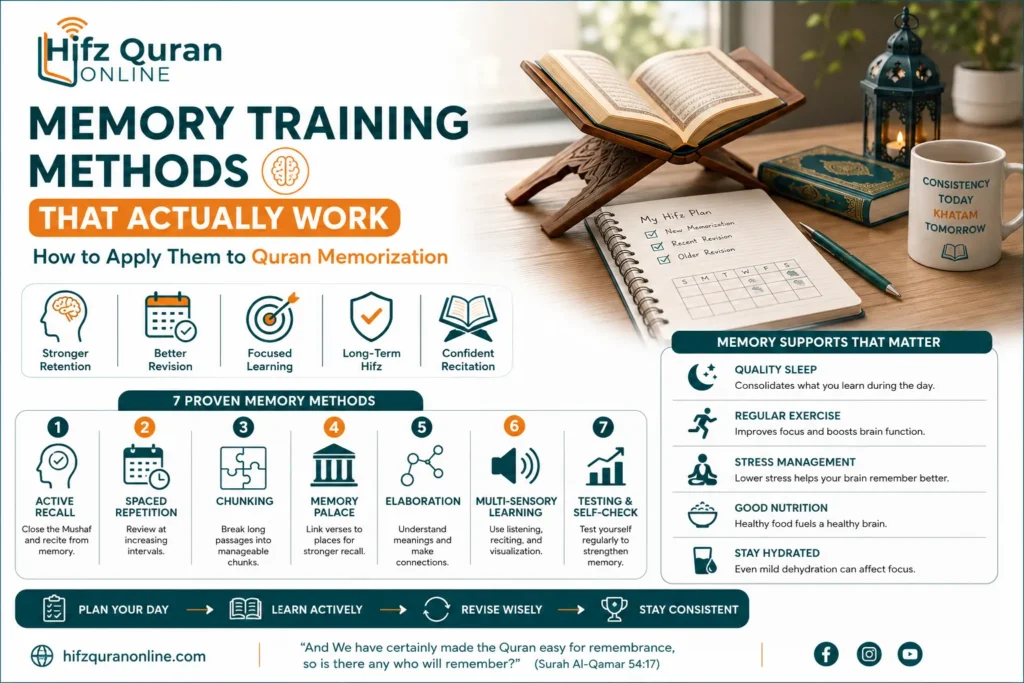
Research in cognitive psychology has identified several learning techniques that can improve long-term retention, including active recall, spaced practice, chunking, and elaboration. These methods are not shortcuts, but they can make your memorization sessions more purposeful and your revision more effective.
In this article, you will learn how these memory training methods work and, more importantly, how you can apply them to Quran memorization. You will also learn how sleep, exercise, stress management, and other daily habits can support your hifz journey.
What You’ll Learn in This Article
- Why passive rereading and repeated listening are not enough for long-term retention
- Seven evidence-based memory techniques that can support durable recall
- How to apply each technique to Quran memorization and hifz revision
- How to combine these techniques into a practical daily routine
- How sleep, exercise, stress, and nutrition can support your memory
The Core Memory Training Methods and How They Work
Memory training is not simply about having a naturally strong memory. The way you encode, retrieve, and review information can make a significant difference in how well you remember it.
Several well-studied learning techniques can be adapted to Quran memorization. Some are especially useful for building new memorization, while others are better suited to revision and maintaining what you have already learned.
Read also: Blurting Memorization Techniques Applied to Quran Hifz
Use Active Recall to Strengthen Your Quran Memorization
Active recall means trying to retrieve information from memory instead of simply looking at it again. For example, after reading an ayah several times, you close the Mushaf and try to recite it without looking.
This feels more difficult than rereading, but that effort is part of the learning process. Retrieval practice has been shown to improve long-term retention more effectively than repeated study alone in many learning situations.
How to Apply Active Recall to Quran Memorization?
After memorizing an ayah or a small group of ayahs:
1. Close your Mushaf.
2. Recite what you have learned from memory.
3. If you make a mistake, pause and identify the exact point where your recall failed.
4. Look back at the Mushaf briefly.
5. Close it again and repeat the recitation.
You can also use active recall during your daily revision. Instead of following every word with your eyes, try reciting the passage from memory and use the Mushaf afterward to check your accuracy.
This is also one reason reciting your memorization to a qualified teacher can be valuable: you are retrieving the verses while receiving immediate correction.
Read also: The Repetitive Memorization Method In the Quran Hifz
Use Spaced Repetition to Keep Your Hifz Strong
Spaced repetition means reviewing information at intervals rather than trying to memorize and review everything in one session.
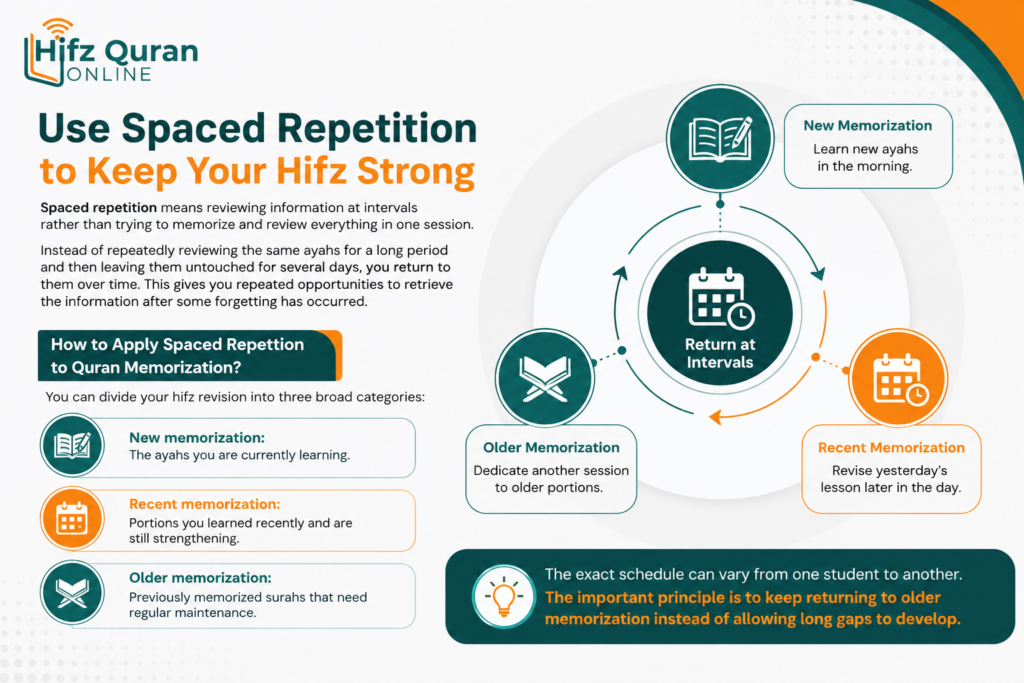
Instead of repeatedly reviewing the same ayahs for a long period and then leaving them untouched for several days, you return to them over time. This gives you repeated opportunities to retrieve the information after some forgetting has occurred.
How to Apply Spaced Repetition to Quran Memorization?
You can divide your hifz revision into three broad categories:
– New memorization: The ayahs you are currently learning.
– Recent memorization: Portions you learned recently and are still strengthening.
– Older memorization: Previously memorized surahs that need regular maintenance.
For example, you might learn new ayahs in the morning, revise yesterday’s lesson later in the day, and dedicate another session to older portions.
The exact schedule can vary from one student to another. The important principle is to keep returning to older memorization instead of allowing long gaps to develop.
Read also: The Repetitive Memorization Method In the Quran Hifz
Break Longer Passages Into Manageable Chunks
Chunking means organizing information into smaller, meaningful units. Instead of trying to memorize a long passage as one continuous stream, you divide it into sections that are easier to process and connect.
This can reduce the amount of information you have to manage at one time and give you clear points at which to check your recall.
How to Apply Chunking to Quran Memorization?
When working through a longer surah, divide the passage into manageable groups of ayahs.
You might use:
- A few ayahs at a time
- A thematic section
- A natural stopping point
- A group of ayahs that share a similar rhythm or subject
Memorize the first chunk until you can recite it accurately. Then learn the next chunk and connect it to the first.
The goal is not simply to memorize each section separately. You should also practice linking the sections together so that you can move smoothly from one passage to the next.
Step Inside Our Virtual Classrooms
Don’t just take our word for it—see how our interactive sessions work! Watch the short clips below to experience our engaging teaching methods, live teacher-student interactions, and the supportive learning environment we bring to every student.
Memorize the Quran at Your Own Pace
Join our expert tutors and begin your Hifz journey with a personalized plan.
Start Your Free TrialUse a Memory Palace as an Additional Recall Aid
The memory palace, also known as the method of loci, involves associating information with familiar physical locations. You imagine moving through a familiar place and connect different pieces of information to specific locations along the route.
Research on memory athletes has shown that mnemonic strategies involving spatial imagery can support impressive memory performance.
However, this is an advanced technique and does not need to be part of every student’s hifz routine.
How to Apply a Memory Palace to Quran Memorization?
You can experiment with spatial cues when you struggle to remember the order of passages.
For example, imagine a familiar route through your home. Associate different sections of a surah with different locations along that route. When you mentally move through the route, the locations can serve as cues for the sequence.
Use this as a supplementary tool rather than a replacement for accurate recitation, repetition, and regular revision.
Use Visual Associations to Support Difficult Information
Visual imagery can make certain types of information easier to remember by giving abstract ideas a concrete mental association.
For example, when learning vocabulary, you might associate a new word with a vivid mental image. The more distinctive the image, the easier it may be to recall the association later.
How to Apply Visual Memory to Quran Memorization
Visual associations can be particularly useful when you are trying to remember:
- The order of surahs
- The general themes of passages
- The meaning of unfamiliar Quranic vocabulary
- Similar passages that you frequently confuse
You can also pay attention to the visual layout of the Mushaf as you memorize. Remembering where a passage appears on the page can provide an additional retrieval cue during revision.
However, visual imagery should support your memorization rather than replace accurate recitation and understanding.
Test Yourself From Random Starting Points
Self-testing is another form of retrieval practice. Instead of always starting a surah from the beginning, challenge yourself to recall it from different points.
This can reveal gaps that are easy to miss when you always recite in the same order.
How to Apply Self-Testing to Quran Memorization?
Ask a teacher, family member, or study partner to:
- Start you from the middle of a surah.
- Ask you to continue after a specific ayah.
- Give you the beginning of an ayah and ask you to complete it.
- Ask what comes immediately before or after a particular passage.
- Test you on passages that sound similar.
You can also test yourself by opening the Mushaf at a random point, reading the beginning of an ayah, and then closing it to see whether you can continue.
This type of practice makes your recall more flexible and can expose weak connections between ayahs.
Connect New Ayahs to Their Meaning
Elaboration means connecting new information to knowledge you already have. Instead of memorizing information as an isolated sequence, you think about its meaning, context, and relationship to what comes before and after it.
For Quran memorization, understanding the meaning can give you additional cues for remembering the passage.
How to Apply Meaning-Based Learning to Hifz?
Before or during memorization, take time to understand the general meaning of the passage you are learning.
You can:
- Read a reliable translation.
- Study basic tafsir from a trusted source.
- Identify the main theme of the passage.
- Notice how one ayah connects to the next.
- Learn the meaning of unfamiliar Quranic vocabulary.
For example, if several ayahs describe a sequence of events, understanding that sequence can help you remember the order of the verses.
Meaning should not replace precise memorization of the Arabic text. Instead, it gives your memorization another layer of connection alongside sound, visual cues, and repeated retrieval.
Support Your Memory With Healthy Daily Habits
Memory techniques are important, but your daily habits can also affect your ability to learn and retrieve information.
1- Prioritize Sleep After Learning
Sleep plays an important role in memory consolidation, the process through which newly learned information becomes more stable over time.
For this reason, sacrificing sleep regularly to spend extra hours memorizing may not be the best strategy. A consistent sleep schedule can help you approach your next memorization session with better attention and mental energy.
If you find that reviewing your new hifz before sleep works well for you, you can make it part of your routine.
2- Stay Physically Active to Support Your Memory and Brain Health
Regular physical activity supports overall brain health and may benefit aspects of memory and cognitive function.
You do not need an intense workout to make movement part of your routine. A regular walk or another form of moderate physical activity can be a practical way to stay active while balancing your hifz schedule.
3- Manage Stress During Your Hifz Journey
High levels of stress can interfere with attention, working memory, and learning. If you are constantly anxious about how much you still have to memorize, it may become harder to focus on the ayahs in front of you.
Instead of measuring your progress only by the number of pages you complete, focus on building a consistent routine.
A smaller amount of accurate memorization followed by strong revision is often more useful than rushing through large portions that you cannot maintain.
4- Choose Nutritious Foods to Support Learning and Mental Energy
A balanced diet supports general health, including brain health. Rather than relying on a particular “memory food,” focus on an overall nutritious eating pattern that includes a variety of whole foods.
Your diet is only one part of the picture. Sleep, physical activity, stress management, and effective learning strategies all work together to support your ability to learn and remember.
Build a Hifz Routine That Uses These Memory Techniques
Knowing memory techniques is useful, but applying them consistently is what turns them into a practical hifz strategy.
You can combine several methods in one daily routine:
1. Learn: Break your new lesson into manageable chunks.
2. Understand: Review the general meaning and context of the ayahs.
3. Retrieve: Close the Mushaf and recite from memory.
4. Check: Compare your recitation with the Mushaf and correct mistakes.
5. Reconnect: Recite the new section together with the previous section.
6. Space your revision: Return to the material later rather than relying on one long memorization session.
7. Test yourself: Occasionally begin from different points to make sure you can retrieve the passage flexibly.
You do not have to use every technique every day. Choose the methods that fit your learning style and current stage of memorization, then apply them consistently.
See Our Classes in Action
Curious about what a 1-on-1 Hifz session looks like? Take a look at these real-time snippets from our daily classes to see our student-centered approach, Tajweed correction techniques, and online whiteboard tools in action.
Memorize the Quran at Your Own Pace
Join our expert tutors and begin your Hifz journey with a personalized plan.
Start Your Free TrialStart Your Hifz Journey With Expert Guidance
Memory techniques can give your hifz routine more structure, but learning how to apply them consistently can be easier with qualified guidance and regular accountability.
At Hifz Quran Online Academy, you can learn Quran memorization with qualified instructors and a structured approach designed around your individual learning needs.
Whether you are beginning your hifz journey or working to strengthen memorization you have previously learned, consistent guidance can help you build a sustainable routine.
Our Quran Courses
- Quran Memorization Course
- Quran Memorization and Hifz Course for Kids
- Online Quran Memorization Courses for Adults
- Quran Hifz Course for Ladies
- Quran Memorization Course for Men
- Saudi-Based Quran Memorization Courses
- Hifz Teachers

Memorize the Quran at Your Own Pace
Join our expert tutors and begin your Hifz journey with a personalized plan.
Start Your Free TrialConclusion
Strong Quran memorization is not simply a matter of having a naturally good memory. The way you learn, retrieve, and review what you memorize matters.
Active recall, spaced repetition, chunking, self-testing, visual associations, and meaning-based learning can all support your hifz when used appropriately. Healthy habits such as adequate sleep, regular physical activity, and stress management can support the learning process as well.
You do not need to change your entire routine today. Start with one technique: close the Mushaf and try to recite what you have learned from memory. Then check your mistakes and return to the passage again later.
With consistent practice and regular revision, you can gradually build stronger and more reliable Quran memorization.
Frequently Asked Questions
What is the best memory training method for Quran memorization?
There is no single method that works best for every student. However, active recall and spaced repetition are two particularly useful techniques for long-term retention. Try to recite from memory without looking at the Mushaf, then revisit the material at spaced intervals.
There is no single method that works best for every student. However, active recall and spaced repetition are two particularly useful techniques for long-term retention. Try to recite from memory without looking at the Mushaf, then revisit the material at spaced intervals.
How many ayahs should I memorize per day?
There is no universal number of ayahs that every student should memorize each day. Your ideal amount depends on your age, schedule, previous memorization, available study time, and ability to maintain accurate revision.
A smaller number of ayahs memorized accurately and reviewed consistently can be more sustainable than rushing through a large amount of new material.
Does understanding the meaning of the Quran help with memorization?
Understanding the meaning can provide additional cues that support recall. When you know the general meaning and context of a passage, you are not relying only on the sound of the Arabic words to remember their sequence.
However, understanding the meaning should complement—not replace—accurate memorization and recitation.
How does sleep affect Quran memorization?
Sleep plays an important role in memory consolidation and learning. Getting adequate, regular sleep can therefore support your ability to retain newly memorized material and stay focused during your hifz sessions.
Is it normal to forget ayahs I have already memorized?
Yes. Forgetting can happen when previously learned material is not retrieved and reviewed regularly. This does not necessarily mean that you have a poor memory.
Regular revision and spaced retrieval can help you maintain older portions of your hifz and identify weak areas before they become larger gaps.
Can adults memorize the Quran effectively?
Yes. Adults can memorize the Quran effectively, although their learning experience may differ from that of children. Adults can benefit from structured routines, meaningful learning, active recall, and spaced revision.
The key is to choose a realistic memorization pace and maintain consistent revision alongside new lessons.
Related Articles
Memorizing Quran







Leave a Reply