 Memorizing Quran
If you are wondering which Surah to memorize first, begin with Surah Al-Fatiha because it is essential to Salah. After Al-Fatiha, move to short Surahs from Juz Amma, especially Al-Ikhlas, Al-Falaq, An-Nas, Al-Kawthar, and Al-Asr.
The Quran contains Surahs of very different lengths. For a beginner, starting with a long chapter can make memorization feel unnecessarily difficult. Short Surahs provide faster milestones while training you to listen, repeat, recall, and revise correctly.
The best starting Surah is therefore not simply the shortest one. It should combine practical use in worship, manageable length, clear recitation patterns, and meaningful content.
Once several short Surahs are secure, you can gradually progress toward chapters such as Al-Mulk, Ar-Rahman, Yaseen, and Al-Kahf.
What You’ll Learn
- Which Surah to memorize first as a complete beginner
- The best order for memorizing short Surahs
- Which Surahs are especially useful for Salah and daily worship
- When to progress from short Surahs to longer chapters
- How to avoid common beginner Hifz mistakes
Which Surah to Memorize First?
Surah Al-Fatiha should be the first Surah a Muslim prioritizes because it is recited in every rak‘ah of Salah. After securing Al-Fatiha, beginners should generally work through short Surahs from Juz Amma rather than jumping immediately into longer chapters.
The Quran contains 114 Surahs of varying lengths, making the shorter chapters a natural training ground for new memorizers.
A practical starting sequence is:
| Order | Surah | Why Memorize It Early? |
| 1 | Al-Fatiha | Essential for Salah |
| 2 | Al-Ikhlas | Very short and teaches Tawheed |
| 3 | Al-Falaq | Short and commonly used for seeking Allah’s protection |
| 4 | An-Nas | Short, rhythmic, and commonly recited for protection |
| 5 | Al-Kawthar | Only three verses and highly manageable |
| 6 | Al-Asr | Three short verses with a powerful message |
| 7 | Al-Kafirun | Repetitive structure supports memorization |
| 8 | An-Nasr | Short and naturally flowing |
| 9 | Al-Qadr | Introduces a slightly longer structure |
| 10 | Other Juz Amma Surahs | Builds toward sustained Hifz |
This progression gives a beginner something more valuable than quick completion: a repeatable memorization system that can later be applied to longer Surahs.
1. Memorize Surah Al-Fatiha First Because You Need It in Salah
Surah Al-Fatiha contains seven verses and opens the Quran. More importantly for a beginner, it has a direct role in the five daily prayers.
That makes Al-Fatiha different from choosing a Surah simply because it is short.
If your Al-Fatiha is already memorized but contains pronunciation uncertainty, correct those errors before focusing heavily on new Surahs. Memorizing more Quran should never come at the cost of preserving mistakes in the Surah you recite most frequently.
2. Memorize Surah Al-Ikhlas as Your First Short Surah
After Al-Fatiha, Surah Al-Ikhlas is one of the strongest choices for your first short Surah.
It contains four concise verses centered on Tawheed: Allah is One, absolute and unlike His creation. Its brevity and clear sound pattern make the sequence manageable for someone who has never followed a formal Hifz routine.
The supplied Quran-learning material also identifies Al-Ikhlas among the short Surahs commonly taught early because of its brevity and practical use.
The Prophet ﷺ described Surah Al-Ikhlas as equivalent to one-third of the Quran in virtue, giving the beginner a short chapter with enormous spiritual significance.
3. Learn Surah Al-Falaq and Surah An-Nas Together
Once Al-Ikhlas is secure, move to Surah Al-Falaq and Surah An-Nas.
Together, Al-Falaq and An-Nas are known as Al-Mu‘awwidhatayn, the two Surahs of seeking refuge. Their themes make them valuable beyond simply expanding the number of chapters you know.
Al-Falaq teaches the believer to seek Allah’s protection from different forms of harm, while An-Nas seeks protection from whispering and spiritual evil. The supplied material specifically identifies both Surahs as Quranic protection recitations.
Memorizing related Surahs together also introduces an important Hifz skill: distinguishing passages that share similar themes without mixing their wording.
4. Use Surah Al-Kawthar for an Early Memorization Win
Surah Al-Kawthar is an excellent early target because it contains only three verses.
A very short Surah lets you practice the entire Hifz cycle on a manageable amount of Quran:
listen → repeat → memorize → connect the verses → recite without looking → revise later.
That process matters more than how quickly you finish.
A beginner who memorizes three verses accurately and retains them has developed a better foundation than someone who rushes through a longer Surah and forgets it shortly afterward.
5. Add Surah Al-Asr Before Moving to Longer Chapters
Surah Al-Asr is another three-verse chapter suitable for early Hifz.
Its message also gives the memorizer useful meaning anchors: time, human loss, faith, righteous deeds, truth, and patience.
Understanding these thematic movements can help you remember what comes next instead of relying entirely on sound.
This is an important transition point. Your first few Surahs teach your tongue the words; the next stage should increasingly connect sound, sequence, and meaning.
Read also: How To Re-Memorise Quran When You’ve Forgotten It
6. Memorize Surah Al-Kafirun to Train Similar-Ayah Recognition
Surah Al-Kafirun contains six verses and is particularly useful as an early Hifz exercise because several verses use closely related wording.
That repetition can make the Surah feel easy at first, but it also creates a new challenge: remembering exactly which similar phrase comes next.
Instead of treating repeated wording as automatic, deliberately connect each verse to the verse before and after it.
This develops a skill you will need repeatedly when memorizing longer portions of the Quran: distinguishing similar verses rather than guessing from familiarity.
7. Add Surah An-Nasr and Surah Al-Qadr as Your Confidence Grows
After several very short chapters, Surah An-Nasr and Surah Al-Qadr provide a manageable next step.
An-Nasr has only three verses but introduces longer phrases than Al-Kawthar or Al-Asr.
Al-Qadr contains five verses and gives you another important advantage: a strong central theme. The entire Surah revolves around Laylatul Qadr, helping you create a clear mental framework for its sequence.
At this point, your goal should gradually change from “How quickly can I memorize this?” to “Can I still recite everything I have memorized accurately?”
Choose Your First Surahs by Usefulness, Not Length Alone
The shortest Surah is not automatically the best starting point for every student.
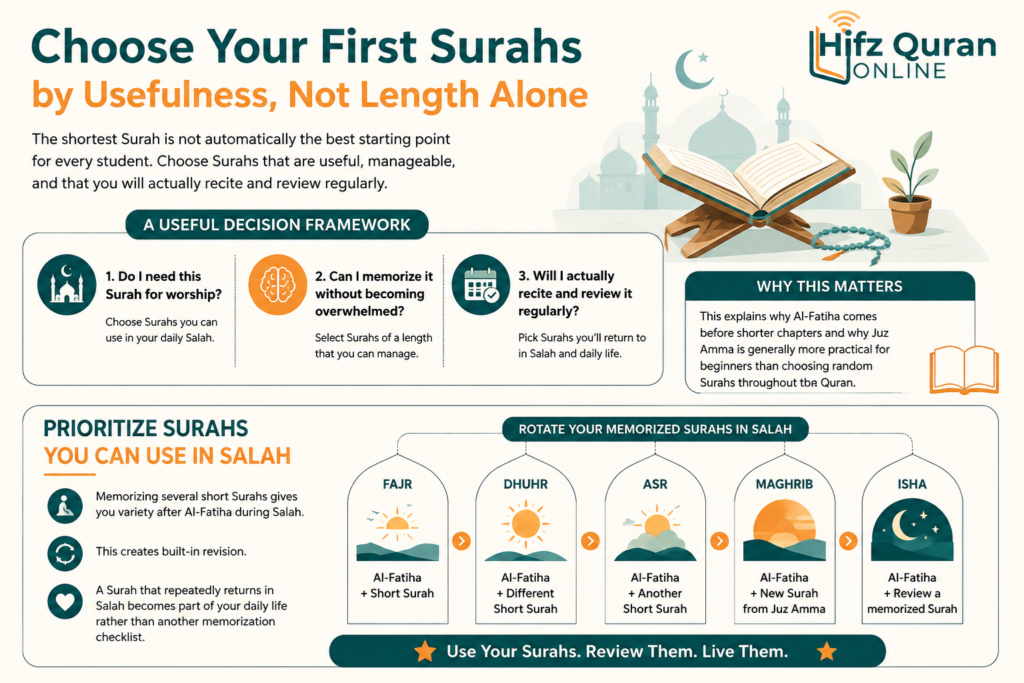
A useful decision framework is to ask three questions: Do I need this Surah for worship? Can I memorize it without becoming overwhelmed? Will I actually recite and review it regularly?
This explains why Al-Fatiha comes before shorter chapters and why Juz Amma is generally more practical for beginners than choosing random Surahs throughout the Quran.
Prioritize Surahs You Can Use in Salah
Memorizing several short Surahs gives you variety after Al-Fatiha during Salah.
This creates built-in revision.
Instead of memorizing a chapter and leaving it untouched for days, you can deliberately rotate your newly memorized Surahs through your prayers.
A Surah that repeatedly returns in Salah becomes part of your daily life rather than another item on a memorization checklist.
Step Inside Our Virtual Classrooms
Don’t just take our word for it—see how our interactive sessions work! Watch the short clips below to experience our engaging teaching methods, live teacher-student interactions, and the supportive learning environment we bring to every student.
Memorize the Quran at Your Own Pace
Join our expert tutors and begin your Hifz journey with a personalized plan.
Start Your Free TrialBuild Several Short Surahs Before Attempting Long Ones
A beginner may feel emotionally drawn to Surah Yaseen, Ar-Rahman, Al-Mulk, or Al-Kahf. There is nothing wrong with having one of these as a future goal.
However, short Surahs teach the mechanics of Hifz with much lower cognitive load.
A practical milestone is to secure a collection of short Surahs first, then gradually increase the length of your targets. The supplied Hifz material similarly recommends beginning with the shortest Surahs and building the habit before increasing the target.
Practitioner note: Do not measure readiness only by how many Surahs you have finished. You are ready to increase difficulty when you can recite your existing Surahs reliably without repeatedly reopening the Mushaf.
If you want help establishing this foundation, Hifz Quran Online Academy can provide structured Quran memorization guidance so your early Surahs are learned with correct pronunciation and a revision plan from the beginning.

Read also: 10 Tips to Memorize Long Surahs Fast and Retain Them for Life
Which Important Surahs and Verses Should You Memorize After the Beginner Stage?
Once your short-Surah foundation is stable, you can begin selecting longer passages according to their role in your Quran routine.
At this stage, do not abandon Juz Amma revision. Longer memorization should be added on top of an established review habit, not used to replace it.
Ayat Al-Kursi
Ayat Al-Kursi is not a Surah; it is verse 255 of Surah Al-Baqarah.
It is nevertheless one of the most important individual verses many Muslims choose to memorize. Its subject centers on Allah’s greatness, knowledge, authority, and sovereignty.
Adding it after several short Surahs also teaches you to memorize a longer individual Ayah without having to tackle an entire long chapter.
Surah Al-Mulk
Surah Al-Mulk is a strong intermediate goal once you are comfortable memorizing and revising shorter chapters.
It contains 30 verses, meaning the student must begin thinking in sections rather than entire Surahs.
Break it into small connected passages and revise everything already learned before adding the next portion. Daily review becomes increasingly important as the amount memorized grows.
Surah Ar-Rahman
Surah Ar-Rahman is memorable partly because of its recurring verse:
“Which of the favors of your Lord will you both deny?”
Repeated phrases can support memorization, but they can also produce sequencing mistakes if you remember the refrain without remembering what precedes it.
The solution is to associate each occurrence with the passage immediately before it rather than memorizing the refrain as an isolated repeated line.
Surah Yaseen
Surah Yaseen contains 83 verses, making it a substantial step beyond beginner short-Surah memorization.
Approach it in small sections rather than treating 83 verses as one project.
At this level, understanding the thematic progression of a Surah becomes increasingly useful because meaning gives you another recall cue beyond sound.
The First Ten Verses of Surah Al-Kahf
You do not need to memorize all 110 verses of Surah Al-Kahf as your first goal.
The first ten verses provide a much more manageable milestone. Authentic Sunnah establishes the virtue of memorizing ten verses from the beginning of Al-Kahf in relation to protection from the trial of the Dajjal.
This demonstrates an important Hifz principle: you can memorize an important passage without committing to the entire Surah immediately.
Memorize Each New Surah With a Repeatable Hifz Routine
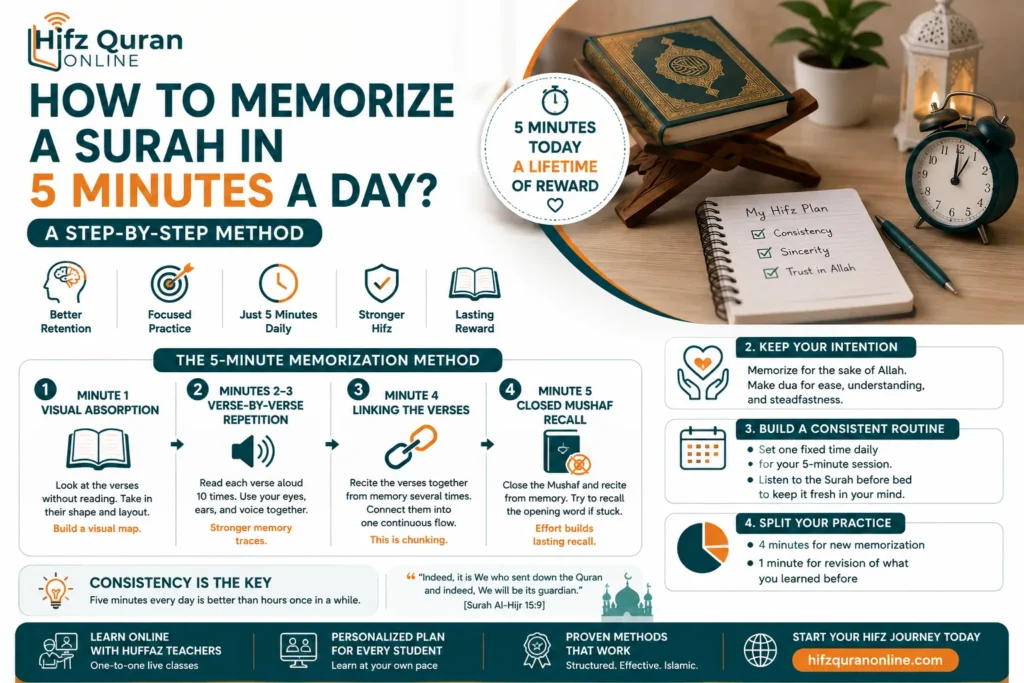
Knowing which Surah to memorize first solves only the first decision. What determines whether that Surah remains in memory is the method you use afterward.
A beginner-friendly process should prioritize accurate listening, small portions, active recall, and revision.
Listen Before You Memorize
Listen to a slow, clear reciter before attempting to reproduce unfamiliar verses yourself.
For structured Hifz, clear Murattal or teaching-style recitation is especially useful because predictable pacing helps establish the correct pronunciation and sequence. The supplied Hifz material specifically recommends slow, clear recitation and consistency with one reciter for beginners.
Do not repeatedly switch between reciters while learning the same passage.
Memorize One Small Portion at a Time
Do not measure every session by the number of verses completed.
Ayah length varies considerably.
Instead, select an amount you can repeat accurately, recall without looking, and connect to the previous passage before ending the session.
Recite Without Looking Before Moving Forward
Reading the same Ayah repeatedly can create an illusion of memorization.
Close the Mushaf or look away and recite independently.
If you cannot reproduce the passage accurately without visual help, it is not yet secure enough to build on.
Review Old Surahs Before Adding New Ones
Revision is part of memorization, not something that begins after Hifz is complete.
Before learning a new Surah, recite previously memorized chapters from memory.
A useful decision rule is simple: if your old Surahs are becoming noticeably weaker, reduce new memorization temporarily and repair them first.
Get Your Recitation Checked
Self-study cannot always reveal pronunciation, Tajweed, or stopping errors because you may repeatedly hear your own incorrect version as normal.
A qualified Quran teacher provides external correction before those errors become attached to memory.
This matters especially for Al-Fatiha because you recite it so frequently.
Read also: How to Memorize Surah Baqarah – A Practical Step-by-Step Hifz Plan
See Our Classes in Action
Curious about what a 1-on-1 Hifz session looks like? Take a look at these real-time snippets from our daily classes to see our student-centered approach, Tajweed correction techniques, and online whiteboard tools in action.
Start Your First Surah With a Structured Hifz Plan
Choosing your first Surah should be the beginning of a sustainable Quran memorization journey, not another goal that disappears after a few enthusiastic days.
Hifz Quran Online Academy can help you build a personalized memorization sequence, correct your recitation, and balance new Hifz with regular revision whether you are beginning with Al-Fatiha, short Surahs from Juz Amma, or progressing toward longer chapters.
Our Quran Courses
- Quran Memorization Course
- Quran Memorization and Hifz Course for Kids
- Online Quran Memorization Courses for Adults
- Quran Hifz Course for Ladies
- Quran Memorization Course for Men
- Saudi-Based Quran Memorization Courses
- Hifz Teachers
Memorize the Quran at Your Own Pace
Join our expert tutors and begin your Hifz journey with a personalized plan.
Start Your Free Trial
Conclusion
So, which Surah should you memorize first? Start with Surah Al-Fatiha if you have not already memorized it correctly. Then progress through short Surahs such as Al-Ikhlas, Al-Falaq, An-Nas, Al-Kawthar, and Al-Asr.
Do not rush into long Surahs simply because they are personally meaningful. First learn how to memorize accurately, connect verses, revise consistently, and correct mistakes.
Your first Surah is not just your first achievement. It is where you build the method you will use for every Surah that follows.
Frequently Asked Questions About Which Surah to Memorize First
Which Surah should I memorize first as a beginner?
Surah Al-Fatiha should generally come first because it is required in Salah. After Al-Fatiha, begin with short Juz Amma Surahs such as Al-Ikhlas, Al-Falaq, An-Nas, and Al-Kawthar.
What is the easiest Surah to memorize?
Al-Kawthar, Al-Asr, and Al-Ikhlas are among the easiest Surahs for beginners because they contain only a few verses. Ease, however, also depends on pronunciation familiarity and how well you understand the sequence.
Which Surahs should I memorize for Salah?
Start with Al-Fatiha, then memorize several short Surahs from Juz Amma. Al-Ikhlas, Al-Falaq, An-Nas, Al-Kawthar, Al-Asr, and Al-Kafirun provide useful variety for regular prayer.
Should I memorize Juz Amma first?
Juz Amma is an excellent starting point after Al-Fatiha because it contains many short Surahs suitable for beginners. Short chapters let you develop correct repetition and revision habits before attempting longer portions.
Should I memorize Surah Yaseen or Surah Al-Mulk first?
For most beginners, Surah Al-Mulk is a more manageable first long-Surah project because it is considerably shorter than Surah Yaseen. However, secure several short Surahs and a consistent revision routine before attempting either.
Can I start memorizing Quran if my Tajweed is not perfect?
Yes, but your pronunciation should be checked while you memorize. You do not need to master every Tajweed rule beforehand, but memorizing repeated pronunciation errors makes them harder to correct later.





Leave a Reply