 Memorizing Quran

Yes, you can keep working on your Hifz during your period, but scholars differ on reading the Quran aloud. Some scholars allow reading aloud and reviewing your Hifz, mainly when you fear forgetting.
Other scholars do not allow reading the Quran aloud during your period. Follow the guidance of your madhhab (school of Islamic law) or a qualified teacher.
Both views come from respected scholars. Each one is based on evidence. This guide does not say that one school is wrong. It explains each view in simple words, so you know what to ask your local scholar.
If you are asking “can I memorize Quran during periods?”, you may also have a practical worry. A week away from review can weaken the pages you worked hard on. This guide also shows you how to protect your Hifz under each view.
What you’ll learn in this article
- Why scholars hold different views about reading Quran on your period.
- Which activities all scholars allow, and where they differ.
- The ruling on reading from a phone and touching a printed Mushaf.
- Simple ways to keep your Hifz strong under each view.
- Quran activities you can do without reading aloud.
Why Do Scholars Differ About Reading Quran On Your Period?
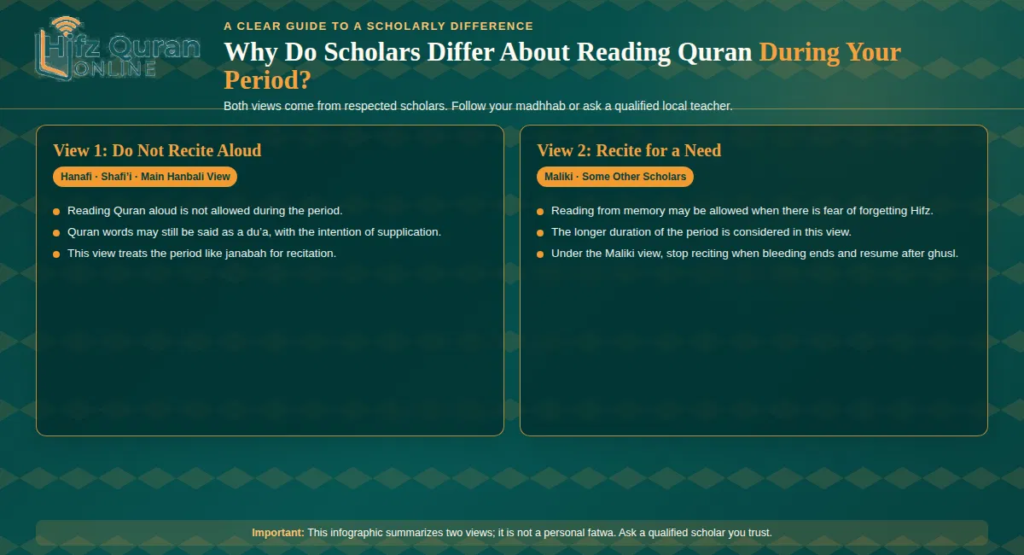
The main question is simple. Is a woman on her period like a person in janabah? Janabah is the state after marital relations, before a full ritual bath called ghusl. All scholars agree that a person in janabah does not read the Quran aloud.
Scholars differ on whether this rule also covers a woman on her period. Here are the two main views.
View 1: Reading The Quran Aloud Is Not Allowed (Hanafi, Shafi’i, And Hanbali)
The Hanafi and Shafi’i schools hold this view, and it is also the main position of the Hanbali school. According to this opinion, a woman on her period does not read the Quran aloud. This covers both short and long parts.
She can still say Quran words as a du’a, as long as she means it as a prayer and not as recitation. One example is “Rabbana atina fid-dunya hasanah.”
These scholars rely on a hadith from Ibn Umar about the woman on her period and the person in janabah. They also point out that both states need ghusl, so they take the same rule.
Many fatwa bodies today follow this view. They say she shouldn’t recite, even from memory, and they see it as the more careful choice in worship.
View 2: Reading The Quran Aloud Is Allowed For A Need (Maliki And Others)
The Maliki school holds that a woman on her period may read the Quran from memory. Their reason is that a period lasts several days. In that time, she could forget what she memorized.
A report from Imam Ahmad agrees with this view. Ibn Taymiyyah also chose it. According to this opinion, reading may even be needed if she fears losing her Hifz. Shaykh Ibn Baz held this view too. In his view, the Ibn Umar hadith has a weak chain.
He also said a person in janabah can bathe at once, while a woman cannot end her period by choice. He pointed to ‘A’ishah during Hajj. The Prophet ﷺ told her to do all that pilgrims do except tawaf, and he did not mention the Quran.
Even so, most scholars who hold this view still say she shouldn’t touch the Mushaf with her bare hands. If she needs to check a verse, she can hold it with a cloth or gloves, or read from an app. This view makes things much easier for women in Hifz programs and for female teachers who listen to students every day.
A Maliki Rule That Many Women Miss
The Maliki view has one key condition. When the bleeding stops, reading aloud stops too. She waits until she takes ghusl. Why? At this point, she can end her state by bathing. So the rule of janabah now applies to her.
Many women know the Maliki permission but not this detail. In short, she may read during her period, pause when the bleeding ends, and read again after ghusl. If you follow this view, take your ghusl soon after your period ends. This keeps the pause short.
Can I Memorize Quran During Periods? A Simple Guide
Yes. You can keep working on your Hifz in some way under every view. What changes is the method you use.
The key question is whether you may read aloud. That depends on the view you follow.
If You Follow The View That Reading Aloud Is Not Allowed
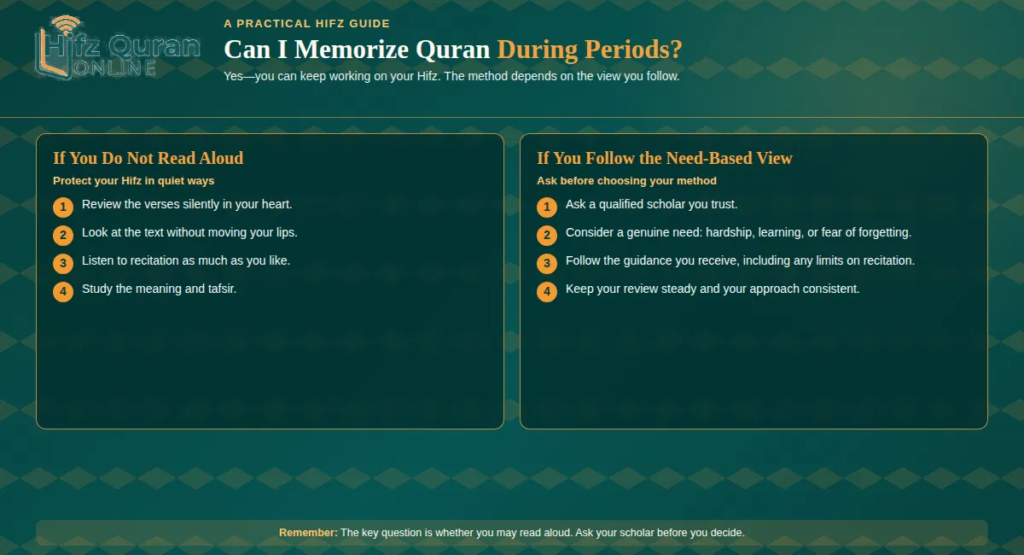
According to this opinion, you do not read the Quran aloud during your period. But you still have good options. You can review the verses silently in your heart, or look at the text without moving your lips.
You can also listen to recitation as much as you like. Scholars who hold this view explain that the rule is about the tongue, not the heart or the eyes. So nothing stops you from going over your memorization in your mind.
This time can also be a chance to learn more about what you’ve memorized. Many women use these days to study the meaning of the verses and read tafsir. That way, the days away from recitation still bring you closer to the Quran.
If You Follow The Need-Based View
Some scholars allow a woman to follow the Maliki view when she has a real need. They usually mention three cases: hardship, learning, and fear of forgetting what she has memorized.
Some Hanafi scholars also allow this for girls and women who are still in the middle of their Hifz. Other Hanafi scholars disagree. They say you shouldn’t switch to another school just because a need comes up.
Instead, they suggest reciting in short parts, with a pause between words, so it doesn’t count as full recitation. So the answer really depends on the scholar you follow. Ask them before you decide what’s right for you.
What can I do during my period? A quick table
This table puts each activity side by side. It is a general guide, not a personal fatwa.
| Activity | More careful view | Need-based view | Practical note |
| Reading Quran aloud | Not allowed during your period | Allowed by some scholars, mainly for learning, teaching, or fear of forgetting | Follow your madhhab or teacher’s guidance |
| Revising from memory | Some do not allow spoken revision | Some allow it without touching a Mushaf | Key for Hifz students; ask for a personal ruling |
| Reading silently | Often allowed | Allowed | Good for checking verse order and meaning |
| Listening to Quran | Allowed | Allowed | Repeat audio to keep the rhythm in your memory |
| Reading from a phone or tablet | Advice differs; a device may not count as a Mushaf | Often allowed by today’s scholars | Ask your scholar, especially about reading aloud |
| Touching a printed Mushaf | Usually not allowed directly | Some allow it for teaching or learning, or with a barrier | A phone and a Mushaf may not have the same ruling |
Can I Read Quran From A Phone During My Period?
Yes, many scholars today allow it, with some details. The question has two parts. The first part is about touching the phone. The second part is about reading aloud from it.
Is Touching A Phone The Same As Touching A Mushaf?
No, according to many scholars today. They say a Quran app is not a real Mushaf.
The words on the screen are only light made by the device. When you close the app, the words are gone. So, according to this opinion, the rules for touching a Mushaf do not apply. The same answer is given for computers and other devices.
Some scholars are more careful. Some Hanafi scholars say not to touch the screen where the verses show. A simple fix is to scroll from the edge of the screen.
Still, many people like to make wudu before reading from their phone, just out of respect for the Quran. It isn’t required by the first opinion, but it’s a good habit. If you’re not sure which view to follow, ask a scholar you trust in your area.
Can I Read Aloud From My Phone?
Yes, if you follow the need-based view. No, if you follow the view that reading aloud is not allowed.
The phone only answers the question of touch. It does not change the ruling on reading aloud. Under the careful view, you may still read the screen with your eyes and heart. Under the need-based view, you may read aloud from it for review
. Either way, a phone is a strong Hifz tool during these days. Keep a Quran app ready before your period starts.
Memorize the Quran at Your Own Pace
Join our expert tutors and begin your Hifz journey with a personalized plan.
Start Your Free TrialCan I Touch A Printed Mushaf During My Period?
No, not directly. The four schools agree on this point, as Dar al-Ifta in Egypt confirms. They base it on the verse “None touch it except the purified” (al-Waqi’ah: 79).
Scholars mention two ways to use a printed copy when there is a need.
Using Gloves Or A Clean Cloth
The Al-Azhar fatwa center allows a woman to hold the Mushaf with a clean barrier when she needs it. Gloves are the most common choice. Many scholars also accept a clean cloth that is separate from her clothes.
The schools differ on small details, such as whether a sleeve counts. So it helps to plan ahead. Keep a pair of clean gloves next to your Mushaf for these days. This small habit removes a lot of doubt. Ask your teacher which barrier your madhhab accepts.
The Maliki Permission For Teachers And Students
The Maliki school allows a female teacher or student to touch the Mushaf for teaching and learning. Al-Dardir, a well-known Maliki scholar, states this in his commentary on Mukhtasar Khalil. IslamWeb notes that this is a valid opinion a woman may follow.
The reason is the hardship of stopping lessons for days each month. This permission is about study. It does not cover reading for general reward. If you do not teach or study, it may not apply to you. A Maliki scholar can tell you if your case fits.
Have a closer look inside our real classes
Watch how our teachers help children build strong recitation skills in the Quran Learning Course for Kids at Hifz Quran Online Academy. In this lesson, a young student learns to recite Surah Al-Qiyamah correctly, verse by verse, with guidance from the teacher.
How To Keep Your Hifz Strong During Your Period
Your period changes how you review. You can still stay close to the Quran every day. The steps below are grouped by view, so you can pick the ones that match your guidance.
Many students lose pages because they had no plan for these days. You can read how other learners stay on track in the student reviews of Hifz Quran Online Academy, where students share how their teachers guided them.
Step 1: Listen To Your Newest Pages
Play the pages you memorized most recently. Use the same reciter you learn with, so the tune and pauses stay fixed in your mind. Listen a few times a day.
Set your app to repeat one page at a time. Give it your full attention for at least one round, with no other task.
Lower the playback speed if a part feels weak, so you can catch every word. Add the last verse of the page before and the first verse of the page after. This joins your pages together in one smooth chain.
Step 2: Read Your Pages Silently On A Screen
Open your pages in a Quran app and read with your eyes only. Pay close attention to how each verse starts. Most mistakes happen when moving from one verse to the next.
Choose the same Mushaf layout you use in class, such as the Madinah print. This way, each page looks the same on the screen as in your book.
Read each page twice: once slowly, then once at a normal pace. Notice where each verse sits on the page, such as the top line or the middle. This picture of the page will help you later when you recite.
Step 3: Test Yourself With A First-Word List
Write the first word of each verse in a small notebook. Look at the list and recall the rest of each verse in your heart. If you get stuck, check the screen, then try again.
Circle any first word that did not bring the verse back quickly. The next day, test those circled words first. Then try the list out of order, so you can recall any verse without the one before it. Keep the notebook in your bag for short breaks during the day.
Five minutes with this list can do more than an hour of passive reading.
Step 4: Recite Your Older Pages From Memory (Need-Based View Only)
According to this opinion, you may read from memory to avoid forgetting. Start with your older pages, since they are often the weakest. Read slowly, as if a teacher were listening. Pause new memorization and use these days for review only.
Pick a fixed daily amount you can keep, such as a quarter or half of a juz. Move through your older portions in order, so none of them is skipped.
You may record yourself reciting on your phone. Then play it back while following the text on the screen. This lets you find mistakes without a teacher present.
Step 5: Mark Weak Spots To Check After Ghusl (Need-Based View Only)
Note every place where you stop or make a mistake. After your period ends and you take ghusl, check these places in the Mushaf first. This fixes small errors before they become habits.
Write the page number and the verse for each mistake. Add a short code for the type, such as “P” for a pause, “W” for a wrong word, or “S” for a skipped verse.
Fix the skipped verses first, since they cause the biggest gaps. After you fix a verse, recite it together with the verse before it a few times. Over a few months, your log will show which pages need extra care.
Step 6: Keep Your Class Time By Learning Online
Talk to your teacher about your plan for these days. According to Dar al-Ifta, most scholars say a woman on her period does not stay in the mosque prayer hall, even for a Hifz class. A room next to the mosque that is not part of it is different.
Online classes at home avoid this question, so you keep your weekly class, and your teacher can adjust the lesson to fit your view. A short private message to your teacher is enough to let her know. Agree together on what a period-week class will look like.
For example, your teacher can go through your weak-spot log with you. She can also set clear goals for your first class after your period. Keeping the same class time every week protects your routine, and routine is what keeps a Hifz strong.
6 Quran Activities If You Follow The View That Reading Aloud Is Not Allowed
Leaving recitation to obey Allah is also a form of worship. You can still grow in your Hifz and your understanding during these days.
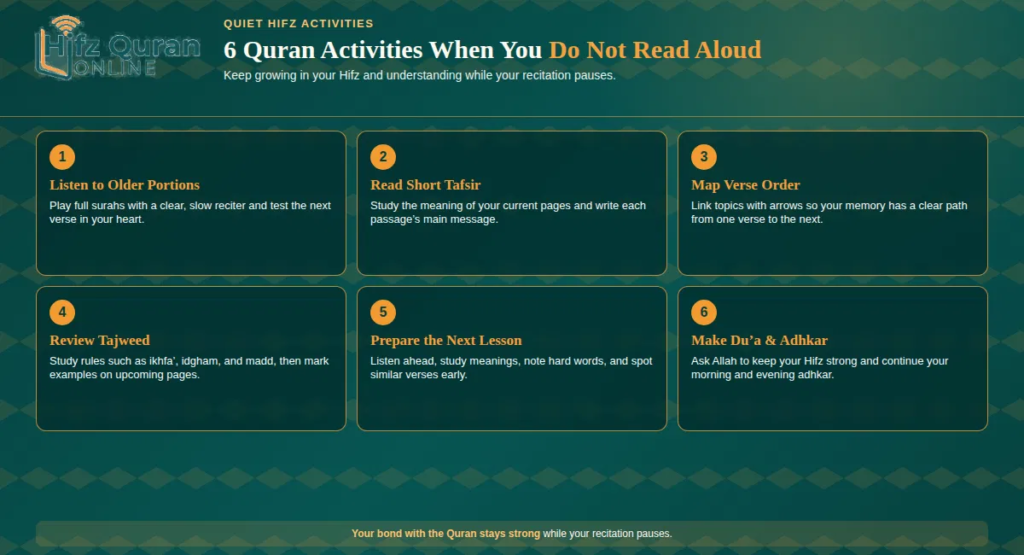
Here are six activities that do not involve reading aloud.
Listen To Your Older Portions And Full Surahs
All scholars allow listening to the Quran. Use these days to listen to the portions you memorized months ago, since they get less attention during normal weeks. Pick a reciter with clear, slow tartil, so every letter is easy to hear.
Play a full surah from start to end, so you hear how its parts connect. Try a simple test while you listen. Pause the audio and continue the next verse in your heart. Then press play to check if you were right.
Make one playlist for each juz, so it is easy to start where you stopped. Use quiet times like cooking or folding laundry to add more listening. Pay attention to where the reciter stops for breath, since these stops follow the meaning.
Set a sleep timer and let a short surah play as you fall asleep. Write down any surah where your pause test failed, so you know where to focus next. The rote memorization method for Quran explains how steady repeating builds long-term memory.
Read A Short Tafsir Of Your Current Pages
Tafsir is the explanation of the Quran. Shaykh Ibn Baz said a woman on her period may read tafsir books, even when they contain verses.
Pick a short tafsir that is easy to read. Read about the pages you are memorizing now. Write the main message of each passage in one line. When you know what a verse means, it is easier to remember. You will also feel more connected to the words.
Look for the reason a verse was revealed, if your tafsir mentions it. A real story behind a verse is hard to forget. Notice words that come back again and again on the same page. Write down one question about the meaning and ask your teacher in your next class.
Share one lesson you learned with a family member at dinner, since teaching others helps you remember too. This turns your period into time for deeper understanding.
Read also: Country With Most Quran Memorizers
Draw A Map Of The Verse Order On Each Page
Draw a simple map for each page you are learning. Write the topic of each group of verses in one or two words.
Then draw arrows from one topic to the next. This shows you which verse comes after which. Mixing up verse order is a common Hifz problem. A map gives your memory a clear path to follow.
Use one color for each type of topic, such as blue for stories and green for rules. Add a small drawing next to a topic if it helps, like a ship for the story of Nuh. Keep all your maps for one juz in the same folder.
After a few days, try to redraw a map from memory, then compare it with the first one. If two surahs feel alike, put their maps side by side to see the differences. The memory bridge method for Quran memorization shows more ways to link verses in your mind.
Review Tajweed Rules And Mark Them On Your Next Pages
Tajweed is the set of rules for reading the Quran correctly. Use these days to review rules like ikhfa’, idgham, and madd. Read the rule, then find an example in your notes. Next, look at your upcoming pages.
Mark each place where a rule appears, using a pencil and a printout. When your period ends, your reading will be more accurate from day one. Your teacher will also need to correct you less.
Pick one or two rules per day, so you do not feel overloaded. Look back at your teacher’s notes and list the tajweed mistakes you make most often.
Study a chart of where each letter comes from in the mouth and throat, called makharij. Make small flashcards with a rule on the front and an example on the back. Watch a short tajweed lesson video if a rule still feels unclear.
Prepare Your Next Hifz Lesson In Advance
Look ahead to the pages you will memorize next. Listen to them a few times. Read their meaning and write down any hard words. Check for verses that look alike, so they do not confuse you later. When you return, half the work will be done.
Split the new pages into small parts for each day after your period. Write down which part you will memorize on which day.
Read a word-by-word translation, so each Arabic word has a meaning in your mind. Find the main idea of each new page and write it at the top of your plan. Set an easy goal for your first day back, so you start with success.
If you’d like help with this plan, the teachers in Hifz Quran Online Academy’s Quran memorization course can set your daily amounts based on how fast you actually memorize.
Make Du’a And Keep Your Daily Adhkar
All scholars allow du’a during your period. Ask Allah to keep your Hifz strong and easy. Ask Him to make the Quran a light in your heart. You may also say your morning and evening adhkar as usual. Short adhkar from the Sunnah fit well into a busy day.
Choose times when du’a is more likely to be answered, such as the last third of the night. The time between the adhan and the iqamah is another good time. Keep a short du’a list in your notebook, so you do not forget what to ask for.
Make du’a for your teacher and the sisters who study with you. Add istighfar and salawat on the Prophet ﷺ to your day, since both are easy to say anywhere. Your bond with the Quran stays strong while your recitation pauses.
See Our Classes in Action
Curious about what a 1-on-1 Hifz session looks like? Take a look at these real-time snippets from our daily classes to see our student-centered approach, Tajweed correction techniques, and online whiteboard tools in action.
Memorize the Quran at Your Own Pace
Join our expert tutors and begin your Hifz journey with a personalized plan.
Start Your Free TrialJoin Hifz Quran Online Academy’s Quran Memorization Courses
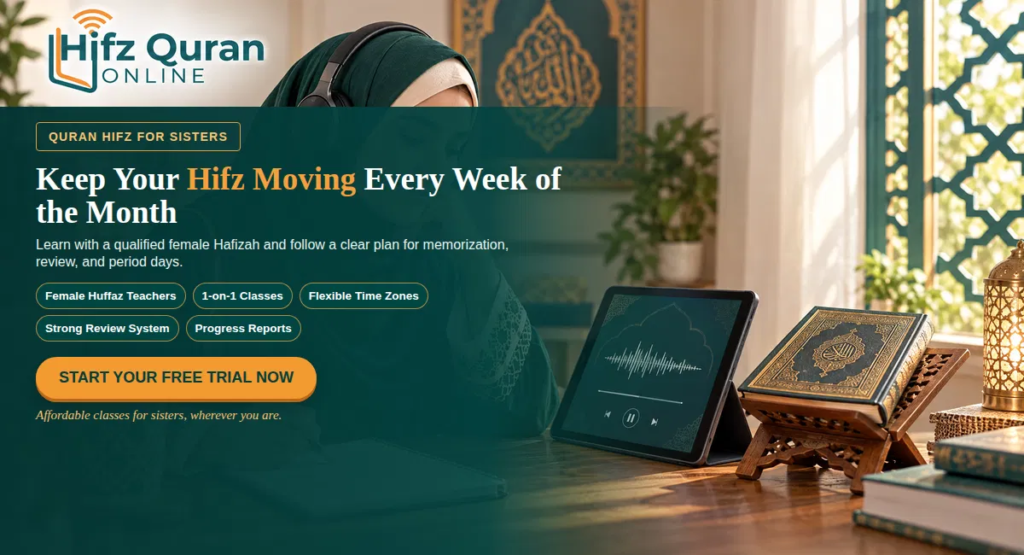
Keep your Hifz moving every week of the month. The Quran Hifz for Sisters course at Hifz Quran Online Academy gives you a clear plan for every day, including period days.
Here is what you get with Hifz Quran Online Academy:
- Female Huffaz teachers: learn with qualified sisters who have memorized the whole Quran.
- One-on-one classes: your teacher hears every letter you recite.
- Flexible times: classes fit your time zone, in the UK, the USA, or anywhere else.
- Strong review system: daily review of new pages and regular review of older ones.
- Progress reports: see how much you have memorized and how strong it is.
- Fair prices: good Hifz classes at affordable rates.
Book your free trial class today.
Our Quran Courses
Can’t decide which Quran course fits you better? Have a look at our Quran courses and decide
- Quran Memorization Course
- Quran Memorization and Hifz Course for Kids
- Online Quran Memorization Courses for Adults
- Quran Hifz Course for Ladies
- Quran Memorization Course for Men
- Saudi-Based Quran Memorization Courses
- Hifz Teachers
Conclusion
Yes, you can keep your Hifz going during your period, but scholars differ on reading aloud. The Maliki school, Ibn Taymiyyah, and Ibn Baz allow reciting from memory, especially when you fear forgetting.
The Hanafi, Shafi’i, and Hanbali schools hold that reading aloud is not allowed. Both views come from respected scholars, and neither one should be treated as wrong.
Some activities are allowed by all scholars. You can listen to the Quran, review verses silently in your heart, read tafsir, and make du’a.
Most scholars today also allow reading from a phone, since a screen is not treated as a printed Mushaf. The four schools agree, however, that a printed Mushaf should not be touched directly, so use gloves or a clean barrier when you need it.
Your period changes how you review, not how much you care about your Hifz. Under every view, you can listen to your newest pages, read silently on a screen, and test yourself with a first-word list.
If you follow the need-based view, you can also recite your older pages and log your weak spots. If you follow the more careful view, use these days to study meaning, map verse order, review tajweed, and prepare your next lesson.
The most important step is to know which view applies to you. Follow the madhhab you already use for prayer and fasting, or ask a scholar or teacher you trust. Then share their answer with your Hifz teacher and plan your month around it. With a clear plan, every period becomes part of your Hifz routine instead of a break from it.
FAQs
Want to know more about memorizing the Quran during the period? Check these questions and answers.
Can I Memorize From A Phone During My Period?
Yes, you can use a phone to listen and review silently under every view. Many scholars say a phone is not a Mushaf.
So, according to this opinion, touching it is fine. Some Hanafi scholars still advise not to touch the screen where verses show. Reading aloud from the phone is a separate question. The need-based view allows it. The more careful view does not.
Can I Memorize Quran On My Period If I Follow The Hanafi School?
No, not by reading aloud, according to the main Hanafi position. You may still review silently in your heart. You may read with your eyes and listen to recitation.
Some Hanafi scholars allow following the Maliki view when there is a real need. Others advise against switching schools. Ask a qualified Hanafi scholar about your case.
Can I Listen To The Quran During My Period?
Yes, all scholars allow listening to the Quran during your period. You can listen at home, in the car, or while doing chores.
Listening is one of the best ways to keep your Hifz fresh. Try to use the same reciter you memorize with. Repeat the same pages often. This keeps the sound of each verse clear in your mind.
Can I Recite Ayat Al-Kursi Before Sleeping During My Period?
Yes, according to Ibn Baz and the Maliki view. They allow reading it from memory. The Shafi’i school allows saying it as dhikr, with the intention to seek protection.
In that case, the intention is not recitation. Other scholars are stricter. Follow the view of your madhhab or teacher.
Does The Same Ruling Apply After Childbirth?
Yes, scholars usually give bleeding after childbirth the same rules as a period. This bleeding is called nifas. It often lasts longer than a period. So the worry about forgetting can be greater.
Talk to your scholar early about your Hifz plan. A teacher can also help you build a review plan for these weeks. apps, and tafsir books give you other ways to stay close to the text.
How Do I Know Which View To Follow For My Hifz?
Follow the madhhab you already use for prayer and fasting. If you don’t have one, ask a scholar or teacher you trust, and tell them how much you have memorized and whether you teach or study in a class.
Once you have an answer, share it with your Hifz teacher and build your monthly plan around it.
Related Articles
Memorizing Quran







Leave a Reply