 Memorizing Quran
Learning how to memorize Surah Al Kahf becomes much easier when you stop treating all 110 verses as one enormous task. Surah Al-Kahf is the 18th chapter of the Quran, and its length makes it especially important to use a structured memorization and revision method.
You do not need to memorize the entire surah in one attempt. You can begin with the first ten verses, build familiarity through repeated listening and recitation, and then gradually expand your memorization.
The key is not memorizing as many verses as possible in a single sitting. It is building a portion that you can recite accurately tomorrow, next week, and months later.
A consistent Hifz routine combines small portions, repeated listening, active recitation, understanding, Tajweed correction, and structured revision.
Why Start Memorizing Surah Al-Kahf With the First 10 Verses?
Surah Al-Kahf is a 110-verse chapter of the Quran containing several major stories and lessons about faith, trials, knowledge, wealth, and power. These themes give you useful mental connections that can support memorization.
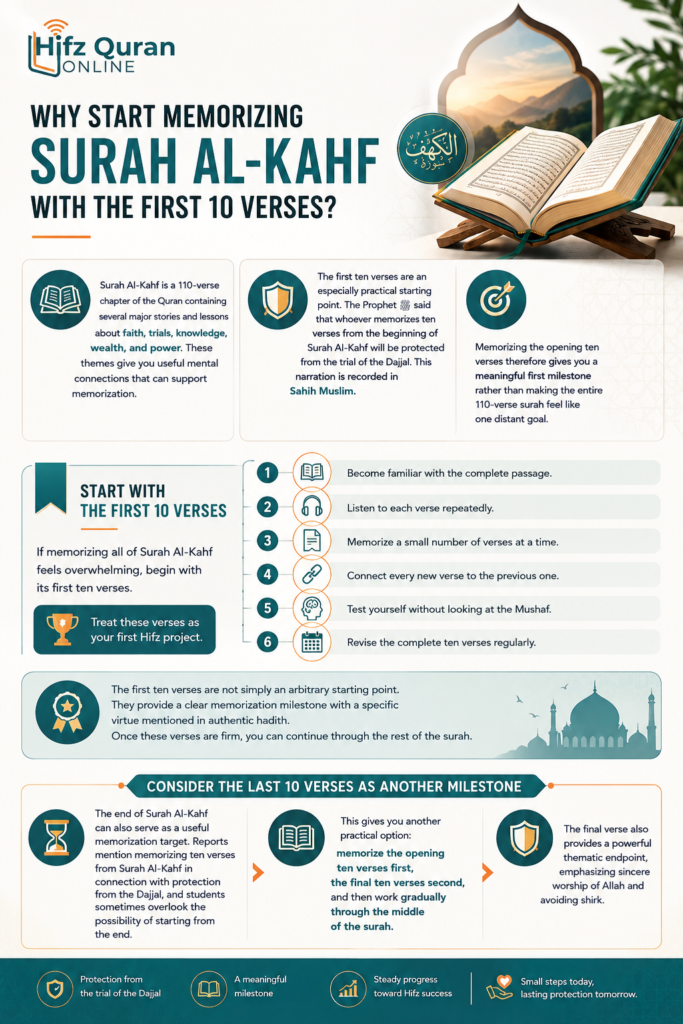
The first ten verses are an especially practical starting point. The Prophet ﷺ said that whoever memorizes ten verses from the beginning of Surah Al-Kahf will be protected from the trial of the Dajjal. This narration is recorded in Sahih Muslim.
Memorizing the opening ten verses therefore gives you a meaningful first milestone rather than making the entire 110-verse surah feel like one distant goal.
Start With the First 10 Verses
If memorizing all of Surah Al-Kahf feels overwhelming, begin with its first ten verses.
Treat these verses as your first Hifz project:
- Become familiar with the complete passage.
- Listen to each verse repeatedly.
- Memorize a small number of verses at a time.
- Connect every new verse to the previous one.
- Test yourself without looking at the Mushaf.
- Revise the complete ten verses regularly.
The first ten verses are not simply an arbitrary starting point. They provide a clear memorization milestone with a specific virtue mentioned in authentic hadith.
Once these verses are firm, you can continue through the rest of the surah.
Consider the Last 10 Verses as Another Milestone
The end of Surah Al-Kahf can also serve as a useful memorization target. A second authentic narration, also recorded in Sahih Muslim, states the same protection from the Dajjal for the last ten verses of the surah.
Classical scholars such as Imam al-Nawawi reconcile the two narrations by noting that both the opening and closing sections address themes directly relevant to the trial of the Dajjal — which is why students are often encouraged to treat either end as a valid starting point.”
This gives you another practical option: memorize the opening ten verses first, the final ten verses second, and then work gradually through the middle of the surah.
The final verse also provides a powerful thematic endpoint, emphasizing sincere worship of Allah and avoiding shirk.
Virtues of Surah Al-Kahf
Surah Al-Kahf is a blessed chapter of the Quran with significant virtues established in the Sunnah. Reciting it on Friday is associated with a light that extends from one Friday to the next,a narration graded authentic by Al-Albani and recorded by al-Hakim and al-Bayhaqi while memorizing ten verses from its beginning—and according to another narration, from its end—provides protection from the trial of the Dajjal.
Its recitation is also associated with the descent of tranquility and angels. Beyond these virtues, Surah Al-Kahf offers profound lessons about overcoming major trials: the trial of faith through the story of the People of the Cave, the trial of wealth and status through the story of the two gardens, the trial of knowledge through Musa and Al-Khidr, and the trial of power and authority through Dhul-Qarnayn.
How to Memorize Surah Al Kahf Step by Step
The most effective approach is to turn memorization into a repeatable sequence rather than relying on motivation. A strong sequence is: listen → read → repeat → recite from memory → revise → connect.
1. Recite Surah Al-Kahf Frequently Before Memorizing It
Before trying to memorize a verse, become familiar with how the surah sounds.
Listen to the same passage repeatedly while following along in your Mushaf. This gives your ear time to recognize the pronunciation, rhythm, word order, and stopping points before you demand full recall from your memory.
Listening should support memorization, not replace active recitation. Combining listening with your own recitation is particularly useful for Quran memorization and Tajweed practice.
2. Choose One Mushaf and One Primary Reciter
Consistency removes unnecessary confusion.
Use the same Mushaf throughout your memorization whenever possible. The visual position of a verse on the page can eventually become part of your memory.
It is also helpful to use one primary reciter for your new memorization portions. Switching repeatedly between reciters can create competing audio patterns, especially around pauses and breath points.
For beginners, a slow, clear Murattal or teaching-style recitation is generally easier to follow than a fast recitation.
3. Understand the Meaning Before Memorizing
Understanding the meaning of a passage does not replace repetition, but it gives your memory something to connect to.
Surah Al-Kahf contains several major narratives and themes. As you move through the surah, identify what each section is about instead of treating every verse as an isolated sentence.
For example, you can create broad mental anchors around:
- The People of the Cave
- The owner of the two gardens
- Musa and Al-Khidr
- Dhul-Qarnayn
- Faith, wealth, knowledge, and power
When the meaning forms a mental map, individual verses have a context to attach themselves to.
This is particularly useful in a long surah because forgetting often happens when verses are memorized as disconnected sounds.
4. Break the Surah Into Small Portions
Do not decide that you must memorize a large block simply because you have time available.
Start with two verses at a time if you are still developing your memorization ability. Once you become more comfortable, you can adjust the portion according to your capacity.
A useful rule is:
Your daily portion should be small enough to memorize accurately and strong enough to survive the next day’s revision.
A structured Hifz approach similarly recommends adjusting daily targets to the learner’s age, concentration, and memorization capacity rather than forcing everyone to follow the same quota.
5. Use the 3:10 Hifz Technique
The 3:10 technique is a repetition method in which you recite a passage three times and then return to it after approximately ten minutes for another retrieval attempt.
For each small portion:
- Read the verse while looking at the Mushaf.
- Recite it three times carefully.
- Move away from the page for about ten minutes.
- Try to recite it from memory.
- Check your Mushaf for mistakes.
- Repeat the difficult portion.
- Connect it with the verse immediately before it.
The important part is not the number three or ten by itself. The value comes from spacing your attempts and forcing yourself to retrieve the verse without visual support.
6. Recite Aloud While Memorizing
Silent reading can create the feeling that you know a verse when you actually only recognize it.
Reciting aloud gives you another test: can your tongue produce the exact words in the correct order?
It also gives you an opportunity to notice Tajweed problems. Tajweed should be applied during memorization rather than postponed until after the entire surah has been learned. Incorrect pronunciation can become attached to the memorized text and become harder to correct later.
If you struggle with a particular letter, Madd, Ghunnah, Qalqalah, or stopping point, correct it before adding too much new material.
Read also: How to Memorize Surah Duha? – A Step-by-Step Guide
7. Close the Mushaf and Retrieve the Verse
This is where memorization actually gets tested.
After reading and repeating the verse, close the Mushaf and recite it independently.
If you forget a word, do not immediately look at the entire verse. First pause and try to retrieve the missing section. Then check the Mushaf and correct the exact point where your recall failed.
This creates a valuable distinction between recognition and retrieval.
Seeing the verse and thinking, “I know this,” is recognition.
Producing the verse when the page is no longer visible is retrieval.
Hifz requires the second skill.
8. Connect Every New Verse to the Previous One
One of the easiest ways to memorize isolated verses is also one of the easiest ways to forget how they connect.
After memorizing a new verse, recite:
Previous verse → new verse
Then:
Previous two verses → new verse
Continue expanding the chain as your portion grows.
This technique helps prevent the common problem of knowing every verse individually but becoming stuck when moving from one verse to the next.
Step Inside Our Virtual Classrooms
Don’t just take our word for it—see how our interactive sessions work! Watch the short clips below to experience our engaging teaching methods, live teacher-student interactions, and the supportive learning environment we bring to every student.
Memorize the Quran at Your Own Pace
Join our expert tutors and begin your Hifz journey with a personalized plan.
Start Your Free TrialHow to Avoid Common Surah Al-Kahf Memorization Mistakes
Memorization problems are often caused by the process rather than by a supposedly weak memory.
Memorizing Too Much in One Session
A large portion may feel impressive on the day you memorize it, but that does not mean it will remain strong.
If you repeatedly forget yesterday’s material, reduce the new portion instead of simply increasing repetition.
Switching Reciters Constantly
Using a different reciter for every session can introduce different pacing, pronunciation patterns, and stopping points.
Choose one primary reciter for each new portion and keep the audio consistent until the passage is firmly memorized and revised.
Memorizing Without Correct Tajweed
Do not wait until the end of your Hifz journey to correct pronunciation.
A memorized mistake can become a deeply established habit. This is why structured Hifz programs integrate Tajweed and Makharij correction directly into memorization sessions.
Skipping Revision When Life Gets Busy
Travel, exams, work, family responsibilities, and illness can interrupt a routine.
The solution is not to abandon the plan because you missed several days. Resume with revision first, identify what remains strong, and then restart new memorization at a sustainable level.
Relying Only on the Phone
Digital Quran tools can be excellent for listening and repetition, but your phone should support active memorization rather than replace it.
Use the device to listen, follow the text, repeat verses, and review. Then put it away and test what you actually remember.
Read also: Surah Yaseen Memorization – A Step-by-Step Plan to Learn Surah Yaseen Easily
When Should You Memorize Surah Al-Kahf With a Teacher?
Self-study can work for learners who already have strong Quran reading and Tajweed foundations. However, a qualified teacher adds something that an app or recording cannot provide: real-time correction of your recitation.

A teacher can identify whether your difficulty comes from:
- Weak Arabic pronunciation
- Incorrect Tajweed
- Poor verse-to-verse connections
- An unrealistic daily target
- Insufficient revision
- Inconsistent recall
A structured online Hifz class typically allows the teacher to listen to the day’s new portion, correct mistakes immediately, and test previous memorization as part of the same lesson.
Before starting formal Hifz, it is also worth assessing your Quran reading level. Students who still struggle with basic Arabic letters or fluent Quran reading may need Noorani Qaida or Quran reading with Tajweed first. Starting Hifz before the reading foundation is ready can cause pronunciation mistakes to become embedded in the memorized text.
Build your Hifz with expert guidance from Hifz Quran Online Academy. Learn Surah Al-Kahf step by step with expert Hifz teachers who can correct your recitation, track your progress, and help you follow a structured memorization and revision plan.

Read also: 11 Tips to Memorize Surah Al-Mulk Easily
See Our Classes in Action
Curious about what a 1-on-1 Hifz session looks like? Take a look at these real-time snippets from our daily classes to see our student-centered approach, Tajweed correction techniques, and online whiteboard tools in action.
Start Your Surah Al-Kahf Memorization Journey Today
You do not need perfect memory to begin memorizing Surah Al-Kahf.
You need a manageable portion, a consistent routine, correct recitation, and a revision system that keeps previous verses active.
Hifz Quran Online Academy can help you turn those principles into a structured memorization plan with teacher guidance, regular recitation correction, and accountability.
[Book Your Free Trial Hifz Class]
Our Quran Courses
- Quran Memorization Course
- Quran Memorization and Hifz Course for Kids
- Online Quran Memorization Courses for Adults
- Quran Hifz Course for Ladies
- Quran Memorization Course for Men
- Saudi-Based Quran Memorization Courses
- Hifz Teachers
Memorize the Quran at Your Own Pace
Join our expert tutors and begin your Hifz journey with a personalized plan.
Start Your Free TrialThe conclusion
Learning how to memorize Surah Al Kahf comes down to one shift in approach: stop treating 110 verses as a single overwhelming target and start treating them as a repeatable daily process.
Listen before you recite, understand what each section is about, memorize in small connected portions, retrieve without looking, and revise what you already know before adding anything new. The first ten verses give you a clear starting milestone, the final ten give you a second one, and the sequence in between fills in once both ends are firm.
None of the individual techniques here — the 3:10 method, verse-chaining, reciting aloud, correcting Tajweed as you go — work as one-time fixes. They work because you repeat them daily, even when the portion is small and progress feels slow. A missed week does not undo your Hifz; going back to revision before adding new material does.
The measure that matters is not how many verses you have touched but how many you can still recite accurately once the Mushaf is closed. Build Surah Al-Kahf one small, well-revised portion at a time, and the surah stops being something you are trying to memorize and becomes something you carry.
FAQs
How long does it take to memorize Surah Al Kahf?
There is no single memorization timeline for Surah Al-Kahf because the appropriate daily portion depends on your Quran reading ability, Tajweed level, concentration, and available practice time. A sustainable target is better than rushing through large portions.
Should I memorize the first 10 verses of Surah Al-Kahf?
Yes. The first ten verses are an excellent starting point, and Sahih Muslim records the hadith that whoever memorizes ten verses from the beginning of Surah Al-Kahf will be protected from the trial of the Dajjal.
Is it better to listen to Surah Al-Kahf before memorizing it?
Yes. Repeated listening familiarizes you with pronunciation, rhythm, and verse structure before you attempt active recall. However, listening should be combined with your own recitation and revision rather than used as a substitute for memorization practice.
Can I memorize Surah Al-Kahf without understanding Arabic?
Yes, you can memorize Quranic verses through listening and repetition without understanding Arabic. However, understanding the meaning gives you additional mental connections that can make a long surah easier to organize and remember.
What is the best way to retain Surah Al-Kahf after memorizing it?
The best approach is consistent revision. Continue testing previously memorized verses while learning new ones, rather than stopping revision once a passage feels familiar. Structured Hifz systems use this combination of new memorization and older revision to support long-term retention.
Should I use a Quran teacher for Surah Al-Kahf memorization?
A qualified teacher is especially valuable if you are unsure about Tajweed, pronunciation, or whether your daily target is realistic. Teacher-supervised recitation allows mistakes to be corrected before they become established memorization habits.






Leave a Reply