 Memorizing Quran
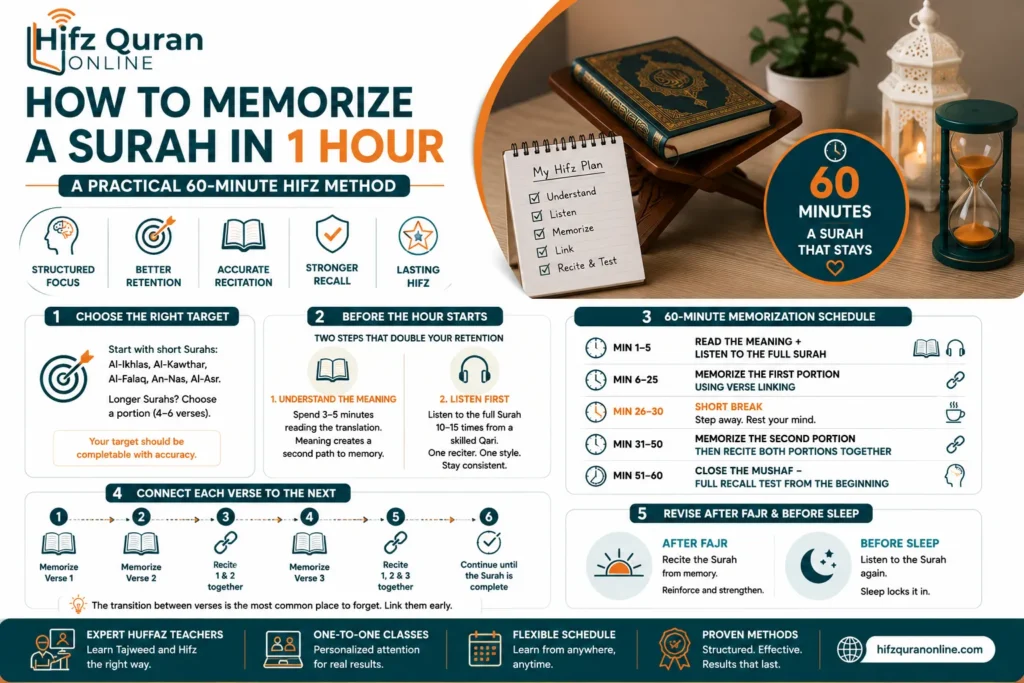
Memorizing a Surah in 1 hour is possible — but only if the hour is structured deliberately, not spent on unguided repetition.
Most people sit down with their Mushaf, set no timer, and read the same verses over and over until the hour disappears. They finish feeling like they worked hard — and forget half of it by Fajr the next morning.
The difference between a session that sticks and one that evaporates is not effort — it is structure. Knowing exactly what each minute is for, and why, is what separates memorization that holds from memorization that fades.
This guide gives you that structure, minute by minute.
1. Choosing the Right Target
The single most common reason one-hour sessions fail is mismatched expectations. Not every Surah is a realistic one-hour target, and choosing the wrong one guarantees frustration before the first repetition.
Short Surahs — Al-Ikhlas, Al-Kawthar, Al-Falaq, An-Nas, Al-Asr — are appropriate one-hour targets for beginners with developing Quran reading skills. Intermediate memorizers can attempt slightly longer Surahs such as Al-Fil or Al-Humazah. For longer Surahs like Al-Kahf or Al-Mulk, use the one-hour session to memorize a clearly defined portion — four to six verses — rather than racing through the entire chapter.
The rule is simple: your target should be completable with accuracy, not just coverage.
2. Before the Hour Starts Two Steps That Double Your Retention
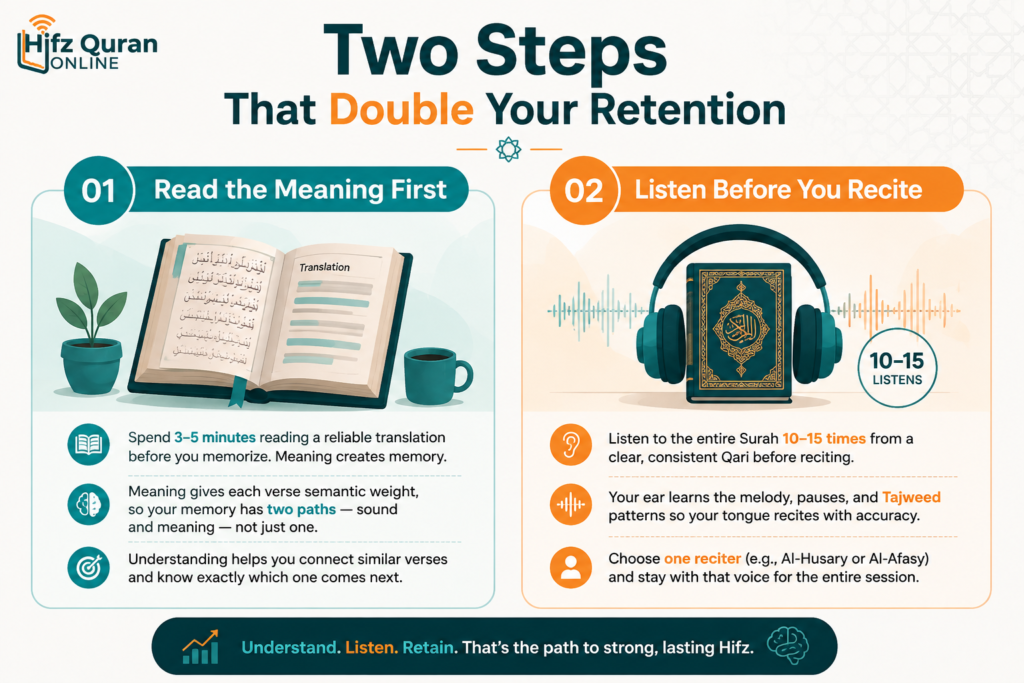
Most students open the Mushaf and begin repeating immediately. These two steps, totaling no more than eight minutes, change what your brain does with every repetition that follows — and they are the difference between memorization that holds and memorization that fades overnight.
Understand the Meaning Before You Begin Memorizing
Spend three to five minutes reading a reliable translation of the Surah before you begin any memorization. This is not optional context — it is a memory tool.
Verses without meaning are sound sequences, and sound sequences are the first thing forgotten. When you know that a verse is a command, a promise, or a description of a specific event, each word carries semantic weight. Your memory now has two retrieval paths — sound and meaning — instead of one. For Surahs with similar-sounding verses, understanding the meaning is often what tells you which verse comes next.
Listen First to Build Familiarity With the Melody and Tajweed
Play the target Surah from a clear, consistent Qari — Sheikh Al-Husary or Sheikh Al-Afasy are reliable choices — and listen to the entire passage ten to fifteen times before attempting a single repetition from memory.
The ear learns the melody, the natural pauses, and the Tajweed pattern before the tongue attempts anything. Students who skip this step often memorize with incorrect rhythm, which creates a Tajweed correction problem later that is harder to fix than starting correctly. Choose one reciter and stay with that voice for the entire session — switching between styles mid-session introduces confusion at verse transitions.
Read also: How to Memorize a Surah in 5 Minutes a Day? – A Step-by-Step Method
3. Follow This 60-Minute Schedule for Focused, Effective Memorization
Use this structure for every one-hour session. The break is not optional — five minutes of mental rest between blocks preserves focus and prevents the diminishing returns that come from uninterrupted drilling.
Before you start the timer, divide the Surah into two roughly equal portions by verse count — not by page or line. If the Surah has an odd number of verses, put the extra verse in the first portion, since the first block carries more cognitive load and benefits from a slightly lighter second half.
| Time | What to Do |
| Minutes 1–5 | Read the meaning + listen to the full Surah |
| Minutes 6–25 | Memorize the first portion using verse linking |
| Minutes 26–30 | Short break — step away from the Mushaf |
| Minutes 31–50 | Memorize the second portion using the same verse-linking method, then recite both portions together from memory |
| Minutes 51–60 | Close the Mushaf — full recall test from the beginning |
4. Connect Each Verse to the Next for Stronger Recall
Repeating individual verses is necessary but not sufficient. The most common failure point in Hifz is not knowing verses — it is hesitating at the transition between them. Verse linking is the technique that solves this directly.
Work through the Surah using this sequence, never moving forward until the current chain is stable:
- Memorize Verse 1 — recite from memory until confident
- Memorize Verse 2 — recite from memory until confident
- Recite Verses 1 and 2 together — repeat until the transition is smooth
- Memorize Verse 3 — recite from memory until confident
- Recite Verses 1, 2, and 3 together
- Continue expanding the chain verse by verse
This pattern trains your brain to remember sequences, not just isolated pieces. A student who has memorized ten verses individually but never practiced them as a chain will stall at every transition during Salah. The expanding chain prevents this entirely.
Step Inside Our Virtual Classrooms
Don’t just take our word for it—see how our interactive sessions work! Watch the short clips below to experience our engaging teaching methods, live teacher-student interactions, and the supportive learning environment we bring to every student.
Memorize the Quran at Your Own Pace
Join our expert tutors and begin your Hifz journey with a personalized plan.
Start Your Free Trial5. Spend Your Time Where Your Memory Is Weakest
Not all verses require equal repetition. A verse with familiar vocabulary may stick after five recitations. A verse with unfamiliar words or similar phrasing to another verse may need twenty-five.
The efficiency principle here is critical: do not restart the entire Surah every time you make a mistake. Isolate the specific verse or transition where you faltered, drill it, then place it back into the surrounding chain. This targeted repetition produces better results per minute than full restarts.
For newly memorized difficult verses, aim for twenty to thirty independent recitations from memory before linking. For easier verses, stop when you can recite accurately three times in a row without looking.
Working with a qualified teacher makes this targeting process faster — they hear exactly where your memory is weak before you do. The certified instructors at Hifz Quran Online guide your session in real time so no minute is wasted on material you’ve already secured. Book a free trial class today.

6. Use Active Recall Instead of Reading the Same Verses Again
The most important part of the hour is also the most skipped. Many students spend the full sixty minutes reading and repeating with the Mushaf open — then discover during Salah that they cannot recite a single verse without it.
Close the Mushaf and Recite From Memory
At the fifty-minute mark, put the Mushaf face-down and recite the entire memorized portion from the beginning. Do not look when you hesitate — give yourself ten full seconds to retrieve the verse first. The effort of struggling to remember is not failure; it is the mechanism by which memory is strengthened.
When you genuinely cannot recall a verse after a genuine attempt, open the Mushaf, locate it, recite it three times, close the book, and continue from the beginning of the chain. Mark that verse mentally — it needs additional revision tomorrow.
Test Yourself in Salah That Same Day
Perform a Sunnah prayer using the Surah you memorized in the hour. Salah creates conditions that desk review cannot replicate — standing, focused, with no Mushaf available. If you trip on a verse during prayer, you have identified your weakest point with complete precision. Return to it in your next session before adding any new material.
Read also: Memory Training Methods That Actually Work
Common Mistakes That Ruin One-Hour Sessions
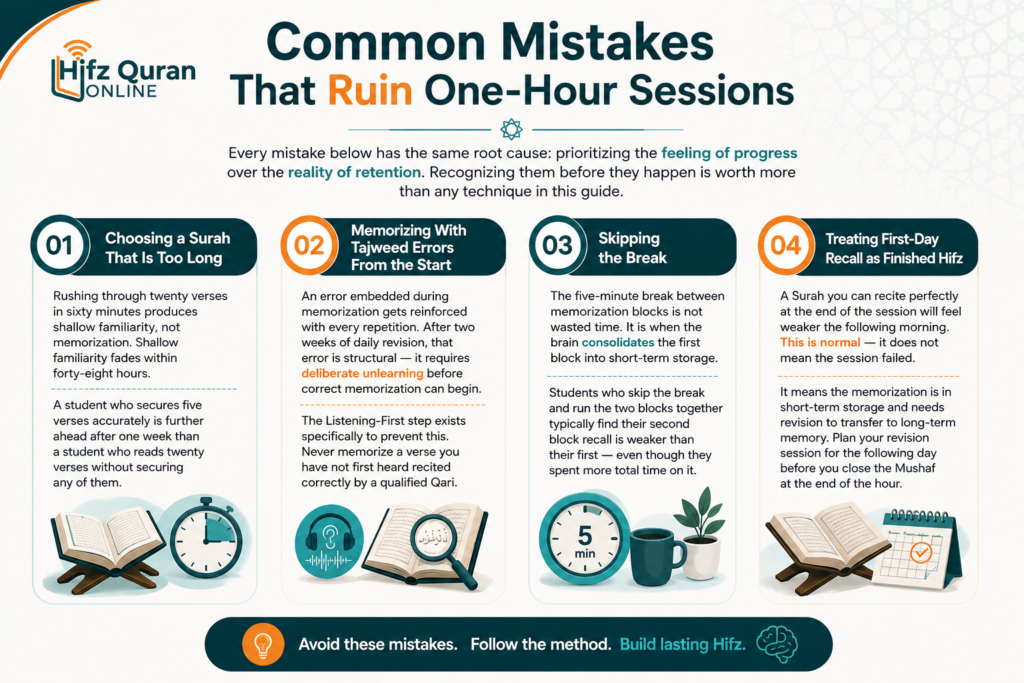
Every mistake below has the same root cause: prioritizing the feeling of progress over the reality of retention. Recognizing them before they happen is worth more than any technique in this guide.
Memorizing With Tajweed Errors From the Start
An error embedded during memorization gets reinforced with every repetition. After two weeks of daily revision, that error is structural — it requires deliberate unlearning before correct memorization can begin. The Listening-First step at the start of this method exists specifically to prevent this. Never memorize a verse you have not first heard recited correctly by a qualified Qari.
Skipping the Break
The five-minute break between memorization blocks is not wasted time. It is when the brain consolidates the first block into short-term storage. Students who skip the break and run the two blocks together typically find their second block recall is weaker than their first — even though they spent more total time on it.
Treating First Day Recall as Finished Hifz
A Surah you can recite perfectly at the end of the session will feel weaker the following morning. This is normal — it does not mean the session failed. It means the memorization is in short-term storage and needs revision to transfer to long-term memory. Plan your revision session for the following day before you close the Mushaf at the end of the hour.
When One Hour Is Not Enough?
Extend your timeline beyond one session when any of the following apply:
- The Surah contains more than ten verses and you are a beginner
- Your Quran reading is still developing and you need to sound out words
- Similar verses in the Surah are causing repeated confusion
- You cannot recite the target portion three times in a row without looking by the end of the hour
- Basic Tajweed rules are not yet applied consistently in your recitation
When you do continue across sessions, always begin the new session by testing the portion you already memorized — before adding a single new verse. What felt solid the night before will reveal its weak points in the morning. Secure what you have first, then move forward.
Slowing down is not failure. A Surah memorized correctly in three sessions is far more durable than a Surah rushed through in one. The objective is not to finish the hour — it is to build a memorization that survives daily life, distraction, and the passage of time.
Read also: 10 Tips to Memorize Long Surahs Fast and Retain Them for Life
See Our Classes in Action
Curious about what a 1-on-1 Hifz session looks like? Take a look at these real-time snippets from our daily classes to see our student-centered approach, Tajweed correction techniques, and online whiteboard tools in action.
Memorize the Quran at Your Own Pace
Join our expert tutors and begin your Hifz journey with a personalized plan.
Start Your Free TrialStart Your Hifz Journey With Expert Guidance
Memorize the Quran accurately — starting with a free session.
Without a teacher, Tajweed errors embed silently, revision schedules fall apart, and motivation drops without accountability. At Hifz Quran Online, Ijazah-certified instructors supervise your pronunciation and memorization from session one — catching what you cannot hear yourself.
Every student receives a personalized plan built around their current level, their schedule, and their memorization goals. Whether you have one hour a day or fifteen minutes, your sessions are structured to produce lasting Hifz, not temporary familiarity.
Our Quran Courses
- Quran Memorization Course
- Quran Memorization and Hifz Course for Kids
- Online Quran Memorization Courses for Adults
- Quran Hifz Course for Ladies
- Quran Memorization Course for Men
- Saudi-Based Quran Memorization Courses
- Hifz Teachers

Memorize the Quran at Your Own Pace
Join our expert tutors and begin your Hifz journey with a personalized plan.
Start Your Free TrialConclusion
Memorizing a Surah in 1 hour is realistic — when the Surah matches your level, the hour is structured deliberately, and the session ends with active recall rather than more reading.
Listen before you recite. Divide the text into small, linked portions. Spend your repetitions where your memory is weakest, not where it is already strong. Close the Mushaf for the final fifteen minutes and test yourself honestly. Then revise the following day before the short-term memory fades.
Five minutes of post-session revision the next morning protects everything the one-hour session built.
FAQs
Can you really memorize a Surah in 1 hour?
Yes — short Surahs of three to seven verses are realistic one-hour targets for students with solid Quran reading skills. Longer or unfamiliar Surahs typically require multiple sessions. The goal of a one-hour session is accurate memorization of a defined portion, not a race through an entire chapter.
What is the fastest way to memorize a Surah?
The most efficient method combines listening first, chunking the text into small portions, verse linking using the expanding chain pattern, and finishing with a closed-book recall test. Listening alone produces recognition, not recall — active retrieval is what converts listening into memorization.
How many times should I repeat a verse before moving on?
For difficult verses with unfamiliar vocabulary, aim for twenty to thirty recitations from memory before linking. For easier verses, stop when you can recite accurately three times in a row without looking. Spending equal time on every verse regardless of difficulty is one of the most common efficiency mistakes in Hifz.
Should I understand the meaning before memorizing?
Yes. Even a one-sentence understanding of what a verse discusses gives your memory a semantic anchor. This is especially useful when two verses sound similar — meaning and context tell you which comes first. Spend three to five minutes on translation before the memorization phase begins.
Is one hour enough to permanently retain a Surah?
No. One hour builds the initial memorization. Long-term retention requires revision on the following day, again three days later, and then weekly thereafter. A Surah reviewed consistently for thirty days becomes significantly more resistant to forgetting than one memorized in an hour and left unrevised.
Related Articles
Memorizing Quran







Leave a Reply