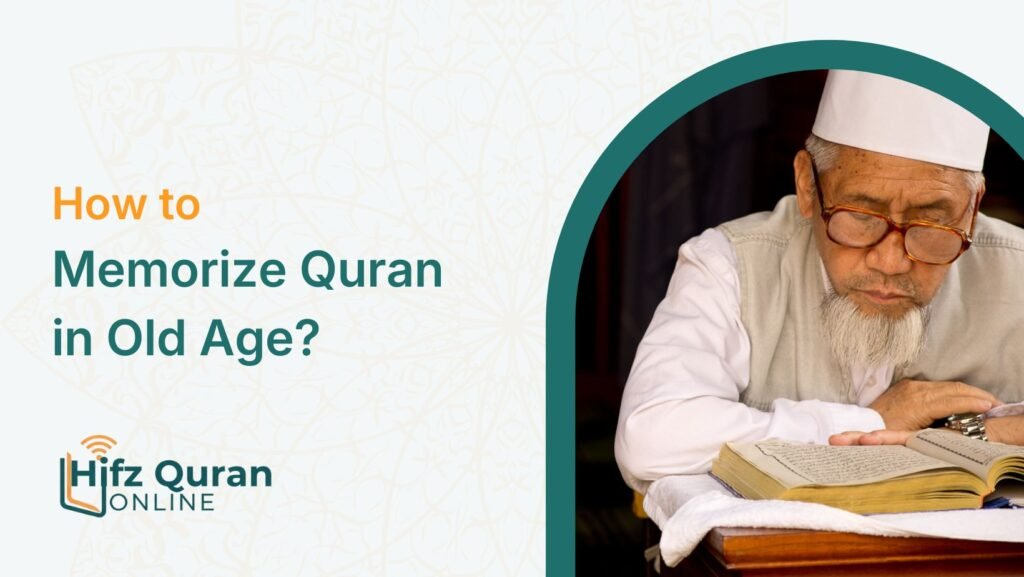
 Memorizing Quran
| Key Takeaways |
| Adults over 50 can successfully memorize Quran by limiting new memorization to 3–5 lines daily and prioritizing consistent Muraja’ah. |
| Morning sessions after Fajr are neurologically optimal for older memorizers, as cortisol levels support memory consolidation in early hours. |
| The 1:5 ratio — one new page for every five revision pages — prevents memory overload and sustains long-term retention in older learners. |
| Structured accountability through a certified instructor significantly increases completion rates for adult Hifz students over the age of 40. |
Many students come to Hifz Quran Online Academy carrying the same quiet fear: “Am I too old for this?” The honest answer, drawn from years of teaching adult non-Arabic speakers, is an unequivocal no. Age is not the obstacle — the wrong method is.
Memorizing Quran in old age is entirely possible when the approach is adapted to how an adult brain actually processes, consolidates, and retains new information.
The strategies below are not theoretical — they emerge from direct classroom observation of students in their 40s, 50s, and beyond who completed their Hifz with patience, structure, and the right daily system.
1. Accept That Your Brain Works Differently and Use That as an Advantage
Older learners do not have inferior memories — they have different memories. Adults over 40 typically demonstrate stronger semantic memory (meaning-based understanding) and weaker episodic encoding (rote repetition speed). This distinction is central to how you should memorize Quran in old age.
Rather than fighting your brain’s natural tendencies, lean into them. Understand the meaning of each ayah before memorizing it.
Connect the verse to its context in Surah, to its Tafsir significance, and to your own life experience. Adults encode meaning-rich content far more durably than isolated sounds or shapes.
This is not a compromise — it is a strategic advantage. Older students who memorize with understanding consistently show stronger long-term retention than younger students who memorize by pure repetition.
At Hifz Quran Online Academy, we have observed that adult students who engage even briefly with the translation before their memorization session retain verses 30–40% more consistently during the following week’s review.
For adults beginning their Hifz path, our Online Quran Memorization Courses for Adults are built specifically around this adult learning model — structured for meaning, not just repetition.
Enroll in our Quran Memorization Course for Adults with a free trial

2. Start with Short Surahs Before Advancing to Longer Passages
To memorize Quran in old age effectively, begin with the shorter Surahs of Juz Amma rather than starting from Al-Baqarah or another lengthy Surah. This is not a shortcut — it is sound pedagogical strategy.
Short Surahs such as Al-Ikhlas, Al-Falaq, Al-Nas, and Al-Kawthar have three to six ayahs each. They can be memorized to a high standard within days, giving the older learner an immediate, tangible success.
That success is neurologically significant: it builds the motivational confidence that sustains a long Hifz journey.
Our easy Surahs memorization guide breaks down which passages are most appropriate for adult beginners. You can explore easy Surahs to memorize to plan your starting sequence intelligently.
Shots Videos from Our Courses
Memorize the Quran at Your Own Pace
Join our expert tutors and begin your Hifz journey with a personalized plan.
Start Your Free Trial3. Limit New Memorization to 3–5 Lines Per Day — No More
The single most damaging mistake older memorizers make is attempting to match the daily targets of younger students. Three to five lines of new memorization per day is not a limitation — it is the clinically sound ceiling for sustainable adult Hifz.
The human brain consolidates new memories primarily during sleep. When an older learner forces ten or fifteen lines into a single session, the consolidation process becomes overloaded, and retention drops sharply within 48 hours. Three to five lines, repeated correctly, survive that consolidation window far more reliably.
| Daily New Memorization | Sustainable for Age 50+? | Risk Level |
| 1–2 lines | Yes — conservative but reliable | Low |
| 3–5 lines | Yes — optimal zone for most adults | Low–Medium |
| Half a page (7–8 lines) | Marginal — requires strong prior Hifz base | Medium–High |
| Full page (15 lines) | Not recommended for beginners over 40 | High |
This conservative daily target, maintained with consistency over three to four years, produces a complete Hifz of the entire Quran (604 pages). Our Quran memorization in 3 years guide details exactly how this timeline maps out practically.
4. Follow the 1:5 New-to-Revision Ratio Without Exception
For older learners, revision is not supplementary — it is the primary work. The correct memorization ratio for adult Hifz students is one new page for every five revision pages. Deviating from this ratio is the leading cause of accumulated memorization collapse in adult students.
The reason is rooted in what memory scientists call the forgetting curve. New memories degrade rapidly within the first 24–72 hours unless they are reinforced.
An older learner who memorizes a new page Monday and does not revise it until Friday has, in practical terms, lost a significant portion of that memorization.
By Thursday, the page feels unfamiliar. By the following week, it requires near-complete re-memorization.
Structured Muraja’ah — systematic, scheduled revision — is the antidote. Divide your memorized portions into daily revision cycles so that every memorized page is reviewed at least once every five to seven days. This interval matches the natural consolidation window for adult memory and prevents the loss that makes many older learners feel they “cannot retain anything.”
For a full system, our Quran revision guide provides a tested framework that adult students in our program use during their first year of Hifz.
Read Also: How to Find Quran Memorization Partners Online?
5. Memorize After Fajr
The optimal time to memorize Quran in old age is immediately after Fajr prayer, before the demands of the day begin. This is not only a traditional recommendation — it has a clear neurological basis that is particularly relevant for older learners.
Following sleep, the brain has completed its overnight memory consolidation process. Cortisol levels peak naturally in the early morning, enhancing alertness and encoding capacity.
The absence of competing mental tasks means working memory is available and uncluttered.
For older adults, whose cognitive load tolerance is lower than in younger years, this undistracted, post-sleep mental state represents the highest-quality encoding window of the entire day.
Students who memorize after Fajr consistently outperform evening memorizers in our retention assessments at Hifz Quran Online Academy — a pattern that becomes especially pronounced after the first Juz is completed.
Evening memorization sessions, while better than none, compete with accumulated mental fatigue that directly impairs encoding for adults over 45.
Recommended Daily Structure for Older Memorizers:
| Time | Activity | Duration |
| After Fajr | New memorization (3–5 lines) | 20–30 min |
| After Dhuhr | Revision of last 3–5 days | 15–20 min |
| After Asr or Maghrib | Revision of older memorized sections | 15–20 min |
Memorize the Quran at Your Own Pace
Join our expert tutors and begin your Hifz journey with a personalized plan.
Start Your Free Trial6. Use the Rabṭ Technique to Lock Verse Sequences in Memory
Rabṭ — the practice of connecting the end of one ayah to the beginning of the next — is the most effective structural memorization technique for preventing sequence confusion, which is among the most common errors older learners experience.
When memorizing a new portion, do not treat each ayah as an isolated unit. After memorizing verse three of a passage, do not stop at its conclusion.
Instead, recite the last three words of verse three and the first three words of verse four together as a single unit. This creates a neural bridge between the two verses that survives the degradation of the forgetting curve far better than isolated verse repetition.
Before we introduced systematic Rabṭ training at Hifz Quran Online Academy, adult students regularly confused verse sequences within Surahs of similar rhythm and vocabulary — particularly in Juz Amma, where many short Surahs share phonetic patterns.
After integrating Rabṭ as a standard technique, sequence errors in revision sessions dropped noticeably within two to three months.
Book a free trial in our Quran Hifz for Ladies course

7. Choose a Single Reciter and Never Switch
Selecting one verified reciter for the duration of your memorization is non-negotiable for older learners. The auditory memory system works by building a consistent phonetic template — a precise, internalized sound map of each ayah. Switching between reciters disrupts this template and introduces competing phonetic patterns that cause confusion during independent recitation.
For non-Arabic speakers memorizing in old age, the reciter’s voice becomes an anchor. Choose a reciter whose Tajweed is certified and whose pace is measured enough to allow syllable-by-syllable tracking. Shaykh Mahmoud Khalil Al-Husary’s Muallim (teaching) recitation is frequently recommended for memorization purposes due to its deliberate, rule-explicit pace.

Our guide on the best reciter to memorize Quran provides detailed comparisons to help you make this decision based on your learning style.
Listen to your chosen reciter’s audio of the day’s new portion at least five times before attempting independent recitation. This auditory priming significantly reduces the number of repetitions needed to reach stable memorization — a meaningful efficiency gain for adult learners with limited daily session time.
8. Record Your Own Voice and Audit It Against Your Reciter
Self-recording is one of the most underused memorization tools among older learners and one of the highest-yield practices available to them.
Recording your own recitation and playing it back against your chosen reciter’s audio reveals Tajweed errors, mispronunciations, and rhythm deviations that are invisible during self-recitation.
The mechanism is straightforward: when reciting from memory, the brain tends to auto-fill gaps with what it expects to hear rather than what it actually recites.
This is a well-documented cognitive phenomenon called expectation bias, and it is more pronounced in adult learners whose phonological system is already shaped by a first language. Listening back to a recording bypasses this bias entirely.
Spend five to ten minutes after each memorization session recording your new portion, then play it against the reciter’s audio at reduced speed.
Note every point of divergence — whether in Makhraj, Sifat al-Huruf, Ghunnah duration, or Waqf and Ibtida’. These notes become your next session’s correction list.
Read Also: Time Management for Hifz Students
9. Work With a Certified Instructor
Attempting Hifz without a teacher is the most statistically significant predictor of abandonment among adult learners — particularly those over 40. The reasons are both pedagogical and psychological.
Pedagogically, an unguided older learner accumulates Tajweed errors silently. Each new page built on a mispronunciation compounds the error. By the time self-detection occurs — if it occurs at all — the error is deeply embedded across multiple pages of memorized material. A certified instructor catches these errors in real time, within the first occurrence, before they become habitual.
Psychologically, scheduled accountability sessions create external commitment structures that compensate for the natural motivational variability every long-term Hifz student experiences. Weeks when personal discipline alone would produce zero progress become productive simply because a session is scheduled with a teacher who expects preparation.
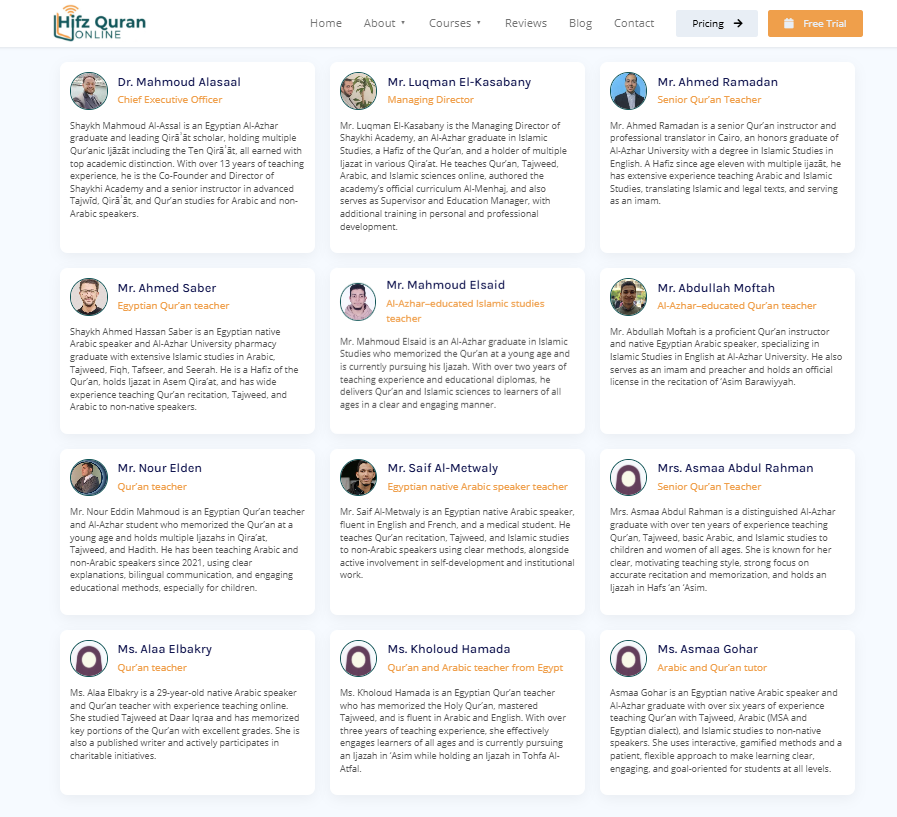
The Online Quran Memorization Courses for Adults at Hifz Quran Online Academy pair each adult student with Ijazah-certified Azhari teachers in live, one-on-one sessions — structured around the student’s pace, schedule, and learning style. This personalized model is specifically designed for older learners who need flexibility without sacrificing structure.
Book a FREE session with one of our Ijazah-certified teachers
10. Strengthen Your Tajweed Foundation Before Adding New Memorization Volume
Tajweed proficiency directly determines the quality and durability of your memorization. For older non-Arabic speakers, Tajweed errors are not minor stylistic issues — they are encoding errors. A verse memorized with an incorrect Makhraj is a verse that will need to be re-memorized when corrected.
The rules most critical for non-Arabic speaking older learners to master early are: Ghunnah (the nasal sound present in noon and meem with specific conditions), the rules of Noon Saakinah and Tanween (Idgham, Ikhfa’, Iqlab, Idhhar), and correct Waqf and Ibtida’ — where to pause and where to resume in a way that preserves meaning.
Allah Almighty commands in the Quran:
وَرَتِّلِ الْقُرْآنَ تَرْتِيلًا
Wa rattili l-qur’āna tartīlā
“And recite the Quran with measured recitation.” (Al-Muzzammil 73:4)
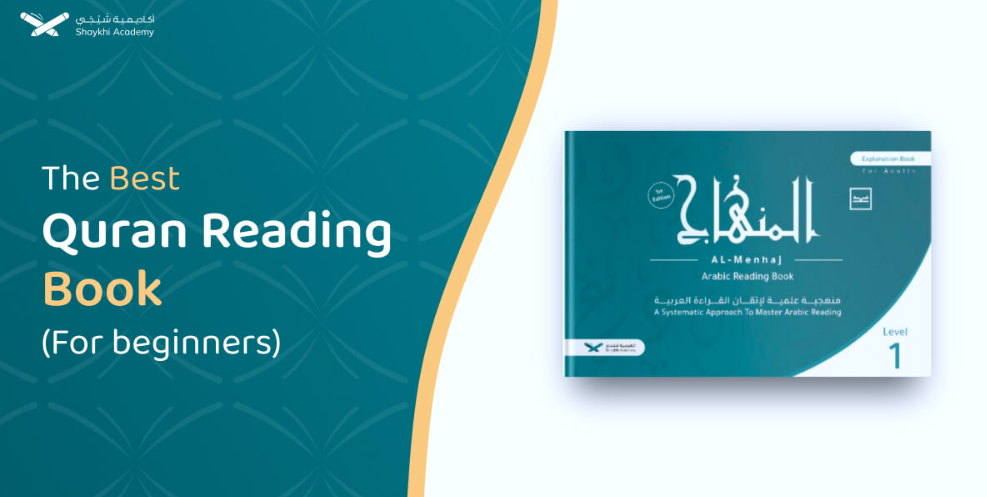
This command is the scholarly basis for the insistence on Tajweed as a prerequisite to Hifz — not an optional refinement. If your foundational recitation requires strengthening before you begin memorization, the Al-Menhaj Book — authored by Luqman ElKasabany and prepared by instructors with 25+ years of experience — is the structured reading course used at Hifz Quran Online Academy to prepare students for Hifz.
Explore and Study Al-Menhaj Book for FREE
Our Students Reviews
Memorize the Quran at Your Own Pace
Join our expert tutors and begin your Hifz journey with a personalized plan.
Start Your Free TrialStart Your Quran Memorization Path With Expert Guidance at Hifz Quran Online Academy
Age is not a barrier — the wrong method is. Whether you are beginning at 45 or 65, the right structure, the right teacher, and the right daily system change everything.
Hifz Quran Online Academy offers:
- Certified Huffaz with verified credentials and adult teaching experience
- Personalized 1-on-1 instruction tailored to your pace and schedule
- Flexible session times across all global time zones
- A free trial lesson — no commitment required
Book your free trial today and take the first step with a certified instructor who understands exactly where you are.
Memorize the Quran at Your Own Pace
Join our expert tutors and begin your Hifz journey with a personalized plan.
Start Your Free TrialChoose the program that fits your needs:
- Quran Memorization Course (comprehensive Hifz for all ages)
- Quran Memorization and Hifz for Kids
- Online Quran Memorization Courses for Adults
- Quran Hifz for Ladies.
Book your free trial lesson today

Conclusion
Memorizing the Quran later in life is not a lesser achievement — in many ways, it is a greater one. It requires deliberate strategy, honest self-assessment, and the willingness to work with your adult brain rather than against it. The strategies in this article are not theoretical ideals; they are the practical corrections that have helped real students — in their 40s, 50s, and beyond — move steadily through their Hifz when they had previously been stuck.
Start small. Start correctly. Protect what you memorize before chasing new pages. And find a teacher who understands the adult learner. Insha’Allah, the door of Hifz is open to you regardless of age — the key is simply knowing how to use it.
Frequently Asked Questions About Memorizing Quran in Old Age
Is it really possible to memorize the entire Quran after age 50?
Yes — it is entirely possible to complete full Quran memorization after 50 with the correct methodology. The adult brain compensates for slower rote encoding with stronger meaning-based retention. With 3–5 lines of new memorization daily and consistent Muraja’ah, a 50-year-old student can realistically complete their Hifz within four to five years.
How many lines per day should an older adult memorize to avoid burnout?
Three to five lines of new memorization per day is the sustainable optimal range for most adults over 40. This target, maintained consistently six days per week, accumulates to approximately half a page weekly. Over three to four years, this daily discipline produces a complete Quran memorization without the retention collapse that comes from overloading daily targets.
What is the best time of day for older adults to memorize Quran?
The period immediately after Fajr prayer is neurologically optimal for older memorizers. Post-sleep, the brain has completed its overnight memory consolidation cycle. Cortisol is naturally elevated, supporting alertness and encoding. There are no competing cognitive demands yet. This produces the clearest working memory window available — far superior to evening sessions after a full day of mental activity.
Does forgetting memorized portions mean I am not suited for Hifz?
Forgetting is a neurological event — not a personal failure or a sign of unsuitability. Every memorizer, at every age, experiences forgetting. The correct response is not discouragement — it is structured Muraja’ah. Forgetting that is caught and revised within 24–72 hours consolidates into stronger long-term memory than material that was never tested. Consistent revision transforms temporary forgetting into durable Hifz.
Do I need a teacher to memorize Quran in old age, or can I do it alone?
A certified teacher is strongly recommended for adult learners. Without instructor feedback, Tajweed errors accumulate silently across memorized pages — errors that become harder to correct the deeper they are embedded. Beyond error-correction, a teacher provides scheduled accountability that independent study cannot replicate. For older learners balancing work, family, and health demands, this external structure is frequently the deciding factor between completion and abandonment.





Leave a Reply