 Memorizing Quran
If you’ve ever sat down to memorize Quran only to find the ayāt slipping away by the next day, you’re not alone. The challenge isn’t lack of dedication — it’s lack of structure. That’s exactly what the 6446 Quran memorization method solves.
Used by Quran teachers and hifz students around the world, the 6446 method gives you a precise, repeatable system that moves each āyah from short-term recognition into long-term, confident recall. In this guide, you’ll learn exactly how it works, step by step, and how to get the most out of it.
What Is the 6446 Quran Memorization Method?
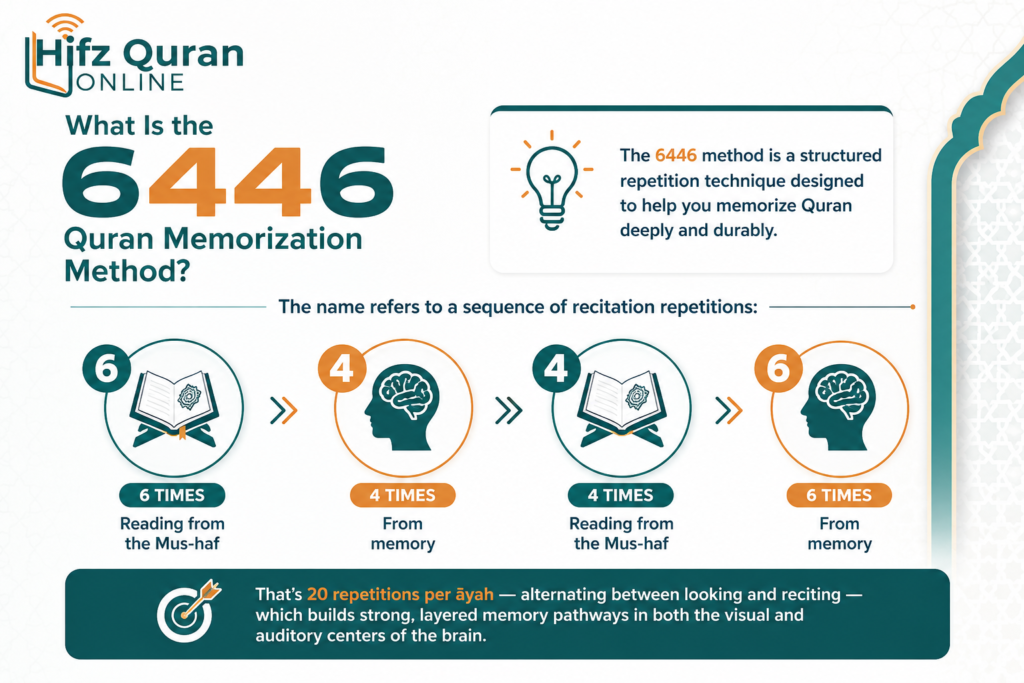
The 6446 Quran Memorization Method is a structured repetition technique designed to help you memorize the Quran deeply and durably. The name refers to a sequence of recitation repetitions:
- 6 times reading from the Mus-haf
- 4 times from memory
- 4 times reading from the Mus-haf again
- 6 times from memory again
Why Does the 6446 Quran Memorization Method Work?
The 6446 Quran Memorization Method is effective because it combines purposeful repetition with active recall. Instead of simply reading the same verses over and over, it alternates between looking at the Mushaf and reciting from memory.
This approach strengthens long-term retention by forcing the brain to retrieve information rather than just recognize it.
1. The 6446 Quran Memorization MethodUses Spaced Retrieval Practice
Memory researchers have consistently found that actively recalling information strengthens memory more than passive review alone. Every time you close the Mushaf and recite an ayah from memory, your brain works to retrieve it without visual support. That retrieval effort reinforces the memory, making it easier to recall accurately in future revision sessions.
2. It Identifies Weak Spots Early
The alternating pattern of read → recall → read → recall helps students quickly discover where their memorization is still weak. If you hesitate or make a mistake during the first four memory recitations, you immediately know which words or transitions need extra attention during the second reading phase. Instead of repeating the entire passage blindly, you reinforce the specific areas that require improvement.
3. The Hifz 6446 Method Reinforces Correct Recitation
After correcting any mistakes during the second reading phase, the final six memory recitations help establish the accurate version in long-term memory. Repeating the corrected recitation several times reduces the chance of reinforcing errors and increases confidence during future review.
4. It Encourages Active, Not Passive, Memorization
One of the biggest strengths of the 6446 Method is that every stage requires active participation. Students continuously switch between reading and recalling instead of relying on recognition alone. This keeps the brain engaged throughout the session and helps explain why many learners find they forget verses more slowly than with repetition-based memorization methods alone.
Read Also: How to Memorize Surah Jinn?
The 6446 Hifz Method Step-by-Step
The 6446 Quran Memorization Method follows a structured sequence that combines reading from the Mushaf with active recall. Each step strengthens a different stage of the memorization process, helping students build accurate, long-lasting Hifz.
Follow the steps in order, and don’t rush to the next ayah until you’re confident with the current one.
Step 1: Memorize the First Ayah Using the 6446 Cycle
Begin by opening the Mushaf to the ayah you want to memorize.
First, read the ayah six times while looking at the text. Focus on the wording, the position of the ayah on the page, and the Tajweed rules you have learned. This creates a strong visual and auditory foundation.
Next, close the Mushaf and recite the ayah from memory four times. If you hesitate or forget a word, don’t worry. Simply notice where the mistake occurred so you know what to reinforce.
Then, open the Mushaf again and read the ayah four more times, paying extra attention to the parts that caused difficulty during your memory test.
Finally, close the Mushaf once more and recite the ayah six times from memory. By the end of this stage, the ayah should feel noticeably more stable and easier to recall without looking.
Move to the next ayah only when you can recite the current one confidently and accurately from memory.
Step 2: Memorize the Second Ayah
Apply the same 6446 sequence to the second ayah:
- Read from the Mushaf 6 times
- Recite from memory 4 times
- Read from the Mushaf 4 times
- Recite from memory 6 times
Using the same process for every new ayah builds a consistent memorization routine and reduces the likelihood of weak recall later.
Step 3: Connect the First Two Ayahs
After memorizing both ayahs individually, combine them into one continuous passage.
Read the two ayahs together three times from the Mushaf, then recite them together three times from memory. This trains your brain to move smoothly between the ayahs rather than treating each one as a separate piece of information.
Many students skip this linking step, but it is essential for developing fluent, uninterrupted recitation.
Read also: The Ottoman Hifz Method – How It Works, Who It’s For, and Why It Matters
Step 4: Add the Third Ayah and Continue Building
Memorize the third ayah using the complete 6446 cycle before connecting it with the previous two.
Once it is memorized, recite Ayahs 1, 2, and 3 together three times from the Mushaf and three times from memory.
Continue using this pattern with every new ayah you learn. Memorize each new ayah individually with the 6446 cycle, then connect it with all the ayahs that came before it. This gradual expansion strengthens both individual recall and the flow of the entire passage.
Step 5: Consolidate the Entire Portion
After completing your assigned portion, finish the session by reciting the entire passage from memory at least five times. This final review reinforces the connections between all the ayahs and helps transfer the memorization into long-term memory.
Think of this as the consolidation stage. Rather than focusing on individual ayahs, you are now practicing the complete passage as a single, continuous unit, making future revision easier and more reliable.
Short-Term Review: Don’t Skip This
Memorizing an ayah with the 6446 Method is only the first step. Without regular review, even well-memorized verses can begin to fade. Short-term revision reinforces new memorization before forgetting occurs and helps move it into long-term memory.
1. Review After One Day
Revisit the portion you memorized the previous day and recite it entirely from memory. This first review strengthens recall while the memorization is still fresh and helps identify any verses that need reinforcement.
2. Review Every 3, 7, and 14 Days
Continue reviewing older portions at increasing intervals. This spaced review schedule challenges your memory just enough to strengthen retention without requiring constant repetition. It also helps prevent earlier memorization from weakening as you add new verses.
3. Repeat the 6446 Cycle When Needed
A portion is truly memorized only when you can recite it from memory with correct Tajweed, the proper verse order, and no hesitation. If you struggle with an ayah or make repeated mistakes, don’t simply review it once. Apply the full 6446 cycle again to rebuild and strengthen that memorization before moving on.
Read also: What Is the 3×3 Method for Memorizing the Quran? A Complete Guide
Step Inside Our Virtual Classrooms
Don’t just take our word for it—see how our interactive sessions work! Watch the short clips below to experience our engaging teaching methods, live teacher-student interactions, and the supportive learning environment we bring to every student.
Memorize the Quran at Your Own Pace
Join our expert tutors and begin your Hifz journey with a personalized plan.
Start Your Free TrialCommon 6446 Hifz Method Mistakes to Avoid
The 6446 Quran Memorization Method is highly effective when applied correctly. However, a few common mistakes can reduce its effectiveness and make memorization less stable. Avoiding these errors will help you build stronger recall, smoother recitation, and better long-term retention.
1. Rushing Through the Repetitions
Every stage of the 6446 cycle has a specific purpose. The reading phases build familiarity with the text, while the memory phases strengthen active recall.
Racing through the repetitions or skipping them weakens the memorization process and often leads to forgetting within a few days. Focus on quality rather than speed.
2. Ignoring Tajweed During Memorization
Incorrect pronunciation becomes much harder to fix after an ayah has been memorized. Before committing a verse to memory, make sure you are reciting it with the Tajweed rules you have already learned.
Listening to a reliable Qari, such as Sheikh Mahmoud Khalil Al-Husary, can help you establish the correct pronunciation from the beginning.
3. Skipping the Linking Step
Memorizing each ayah individually without connecting it to the previous one creates what many teachers call “memory islands.” You may be able to recite a single ayah perfectly, yet hesitate or lose your place when reciting a passage continuously. Always complete the linking stage by reciting the connected ayahs together from both the Mushaf and memory.
4. Memorizing Without Understanding the Meaning
Although understanding the meaning is not required for memorization, it provides another layer of memory that supports recall. Reading a brief Tafsir or translation before beginning your session helps you connect with the message of the verses and makes them easier to remember over time.
5. Skipping the Final 4–6 Consolidation Cycle
Some learners stop after the first 6–4 sequence because they feel they already know the ayah. However, the second 4–6 sequence is the consolidation stage of the method.
The additional reading corrects any weak areas, while the final six memory recitations reinforce the corrected version. Omitting this stage significantly reduces the long-term retention that makes the 6446 Method so effective.
Read also: Memory Training Methods That Actually Work — And How to Apply Them to Quran Memorization
Combining 6446 With Other Methods
The 6446 method pairs well with other hifz techniques:
- 6446 + 3×10: Use 3×10 to get initial exposure to new āyāt, then apply 6446 for deep consolidation.
- 6446 + Page visualization: Note the exact position of each āyah on the page. Visualizing the page layout adds a spatial memory layer that helps distinguish similar-looking āyāt.
- 6446 + daily murāja’ah: Keep a running list of previously memorized āyāt and review a set number each day alongside your new 6446 sessions.
Tracking Your Progress
Keep a simple log — a notebook or a digital app — where you record:
- Which āyāt you memorized and when
- Your review schedule (1 hour, 1 day, 3 days, 7 days, 14 days)
- Notes on which āyāt need extra attention
Apps like Quran Companion and Tarteel can support structured repetition and help you find reliable audio recitations to model your pronunciation on.
see our Quran memorization schedule guide.
Read also: The Ottoman Hifz Method – How It Works, Who It’s For, and Why It Matters
Adapting the Method for Children and Beginners
For younger learners or those new to hifz, the full 6446 cycle can feel intense. Start with shorter āyāt, reduce the joining step to 2x instead of 3x, and use positive reinforcement at each milestone. The structure remains the same — only the scale is adjusted.

See Our Classes in Action
Curious about what a 1-on-1 Hifz session looks like? Take a look at these real-time snippets from our daily classes to see our student-centered approach, Tajweed correction techniques, and online whiteboard tools in action.
Start Your Hifz Journey With Structured Support
The 6446 Quran memorization method is one of the most effective frameworks available to modern hifz students — but knowing the method and applying it consistently are two different things. Having a qualified teacher who can correct your tajweed in real time, track your progress, and guide your review schedule makes a measurable difference.
At Hifz Quran Online Academy, our certified Quran teachers work with students of all levels, using proven methods including 6446, with flexible scheduling across all time zones. Whether you’re beginning your hifz journey or returning after a break, we can help you build a system that holds.
Choose the program that fits your needs:
- Quran Memorization Course (comprehensive Hifz for all ages)
- Quran Memorization and Hifz for Kids
- Online Quran Memorization Courses for Adults
- Quran Hifz for Ladies.
Book your free trial lesson today
Memorize the Quran at Your Own Pace
Join our expert tutors and begin your Hifz journey with a personalized plan.
Start Your Free Trial
Conclusion
What sets this method apart from simply “reading an āyah many times” is intentionality. You are not just accumulating repetitions — you are alternating between looking and recalling, between input and output, in a way that forces your brain to work. That effort is the mechanism. That effort is what makes the memory last.
If you apply this method consistently — one āyah at a time, with proper tajweed, with the joining step, with short-term review — you will not just memorize Quran. You will build a relationship with it that holds.
Start today. Start with one āyah. Start with 6446.
Consistent repetition, done with intention, is how the Quran moves from the page into the heart.
Frequently Asked Questions About the 6446 Quran Memorization Method
Is the 6446 Quran memorization method suitable for beginners?
Yes. The 6446 method is beginner-friendly because it breaks memorization into small, manageable steps. New students can start with short surahs or individual ayahs and gradually increase their daily portion as their confidence and retention improve.
How many ayahs should I memorize each day with the 6446 method?
The ideal number depends on your experience and available time. Beginners often memorize one to three ayahs per session, while more advanced Hifz students may comfortably memorize larger portions. The priority should always be accurate memorization and consistent review rather than memorizing as many ayahs as possible.
How long does one 6446 memorization session take?
For one ayah, the complete 6446 cycle usually takes between 10 and 15 minutes. A session covering two or three ayahs, including the linking and review stages, typically takes 30 to 45 minutes, depending on the length of the verses.
Can I use the 6446 method without a Quran teacher?
You can practice the method independently, but learning with a qualified Quran teacher is strongly recommended. A teacher can correct Tajweed mistakes, identify weak areas in your memorization, and ensure that errors do not become permanent habits.
Does the 6446 method work for children?
Yes. The method can be adapted for children by using shorter ayahs, shorter study sessions, and frequent encouragement. Parents and teachers often reduce the daily memorization target while keeping the same structured repetition pattern.
What should I do if I keep forgetting an ayah?
If an ayah repeatedly causes difficulty, don’t simply reread it once or twice. Repeat the complete 6446 cycle for that ayah, then review it again the next day and during your scheduled 3-, 7-, and 14-day revision sessions. Consistent review is essential for long-term retention.
Is the 6446 method better than simply repeating an ayah many times?
For many learners, yes. The 6446 method alternates between reading from the Mushaf and recalling from memory, encouraging active retrieval instead of passive repetition. This structured approach helps identify mistakes, strengthen recall, and improve long-term retention more effectively than reading the same ayah repeatedly.
Can I combine the 6446 method with other Hifz techniques?
Absolutely. Many students combine the 6446 method with daily Muraja’ah (revision), page visualization, or other structured memorization techniques. The key is to maintain a consistent review schedule so that previously memorized portions remain strong while new material is added.







Leave a Reply