 Memorizing Quran
Many Huffaz face the same challenge: they memorize forward and forget backward. The Ottoman Hifz method was developed centuries ago with this problem in mind. Rather than moving through the Quran from beginning to end, it uses a rotating structure that keeps previously memorized material active while new pages are added. This guide breaks down exactly how it works and whether it might suit your situation.
What you’ll learn in this article:
- The exact structure of the Ottoman stacking system
- How revision is built into every lesson
- Who this method suits — and who it doesn’t
What Is the Ottoman Hifz Method?
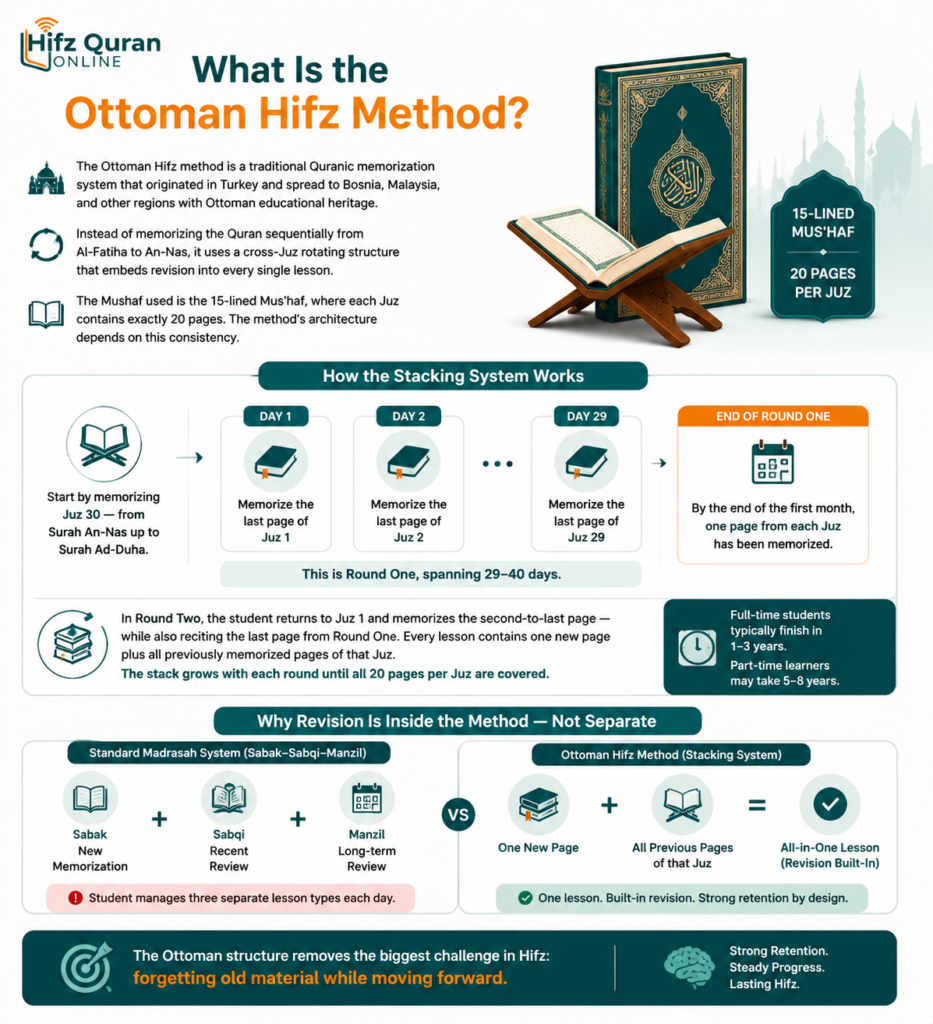
The Ottoman Hifz method is a traditional Quranic memorization system that originated in Turkey and spread to Bosnia, Malaysia, and other regions with Ottoman educational heritage. Instead of memorizing the Quran sequentially from Al-Fatiha to An-Nas, it uses a cross-Juz rotating structure that embeds revision into every single lesson.
The Mushaf used is the 15-lined Mus’haf, where each Juz contains exactly 20 pages. The method’s architecture depends on this consistency.
How the Ottoman Hifz System Works?
Steudends in the Ottoman Hifz system begin by memorizing Juz 30 — from Surah An-Nas up to Surah Ad-Duha. Once complete, the stacking System begins:
- Day 1: memorize the last page of Juz 1
- Day 2: memorize the last page of Juz 2
- Continue through all 29 Juz
By the end of the first month, one page from each Juz has been memorized. This is Round One, spanning 29–40 days.
In Round Two, the student returns to Juz 1 and memorizes the second-to-last page — while also reciting the last page from Round One. Every lesson contains one new page plus all previously memorized pages of that Juz. The stack grows with each round until all 20 pages per Juz are covered.
Why Memorization Revision Is A Part Of The Ottoman Hifz Method Not Separate ?
In the standard madrasah system — Sabak–Sabqi–Manzil — a student manages three separate lesson types each day: new memorization, recent review, and long-term review.
The Ottoman method collapses all three into one. When a student presents their lesson, they recite one new page plus every previously memorized page of that Juz in sequence. There is no separate revision session — the stacking structure is the revision.
This addresses one of the most common reasons students plateau: forgetting old material while pushing into new sections. The Ottoman structure removes that risk by design.
Read also: The 3-2-1 Memorization Method-How to Use It for Quran Hifz
Why Does The Ottoman Hifz Method Support Strong Quran Memorization Retention?
The stacking structure aligns closely with how long-term memory consolidation works. Instead of reviewing memorized pages in isolation, students revisit them repeatedly in different contexts, strengthening both recall and confidence.
Turkish academic research, including studies published on DergiPark, suggests several reasons why this approach supports stronger Quran memorization retention.
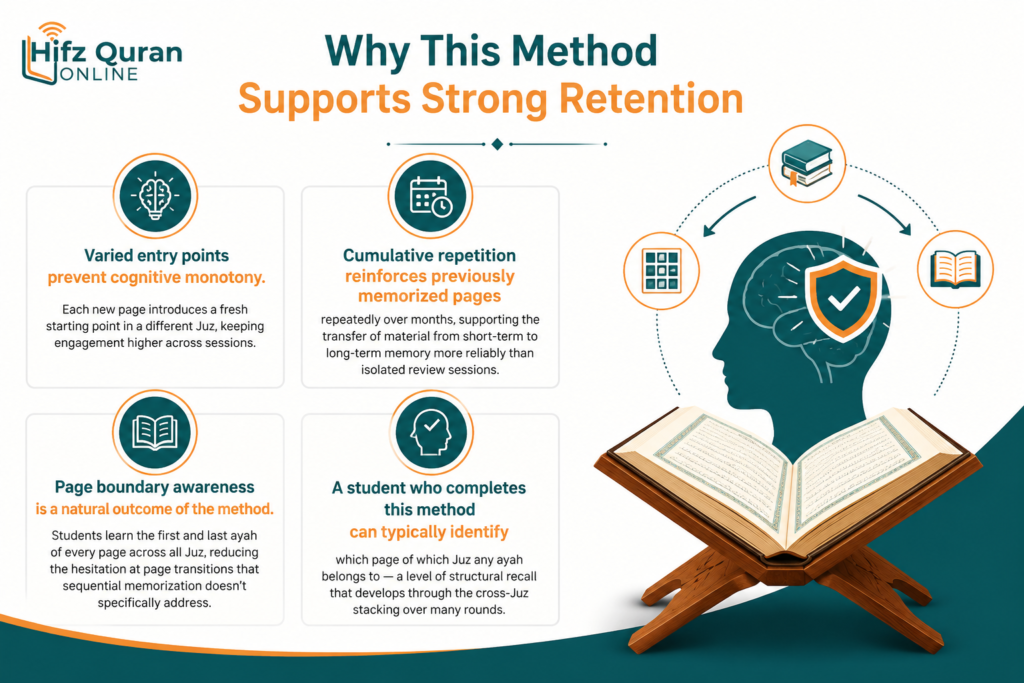
1. Varied Entry Points Prevent Cognitive Monotony
Starting each memorization session from a different Juz keeps the brain actively engaged. Rather than following the same review sequence every day, students encounter familiar pages from new starting points, reducing mental fatigue and encouraging deeper concentration. This variety helps maintain motivation throughout months of memorization.
2. Cumulative Repetition Strengthens Long-Term Retention
Every new memorization layer naturally includes material learned in previous sessions. This repeated exposure reinforces older pages without requiring separate, lengthy review sessions. Over time, these spaced repetitions help transfer verses from short-term memory into long-term memory, making recall more stable and resistant to forgetting.
3. Page Boundary Awareness Improves Recall
Because students repeatedly memorize and review complete pages across different Juz, they become familiar with the beginning and ending of every page. This awareness reduces hesitation when moving from one page to the next during recitation, a common point where many students lose confidence when using strictly sequential memorization methods.
Read also: What Is the 3×3 Method for Memorizing the Quran? A Complete Guide
Step Inside Our Virtual Classrooms
Don’t just take our word for it—see how our interactive sessions work! Watch the short clips below to experience our engaging teaching methods, live teacher-student interactions, and the supportive learning environment we bring to every student.
Memorize the Quran at Your Own Pace
Join our expert tutors and begin your Hifz journey with a personalized plan.
Start Your Free Trial4. Structural Memory Develops Across the Entire Quran
One of the strongest outcomes of the stacking method is the development of structural memory. Students gradually learn not only the words of each ayah but also where it appears within the Mushaf. After completing the full cycle, many can quickly identify the page and Juz where a verse belongs, making revision, teaching, and error correction significantly easier.
Who Should Use the Ottoman Hifz Method?
The Ottoman Hifz Method is highly structured and demands consistency, patience, and close supervision. While it has produced generations of accomplished Huffaz, it is not the most practical approach for every student.
Before committing to this system, it’s important to consider your current level, available study time, and learning goals.
The following guidelines can help you determine whether this traditional method matches your circumstances and whether another memorization approach might be a better fit.
The Ottoman Hifz Method Could Fit With the Following Conditions:
- You are memorizing full-time with consistent daily availability
- You have already completed Juz 30 with correct Tajweed
- You are consistent by nature — missed sessions disrupt the stacking sequence
- You have a qualified teacher who understands the Ottoman system
The Ottoman Hifz Method Is Not The Best Option With the Following Cases:
- If you are memorizing part-time
- If you are a beginner who has not yet completed Juz 30
- If you want to study Arabic meanings alongside memorization — the non-sequential structure makes following narrative context more difficult during the Hifz phase
Many Ottoman-trained students pursue dedicated Arabic and Tafseer programs after completing Hifz. The method focuses on precision of memorization first.
Meet our teachers and book your free trial today. Insha’Allah, your Hifz begins now.
Read Also: How to Memorize a Surah Fast?

See Our Classes in Action
Curious about what a 1-on-1 Hifz session looks like? Take a look at these real-time snippets from our daily classes to see our student-centered approach, Tajweed correction techniques, and online whiteboard tools in action.
Start Your Hifz Journey with Qualified Guidance
The Ottoman method’s results depend heavily on implementation. Without a teacher who tracks the stacking schedule, corrects Tajweed during memorization, and adjusts pacing when retention slips, the growing daily recitation load becomes difficult to manage.
Enroll in Hifz Quran Online Academyand begin your memorization with qualified teachers who guide you through structured methods — tailored to your pace and goals.
Our Quran Courses
- Quran Memorization Course
- Quran Memorization and Hifz Course for Kids
- Online Quran Memorization Courses for Adults
- Quran Hifz Course for Ladies
- Quran Memorization Course for Men
- Saudi-Based Quran Memorization Courses
- Hifz Teachers
Memorize the Quran at Your Own Pace
Join our expert tutors and begin your Hifz journey with a personalized plan.
Start Your Free Trial
Conclusion
The Ottoman Hifz method addresses a problem most systems handle separately: keeping old material alive while learning new material. By building revision into every lesson, it removes the need for a parallel review cycle and develops a detailed familiarity with the Quran’s structure.
It requires full-time commitment and a specialist teacher. For students who meet those conditions, it offers a well-structured, time-tested path to completing the Quran with confidence. Whatever method you choose, qualified guidance from day one remains the most important factor in reaching completion.
Read also: The 6446 Quran Memorization Method – A Complete Step-by-Step Guide
Frequently Asked Questions
What is the Ottoman Hifz method?
The Ottoman Hifz method is a traditional Quran memorization system that begins with the last page of each Juz and works inward across all 29 Juz simultaneously. Revision is built into every lesson through a cumulative stacking structure, removing the need for a separate review cycle.
How long does it take to complete Hifz using the Ottoman method?
Full-time students typically complete the Quran in 1–3 years. Part-time learners may take 5–8 years depending on availability and memorization pace.
How does the Ottoman method compare to the standard Juz-by-Juz approach?
The Ottoman method integrates revision into the daily lesson and builds stronger page-level structural awareness. The standard Sabak–Sabqi–Manzil system is more flexible and better suited to part-time learners. Each has genuine strengths depending on the student’s schedule and consistency.
Can the Ottoman method be used to strengthen weak Hifz after completion?
Yes. The stacking approach can be adapted for revision by grouping pages across Juz in batches — for example, 5 pages per 5 Juz daily — to systematically review the entire Quran rather than cycling Juz by Juz.
Do you need a specialist teacher to use the Ottoman method?
Yes. The stacking schedule needs careful tracking, and the daily recitation load must be managed by someone who understands the method. Attempting it without qualified guidance typically leads to sequencing errors that are difficult to correct later.
Related Articles
Memorizing Quran







Leave a Reply