 Memorizing Quran
Most people who struggle to memorize the Quran are not lacking willpower — they are using a method that doesn’t match how memory actually works. The 3:10 hifz technique directly addresses this by separating the reading phase from the recall phase, giving each the attention it needs to produce lasting retention.
This guide explains exactly what the technique is, how to apply it verse by verse, why it works at the cognitive level, and when it may need to be adapted for your stage as a student.
What you’ll learn in this article:
- The precise steps of the 3:10 hifz technique, explained clearly
- A worked example using Surah Ad-Duha so you can follow along
- Why the 10+3 ratio works — the cognitive mechanism behind it
- Common mistakes that make the method fail, and how to avoid them
- How to adapt the method if you are an experienced memorizer
Read also: Blurting Memorization Techniques Applied to Quran Hifz
What Is the 3:10 Hifz Technique?
The 3:10 hifz technique is a structured Quran memorization method in which a student reads each verse ten times while looking at the Mushaf, then recites it three times from memory.
The ten readings build proficiency in Tajweed, correct makharij, fluency, comprehension of meaning, and visual imprinting of the text. The three recitations from memory then activate recall under conditions that simulate what retention actually requires.
The ratio is not arbitrary. It reflects a deliberate split: input mode (reading with the Mushaf open) followed by output mode (reciting with the Mushaf closed).
Most memorization methods blur these two phases, which is why students feel they know a verse while looking at it, then go blank the moment the page closes.
Read also: The 7-3-2-1 Hifz Method – Full Guide
How to Apply the 3:10 Hifz Technique Step by Step
The 3:10 Hifz Technique follows a structured sequence that helps students move from recognition to confident recall. Each step has a specific purpose, and following the complete process for every verse builds stronger memorization and long-term retention.
Step 1: Read the Verse 10 Times
Begin by reading the target verse ten times while looking at the Mushaf. Focus on correct pronunciation, apply the Tajweed rules you know, and pay attention to the meaning of the verse. These repeated readings build familiarity with the words, their order, and their position on the page.
Step 2: Recite the Verse 3 Times While Looking
After completing the ten readings, recite the verse three times while still looking at the Mushaf. This stage bridges the gap between reading and memorization by encouraging active recitation without completely removing the visual support.
Step 3: Recite the Verse 3 Times from Memory
Close the Mushaf and recite the verse three times from memory. This is the active recall stage, where your brain retrieves the verse without relying on the written text. If you can complete all three recitations confidently, the verse is ready to be connected with the next one.
Step 4: Restart If You Make a Mistake
If you make a mistake, hesitate significantly, or need to look back at the Mushaf during the memory stage, reopen the Mushaf and restart the process from the beginning for that verse. Although this may seem demanding, it prevents incorrect recitation from becoming part of your memorization and reinforces accurate recall.
Step 5: Repeat the Process for the Next Verse
Once the current verse has been memorized successfully, apply the same 10–3–3 sequence to the next verse. Memorize each verse individually before attempting to connect them, ensuring that every ayah has a strong foundation.
Step 6: Connect the Verses
After memorizing several verses, recite them together as one continuous passage. Begin by reading the connected verses from the Mushaf several times, then close the Mushaf and recite the entire passage from memory. This final step strengthens the transitions between verses, improves fluency, and prepares the passage for long-term revision.
Struggling to stay consistent in your Hifz journey? At Hifz Quran Online Academy, certified instructors guide you through structured methods like the 3:10 technique in live, one-on-one sessions. Book a free trial class today →

Why Does the 3:10 Hifz Technique Work?
The effectiveness of the 3:10 ratio isn’t based on repetition alone—it’s based on how the brain builds durable memories through repeated, accurate retrieval and reinforcement.
What the 10 Readings Actually Accomplish?
The ten readings are not simply repetition for repetition’s sake. Each of the five goals has a distinct cognitive function:
- Tajweed accuracy — reading aloud ten times with rules applied creates motor memory in the tongue and lips, not just visual recognition.
- Makharij precision — repeated articulation at the correct point of pronunciation builds muscle-memory that survives fatigue and distraction.
- Fluency — the verse stops being decoded word by word and begins to flow as a unit.
- Meaning comprehension — understanding what a verse means creates a semantic anchor that makes the words far easier to retrieve than phonetic strings without meaning.
- Visual imagery — the position of the verse on the page, its shape, and its surrounding text become part of the memory trace. Many Huffaz report “seeing” the page during recitation.
Read also: The 7-3-2-1 Hifz Method – Full Guide
Step Inside Our Virtual Classrooms
Don’t just take our word for it—see how our interactive sessions work! Watch the short clips below to experience our engaging teaching methods, live teacher-student interactions, and the supportive learning environment we bring to every student.
Memorize the Quran at Your Own Pace
Join our expert tutors and begin your Hifz journey with a personalized plan.
Start Your Free TrialWhat the 3 Recall Repetitions Actually Accomplish?
Three recitations from memory activate retrieval practice — the cognitive process that has the strongest evidence base for long-term retention.
Reading something ten times builds familiarity; retrieving it from memory is what transfers knowledge into durable storage. The three recall attempts also reveal exactly which word or phrase is unstable, so the student can target it rather than blindly repeat the whole verse.
Want a teacher who applies the 3:10 technique correctly and catches your errors in real time? Hifz Quran Online Academy offers structured Hifz courses with qualified instructors available for students of all levels.
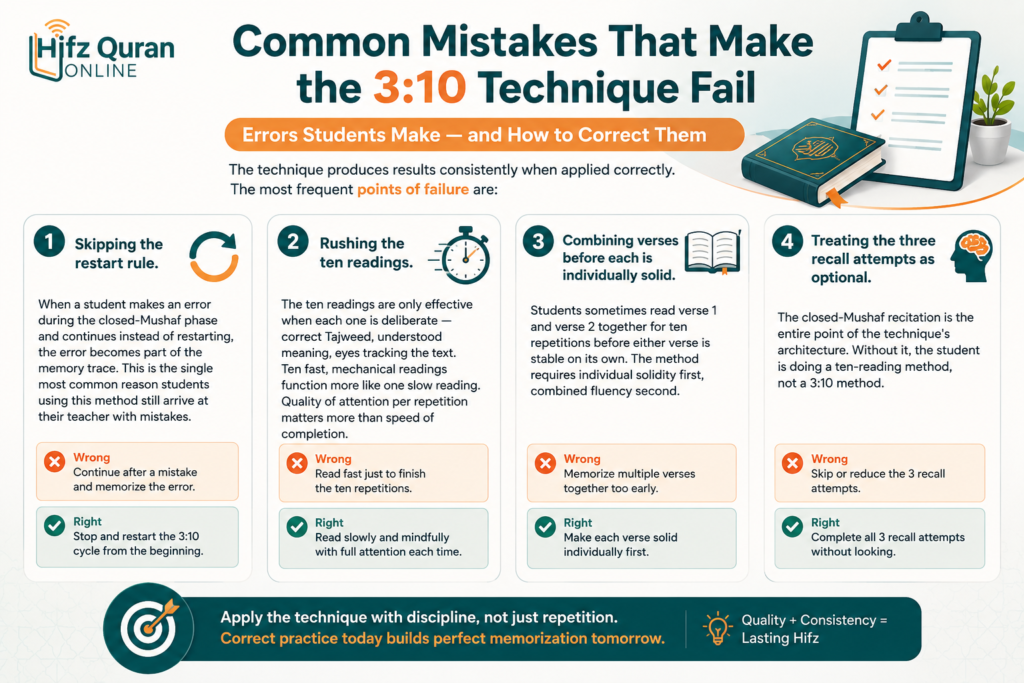
Common Mistakes That Make the 3:10 Hifz Technique Fail
The 3:10 Hifz Technique delivers consistent results when each step is followed carefully. However, a few common mistakes can weaken memorization and make verses harder to retain.
Avoiding these errors will help you build stronger recall, improve accuracy, and make your Hifz more reliable.
1. Skipping the Restart Rule
The restart rule is one of the most important parts of the 3:10 method. If you make a mistake during the closed-Mushaf recitation, simply continuing from that point reinforces the incorrect version in your memory.
Instead, reopen the Mushaf, review the verse again, and restart the memorization process for that ayah. Correcting mistakes immediately prevents them from becoming long-term habits.
2. Rushing Through the Ten Readings
The first ten readings are meant to build a strong foundation, not simply increase the repetition count.
Each reading should include careful attention to Tajweed, accurate pronunciation, and the meaning of the verse. Reading too quickly or mechanically reduces the effectiveness of the method and often leads to weaker memorization.
3. Combining Verses Too Early
Some students begin linking verses together before each one has been memorized confidently on its own. This often creates hesitation and confusion during recitation.
Memorize each verse individually using the full 3:10 process before combining it with the next verse. Strong individual memorization always comes before fluent connected recitation.
4. Skipping the Three Memory Recitations
The three recitations from memory are the core of the 3:10 Hifz Technique. They transform passive reading into active recall, which is what strengthens long-term retention. If you skip this stage, you are no longer using the complete 3:10 method.
Always complete the three closed-Mushaf recitations before moving to the next verse to ensure your memorization is accurate and durable.
Read also: The 6446 Quran Memorization Method – A Complete Step-by-Step Guide
See Our Classes in Action
Curious about what a 1-on-1 Hifz session looks like? Take a look at these real-time snippets from our daily classes to see our student-centered approach, Tajweed correction techniques, and online whiteboard tools in action.
Start Your Hifz Journey with Expert Guidance
Memorize the Quran with a Certified Teacher Who Knows This Method.The 3:10 technique is highly effective — but its results depend on applying it precisely. A single consistent error in the recall phase, uncorrected, embeds itself into long-term memory and becomes progressively harder to fix the more the verse is subsequently reviewed.
At Hifz Quran Online Academy, every student works with a qualified Hifz instructor who structures each session using proven techniques like 3:10, tracks progress, corrects Tajweed in real time, and adjusts the daily target based on actual retention — not guesswork.
You do not need to figure this out alone.
Our Quran Courses
- Quran Memorization Course
- Quran Memorization and Hifz Course for Kids
- Online Quran Memorization Courses for Adults
- Quran Hifz Course for Ladies
- Quran Memorization Course for Men
- Saudi-Based Quran Memorization Courses
- Hifz Teachers
Memorize the Quran at Your Own Pace
Join our expert tutors and begin your Hifz journey with a personalized plan.
Start Your Free TrialConclusion
The 3:10 hifz technique works because it enforces the two things that turn reading into memory: deep, accurate input through ten deliberate repetitions, and active retrieval through three closed-Mushaf recitations.
Most memorization failures happen because students skip one of these phases — either repeating without ever closing the book, or trying to recall before the verse is solid enough to retrieve.
Apply the method verse by verse, follow the restart rule without exception, and combine verses only after each one is individually stable.
For experienced students, the ratio can be adjusted — but the core structure of separated input and retrieval phases is what makes it effective at any level.
Frequently Asked Questions
What is the 3:10 hifz technique?
The 3:10 hifz technique is a Quran memorization method where each verse is read ten times with the Mushaf open — focusing on Tajweed, meaning, and fluency — then recited three times from memory with the Mushaf closed. Any error during the recall phase requires restarting the reading phase for that verse.
How long does the 3:10 technique take per page?
The time varies by student level and verse length, but most beginners should expect 45–90 minutes to complete one full page using the 3:10 method correctly. Students who feel they are completing a page in under 30 minutes are likely rushing the ten readings or skipping the individual verse process.
Is the 3:10 technique suitable for beginners?
Yes — it is particularly well suited to beginners because the ten reading repetitions build Tajweed and fluency from the start, rather than allowing bad pronunciation habits to be memorized. The structured restart rule also prevents errors from becoming embedded before they are corrected.
Can the 3:10 method be used for revision, not just new memorization?
It can, but a modified ratio is more practical for revision. Using 7:3 (seven readings, three recalls) for previously memorized verses reduces the time required while maintaining the critical retrieval-practice phase that makes revision effective.
What happens if I keep making the same error on a verse?
A persistent error on the same word typically signals either a Tajweed rule misunderstood (the pronunciation is wrong but feels right) or a mutashabihat confusion (a word from a similar verse in another Surah is intruding).
The correct response is to isolate that specific word, repeat it alone until the correct form is solid, then re-embed it into the verse. A qualified teacher can usually identify which of these two causes is responsible within a single session.
Do I need a teacher to use the 3:10 technique?
You can learn the steps independently, but a teacher is essential for catching pronunciation errors you cannot hear in yourself. Students who use the 3:10 method without teacher feedback regularly arrive at higher Juz having memorized Tajweed errors alongside the correct text — errors that take significantly longer to correct than they would have taken to prevent.
Related Articles
Memorizing Quran






Leave a Reply