 Memorizing Quran

Most students who try to memorize the Quran read a verse, repeat it a few times, and assume the job is done. Then they open the Mushaf the next day and find the verse has slipped. The problem is not effort — it is method. Passive repetition creates familiarity, not recall. And in Hifz, what you need is recall: the ability to produce a verse accurately, without prompting, under pressure.
Blurting memorization techniques solve this exact problem. Originally developed for academic study, blurting is a retrieval-practice method where you close your source, produce everything you remember, and then check your output against the original to identify gaps.
For Quranic memorization, this is not a foreign concept — it is the cognitive engine behind every classical Hifz method. The difference is in understanding why it works, and adapting it precisely to the demands of Tajweed-accurate recitation.
This article shows you how to apply blurting memorization techniques to Hifz, what mistakes to avoid, and how to build a daily system that converts passive reading into reliable, long-term retention.
What You’ll Learn in This Article
- What blurting memorization techniques are and the science behind them
- How blurting maps directly onto classical Hifz stages (Memorization (Hifz Jaded), muraja’ah, dhor)
- How to adapt blurting correctly for Quranic recitation — including the Tajweed constraint
- The four most common mistakes Hifz students make with retrieval practice
- A practical daily workflow you can start today
What Are The Blurting Memorization Techniques?
Blurting is an active recall technique in which you study a defined chunk of material, close the source completely, and write or recite everything you can remember — then immediately compare your output against the original to identify what you missed.
The underlying mechanism is retrieval practice. Every time your brain successfully retrieves a piece of information — rather than simply reading it again — the memory trace for that information strengthens.
According to cognitive science research, retrieval practice produces significantly stronger long-term retention than repeated reading of the same material. In one commonly cited pattern, 80% of students using active recall methods report better memory retention than those using passive review (Save My Exams, 2025).
Read also: The Repetitive Memorization Method In the Quran Hifz
Why Do Blurting Memorization Techniques Work for Hifz?
For Hifz students, this matters because the most common study mistake — re-reading ayat over and over — feels productive but creates what researchers call familiarity without recall. The verse looks familiar on the page. It does not come out of the mouth reliably when the page is closed.
Blurting forces the test condition every time you practice. That is exactly what Hifz requires.
How Classical Hifz Already Uses Blurting Memorization Techniques?
The traditional Hifz Quran memorization system already contains the core principles behind modern blurting memorization techniques. What may seem like a new study method is actually very close to the way effective Quran memorization has been practiced for generations.
The connection becomes clear when we look at the three essential stages of Hifz: Memorization (Hifz Jaded), Tasmie, and Dhor.
1. Build a Strong Memory Foundation With Hifz Jadeed
Memorization (Hifz Jaded) is the new lesson a student is currently memorizing. At this stage, the student carefully studies the verses, listens to correct recitation, pays attention to Tajweed and Makharij, and works to understand the meaning and sequence of the ayahs.
This is similar to the input stage of blurting. Before you can retrieve information from memory, you first need to study it carefully and build an accurate mental representation of the material.
However, studying the verses repeatedly is not enough. The real test begins when the Mushaf is closed.
2. Turn Recitation Into Active Recall With Tasmie
Tasmie is where the connection between classical Hifz and blurting memorization becomes especially clear.
Instead of looking at the Mushaf, the student recites the newly memorized portion from memory. A teacher listens carefully and identifies mistakes, forgotten words, incorrect pronunciations, or places where the student hesitates.
This is essentially blurting through recitation.
In traditional blurting, a student writes everything they can remember before checking their notes. In Hifz, the student does the same thing through oral Quran recitation: they attempt to retrieve the entire passage first and only then check where their memory failed.
Every hesitation or mistake reveals a retrieval gap that needs additional practice.
3. Make Quran Memorization Stick With Dhor and Spaced Retrieval
Dhor, or regular revision of older memorized portions, adds another important element: spaced retrieval.
After a passage has been memorized, the student does not simply repeat it continuously. The passage is revisited after increasing periods of time, forcing the brain to retrieve it when the memory is less immediately available.
This makes Dhor essential for long-term Quran memorization. A student may be able to recite a page perfectly immediately after learning it, but the real test is whether that page remains accessible days, weeks, and months later.
That is why effective Hifz requires more than memorizing new verses. It requires a structured balance between new memorization, active recall, and old revision.
Step Inside Our Virtual Classrooms
Don’t just take our word for it—see how our interactive sessions work! Watch the short clips below to experience our engaging teaching methods, live teacher-student interactions, and the supportive learning environment we bring to every student.
Memorize the Quran at Your Own Pace
Join our expert tutors and begin your Hifz journey with a personalized plan.
Start Your Free TrialWhy Many Hifz Students Struggle to Turn Repetition Into Lasting Recall
The problem is not usually the absence of a good memorization system. The problem is that students can unintentionally turn an active system into a passive one.
1. Avoid Turning Hifz Jadeed Into Passive Repetition
Students may spend too much time repeating their Hifz Jadeed while looking at the Mushaf. Although this creates familiarity with the verses, it does not always strengthen the ability to retrieve them independently.
2. Strengthen Your Memory by Testing Recall Before Checking
The key principle is simple:
Do not confuse recognizing a verse with being able to retrieve it from memory.
When you open the Mushaf at the first sign of difficulty, you are no longer fully testing your memory. You are recognizing the answer rather than retrieving it independently.
Checking the Mushaf is important—but check only after completing a genuine retrieval attempt.
3. Turn Every Mistake Into a Memory Gap You Can Fix
That retrieval attempt shows you exactly where your memory needs more work. A forgotten word, hesitation, or incorrect sequence is not simply a mistake—it identifies a retrieval gap that you can target during your next repetition.
This makes your revision more focused instead of repeatedly reviewing material you already know.
4. Build Stronger Hifz With Recall, Correction, and Revision
That is the real blurting principle behind effective Hifz:
Recall first, check second, correct the gap, and then retrieve it again.
When combined with Hifz Jadeed, Tasmie, and Dhor, this approach turns Quran memorization from repeated exposure into a structured cycle of learning, active recall, correction, and spaced revision.
Memorize the Quran at Your Own Pace
Join our expert tutors and begin your Hifz journey with a personalized plan.
Start Your Free Trial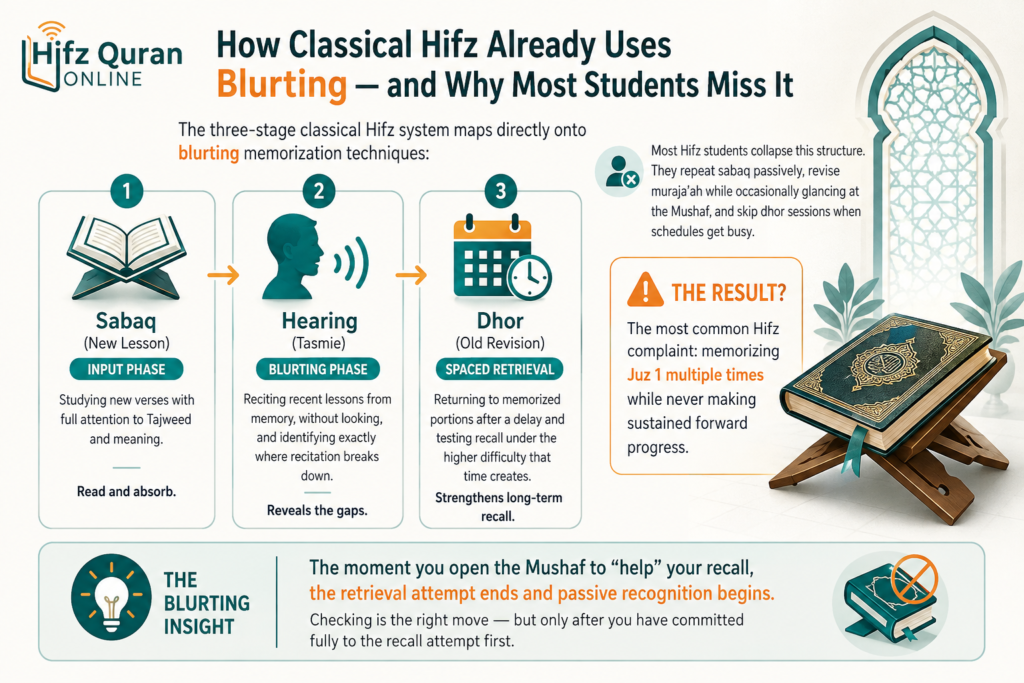
How to Adapt Blurting Memorization Techniques for Quranic Recitation
Secular blurting produces written output: you write what you remember and check against the text. Hifz blurting produces recited output — but the principle is identical. Here is the adapted method for Quran memorization.
1. Define the Right Chunk Size Before You Start
The most important decision in blurting is how much material you attempt to recall at once. For general study, one concept or one page is a reasonable chunk. For Hifz, the right chunk is usually three to five ayat — or one coherent section if the surah has natural pauses.
A full page at once produces a vague, incomplete output and teaches you nothing precise about your gaps.
Three to five ayat is large enough to require genuine effort but small enough that your gap-check afterward is specific: you know exactly which word failed, not just that “something went wrong in the middle.”
2. Close the Mushaf Completely — No Glancing
Physically turn the Mushaf face-down or close the tab if you are using a digital copy. The discomfort of not knowing a word is the signal that memory is being built.
A student who glances “just to check the start of the next phrase” interrupts the retrieval attempt and replaces it with recognition. That recognition feels satisfying in the moment and teaches nothing durable.
3. Recite Aloud Not Silently
Unlike written blurting, Hifz blurting must be oral. Silent recall does not test Tajweed accuracy, does not activate auditory memory, and does not replicate exam conditions (reciting to a teacher or in Salah). Recite with full voice.
Your ear will catch errors your internal voice cannot. This is also why experienced Hifz teachers distinguish between muraja’ah sirriyyah (silent revision, for speed and coverage) and muraja’ah jahriyyah (loud revision, for accuracy and error detection). Blurting sessions belong in the second category.
4. Mark Gaps Precisely Then Correct Only the Gap
When you open the Mushaf to compare, the rule is this: mark the specific word or phrase that failed, not the verse, not the section. Use a pencil mark or a different color.
Then close the Mushaf again and drill only that word or phrase — ten repetitions minimum — before attempting the full recall cycle again. Students who re-read the entire section when gap-filling are returning to passive review, which defeats the purpose of the session.
5. Revisit After a Delay
One blurting session does not create retention. Spacing the repetition does. Return to the same three-to-five ayat the following day and attempt the recall again — before reviewing. The difficulty you feel on day two is not a sign of failure; it is the mechanism of long-term retention. Each delayed retrieval that succeeds strengthens the memory trace more than ten same-day repetitions.
Effective blurting is more than simply closing the Mushaf and trying to remember what you studied. Adults learning Quran need a structured approach that balances memorization, Tajweed, revision, and the demands of daily life.
At Hifz Quran Online Academy, our Quran Memorization Course for Adults provides personalized guidance from qualified teachers, helping you choose manageable memorization portions, correct recitation mistakes, and build a consistent revision routine.
Read also: The Space Method for Memorizing the Quran To Retain Every Verse
Memorize the Quran at Your Own Pace
Join our expert tutors and begin your Hifz journey with a personalized plan.
Start Your Free Trial
Four Mistakes Hifz Students Make With Blurting Memorization Techniques
1. Peeking at the Mushaf Before Finishing the Recall Attempt
This is the most common and most damaging mistake. The discomfort of not remembering a word is precisely what creates a durable memory. Students who glance at the Mushaf “just to get started” cut the retrieval attempt short and replace it with recognition.
Fix: make peeking physically inconvenient. Place the Mushaf across the room, close the digital tab, or use a blank sheet of paper as a cover.
2. Blurting Too Large a Chunk
Attempting to recall an entire Juz or a full page in one session produces disorganized, incomplete output and a demoralizing gap-check.
Students who do this once conclude that blurting “doesn’t work” — when in fact the chunk size was the problem. Fix: define your blurting chunk before you review. “I am going to recall ayat 1–5 of Surah Al-Baqarah” — not “I am going to recall everything I know from Juz 1.”
3. Correcting Gaps by Re-Reading the Full Section
After identifying a missed word or phrase, many students re-read the surrounding ayat as well. This reverts to passive review and wastes the time efficiency that makes blurting valuable. Fix: mark only the specific gap with a pencil, close the Mushaf, drill the missed phrase in isolation, then run the full recall cycle again immediately.
4. Using Blurting for Material That Requires Tajweed Application, Not Just Recall
Blurting is a retrieval technique. It tests whether you can produce a verse from memory. It does not, on its own, correct Tajweed errors in your underlying recitation. A student who has learned a verse with an incorrect elongation will blurt that same incorrect elongation — and the gap-check against a written text will not catch it.
Fix: Tajweed accuracy must be established first through live teacher correction. Blurting then locks in what has been correctly learned. This is why a qualified online Hifz teacher is not optional — it is the foundation that makes blurting reliable.
Blurting can be a powerful tool for strengthening Quran memorization, but it works best when your recitation is corrected and your recall practice is structured properly.
At Hifz Quran Online Academy, our Quran Memorization Course combines guided memorization, Tajweed correction, regular revision, and personalized teacher feedback to help you build accurate, lasting Hifz.
A Practical Blurting Workflow for Hifz Students This Week
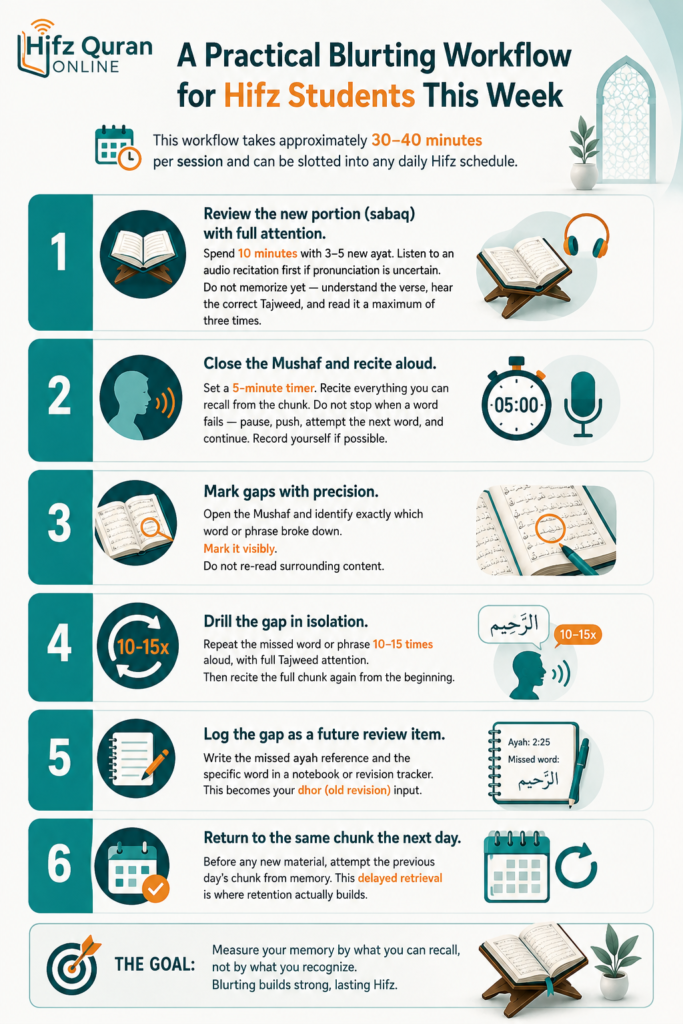
This workflow takes approximately 30–40 minutes per session and can be slotted into any daily Hifz schedule.
A Practical Blurting Workflow for Hifz Students This Week
The best way to apply blurting memorization techniques to Hifz is to keep the process simple and repeatable. The following Quran memorization workflow takes about 30–40 minutes and can be added to most daily Hifz schedules without replacing your regular Memorization (Hifz Jaded) or Dhor.
The goal is not to memorize more verses in one sitting. Instead, it is to make every memorization attempt an opportunity for active recall, error detection, and targeted revision.
Step 1 — Review Your New Memorization (Hifz Jaded) With Full Attention
Spend about 10 minutes studying 3–5 new ayat. If you are unsure about pronunciation, listen to a reliable reciter before beginning.
Do not rush into memorization. First, understand the general meaning, listen carefully to the correct Tajweed and Makharij, and observe the sequence of the verses.
Read the passage no more than three times before testing yourself. The purpose of this stage is to create a clear mental representation of the ayat—not to rely on repeated reading.
Step 2 — Close the Mushaf and Recite From Memory
Close the Mushaf and set a timer for about five minutes.
Now attempt to recite everything you can remember from the selected portion. This is the blurting stage of the Hifz process.
If you forget a word, do not immediately open the Mushaf. Pause, think about the surrounding words, attempt to retrieve the missing phrase, and continue reciting.
If possible, record your recitation. Listening to the recording afterward can help you identify hesitation, repeated mistakes, and weak transitions that you may not notice while reciting.
Step 3 — Identify Your Retrieval Gaps Precisely
Only after completing your recall attempt should you open the Mushaf.
Find the exact word, phrase, or ayah where your memory broke down. Mark it clearly in your notes or revision tracker.
Avoid rereading the entire passage at this point. The purpose of checking is not to restart the memorization process—it is to identify the specific retrieval gap that needs correction.
Step 4 — Drill the Weak Point in Isolation
Take the missed word or phrase and repeat it aloud around 10–15 times, paying close attention to Tajweed, pronunciation, and the connection between the surrounding words.
Then close the Mushaf again and recite the entire chunk from the beginning.
This second retrieval attempt is important. It confirms whether the correction has actually strengthened your memory or whether the same gap still needs attention.
Step 5 — Turn Your Mistakes Into Dhor
Record the missed ayah reference and the specific word or phrase in a notebook, spreadsheet, or Hifz revision tracker.
These mistakes should not disappear after today’s Memorization (Hifz Jaded). They become targeted items for your future Muraja’ah sessions.
Over time, your revision list becomes highly personalized. Instead of spending the same amount of time on every verse, you can give additional attention to the passages your memory consistently struggles to retrieve.
Step 6 — Test Yesterday’s Memorization (Hifz Jaded) Before Learning Anything New
The next day, begin by attempting yesterday’s portion from memory before opening the Mushaf or starting new Memorization (Hifz Jaded).
This delayed retrieval is one of the most valuable parts of the workflow. The passage is no longer completely fresh, so retrieving it requires more effort—and that effort helps strengthen long-term retention.
If you make a mistake, repeat the same process: recall first, check second, correct the gap, and retrieve again.
The Complete Hifz Blurting Cycle
The entire workflow can be reduced to one simple cycle:
Study → Close the Mushaf → Recite → Identify gaps → Correct → Recite again → Review later
This approach makes blurting for Quran memorization practical without turning Hifz into a complicated system. You are simply making the retrieval process more deliberate and using your mistakes to guide future revision.
Most importantly, remember that blurting is not a replacement for traditional Hifz methods such as Memorization (Hifz Jaded), Tasmie, and Muraja’ah . It is a way to make those stages more active by ensuring that you regularly test what you can actually retrieve without looking at the Mushaf.
See Our Classes in Action
Curious about what a 1-on-1 Hifz session looks like? Take a look at these real-time snippets from our daily classes to see our student-centered approach, Tajweed correction techniques, and online whiteboard tools in action.
Memorize the Quran at Your Own Pace
Join our expert tutors and begin your Hifz journey with a personalized plan.
Start Your Free TrialStart Your Hifz Journey With a Method That Actually Builds Retention
Most online Hifz programs give students a schedule. What they rarely give is a system — a method that tells students exactly what to recall, how to identify gaps, and when to return to difficult ayat.
Hifz Quran Online Academy’s structured program combines the retrieval-practice principles behind blurting memorization techniques with live instruction from qualified teachers who correct Tajweed errors, set precise chunk targets, and manage revision schedules so students move forward without forgetting what they have already memorized.
If you have been repeating ayat passively and wondering why retention is not sticking, a structured trial session will show you the difference within one lesson.
Our Quran Courses
- Quran Memorization Course
- Quran Memorization and Hifz Course for Kids
- Online Quran Memorization Courses for Adults
- Quran Hifz Course for Ladies
- Quran Memorization Course for Men
- Saudi-Based Quran Memorization Courses
- Hifz Teachers
[Book Your Free Trial Session]

Memorize the Quran at Your Own Pace
Join our expert tutors and begin your Hifz journey with a personalized plan.
Start Your Free TrialConclusion
Blurting memorization techniques work because they replace passive reading with active retrieval — and active retrieval is what Hifz has always required. The classical Hifz system of Memorization (Hifz Jaded), muraja’ah, and dhor is, at its core, a spaced retrieval practice. What blurting adds is precision: defined chunk sizes, complete source closure, gap-specific correction, and delayed re-testing.
The four mistakes to avoid are peeking, over-sized chunks, re-reading during gap correction, and attempting to use blurting as a substitute for Tajweed instruction. Apply the six-step daily workflow, and you will find that 20 focused minutes of retrieval practice outperforms an hour of passive re-reading — not because blurting is harder, but because it is honest about what you actually know.
Read also: How to Memorize a Surah in 5 Minutes a Day? – A Step-by-Step Method
FAQs
What is the blurting memorization technique?
Blurting memorization is an active recall method adapted for Hifz by replacing written output with oral recitation. You define a chunk of 3–5 ayat, close the Mushaf entirely, recite from memory, then identify the exact word or phrase that broke down — not the section, the word. That precision is what separates it from passive review.
Does blurting work for Quran memorization?
Yes — retrieval practice is the cognitive mechanism behind classical Hifz methods. The Memorization (Hifz Jaded)-muraja’ah-dhor cycle is structured retrieval practice. Blurting makes the process explicit by forcing full Mushaf closure and gap-specific correction rather than passive repetition.
How many ayat should I blurt at once?
Three to five ayat is the most effective chunk size for most students. A smaller chunk makes the gap-check too trivial; a larger chunk makes it too vague to act on. Adjust based on verse length — short ayat can be grouped; long ayat like the Ayatul Kursi may be one chunk on their own.
Why do I forget ayat even after repeating them many times?
Repetition while looking at the Mushaf trains recognition, not recall. You become familiar with how the verse looks, but your brain has not been forced to retrieve it independently. Switching to retrieval-first practice — blurting before re-reading — resolves this within a few sessions.
Can I use blurting for muraja’ah as well as new memorization?
Yes, and muraja’ah is arguably where blurting is most valuable. Attempt old revision entirely from memory before opening the Mushaf. The difficulty you experience on older material tells you exactly which portions need priority attention — far more precisely than reading through them in order.
Is blurting enough on its own for Hifz?
No. Blurting is a retrieval tool — it locks in material that has been correctly learned. It does not correct Tajweed errors embedded in your recitation. A qualified teacher who listens and corrects in real time is the necessary complement, because blurting will reinforce whatever is already in your memory, correct or not.
Related Articles
Memorizing Quran







Leave a Reply