 Memorizing Quran

Can you memorize the whole Quran without giving up your job, your studies, or time with your family? Yes. Learning how to memorize Quran in 4 years depends on a small daily amount, a fixed routine, and a revision system that grows as your memorization grows.
Many students start Hifz with a fast pace, memorizing a page or more every day. A few months later, older pages start slipping, revision eats into new memorization, and the plan stalls. In most cases the student was capable. The pace simply left no time to hold on to what was already memorized.
A 4-year plan avoids this by asking for about half a page a day. That amount fits around a working day or a school timetable, leaves room for daily revision, and includes spare weeks for travel, illness, or exam season.
The plan does ask for consistency. Expect about 60 minutes a day in the first year, rising to about 90 minutes by the final year, along with a teacher who hears your recitation and tests you every week.
This guide walks you through the full method in seven steps, from preparing to memorize your first page to testing your progress each Friday. It also covers what to do if you stop for a week, a month, or a year, and how to stay motivated until you reach the last page.
Step 1 – Prepare Your Reading, Your Teacher, And Your Mushaf
Get three things ready before day one. Skipping any of them usually means stopping later to fix problems that could have been avoided at the start.
Check That You Can Read The Quran Fluently With Basic Tajweed
The plan assumes you already read the Quran in Arabic accurately. Fixing pronunciation after you’ve memorized hundreds of pages is much harder than learning it correctly at the start, because every mistake is repeated hundreds of times in revision.
A simple self-check is to read one full page aloud to a teacher. If you often stop to sound out letters, mix up close sounds such as ح and ه or ق and ك, or shorten long vowels, spend more time on reading before you begin Hifz.
You don’t need advanced tajweed to start. You do need the basics: correct letter sounds, the rules of madd (elongation), ghunnah (nasal sound), and the rules of noon sakinah and tanween.
Find A Qualified Teacher To Hear And Correct Your Recitation
A teacher catches tajweed and pronunciation errors before they become habits. In the online Quran memorization course at Hifz Quran Online Academy, you recite to a personal teacher in live one-to-one classes. Students who don’t read fluently yet start with a one-month reading course.

When you choose a teacher, look for someone who listens to every new portion, not just a sample of it. They should also be able to test your older pages and adjust your plan when you fall behind.
Class frequency matters too. For full Hifz, classes on 5 to 6 days a week keep your teacher close to your daily progress, so mistakes are corrected the same week they appear.
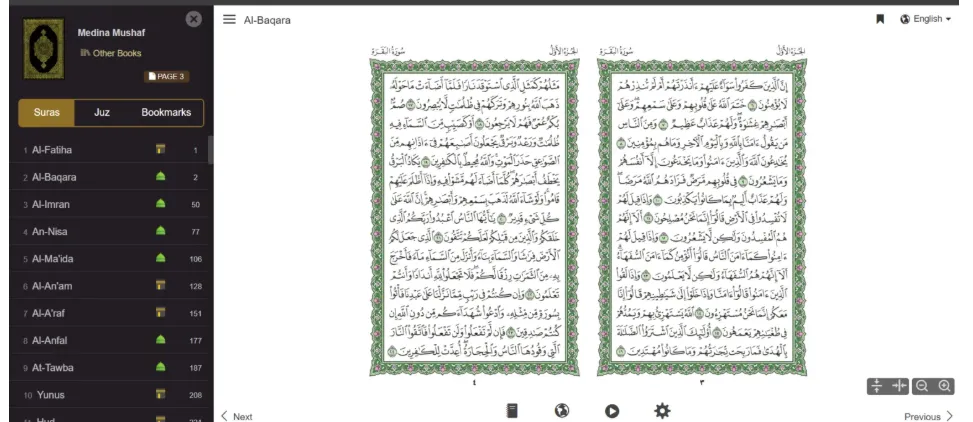
Use The Same 15-Line Madinah Mushaf For All Four Years
Pick one copy of the 15-line Madinah Mushaf and keep it until the end. Your memory ties each verse to its spot on the page, and a print with a different layout breaks those visual cues.
A paper copy works best for memorizing, since you can see the whole page at once. If you also use an app, choose one that shows the same 15-line Madinah layout.
Many teachers suggest marking repeated mistakes lightly in pencil. Over time, those marks show you which lines need extra attention during revision.

Should You Start Memorizing From Surah An-Nas Or Surah Al-Baqarah?
For most beginners, starting from Surah An-Nas and moving backward through Juz 30 is the easier choice. These surahs are short, so you finish complete surahs quickly, and many of them are already familiar from daily prayers.
Starting from Surah Al-Baqarah suits students who already read fluently and want to follow the order of the Mushaf from the first page. Its long passages are harder at first, but they give you early practice at linking pages that continue one topic.
A common middle path is to memorize Juz 30 from An-Nas backward, then continue from Al-Baqarah forward. You get early confidence from the short surahs, then follow the Mushaf order for the rest of the plan. Whichever you choose, keep the same direction for all four years so your revision rotation stays simple.
Step 2 – Set Your Daily Memorization Amount At Half A Page, Six Days A Week
To finish the Quran in 4 years, memorize about half a page a day, six days a week. That is roughly 7 to 8 lines, or 3 pages a week.
How Half A Page A Day Adds Up To 604 Pages In 4 Years
The Madinah Mushaf has 604 pages. At 3 pages a week, you need about 202 weeks to memorize them all. Four years is about 208 weeks, which leaves around 6 spare weeks for interruptions.
Thinking in juz makes the pace easier to picture. A juz is about 20 pages, so at this pace you complete one roughly every seven weeks.
Over a full year, this adds up to nearly eight juz. In a single month, it comes to about 13 pages. To check whether you’re on pace at any point, multiply the number of weeks you’ve completed by 3.
Many students also alternate between 7 lines one day and 8 lines the next, which completes exactly one page every two days. Keep the 6 spare weeks for real interruptions such as illness, travel, or exams, not for days you could have kept.
Why One Page A Day Is Too Fast For A 4-Year Plan
Many Hifz guides suggest one page a day for a 4-year plan. In fact, that pace finishes the Quran in about two years. Kept up for the full four years, one page a day would cover around 1,248 pages, roughly twice the length of the Quran.
Before following any guide’s daily amount, check how many years its plan actually covers.
| Daily amount (6 days a week) | Pages per week | Time to memorize 604 pages |
| 1 page | 6 | About 101 weeks (around 2 years) |
| Half a page | 3 | About 202 weeks (around 4 years) |
Doubling the daily amount also doubles how fast your revision load grows. Students on a one-page pace often reach the point where revision fills their whole session within the first year.
If you want a shorter timeline, read our guide on how to memorize Quran fast first. A faster pace needs a heavier revision routine to match.
A Five-Day Schedule For Students With A Busier Week
If six days of new memorization doesn’t fit your week, memorize on five days instead. Use the sixth day for revision and your weekly test, and keep the seventh for rest or catch-up. To keep 3 pages a week, raise your daily amount to about 9 lines.
For example, a student could memorize from Saturday to Wednesday, revise and test on Thursday, and rest on Friday. Choose the days that match your work or school week, then keep them fixed.
Step 3 – Follow The Four Phases Of The 4-Year Hifz Roadmap
Your new portion stays the same size for four years, but revision gets heavier as your total grows. The plan is split into four phases, and the end of each phase is also your yearly checkpoint.
| Phase | Weeks | Pages memorized | Total at end of phase | Daily time |
| 1. Foundation | 1 to 52 | 1 to 156 | 156 pages (about 26%) | About 60 min |
| 2. Building | 53 to 104 | 157 to 312 | 312 pages (about 52%) | About 70 min |
| 3. Consolidation | 105 to 156 | 313 to 468 | 468 pages (about 77%) | About 80 min |
| 4. Completion | 157 to 208 | 469 to 604, then full revision | 604 pages (100%) | About 90 min |
Year 1 – Build The Daily Habit And Choose Your Starting Surah
Decide with your teacher where to begin. Many students start with Juz 30, because its short surahs build confidence quickly. Others start from Surah Al-Baqarah to follow the order of the Mushaf.
If you start with Juz 30, a single half page often holds one or more complete surahs, so you finish whole surahs in a day. These surahs are also the ones most people recite in daily prayers, which gives you extra revision without planning it.
Starting with Al-Baqarah gives you early practice at linking pages that continue one long passage. If half a page feels heavy at first, memorize 4 to 5 lines a day for the first four weeks. This uses about two of your spare weeks while the habit settles in.
Your first few Friday tests may show more mistakes than later ones while you learn how to prepare for them. Around the six-month mark, near page 78, sit down with your teacher to confirm that your daily amount still suits you.
The main goal of year 1 is the routine itself. By the end of this phase, the four daily slots should feel like a normal part of your day, not an extra task.
Year 2 – Prepare For Longer Revision Sessions
Year 2 is usually when students first feel the weight of revision, because they now hold several juz. Your sessions will feel longer, even though your new portion stays the same.
One practical fix is to split old revision across two prayers instead of doing it all in one sitting. Reciting part of it in Maghrib and part in Isha, for example, keeps each block short and manageable.
Pages from your first months are now far behind you, and they are often the first to weaken. If your mistake log shows errors in those early pages, give them an extra place in your revision rotation. This is also a good year to ask your teacher to hear part of your old revision in class, not only your new portion.
When your evening becomes crowded, move recent revision to a lunch break or your commute and recite quietly from memory. Keep your new portion at the same size through this phase, so your yearly checkpoints stay predictable.
Year 3 – Manage Similar Verses As Revision Takes Over
In year 3, revision takes more of your day than new memorization. This is also when mutashabihat start causing mix-ups. These are verses with almost identical wording in different surahs.
Keep a written list of each similar pair, noting the exact word or phrase that differs. Review the list with your teacher once a month, and recite both verses one after the other so the difference stays clear.
The story of Prophet Musa, for example, appears in several surahs, including Al-A’raf, Ta-Ha, and Ash-Shu’ara, with small changes in wording.
When a new verse reminds you of one you memorized earlier, turn back to the earlier one the same day and compare them. Some students also make up a short reminder for each pair, such as which surah uses which word.
Your Friday tests may now show more mix-up mistakes than before, which is normal at this stage. Ask your teacher to include some of these similar pairs in your monthly random test as well.
Year 4 – Finish The Last Pages And Revise The Full Quran
You memorize the final 136 pages in about 46 weeks and finish new memorization around week 202. Weeks 203 to 208 are for revision only. The goal is to recite the full Quran from memory every three to four weeks.
The last juz you memorize have had the least revision, so give them extra time in your rotation during the final weeks. As each new juz joins your memorization, practice the move from the end of one juz into the start of the next.
During these final weeks, recite larger sections to your teacher in one sitting, such as a full juz. Longer recitations show whether you can move smoothly from one surah to the next without help.
Make a list of the surahs you found hardest over the four years, and give each one its own review day between weeks 203 and 208. If you used your spare weeks earlier, talk to your teacher about moving your finish date instead of cutting this revision period short.
Have a closer look inside our real classes
Watch how our teachers help children build strong recitation skills in the Quran Learning Course for Kids at Hifz Quran Online Academy. In this lesson, a young student learns to recite Surah Al-Qiyamah correctly, verse by verse, with guidance from the teacher.
Memorize the Quran at Your Own Pace
Join our expert tutors and begin your Hifz journey with a personalized plan.
Start Your Free TrialRead also: How to Memorize Quran in 5 Years?
Step 4 – Fix Your Daily Time Blocks For New Memorization And Revision
A fixed timetable is easier to keep than searching for free time each day. Split your 60 to 90 minutes into four slots, give each slot one job, and tie each one to a time you can protect.
| Slot | When | Task | Phase 1 | Phase 4 |
| 1. New | After Fajr | Memorize today’s half page | 25 min | 25 min |
| 2. Recent | After Dhuhr or Asr | Revise the last 7 days | 10 min | 15 min |
| 3. Old | Between Maghrib and Isha, or in sunnah prayers | Revise older pages | 20 min | 40 to 45 min |
| 4. Preview | Before sleep | Listen to tomorrow’s portion and read its tafsir | 5 min | 5 min |
| Total | About 60 min | About 90 min |
Why New Memorization Goes In The Early Morning Slot After Fajr
Early morning usually brings the fewest interruptions of the day, before messages, work tasks, and plans start competing for your attention. Giving this time to new memorization means your hardest task gets your clearest focus.
The Prophet (peace be upon him) also asked Allah to bless his community in its early mornings (Sunan Abu Dawud and Jami at-Tirmidhi). Because you listened to the portion the night before in your preview slot, the verses already sound familiar when you sit down.
If you usually sleep after Fajr, memorize first and rest afterward. If your mornings are taken by work or school runs, choose the calmest time you have later in the day.
Night-shift workers can use the first hour after waking, which works the same way. Try to avoid memorizing right after a heavy meal or late at night, when it’s harder to concentrate.
How To Protect Your Time Slots On Work And School Days
Follow these steps to keep your four daily slots in place, even on your busiest days.
- Link each slot to a prayer. This gives every slot a fixed start time that doesn’t move, including on weekends and holidays.
- Keep your Mushaf where you pray. Place a bookmark on tomorrow’s portion so you can begin straight after salah.
- Tell your family or housemates your slot times. When they know your schedule, they’re less likely to interrupt you.
- Put your phone on silent during new memorization. Even short breaks in concentration undo the repetition that fixes a chunk in your memory.
- Set a timer for each slot. It shows you exactly when to stop, so your Hifz doesn’t spill into other duties.
- Make up a missed slot after the next prayer. Moving it is better than dropping it for the day.
- Tick off each slot on a daily checklist. Four boxes, one for each slot, show at a glance whether anything was missed and give you a small sense of progress every day.
What To Do On A Busy Day When You Only Have 30 Minutes
Skip the new portion and split the time into about 10 minutes for recent revision and 20 minutes for old revision. Delaying a new portion by one day costs very little. Relearning a forgotten page can take a week. On days with less time than that, give whatever minutes you have to recent revision alone.
Don’t double your new portion the next day to make up for it. Instead, spread the missed lines over the following days, adding a line or two to each portion. Mark the skipped day on your checklist so you can spot patterns over time.
If you know a busy day is coming, do your evening preview anyway so the next morning starts smoothly. If busy days happen more than twice a week, talk to your teacher about switching to the five-day schedule.
Step 5 – Memorize Each Half Page In 25 Minutes With A Five-Part Method
Follow the same routine every morning. Once the routine becomes familiar, you stop thinking about the process and can give all your attention to the verses.
A. Listen To A Clear Reciter 2 To 3 Times Before Reading (3 Minutes)
Play your portion 2 to 3 times from a reciter with a clear, measured style, such as Sheikh Al-Husary or Sheikh Al-Minshawi. Our guide to the best reciter to memorize Quran compares the most common choices.
Give the recitation your full attention instead of playing it in the background while you do other things. Sheikh Al-Husary’s Muallim (teaching) recording is a popular choice, because it was recorded at a slower pace for learners. Many Quran apps also let you repeat a single verse a set number of times, which saves you from scrolling back.
Follow along in your Mushaf while you listen. Hearing the verses and seeing them on the page at the same time gives your memory two cues to hold on to.
Notice where the reciter pauses, since these stops often mark good places to split your chunks. Listen closely to how long each vowel is stretched, so you can match the same lengths when you recite.
Stick with one reciter for your new memorization. Switching between reciters with different pacing can make it harder to settle on one rhythm for each verse.
B. Split The Page Into 3-Line Chunks And Repeat Each One (15 Minutes)
Break your half page into chunks of about 3 lines. Read each chunk over and over until you can say it with your eyes closed. Then move on to the next one.
There’s no fixed number of repetitions, and harder chunks will simply need more. After each round, cover the page with your hand and test yourself before reading again. If a chunk still won’t stick, make it smaller, even a single line.
Recite out loud, not silently. Saying the words aloud also lets you hear your own mistakes as soon as you make them. Pay attention to the first word of each line, because it often brings the rest of the line back to mind. Keep the same speed and tone each time you repeat, so the rhythm stays consistent.
If a chunk ends in the middle of a verse, extend it to the end of that verse. Stopping halfway makes it harder to link the chunks later.
C. Link The Chunks Together And Practice The Joins Between Verses (4 Minutes)
Recite all the chunks in order without looking. Focus on the point where one verse ends and the next begins, since most students get stuck there.
Build the links step by step: join the first and second chunks, then add the third. Once today’s portion flows, connect it to the last verse you memorized yesterday. When you complete a full page, recite the whole page once from start to finish.
When you stall at a join, recite the last few words of the earlier verse together with the first few words of the next one several times. Practicing the join on its own fixes the gap faster than repeating the whole portion.
The move from the bottom of one page to the top of the next is a common weak spot, so practice it on its own. If you stall at the same join more than once, recite it at the start of your recent revision for the next few days.
D. Recite The Full Portion From Memory To A Listener (3 Minutes)
Recite the whole portion to your teacher, a family member, or a study partner. A listener will catch skipped or swapped words that you won’t notice on your own.
A family member doesn’t need to know tajweed to help, because they only have to follow the words in the Mushaf. Ask them to note any mistakes and tell you at the end, so you practice reciting without stopping. Always begin from the first verse of the portion, so the order stays fixed in your memory.
Recite at your normal pace, not faster, since rushing hides mistakes. After each correction, repeat the corrected line several times before you finish the session.
If no one is available, record yourself and play it back while following in the Mushaf. This is less reliable than a live listener, but it still catches most skipped words.
E. Read The Meaning Of Tomorrow’s Verses The Night Before
During your evening preview slot, read a short explanation of tomorrow’s verses, such as Tafsir al-Sa’di. Once you know what the verses say, their order is easier to remember.
Tafsir al-Sa’di is also available in English translation, so you don’t need to read Arabic to use it. As you read, notice who is speaking in the passage and who is being addressed. Write the main topic in a few words in your notebook, next to the page number.
You don’t need to study the tafsir in depth. A few minutes on the main meaning of the passage is enough to give the verses a clear sequence in your mind.
This understanding helps later too, because when you forget a verse during revision, you can recall what comes next in the meaning. It also lets you reflect on the verses when you recite them in prayer.
Step 6 – Revise In Three Layers Every Day To Protect What You Memorize
The 3-layer revision system divides your daily Quran time into new memorization, recent revision, and old revision. Each layer protects pages at a different stage, so no page goes long without being recited.
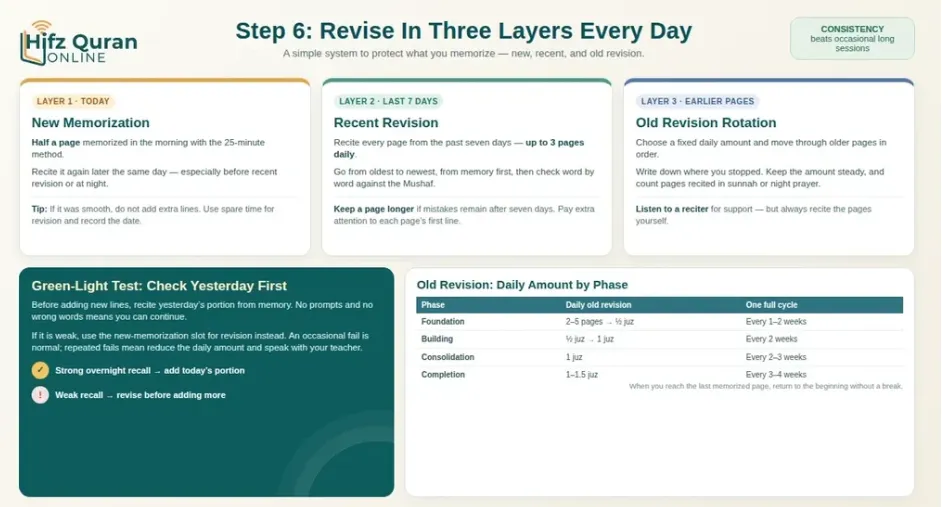
A. new memorization of today’s half page
This is the portion you memorize each morning with the 25-minute method. It is the only layer that adds pages to your total. Recite it once more later the same day, even briefly. A second recitation a few hours after memorizing helps the portion hold until the next morning.
A good time for this is just before your recent revision slot. You can also recite it once at night, right before you listen to tomorrow’s portion. If any lines give you trouble, note them and repeat them a few extra times before the day ends.
If the portion went smoothly, don’t add extra lines. Use the spare minutes for revision instead. Write the date next to each portion in your notebook, so you know when it moves into recent revision and later into old revision.
B. Recent Revision Of Everything From The Last 7 Days
Recite every page from the past seven days, up to 3 pages, daily. New pages fade faster than older ones, so they need attention every day until they move into old revision.
This layer works as a rolling window. Each morning, today’s portion joins it and the oldest portion moves out to old revision. Recite the pages from oldest to newest, so you also practice the move from one day’s portion to the next.
Recite these pages from memory first, then check them against the Mushaf. Reading them while looking can make you feel more confident than you really are.
When you check, go slowly and word by word, since a quick glance misses small errors. Pay extra attention to the first line of each page, because it’s often the hardest to recall without seeing the page. If a page still has mistakes after seven days, keep it in recent revision for another week.
C. Old Revision On A Fixed Rotation Of Earlier Pages
Choose a set amount for each day and work through your older pages in order. This way, every page comes back on a predictable cycle.
| Phase | Daily old revision | One full cycle of your pages |
| 1. Foundation | 2 to 5 pages, rising to half a juz | Every 1 to 2 weeks |
| 2. Building | Half a juz, rising to 1 juz | Every 2 weeks |
| 3. Consolidation | 1 juz | Every 2 to 3 weeks |
| 4. Completion | 1 to 1.5 juz | Every 3 to 4 weeks for the full Quran |
Pages you recite in sunnah and night prayers count toward this layer. For more revision methods, read our guide on how to memorize Quran without forgetting.
Write down where you stopped each day, so the next session starts in the right place. Without a note, it’s easy to repeat the pages you like and skip the ones you find hard.
The hizb and quarter markers printed in the Madinah Mushaf make clear daily stopping points. When the rotation reaches your last memorized page, go back to the beginning without taking a break.
Keep the daily amount steady instead of doing a lot on free days and nothing on busy ones. Check how many days a full cycle actually takes you, and if it’s longer than the table shows, raise your daily amount slightly.
Listening to your old pages from a reciter can help, but it doesn’t replace reciting them yourself.
The Green-Light Test – Check Yesterday’s Portion Before Adding New Lines
Each morning, recite yesterday’s portion from memory before you start anything new. If it comes out clean, go ahead with today’s portion. If it doesn’t, use the new slot for revision instead.
Don’t look at the page or warm up first, because the test should show what stayed in your memory overnight. A clean recitation means no prompts and no wrong words, though a short pause you recover from on your own is fine.
This takes only a minute or two, but it stops weak pages from piling up. Each new portion is then built on pages you already know well.
Failing the test now and then is normal and doesn’t mean the plan isn’t working. If you fail it several days in a row, talk to your teacher about reducing your daily amount for a week. Mark each result on your daily checklist, so you can see how often your portions hold overnight.
Step 7 – Test Every Week And Log Your Mistakes To Track Real Progress
A weekly test gives you a clear answer about your pace. Without one, weak pages can stay hidden until the problem has spread across several juz.
The Friday Test – Recite The Week’s 3 Pages To Your Teacher
Friday has no new memorization. Recite all 3 pages from the week to your teacher in one go, without prompts. The number of mistakes decides what happens next week.
| Mistakes in the week’s 3 pages | Result | Next week |
| 0 to 1 | Pass | Continue with half a page a day |
| 2 to 4 | Pass with review | Continue, and give these pages extra recent revision |
| 5 or more | Repeat | No new pages; revise this week’s portion again |
Agree with your teacher on what counts as a mistake before the first test. A common approach is to count any word your teacher has to correct or prompt, including tajweed errors. If you use the five-day schedule, hold the test on your revision day. What matters is that it happens on the same day each week.
The Monthly Test – Continue From A Random Verse In Your Old Pages
Once a month, your teacher reads the opening of a verse from anywhere you’ve memorized and asks you to continue. This checks whether you know your pages in any order, not only from the start of a surah. Any page that fails moves higher in next month’s old revision.
Hold the test on a fixed day, such as the first Friday of each month, so it never gets skipped. Around 5 to 10 starting points give a fair picture of your old pages without taking up a whole class. After each starting point, keep reciting until your teacher stops you, usually after a few verses.
Ask your teacher to choose verses from different parts of your memorization each month, including the earliest pages. Old pages you rarely think about are often the first to weaken.
Some teachers also ask which surah a verse comes from, or what comes just before it. Compare your results from month to month, since fewer failed pages show that your revision rotation is working.
Keep A Mistake Log To Find Your Weakest Areas
Record every test mistake under one of three types: tajweed errors, skipped or swapped words, or mix-ups between similar verses. After a few months, the log shows which type of mistake you make most often, so you know where to focus your practice.
Each type points to a different fix. Repeated tajweed errors mean asking your teacher to go over that rule again in class. Skipped or swapped words usually show that a page needs more repetition, while similar-verse mix-ups belong on your mutashabihat list from Phase 3.
A simple notebook works well. For each mistake, write the date, the page and line, and the type. Pages that appear in the log more than once should get extra time in your next revision cycle.
Look through the log for a few minutes before each Friday test, so recent weak spots are fresh in your mind. Once a month, share it with your teacher so they can see the same patterns you do.
Memorize the Quran at Your Own Pace
Join our expert tutors and begin your Hifz journey with a personalized plan.
Start Your Free TrialCan You Pause New Memorization During Ramadan?
Yes, you can stop new memorization during Ramadan and spend the month on revision only. Many students choose to do this so they can focus on recitation, prayer, and worship. The pause won’t harm your memorization, but it does affect your finish date, so plan for it from the start.
Does Revising Only During Ramadan Weaken Your Memorization?
No. A month of revision without new pages usually strengthens what you’ve memorized. Reciting your pages from memory in Taraweeh and night prayers also shows you clearly how well you know them.
Ramadan is the month in which the Quran was first revealed (Surah Al-Baqarah, 2:185). Every Ramadan, the Angel Jibril met the Prophet (peace be upon him) to review the Quran with him (Sahih al-Bukhari 6), and in his final year they reviewed it twice (Sahih al-Bukhari 4998).
Following this example, many huffaz treat Ramadan as their main revision month of the year.
The only thing a Ramadan pause changes is how many pages you add that year. Your existing memorization stays protected as long as you keep revising every day.
What matters is that a pause in new pages never turns into a pause in revision. Students who stop both may find that their last few weeks of pages need relearning after Eid.

How a Ramadan pause affects your 4-year finish date
Ramadan lasts about 4 weeks, so a full pause means about 12 pages you don’t memorize that year. A 4-year plan usually includes 4 Ramadans, which adds up to about 16 weeks without new pages. That’s more than your 6 spare weeks.
Because the Islamic year is shorter than the solar year, Ramadan arrives about 11 days earlier each year. Depending on your start date, a 4-year plan can occasionally include 5 Ramadans. Check the calendar before you begin, so you know exactly how many fall within your plan.
| Ramadan approach | Pages not memorized each Ramadan | Effect on your 4-year finish |
| Full pause, no other changes | About 12 | About 10 weeks late |
| Full pause, 8 lines a day for the rest of the year | About 12 | On time, with about 3 spare weeks left |
| Quarter page a day during Ramadan | About 6 | About 2 weeks late |
| Normal half page a day during Ramadan | None | On time, with all 6 spare weeks left |
The figures assume you keep your normal pace for the rest of each year. The delay builds slowly, one Ramadan at a time, so it’s easy to miss until year 3 or 4.
Two Ways To Stay On Schedule If You Pause Every Ramadan
The simplest fix is to memorize 8 lines every day for the rest of the year, instead of alternating between 7 and 8. That small increase covers all four Ramadan pauses and still leaves about 3 spare weeks for other interruptions.
Start the 8-line pace from your first week, so the extra lines build up before your first Ramadan arrives. If it feels too heavy after a few weeks, switch to the second option instead.
The second option is to keep a small amount going during Ramadan. A quarter page a day keeps the habit alive and brings you within about 2 weeks of your original finish date.
A quarter page is about 4 lines, which takes only a few minutes after suhoor. This option suits students who find it hard to restart after a complete stop. Some students also combine the two approaches, memorizing a quarter page for the first twenty days and pausing fully in the last ten nights.
If neither suits you, you can accept a finish date about two and a half months later. Whichever choice you make, agree on it with your teacher before your first Ramadan, so it doesn’t feel like falling behind.
How to plan your revision during Ramadan
Follow these steps to keep your revision on track throughout the month.
- Turn your new memorization slot into extra old revision. With that time freed up, many students can recite more of their memorized pages than usual.
- Set a revision goal for the month. Aim to complete at least one full cycle of everything you’ve memorized before Eid.
- Move your revision to the times when your energy is highest. Energy often drops in the afternoon while fasting, so many students find it easier to revise after suhoor, after Fajr, and after iftar.
- Break your revision into shorter sessions. Several short sessions spread across the day usually work better than one long block.
- Reschedule your online classes around your fasting day. A time after iftar suits many students.
- Update your daily checklist. Use the box for new memorization to record your extra old revision.
- Keep your Friday test with your teacher, but base it on your old pages instead of new ones. This shows which parts of your memorization need attention before you restart after Eid.
Before Ramadan starts, divide your memorized pages by the number of days in the month, so you know exactly how much to revise each day. If you finish a full cycle before Eid, start a second one instead of adding new pages.
How to restart new memorization after Eid
Follow these steps to return to your normal routine smoothly.
- Keep some revision going during the days of Eid. It can be lighter than usual, but don’t stop completely.
- Go back to the slot times you used before Ramadan. Returning to the same times helps your usual routine settle back in quickly.
- Do the green-light test on your last memorized portion before adding new lines. After a month of steady revision, it usually comes out clean.
- If the test is clean, return to your full daily amount straight away. This applies even if you memorized a quarter page a day during Ramadan.
- If the test shows weak spots, spend a few days on recent and old revision first. Restart new memorization once your last portion is solid.
- Switch your Friday test back to the week’s new pages. From the first week after Eid, the test covers new memorization again.
- Write your updated finish date in your notebook. Base it on the Ramadan option you chose.
If you fast the six days of Shawwal, keep your daily amount the same but place your new memorization slot at the time of day when your energy is highest. Your first week back may feel a little slower than before Ramadan, which is normal and usually passes once the routine settles in.
What To Do If You Stop Your Hifz Plan For A Week, A Month, Or A Year
Almost every student pauses at some point over four years. The right way to restart depends on how long the break lasted.
1. If You Stop For A Week
Spend the first two or three days on revision only, starting with the pages from the two weeks before your break. Go back to new memorization once you pass the green-light test. A one-week pause fits inside your 6 spare weeks, so your finish date doesn’t change.
There’s no need to make up the missed lines, since your spare week already covers them. Your old revision rotation also lost a week, so add a few extra pages to it each day until the cycle catches up.
If the break was caused by illness, start with shorter sessions and build back to your full time over a few days. Let your teacher know about the break, so your next Friday test can include the pages you revised.
2. If You Stop For A Month
Give the first two weeks to revision only, beginning with your most recent juz and the pages your mistake log shows as weakest. Then restart new memorization at a quarter page a day for one week before returning to half a page. A month uses most of your spare weeks, so ask your teacher to recalculate your finish date.
In your first class back, ask your teacher for a random test across your memorized pages, like the monthly test. Record every mistake from it in your log, since this shows which pages the break affected most. If the test shows that your old pages held well, you may not need the full two weeks of revision.
Think about what caused the break, and if it’s likely to happen again, such as a yearly exam season, plan for it in advance next time.
3. If You Stop For A Year
Don’t pick up where you left off. Ask your teacher to test your memorized pages and sort them into pages that held and pages that need relearning. Treat the weak pages as new memorization, and rebuild your old revision before adding pages you’ve never memorized.
To set a new finish date, add the pages to relearn to the pages you haven’t memorized yet and divide by 3. For example, a student who stopped at 300 pages and kept 200 has 404 pages ahead, about 135 weeks at 3 pages a week.
Relearning a page is usually faster than memorizing it for the first time, so your real timeline may turn out shorter than this estimate. Restart with a daily routine of about 60 minutes, as in Phase 1, and build back up as your old revision grows again.
4. If you know a break is coming
Tell your teacher your break dates in advance, so they can plan your first class back. In the last week before you leave, pause new memorization and use the time to strengthen the pages from the past month.
During the break, such as travel or exams, keep a small amount of old revision going inside your daily prayers. A few pages a day won’t move you forward, but it shortens the restart when you come back. Choosing one fixed prayer for this, such as the sunnah of Fajr, makes it easier to keep up while your routine is disrupted.
Pack your Mushaf, so you can check any verse you’re unsure of. Set your restart date before you leave, so your return is already planned.
Words are not enough?! Look and Judge
Watch how our teachers guide young learners in the Quran Memorization Course for Kids at Hifz Quran Online Academy. In this lesson, a student memorizes Surah An-Nazi’at step by step, using a simple method that makes each verse easier to remember.
How To Stay Motivated Through Four Years Of Hifz
Over four years, your motivation will rise and fall. Preparing for the slower months ahead of time makes them much easier to get through.
1. Remember The Reward Of Memorizing The Quran And Write Down Your Own Reason
The Prophet (peace be upon him) said that the best among Muslims are those who learn the Quran and teach it (Sahih al-Bukhari 5027). He also said that the companion of the Quran will be told on the Day of Judgement to recite and rise, with his rank at the last verse he recites (Sunan Abu Dawud 1464 and Jami at-Tirmidhi 2914).
Write your own reason for starting on the first page of your log and read it when a week feels heavy. Your reason can be personal, such as leading your family in prayer, teaching your children, or reciting long passages in night prayers.
Hifz is an act of worship, so renew your intention from time to time and keep your focus on pleasing Allah. Make dua regularly for help in memorizing the Quran and keeping it. It also helps to share your goal with one person you trust, who can check in with you every few weeks.
2. Celebrate Every Juz You Complete To Keep Your Progress Visible
Each finished juz is one of thirty milestones on your way to 604 pages. Mark each one on a chart you can see, so your progress stays visible even when the final page feels far away.
Write the date you finished each juz next to its number, so you can look back and see how far you’ve come. Share the news with your family, since their encouragement adds to your own. For children, a small reward at each juz gives them something to look forward to.
Some students give a small charity each time they finish a juz, as a way of showing gratitude. Larger milestones, such as your fifth or tenth juz, deserve a bigger celebration.
3. Recite Your Newly Memorized Surahs In Your Daily Prayers
Using new surahs in your salah gives you an immediate return on your effort. It lets you feel the benefit of each new surah long before you reach the final page.
Try to vary what you recite, instead of returning to the same short surahs you’ve known since childhood. Once a new surah is solid, start with it in your sunnah prayers, where a pause matters less than when you lead others.
When you’re confident, lead your family in prayer with your new surahs, and ask them to follow along so they can correct you afterward. If you get stuck during a prayer, move on to a passage you know well. Note the spot after you finish, so you can give it extra attention in your next session.
4. Prepare For The Hard Middle Stage Of Your Hifz In Year 2
In year 2, the excitement of starting has faded and the finish line still looks far away. Knowing this in advance helps you treat it as a normal stage of Hifz and not a sign that the plan has failed.
Compare yourself with where you were a year ago, not with the pages still ahead. Set short goals during this stage, such as finishing the surah you’re on now.
Tell your teacher when your motivation drops, since they can help you adjust your routine before you fall behind. A study partner who is also memorizing can help too, because you can keep each other going on difficult weeks. On low days, aim only to complete your four daily slots, without judging how well they went.
5. Learn From Students Who Are On The Same Hifz Path As You
There will be weeks when it feels like you’re the only one finding Hifz hard. You aren’t. Students all over the world are memorizing the same pages, facing the same busy schedules, and pushing through the same slow months.
Reading their stories can remind you that steady effort does pay off, one page at a time. Take a few minutes to read the student reviews of Hifz Quran Online Academy. Learners there share how they made room for the Quran alongside work, school, and family life. Their experience may be exactly the encouragement you need to keep going.
As you read, look for the small habits that helped them, such as the time of day they memorized or how they handled a missed week. Then try the ones that fit your life. If you’re a parent, the reviews from other families can also show you what steady progress looks like for a child. One day, your own story may be the one that encourages someone else to begin.

Memorize the Quran at Your Own Pace
Join our expert tutors and begin your Hifz journey with a personalized plan.
Start Your Free TrialStart Your 4-Year Hifz Plan With Hifz Quran Online Academy
Following a 4-year plan alone is hard to sustain. At Hifz Quran Online Academy, a personal teacher hears your recitation, corrects you early, and adjusts your plan to your level and your schedule.
When you join, you get:
- Live one-to-one classes, so every lesson is focused on your recitation
- Teachers who are Ijazah-certified huffaz and graduates of Islamic universities
- Male and female teachers for men, women, and children
- Classes available 24/7, from 2 to 7 days a week
- Recitation recordings of well-known Qaris for practice between classes
- A certificate signed by the academy’s supervisors
- Family discounts, with classes on Zoom or Skype from any device
Book your free trial class today and start your 4-year plan with the right method from the first page.

Our Quran Courses
Have a look at our Quran courses and choose the one that suits you perfectly.
- Quran Memorization Course
- Quran Memorization and Hifz Course for Kids
- Online Quran Memorization Courses for Adults
- Quran Hifz Course for Ladies
- Quran Memorization Course for Men
- Saudi-Based Quran Memorization Courses
- Hifz Teachers
Conclusion
Your plan will change along the way, and that’s okay. Work, family, illness, or busy seasons may slow you down or push your finish date back. That doesn’t mean you’ve failed.
What matters is returning to your routine: half a new page, daily revision, and a weekly check with your teacher. If you’re following a plan for how to memorize Quran in 4 years, remember that consistency matters more than sticking to a perfect schedule. Keep showing up, and the pages will add up. One juz at a time, you’ll make your way to page 604.
Remember, memorizing the Quran is not just about reaching the final page. It’s about building a lasting relationship with the words of Allah. Stay consistent, be patient with yourself, and trust that every small step brings you closer to your goal.
Some days will feel easier than others, but consistency matters more than speed. Even when progress feels slow, every verse you memorize is an achievement worth holding on to. Keep your intention sincere, ask Allah for guidance, and take it one day at a time.
FAQs
Want to know more? Read these questions and answers.
Is It Realistic To Memorize The Quran In 4 Years?
Yes, memorizing the Quran in 4 years is realistic for most students who read Arabic fluently. Half a page a day leaves enough time for daily revision and fits around work, school, or family life.
Can I Memorize The Quran In 4 Years While Working Full Time?
Yes, working adults can follow this plan by splitting the daily 60 to 90 minutes into short slots. Linking each slot to one of the daily prayers makes the routine easier to keep on busy workdays.
Can Children Follow A 4-Year Quran Memorization Plan?
Yes, children can follow a 4-year plan once they read the Quran fluently. Younger children often do better with shorter sessions spread through the day, and their teacher may adjust the daily amount to their age.
Do I Need To Understand Arabic To Memorize The Quran?
No, you don’t need to speak Arabic to memorize the Quran, but you do need to read it accurately. Reading a short translation or tafsir of each portion helps you keep the verses in the right order.
Can I Memorize The Quran Without A Teacher?
You can, but tajweed and pronunciation mistakes often go unnoticed and get memorized along with the verses. Studying alone also means you have no outside listener for weekly testing.
Should I Speed Up If I’m Ahead Of Schedule?
No, if you’re ahead of schedule, spend the extra time on revision. Stronger older pages save you time in years 3 and 4, when the revision load is at its highest.
What Should I Do After Memorizing All 604 Pages?
Keep a daily revision routine for life, such as one juz a day. Many huffaz also recite the full Quran from memory to a teacher to confirm their memorization is complete and accurate.
Can I Memorize The Quran In 4 Years Through Online Classes?
Yes, online classes work well for a 4-year plan when they’re live and one-to-one. Your teacher can hear each portion, run your weekly tests, and correct mistakes as closely as in a classroom.
Related Articles
Memorizing Quran







Leave a Reply