 Memorizing Quran

Many new Hifz students search for how to learn Surah An-Nasr because it is short, meaningful, and often assigned as an early memorization goal for beginners building consistent daily habits.
Its brevity makes it approachable, yet its message carries weight that deserves proper attention before memorization begins.
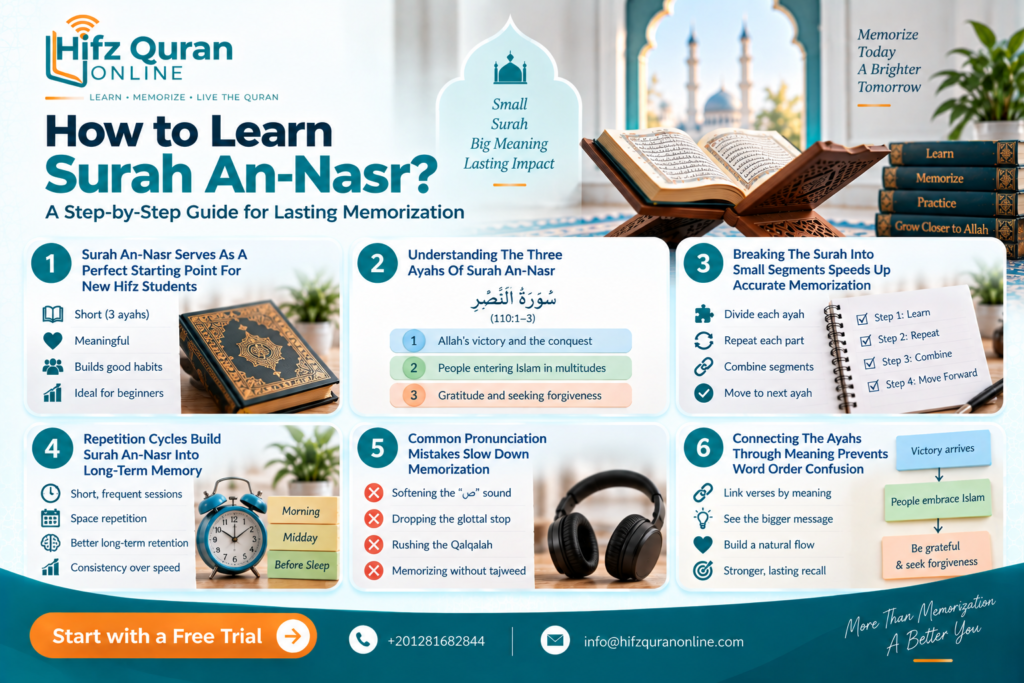
This guide breaks down proven memorization techniques for non-Arabic speakers, covering pronunciation, repetition ratios, and revision scheduling so Surah An-Nasr becomes a permanently retained portion of your Hifz journey, Insha’Allah.
1. Start Your Hifz Journey with Surah An-Nasr
Surah An-Nasr serves as a perfect starting point for new Hifz students because it contains only three ayahs, a simple structure, and a message of gratitude that resonates with beginners right away.
At Hifz Quran Online Academy, certified Huffaz frequently introduce this surah early within the Quran Memorization Course, using it to establish foundational habits before students progress to longer chapters.
Book a free trial for the Quran Memorization Course!
Short surahs like An-Nasr also teach beginners how memorization actually works. Students learn to notice word patterns, Arabic root letters, and rhythm before tackling pages with dozens of verses and repeated phrasing.
Choosing the right first surah matters more than most new students realize. A rushed start on a difficult chapter often causes frustration that discourages beginners from continuing their memorization altogether.
Read also: How to Memorize Surah An-Naziat? A Complete Guide
Step Inside Our Virtual Classrooms
Don’t just take our word for it—see how our interactive sessions work! Watch the short clips below to experience our engaging teaching methods, live teacher-student interactions, and the supportive learning environment we bring to every student.
Memorize the Quran at Your Own Pace
Join our expert tutors and begin your Hifz journey with a personalized plan.
Start Your Free Trial2. Understand the Meaning of Surah An-Nasr Before Memorizing
Understanding meaning before memorizing wording strengthens retention, since students recall verses more easily when they know what each phrase communicates.
Below is the full surah with transliteration and translation, so you can connect sound to meaning from your very first repetition:
بِسْمِ اللَّهِ الرَّحْمَٰنِ الرَّحِيمِ
إِذَا جَاءَ نَصْرُ اللَّهِ وَالْفَتْحُ
Idha ja’a nasrullahi wal-fath
“When the victory of Allah has come and the conquest,” (An-Nasr 110:1)
وَرَأَيْتَ النَّاسَ يَدْخُلُونَ فِي دِينِ اللَّهِ أَفْوَاجًا
Wa ra’ayta an-nasa yadkhuluna fi dinillahi afwaja
“And you see the people entering into the religion of Allah in multitudes,” (An-Nasr 110:2)
فَسَبِّحْ بِحَمْدِ رَبِّكَ وَاسْتَغْفِرْهُ ۚ إِنَّهُ كَانَ تَوَّابًا
Fasabbih bihamdi rabbika wastaghfirhu innahu kana tawwaba
“Then exalt [Him] with praise of your Lord and ask forgiveness of Him. Indeed, He is ever Accepting of repentance.” (An-Nasr 110:3)
Notice how the surah moves from victory, to witnessing people embracing faith, to a personal instruction for gratitude and repentance. This progression gives your memorization a natural emotional anchor.
Read also: How to Memorize Surah Waqiah? – A Step-by-Step Guide
3. Break Surah An-Nasr into Small Memorization Segments
Breaking Surah An-Nasr into segments, each ayah into two or three word groups, allows non-Arabic speakers to master pronunciation before attempting full-verse recall.
This approach prevents the common beginner mistake of memorizing sound without securing correct articulation points.
A. Divide the Second Ayah into Manageable Parts
Start with “Idha ja’a nasrullah,” repeat it ten times, then add “wal-fath” once pronunciation feels stable.
Only move to ayah two once ayah one flows without hesitation or mispronunciation.
B. Segment The Second Ayah Using The Same Method
Break “wa ra’ayta an-nasa” from “yadkhuluna fi dinillahi afwaja” and repeat each half separately. Combining segments too early is a leading cause of stumbling during recitation tests.
C. Memorize the Third Ayah with Correct Tajweed
The final ayah contains a Qalqalah letter and an Idgham rule that non-native speakers often rush past. Slow, deliberate repetition here prevents mistakes from becoming permanent habits.
This ratio reflects the Hifz-Muraja’ah structure used throughout our Online Quran Memorization Courses for Adults, where revision is treated as seriously as new memorization rather than an afterthought.
Read also: How to Memorize Surah Duha? – A Step-by-Step Guide
Enroll in our Quran Memorization Course for Adults With a Free Trial!
4. Use Spaced Repetition to Retain Surah An-Nasr
Repetition cycles build Surah An-Nasr into long-term memory far more effectively than single, lengthy practice sessions spread across one sitting. Neuroscience-informed Hifz methodology recommends spaced repetition, meaning short practice bursts repeated across a day.
A reliable approach for a beginner is ten repetitions in the morning, ten at midday, and ten before sleep, for three consecutive days per ayah.
This spacing lets short-term memory consolidate into long-term retention without mental fatigue.
Rushing repetition into one long block often produces memorization that fades within a week. Spacing it across a day and across several days is what makes memorization permanent rather than temporary.
5. Avoid Common Pronunciation Mistakes in Surah An–Nasr
Non-Arabic speakers frequently struggle with the same mistakes of pronunciation errors, and recognizing them early prevents mistakes from becoming permanent habits.
These recurring errors appear consistently among new students, regardless of native language background.
- Softening the heavy “ص” sound in “nasrullah” so it resembles a regular “s”.
- Dropping the glottal stop in “ja’a,” turning it into a smooth, single syllable.
- Rushing the Qalqalah bounce on the letter “ب” in “wastaghfirhu”.
A certified Hafiz instructor catches these errors during live correction, something self-study or recorded lessons cannot replicate.
This is precisely why Hifz Quran Online Academy structures every course around one-on-one sessions rather than group classes.
6. Use Rabt to Connect the Ayahs of Surah An-Nasr
Rabt, the technique of connecting verses through meaning rather than rote sound, prevents the word-order confusion that trips up many memorizers. Instead of memorizing three disconnected ayahs, students link them as one flowing narrative.
Think of it as a sequence: victory arrives, people enter the faith in large numbers, and the appropriate response is gratitude paired with seeking forgiveness. This mental thread makes recall automatic rather than effortful, even months later.
Students who skip rabt often memorize accurately at first but lose sequence accuracy weeks later. Building meaning-based connections from day one protects against this exact kind of memory slippage.
Sisters preferring a female-led learning environment can follow this same structure comfortably within our Quran Hifz for Sisters classes, taught entirely by qualified female Huffaz.
Book a free trial for the Quran Hifz for Sisters Course!
What Makes Surah An-Nasr Different From Other Beginner Surahs?
Surah An-Nasr stands apart from other common beginner choices like Al-Ikhlas or Al-Falaq because it was revealed as a complete message rather than a set of standalone declarations.
Its three ayahs, broken down in step two, tell a single continuous moment: the arrival of victory, the sight of people entering faith, and the instruction to respond with gratitude, which gives beginners practice connecting meaning across verses rather than memorizing isolated statements.
This makes it a slightly different kind of “easy,” one that rewards understanding the flow rather than just repeating short phrases.
Memorizing Surah An-Nasr Takes Only a Few Days for Most Beginners
Memorizing Surah An-Nasr typically takes new Hifz students anywhere from two to five days, since the surah contains only three ayahs and a naturally flowing narrative.
Students who rush all three ayahs into a single sitting often find the surah fades within a week, which is exactly why the spaced repetition method in step four matters even for a surah this short.
See Our Classes in Action
Curious about what a 1-on-1 Hifz session looks like? Take a look at these real-time snippets from our daily classes to see our student-centered approach, Tajweed correction techniques, and online whiteboard tools in action.
Memorize the Quran at Your Own Pace
Join our expert tutors and begin your Hifz journey with a personalized plan.
Start Your Free TrialMemorize Surah An-Nasr with a Qualified Hafiz
Surah An-Nasr is a meaningful first step, but lasting memorization requires personalized correction, structured revision, and a teacher who catches mistakes before they become habits. Hifz Quran Online Academy offers exactly that.
- 1-on-1 sessions with certified Azhari-trained Huffaz, never group classes
- Flexible scheduling across UK, USA, Canada, and Australia time zones
- Specific, honest progress tracking rather than vague feedback
- 10+ years of experience with over 350 satisfied students
Our Quran Courses
- Quran Memorization Course
- Quran Memorization and Hifz Course for Kids
- Online Quran Memorization Courses for Adults
- Quran Hifz Course for Ladies
- Quran Memorization Course for Men
- Saudi-Based Quran Memorization Courses
- Hifz Teachers
Book a Free Trial Class Today With Hifz Quran Online Academy!

Memorize the Quran at Your Own Pace
Join our expert tutors and begin your Hifz journey with a personalized plan.
Start Your Free TrialConclusion
Learning Surah An-Nasr well means pairing correct pronunciation, meaning-based connection, and disciplined repetition rather than relying on memorization speed alone.
Beginners who follow a structured schedule retain the surah permanently rather than losing it within weeks.
Revision deserves equal weight to new memorization from the very first day, not as an afterthought once a surah feels complete. This mindset shift is what separates lasting Hifz from memorization that quietly fades over time.
With guidance from a certified Hafiz, correct Tajweed, and consistent daily practice, Surah An-Nasr becomes a firmly rooted part of your memorized Quran, Alhamdulillah.
Frequently Asked Questions
How Long Does It Take To Memorize Surah An-Nasr?
Most adult beginners memorize Surah An-Nasr in five to seven days using structured segment-based repetition and daily revision. Pace varies by individual memory capacity, prior Arabic exposure, and consistency of daily practice sessions.
Is Surah An-Nasr A Good First Surah For Beginners?
Yes, its three short ayahs and meaningful theme make it an excellent entry point for building foundational Hifz habits. Many certified Huffaz recommend it before progressing to longer, more complex chapters.
What Is The Best Daily Repetition Count For A Short Surah?
Thirty repetitions per ayah, spread across three sessions daily, balances effective memorization with realistic time commitment for working adults. Spacing repetitions prevents mental fatigue and strengthens long-term retention significantly.
How Often Should Surah An-Nasr Be Revised After Memorization?
Recite it twice weekly for the first month, then once weekly folded into a broader revision cycle afterward. Consistent, scheduled revision prevents the gradual forgetting that affects unreviewed memorized portions.
Can Non-Arabic Speakers Pronounce Surah An-Nasr Correctly Without A Teacher?
Self-study often introduces pronunciation errors that go uncorrected for months, particularly with Qalqalah and glottal stop sounds. Live correction from a certified Hafiz remains the most reliable path to accurate Tajweed.
Related Articles
Memorizing Quran





Leave a Reply