 Memorizing Quran
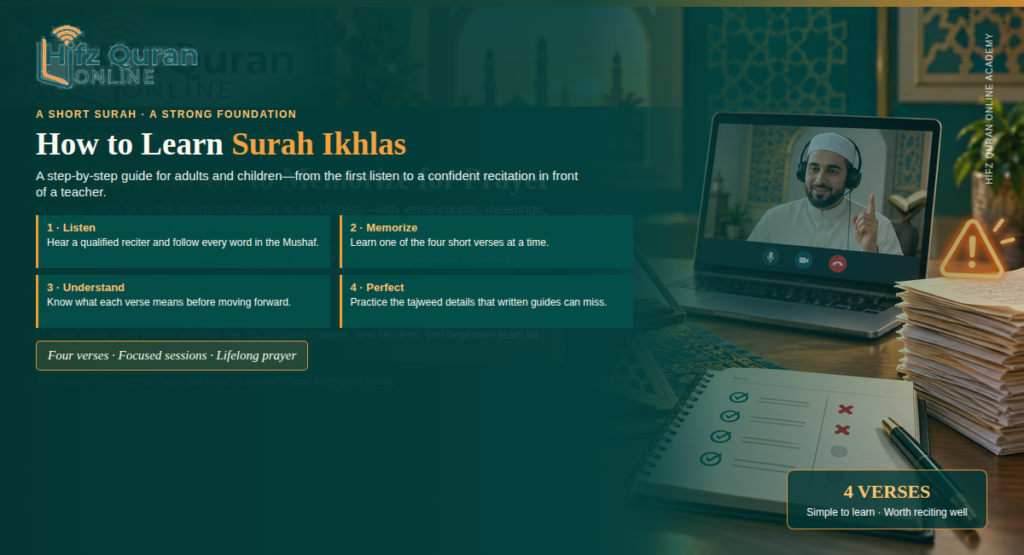
Learning Surah Ikhlas takes three things: you listen to a qualified reciter, you memorize one verse at a time, and you understand what each verse means before you move on.
The surah has only four short verses, so most learners can memorize it in a few focused sessions. Reciting it correctly takes longer. It depends on a few tajweed details that written guides usually skip.
This guide covers both parts: memorizing Surah Ikhlas, and saying it in a way that would hold up when recited in front of a teacher.
Step 1: Listen To A Good Reciter
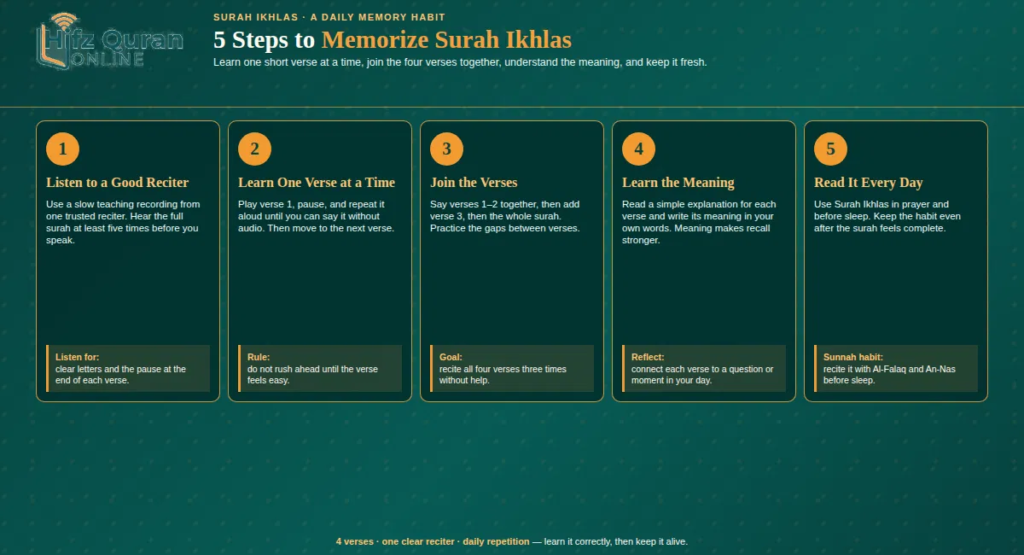
Start by listening. Don’t try to say it yet. Pick a slow teaching recording from a well-known reciter, such as Sheikh Al-Husary or Sheikh Al-Minshawi. These recordings pause after each verse. Play the surah a few times. This helps your ear learn the right sounds before you say them.
Choose a quiet time with no phone alerts or noise around you. You can also play it in the car, while you cook, or before you sleep. Listen closely to how the reciter stops at the end of each verse.
Stick with the same reciter every time, so your ear gets used to one clear style. Try to hear the whole surah at least five times before you move to Step 2.
Step 2: Learn One Verse At A Time
Play verse 1 and pause. Say it out loud. Do this again and again until you can say it without the audio. Then move on to verse 2. Each verse is short, so your mind can hold it all at once.
Say each verse slowly at first, then a little faster as it feels easier. If you can read Arabic, look at the words while you listen.
Next, close your eyes and try to say the verse from memory. If you get stuck, play the verse again and repeat it a few more times. Don’t rush to the next verse until the one you are on feels easy.
Step 3: Join The Verses Together
When you know verses 1 and 2, say them together. Then add verse 3 and say all three. Then add verse 4 and say the whole surah.
Many people know each verse alone but get stuck when they move from one verse to the next. Joining the verses fixes that.
Say the verses out loud, not just in your head, because your tongue needs practice too. If you forget a verse, go back one verse and start again from there.
Say the whole surah a few times during the day, even for one minute at a time. Try reading it to a family member and ask them to follow along with the text. Once you can say it three times in a row with no help, this step is done.
Step 4: Learn What Each Verse Means
Read the meaning of each verse. Think about it while you say the words. When you know what the words mean, you remember them longer. You also focus better when you pray.
Learn the meaning of one verse at a time, just as you memorized them. A simple tafsir book or a trusted teacher can explain each verse in easy words.
Ask yourself a small question for each verse, such as “What does it mean that everyone needs Allah?” Write the meaning of each verse in a notebook in your own words. Then link it to your day, like remembering “aṣ-ṣamad” when you ask Allah for help.
Step 5: Read Surah Ikhlas Every Day
Use the surah in your daily prayers. Read it before you go to sleep. Aisha (may Allah be pleased with her) said the Prophet ﷺ did this every night. Before sleeping, he read Surah Al-Ikhlas, Al-Falaq, and An-Nas. Then he blew into his hands and wiped them over his body. He did this three times. This is in Sahih al-Bukhari (hadith 5017).
Daily reading keeps the surah in your memory for good. The Prophet ﷺ also read Surah Ikhlas in the two sunnah rak’ahs before Fajr, as reported in Sahih Muslim. Pick a set time each day, so reading it becomes a habit.
Linking it to something you already do, like prayer or bedtime, makes it easy to remember. Keep reading it even after you know it well, so you don’t forget it. Teaching it to someone else is also one of the best ways to keep it fresh.
Need help with your recitation? Look through our tutors, choose the one who suits you best, and book your trial lesson. Your tutor will listen to you read Surah Ikhlas and fix your mistakes as you go. Meet our tutors and book your trial.
Surah Ikhlas Place In The Quran And The Story Behind It
Surah Ikhlas is in Juz 30 (Juz ‘Amma), just before Surah Al-Falaq and Surah An-Nas. It is also known as Surah At-Tawhid and Surah As-Samad. Most scholars say it was revealed in Makkah.
A report in Sunan at-Tirmidhi says people asked the Prophet ﷺ to describe his Lord and His family line. In Arab culture at that time, a person’s family line told others who they were. Many Arabs also claimed that the angels were Allah’s daughters. Allah sent this surah as the answer, in four short verses that anyone could remember.
Why Surah Ikhlas Equals One Third Of The Quran
The Prophet ﷺ said this surah is equal to one third of the Quran (Sahih al-Bukhari, 5013). Scholars explain that the Quran teaches three main things. These are rules for living, stories of past nations, and who Allah is.
Surah Ikhlas sums up the third part in four verses. One day, the Prophet ﷺ asked his companions if any of them could read a third of the Quran in one night (Sahih al-Bukhari, 5015). They found it hard, since a third of the Quran is very long. He then told them that Surah Ikhlas is a third of the Quran.
This shows how much reward Allah puts in these few words. It also shows that the value of a surah comes from its meaning, not from its length.
Allah Loves Those Who Love It
The Prophet ﷺ once sent a companion to lead a group of Muslims on a journey. In every prayer he led, he ended his recitation with Surah Ikhlas. When the group came back, they told the Prophet ﷺ about it.
The Prophet ﷺ asked them to find out why he did this. The companion said it describes Allah, the Most Merciful, and he loved to read it.
The Prophet ﷺ said, “Tell him that Allah loves him” (Sahih al-Bukhari, 7375). This story teaches that loving a surah for its meaning is something Allah values. When you learn what each verse of Surah Ikhlas means, you start to feel that same love.
The words and meaning of Surah Ikhlas
Surah Ikhlas has only 15 Arabic words, spread over four short verses. The table below shows each verse in Arabic, how it sounds, and what it means. Read each verse first and then its meaning, so the words and the meaning stay linked in your mind.
| Verse | Arabic | How it sounds | Short meaning |
| 1 | قُلْ هُوَ اللَّهُ أَحَدٌ | Qul huwa Allāhu aḥad | Say: He is Allah, the One |
| 2 | اللَّهُ الصَّمَدُ | Allāhu aṣ-ṣamad | Allah, the One everyone needs |
| 3 | لَمْ يَلِدْ وَلَمْ يُولَدْ | Lam yalid wa lam yūlad | He has no child, and He was not born |
| 4 | وَلَمْ يَكُن لَّهُ كُفُوًا أَحَدٌ | Wa lam yakul-lahū kufuwan aḥad | And no one is like Him |
The meanings below follow the explanations of Ibn Kathir and al-Sa’di.
Verse 1: Allah is One
“Qul” means “say.” Allah tells the Prophet ﷺ to say this truth out loud. “Aḥad” means One in every way. No one shares Allah’s names, His qualities, or His actions.
Verse 2: Everyone needs Allah
“Aṣ-Ṣamad” is the One that every living thing turns to for what it needs. People ask Him for food, health, and help. He needs nothing from anyone.
Verse 3: Allah has no child and no parent
This verse answers people who said that God has a son or a daughter. Allah was not born, so He has no beginning. He has no child, so no one comes after Him.
Verse 4: Nothing is like Allah
“Kufuwan” means an equal or a match. Nothing Allah created is like Him in any way. Surah Ash-Shura (42:11) says the same thing: “There is nothing like Him, and He is the All-Hearing, the All-Seeing.”
Read also: How long does it take to memorize Juz 30?
Have a closer look inside our real classes
Watch how our teachers help children build strong recitation skills in the Quran Learning Course for Kids at Hifz Quran Online Academy. In this lesson, a young student learns to recite Surah Al-Qiyamah correctly, verse by verse, with guidance from the teacher.
Memorize the Quran at Your Own Pace
Join our expert tutors and begin your Hifz journey with a personalized plan.
Start Your Free TrialCommon Misunderstandings About Surah Ikhlas
Many people believe things about Surah Ikhlas that are not correct. Here is what people often get wrong, and what is true.
Most of these ideas spread through kind people who simply heard them from someone else. Even so, small errors about the Quran can change how a person believes or worships. Each answer below gives the correct view and, where possible, a source you can check.
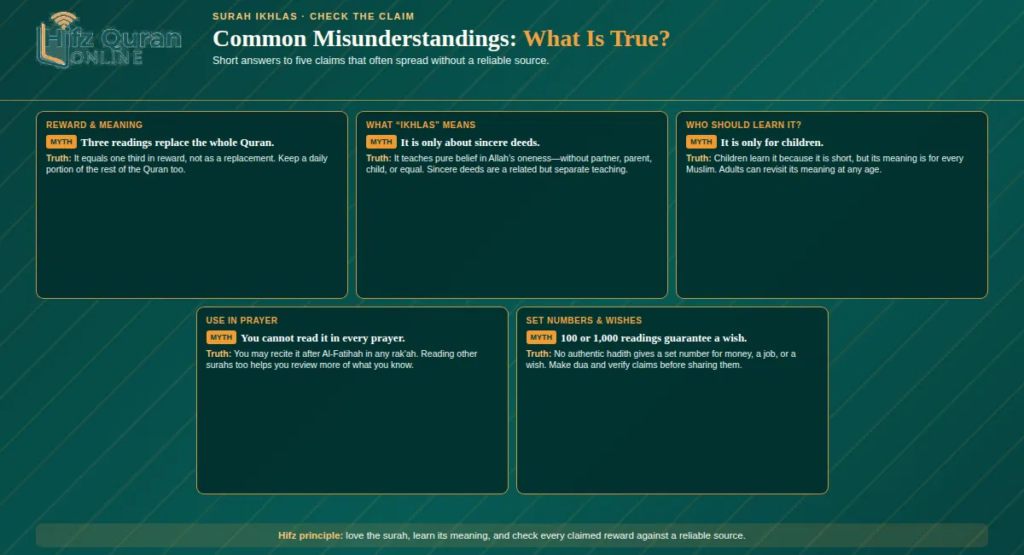
Does Reading It Three Times Replace The Whole Quran?
No. Surah Ikhlas equals one third of the Quran in reward, not as a replacement for it. Each surah teaches things you can’t learn from Surah Ikhlas alone, like the rules of prayer and the stories of the prophets.
The Prophet ﷺ said that every letter you read from the Quran brings you a reward (Sunan at-Tirmidhi, 2910). So read Surah Ikhlas often, and keep a daily portion of the rest of the Quran too.
Many scholars explain the “one third” this way: the Quran covers laws, stories, and teachings about who Allah is. Surah Ikhlas sums up that third part, the teaching about Allah. That is why reading it three times does not count as finishing the whole Quran.
Is Surah Ikhlas About Sincere Deeds?
No. It is about belief. The name “Ikhlas” makes some people think the surah is about doing good deeds only for Allah.
In fact, it teaches that Allah is One, with no partner, no parent, no child, and no equal. Sincere deeds are taught in other verses, such as Surah Al-Bayyinah (98:5). The two ideas are linked, because pure belief leads to pure worship.
The word “ikhlas” does not appear anywhere in the surah’s four verses. Scholars say the name means purity, because the surah makes belief in Allah pure and free from shirk. For the same reason, it is also known as Surat at-Tawhid, the surah of Allah’s Oneness.
Is Surah Ikhlas Only For Children?
No. Children learn it first because it is short, but its meaning is for everyone. In four verses, it explains who Allah is, and scholars have written whole books about it. The Prophet ﷺ read it often in his own prayers.
Many adults memorized it as children but never learned what it means, so it is worth learning the meaning now.
Take the name “As-Samad” in the second verse as an example. It means the One whom all creation turns to in need, while He needs no one. A simple tafsir can open up each word like this, and you can share it with your children as they learn the surah.
Can You Read Surah Ikhlas In Every Prayer?
Yes. The companion in the hadith above read Surah Ikhlas in every prayer he led. The Prophet ﷺ did not stop him. Instead, he told him that Allah loves him. You can read it after Al-Fatiha in any rak’ah, in both fard and sunnah prayers.
Reading other surahs too is good, because it helps you review more of what you know. Al-Bukhari also reports another companion who began every rak’ah with Surah Ikhlas before reading a second surah.
When the Prophet ﷺ asked him why, he said he loved it, and the Prophet ﷺ told him that this love would admit him to Paradise. These reports show that choosing this surah often, out of love for its meaning, is praised.
Does Reading It A Set Number Of Times Grant Wishes?
No. You may hear that reading Surah Ikhlas 100 or 1,000 times will bring money, a job, or a wish. No authentic hadith gives a set number for this.
Claims like this often spread through social media and chain messages with no source. Before you follow one, ask for the hadith and check whether scholars graded it as authentic. If you want something from Allah, make dua and ask Him directly.
Islam also teaches you to take real steps toward your goal, such as applying for jobs and working hard, while you make dua.
Some times are especially good for dua, like during sujood and in the last third of the night. Scholars warn that inventing fixed rituals with no source can turn into a new practice in religion, which Islam does not allow.
Tips To Help You Read Surah Ikhlas With Tajweed
Tajweed is the set of rules for reading the Quran correctly. These five tips cover the sounds in Surah Ikhlas that learners most often get wrong. Each tip shows how to say the sound and the mistake to avoid.
- Say “ḥ” from the throat in “aḥad”: The ḥ (ح) comes from the middle of the throat. It is a strong, breathy sound. Many learners use the soft h (ه) from “huwa,” and that turns it into a different letter.
- Make the “ṣ” heavy in “aṣ-ṣamad”: Raise the back of your tongue to say ṣ (ص). It should sound deep, not like a light s (س). The “l” in “al-” is silent here, so you say “aṣ-ṣamad,” not “al-ṣamad.”
- Keep the “l” full in “Allāhu”: In verses 1 and 2, say the “l” in “Allāhu” with a round, full mouth. New learners often make this “l” too thin.
- Bounce the “d” without adding a vowel: When dal (د) has no vowel after it, it gets a small bounce. This rule is called qalqalah. You hear it in “lam yalid” and when you stop at aḥad, aṣ-ṣamad, and yūlad. Keep the bounce short. If you say “aḥada” or “yalidu,” you add a sound that is not there.
- Merge the “n” into the “l” in verse 4: “Yakun” ends in “n,” and “lahu” starts with “l.” The “n” drops into the “l,” so you say “yakul-lahu,” not “yakun lahu.” This is the most common mistake in the surah.
Read also: How long does it take to memorize Juz 30?
Common mistakes when reading Surah Ikhlas, and how to fix them
The tips above cover single sounds. The mistakes below are bigger habits that change how the whole surah sounds.
Mistake 1: Learning Only From English Letters
English letters can’t show the difference between ح and ه, or between ص and س. So if you learn only from English letters, you may learn the wrong sounds without knowing it.
This mistake is hard to notice on your own, because the wrong sound starts to feel normal. Some Arabic sounds don’t exist in English at all, so your mouth needs practice to make them. A teacher can hear the difference right away and show you where each sound comes from.
Use the “How it sounds” column only as a helper, and let the audio be your main guide. Listen to each verse first, then check the English letters if you need help.
You can lean on them for the first few days while your ear gets used to the audio. After that, cover the English column and read from the Arabic or from memory. Over time, you will need the English letters less and less.
Mistake 2: Saying The “-Un” Ending When You Stop
When you stop at the end of a verse, you drop the ending sound. You say “aḥad,” not “aḥadun.” Many learners keep the “-un” because they see the two marks on the last letter. These two marks are called tanween, and they make the “-un” sound when you keep reading.
This rule is not only for Surah Ikhlas. It applies at the end of every verse you stop on, so once you learn it here, you will use it in every surah.
Stop on a silent letter at the end of each verse. If you join verse 1 to verse 2, keep the ending and add a small “i” sound, like “aḥadunil-lāhuṣ-ṣamad.
” Listen to how your reciter ends each verse, and copy that ending. To practice, say the last word of each verse on its own: aḥad, aṣ-ṣamad, yūlad, aḥad. Then read the full verses and keep the same endings.
Mistake 3: Reading Too Fast Because The Surah Is Short
Short surahs are easy to rush, especially when you know them well. When you read fast, you swallow letters and skip the bounce on the “d.” Fast reading also makes it hard to think about the meaning while you pray.
Allah tells us to read the Quran slowly and clearly in Surah Al-Muzzammil (73:4). Taking a short pause at the end of each verse helps you slow down.
Read slowly enough that every letter is clear. Record yourself and check that you can hear each letter. Try to match the speed of a slow teaching recording. If you catch yourself speeding up, stop and start the verse again. A slow pace may feel strange at first, but it soon becomes normal.
Read also: How to memorize a surah in 5 minutes a day
How To Teach Surah Ikhlas To A Child
The best way to teach a child Surah Ikhlas is to build understanding first, then memorization. This method comes from an article by Dr. Shereen Labib Khorshid on Alukah.net. Follow these five steps in order.
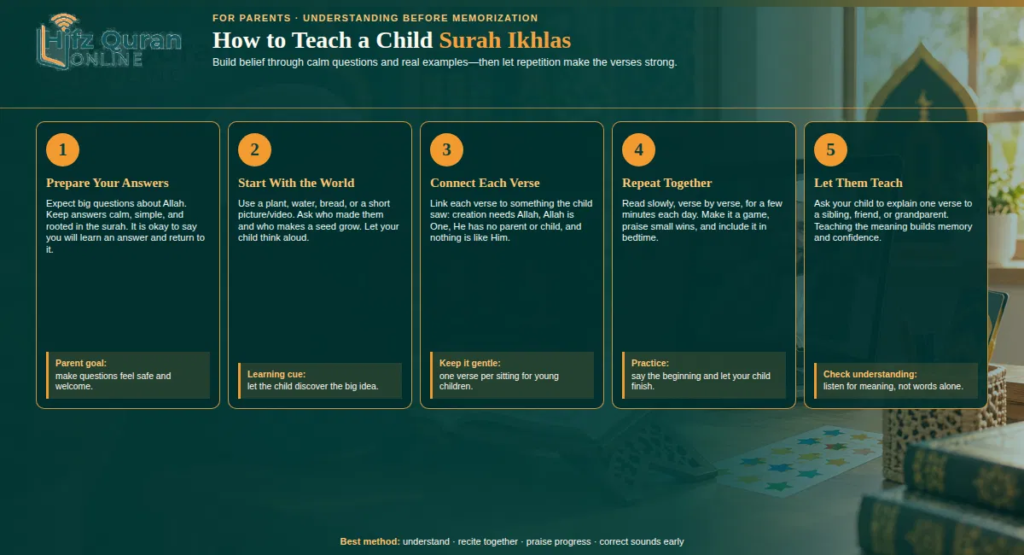
Step 1: Prepare Your Answers Before The Lesson
Children often ask big questions, like “What does Allah look like?” or “Who made Allah?” Think about your answers before you start, because what you say shapes what your child believes.
Keep your answers calm and simple, and use the surah itself. Allah is One, He was not born, and nothing is like Him. Reading a simple tafsir of the surah before the lesson will help you feel ready. If you don’t know an answer, it is fine to say you will find out and come back to it.
This teaches your child that asking and learning are good things. Never make your child feel bad for asking, because questions show they are thinking. A calm, sure answer helps your child feel safe in their faith.
Step 2: Start With Questions About The World
Show your child pictures or a short video of people, animals, birds, the sun, and the moon. Then ask who made them, where food comes from, and who makes a seed grow. Most children say “the farmer” for the plants but get stuck on the seed.
Use that moment to explain that Allah makes everything grow. Then tell them that a short surah teaches this. Keep the video short, so your child stays focused. You can also use real things at home, like a plant, a glass of water, or a piece of bread.
Let your child answer in their own words, even if the answers are wrong at first. Each answer leads to the next question, so your child reaches the big idea by thinking it through. When children find an answer this way, they remember it much longer than when they are simply told.
Step 3: Explain Each Verse With Something They Saw
Connect each verse to the pictures or video. For “aṣ-ṣamad,” point out that the animals, plants, and people all need food and water.
All of it comes from Allah, and He needs nothing. For the last verse, explain that nothing in the video, and nothing in the world, is like Allah. For verse 1, explain that Allah is One and has no partner who helps Him.
For verse 3, explain that people and animals have parents and children, but Allah does not. If your child is young, explain one verse per sitting and use short words. Ask your child to point to something in the picture and say who gave it food and water. Then read the verse again, so the words and the meaning come together.
Step 4: Repeat the surah together
Read the surah together several times, verse by verse. You can also say some of Allah’s names together, like Ar-Rahman, Al-Kareem, and Al-Azeem, so your child learns more about who Allah is. Group reading helps shy children join in without fear of mistakes.
Short sessions work better than long ones, so a few minutes a day is enough. Read slowly, so your child hears each letter clearly. You can turn it into a game, where you say the start of a verse and your child finishes it. Praise every small step, like learning one new verse. Make it part of bedtime too, and read it together three times before sleep.
Step 5: Let Your Child Teach Someone Else
Ask your child to explain one verse to a brother, sister, or friend. A child who knows the surah well can also help one who is still learning.
Teaching others makes their own memory stronger and builds their confidence. Ask them to explain the meaning, not only to recite the words.
This shows you whether they truly understood the surah. Let them recite it for grandparents or other family members, in person or on a call. Praise from family gives children a reason to keep practicing. When your child can teach a verse clearly, you know they have learned it well.
Children pick up wrong sounds as fast as right ones, so it helps to have a teacher correct them early. Our Quran memorization course for kids at Hifz Quran Online Academy pairs your child with a tutor who teaches one verse at a time and fixes mistakes in every lesson. Explore the Quran memorization course for kids.
Words are not enough?! Look and Judge
Watch how our teachers guide young learners in the Quran Memorization Course for Kids at Hifz Quran Online Academy. In this lesson, a student memorizes Surah An-Nazi’at step by step, using a simple method that makes each verse easier to remember.
Memorize the Quran at Your Own Pace
Join our expert tutors and begin your Hifz journey with a personalized plan.
Start Your Free TrialLearn Surah Ikhlas With A Quran Teacher
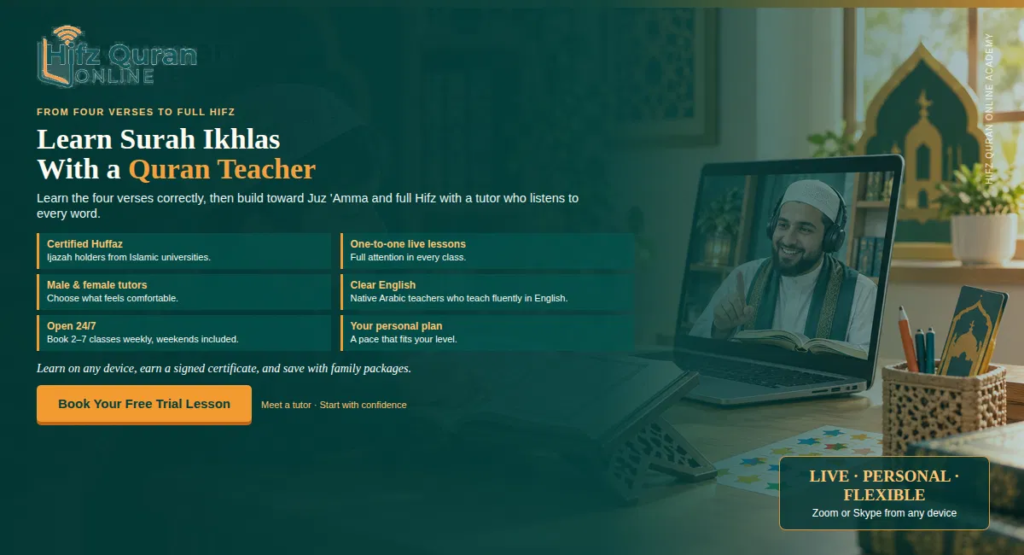
Learning four verses is a great start. The next step is saying them the right way and moving on to Juz ‘Amma and full hifz. Hifz Quran Online Academy offers live one-to-one lessons for children and adults. Your tutor listens as you read and fixes mistakes right away, before they turn into habits.
Why learn with Hifz Quran Online
- Certified teachers. All our teachers are huffaz with Ijazah, and they graduated from well-known Islamic universities.
- Live one-to-one classes. Every lesson is live, just you and your tutor, so you get full attention.
- Male and female tutors. You can choose a female teacher for girls and women, or a male teacher if you prefer.
- Clear English. Our teachers are Egyptian, native Arabic speakers who also teach fluently in English.
- Classes at any hour. We are open 24/7, including weekends, and you can book 2 to 7 classes a week.
- A plan made for you. Each course follows a personal plan that fits your level and your pace.
- Learn on any device. Join your class on a computer, an iPhone, or an Android phone, using Zoom or Skype.
- Signed certificates. Every course ends with a certificate signed by our supervisors.
- Family discounts. We offer lower prices on family packages.
Look through our tutors, choose the one who suits you best, and book your trial lesson. Meet our tutors and book your trial.
Our Quran Courses
Check our available Quran courses, choose the one that suits you and your child.
- Quran Memorization Course
- Quran Memorization and Hifz Course for Kids
- Online Quran Memorization Courses for Adults
- Quran Hifz Course for Ladies
- Quran Memorization Course for Men
- Saudi-Based Quran Memorization Courses
- Hifz Teachers
Conclusion
Surah Ikhlas is short, but it holds the core of what a Muslim believes about Allah. In just four verses, it tells us that Allah is One, that everyone needs Him, that He has no parent or child, and that nothing is like Him.
The Prophet ﷺ said it equals one third of the Quran, and he told a companion who loved it that Allah loves him too. That is a lot of reward and meaning in a surah you can learn in a few short sessions.
To learn it well, take it one verse at a time and understand each verse before you move on. Get the five tajweed points right from the start, because small mistakes are easy to fix early and hard to fix later. If you are teaching a child, start with questions about the world, and let the meaning come before the memorizing.
Once you know it, keep it alive. Read it in your prayers, before Fajr, and at bedtime, as the Prophet ﷺ did. Then use it as your first step toward the rest of Juz ‘Amma. Each short surah you learn this way makes the next one easier, and soon you will have a strong base for memorizing more of the Quran.
FAQs
These are the questions people ask most about Surah Ikhlas, from learning it to reading it in prayer. Each answer is short and to the point, so you can find what you need quickly.
How Long Does It Take To Learn Surah Ikhlas?
Most people can learn Surah Ikhlas by heart in a few short sessions, because it has only four verses. Saying it with correct tajweed can take longer. It depends on how well you know Arabic sounds and whether a teacher helps you.
What Is The Easiest Way To Learn Surah Ikhlas?
The easiest way to learn Surah Ikhlas is to listen to a good reciter, learn one verse at a time, and then join the verses together. Learning the meaning helps you remember it longer.
What Tajweed Rules Are In Surah Ikhlas?
Surah Ikhlas has five main tajweed points. These are the throat sound ḥ in “aḥad,” the heavy ṣ in “aṣ-ṣamad,” the full “l” in “Allāhu,” the bounce on the “d” (qalqalah), and the “n” merging into the “l” in “yakul-lahu.”
Why Is Surah Ikhlas Equal To One Third Of The Quran?
Surah Ikhlas equals one third of the Quran because it sums up what the Quran teaches about Allah being One. The Prophet ﷺ said this in a hadith in Sahih al-Bukhari (5013).
How Do I Teach Surah Ikhlas To A Young Child?
To teach Surah Ikhlas to a young child, start with simple questions about who made and feeds everything. Then share the verses and their meaning. Ask your child to explain a verse to someone else.
Can I Learn Surah Ikhlas From English Letters?
You can use English letters as a helper for Surah Ikhlas, but don’t learn from them alone. They can’t show sounds like ḥ and ṣ. Always learn with audio from a good reciter.
Related Articles
Memorizing Quran




Leave a Reply