 Memorizing Quran
| Key Takeaways |
| Memorizing one page daily requires splitting the page into three segments of 4–6 lines and mastering each before combining. |
| Reciting each line 20–25 times aloud before moving forward is the minimum threshold for short-term retention to form. |
| Connecting the final word of each verse to the opening of the next (Rabṭ) prevents sequence confusion between similar-sounding ayat. |
| The page must be reviewed immediately after Fajr and once more before sleeping to activate dual-consolidation memory encoding. |
| One page of new memorization daily requires at least five pages of Muraja’ah to prevent previously memorized content from deteriorating. |
Memorizing one page of Quran a day is an achievable, structured goal — but only when it is approached with the right method. Most students who attempt this pace fail not because they lack dedication, but because they treat memorization as repetition rather than as a deliberate cognitive process.
As an instructor who has worked with non-Arabic speaking students across dozens of countries, I have seen this pattern consistently: effort without method leads to frustration, not Hifz.
To memorize one page of Quran a day as a non-Arabic speaker, you must segment the page, repeat each segment to mastery, apply the Rabṭ technique to link verses, and complete two revision passes within the same 24-hour window. Done correctly, this method produces stable, retrievable memorization — not surface-level repetition that fades by morning.
1. Prepare Your Mushaf, Environment, and Mindset Before You Begin
To memorize one page of Quran effectively each day, your preparation must be deliberate and consistent. Sit with a single, fixed Mushaf — the same edition every session — so your visual memory encodes a consistent page layout.
Tajweed-color-coded editions are particularly useful for non-Arabic speakers, as they highlight pronunciation rules visually.
Choose a space free from sound distractions. Research in cognitive science consistently shows that ambient noise — even low-level — increases the number of repetitions needed to form stable memory traces. Your memorization space should be your most protected daily commitment.
Perform Wudu before beginning. Beyond its spiritual significance, this ritual transition signals to the mind that a focused, elevated task is beginning.
Students at Hifz Quran Online Academy who consistently observe this preparation step report stronger mental presence during memorization — a difference instructors notice in their weekly recitation assessments.
Begin with:
- Ta’awwudh (أعوذ بالله من الشيطان الرجيم)
- Basmallah (بسم الله الرحمن الرحيم)
- A sincere intention (Niyyah) for Allah’s sake alone
Shots Videos from Our Courses
Memorize the Quran at Your Own Pace
Join our expert tutors and begin your Hifz journey with a personalized plan.
Start Your Free Trial2. Read the Full Page Aloud Three Times for Familiarity
Before attempting a single line of memorization, read the entire page aloud three times with correct Tajweed. This is a step the majority of self-taught students skip entirely — and it is one of the most costly errors I see in new students.
Reading the full page first activates semantic familiarity, so your brain is not encountering each line as an isolated, meaningless sound string when memorization begins.
Listen to a verified recitation of the page by a reliable Qari — Sheikh Mahmoud Khalil Al-Husary’s Murattal recordings are widely used in traditional Hifz programs for their clear Makhraj articulation. Follow along in your Mushaf as you listen, then recite aloud independently.
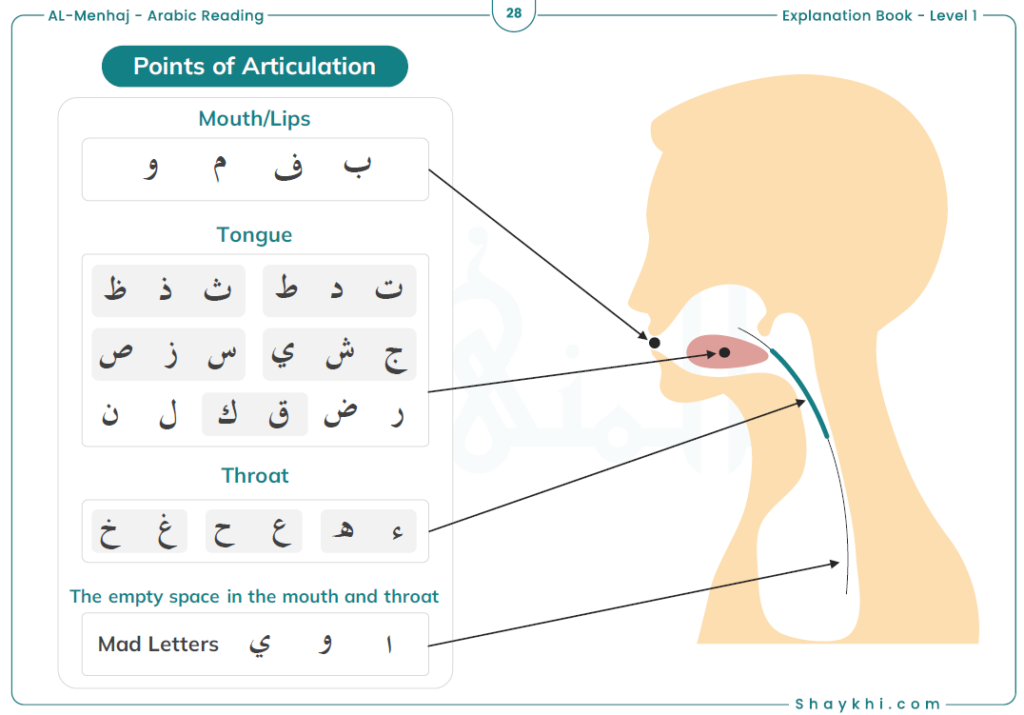
Explore and Study Al-Menhaj Book for FREE
This three-read orientation phase takes approximately 8–12 minutes. It is not wasted time — it is the foundation that reduces total repetitions needed for memorization by a measurable margin.
Memorize the Quran at Your Own Pace
Join our expert tutors and begin your Hifz journey with a personalized plan.
Start Your Free Trial3. Divide the Page into Three Equal Segments and Memorize Each One Separately
To memorize one page of Quran a day without overwhelming your working memory, divide the page into three segments. A standard Mushaf page (15 lines) should be divided into three groups of approximately 5 lines each.
Attempting to memorize a full page as a single block is one of the most common structural errors in self-directed Hifz.
Work through each segment using this sequence:
| Segment | Lines | Method |
| Segment 1 | Lines 1–5 | Memorize to mastery, then move forward |
| Segment 2 | Lines 6–10 | Memorize to mastery, then combine with Segment 1 |
| Segment 3 | Lines 11–15 | Memorize to mastery, then combine all three |
Master each segment before advancing. “Mastery” means reciting the segment from memory five consecutive times without error, without looking, and with correct Tajweed. This is non-negotiable.
Moving forward before this threshold produces fragile memorization that collapses under review.
If you are building toward a full Hifz program, learning how to structure your complete memorization journey from the beginning will prevent common structural mistakes that slow students down significantly later.
The Quran Memorization Course at Hifz Quran Online Academy pairs every student with a certified Hafiz for weekly one-on-one recitation sessions, structured specifically around the page-per-day methodology described in this article.
Book a free trial to start your Hifz path today

4. Repeat Each Line 20 to 25 Times Aloud Before Moving to the Next Line
Repeating each line 20–25 times aloud before advancing is the minimum repetition threshold for short-term retention to form in non-Arabic speakers. This is not an arbitrary number.
Traditional Hifz methodology, refined over centuries of teaching non-native Arabic learners, consistently converges on this range as the lower boundary for functional encoding.
The repetition must be vocal, not silent. Subvocalizing or mouthing the words without producing full sound activates a different and weaker memory pathway.
Hearing your own voice recite the Arabic engages auditory memory alongside visual and motor memory — three reinforcing channels instead of one.
Within your 20–25 repetitions, use this progression:
A. Recite While Looking (Repetitions 1–10)
Read from the Mushaf with correct Tajweed, paying attention to every Makhraj and vowel marking.
B. Recite With Partial Glancing (Repetitions 11–18)
Begin closing the Mushaf between recitations, glancing only when you lose the line.
C. Recite Fully from Memory (Repetitions 19–25)
Close the Mushaf entirely. These final repetitions are where the memory trace solidifies.
5. Apply the Rabṭ Technique to Connect Every Verse to the One That Follows It
Rabṭ — the practice of deliberately connecting the ending of one verse to the beginning of the next — is among the most critical and most overlooked techniques in Hifz methodology.
Before introducing Rabṭ to students at Hifz Quran Online Academy, we observed a consistent error pattern: students could recite each verse correctly in isolation but stumbled at the transition points, producing hesitation and sequence confusion during fluent recitation.
To apply Rabṭ:
- Recite the last 2–3 words of verse N
- Continue directly into the opening 2–3 words of verse N+1
- Repeat this bridge 10 times before moving forward
- Apply to every verse transition on the page
This technique is especially vital in Surahs where consecutive verses begin with similar phonetic patterns — a common source of sequence confusion for non-Arabic speakers.
Allah ﷻ describes the Quran’s nature in Surah Al-Furqan:
وَرَتِّلِ الْقُرْآنَ تَرْتِيلًا
Wa rattil il-Qur’āna tartīlā
“And recite the Quran with measured recitation.” (Al-Furqan 25:32)
Tarteel — measured, precise recitation — is not only a recitation standard. It is itself a memorization method. Slowing down and articulating each word distinctly during the Rabṭ phase produces deeper encoding than rushed repetition.
Memorize the Quran at Your Own Pace
Join our expert tutors and begin your Hifz journey with a personalized plan.
Start Your Free Trial6. Test Yourself by Reciting the Full Page from Memory Before Ending Your Session
After completing all three segments and applying Rabṭ at every verse junction, recite the entire page from memory without any reference to the Mushaf.
This full-page retrieval test is not optional — it is the moment that determines whether you have memorized the page or merely rehearsed it.
Retrieval practice — the act of actively pulling information from memory rather than re-reading it — is one of the most validated findings in memory science. Each successful retrieval strengthens the memory trace more than an equivalent repetition with the text in front of you.
If you stumble during this test:
- Note the exact transition point where the error occurred
- Isolate that two-verse window and apply 10 additional Rabṭ repetitions
- Re-test the full page from that transition point forward
- Do not consider the session complete until the full page flows without hesitation
This honest self-assessment is what separates genuine Hifz from surface memorization. Students aiming for a structured one-year completion timeline can explore a detailed Quran memorization schedule built around this daily page target.
If a full morning session is not possible due to work or family obligations, the Online Quran Memorization Courses for Adults at Hifz Quran Online Academy are structured around flexible scheduling — certified instructors accommodate time zones and working schedules across 40+ countries.
Enroll in our Quran Memorization Course for Adults with a free trial

7. Perform Muraja’ah of Yesterday’s Page Before Beginning Any New Memorization
Before you open to today’s new page, recite yesterday’s page from memory. This is not optional. Muraja’ah — systematic revision — is not separate from Hifz; it is the other half of Hifz. Memorizing without revising is filling a container with a hole in the base.
The forgetting curve is aggressive with Quranic Arabic for non-native speakers. Without active retrieval within 24 hours, up to 60% of new memorization can become inaccessible within 48 hours. Muraja’ah is the intervention that flattens this curve.
For every one new page memorized, five pages of previously memorized content must be revised daily.
This 1:5 ratio is the standard maintained in structured Hifz programs. Students who skip this ratio in favor of pushing forward with new pages consistently find themselves unable to recite older sections when tested.
Understanding how to revise memorized Quran systematically is as essential as the memorization method itself — treat both with equal seriousness.
8. Track Your Daily Progress and Recite to a Certified Instructor Weekly
Accountability is not motivation — it is a structural component of effective Hifz. Students who recite to a certified instructor weekly retain significantly more than those who self-assess exclusively.
An instructor catches Tajweed errors, mispronounced Makhraj points, and sequence gaps that the student cannot hear in their own recitation.
Track your daily progress using a simple log:
| Day | Page Memorized | Pages Revised | Errors Noted | Instructor Check |
| Monday | Page 45 | Pages 40–44 | Surah transition at line 9 | — |
| Tuesday | Page 46 | Pages 41–45 | None | ✓ |
Keep this log honestly. If a day was missed, record it. The log creates visible accountability and helps your instructor identify patterns — consistent errors at the same structural points, fatigue-related decline on specific days, or revision gaps accumulating in a particular Juz.
Meet our Ijazah-certified Azhari teachers

Read Also: How Long Does It Take to Memorize Surah Baqarah?
How to Memorize 1 Page of the Quran Fast?
The single most consistent finding across students I have worked with is this: memorization performed within 30 minutes of Fajr prayer is retained more reliably and with fewer repetitions than memorization done at any other time of day.
Students who memorize after Fajr consistently outperform those who memorize in the evening — and the performance gap becomes measurable by the second Juz.
The neuroscience aligns with classical Hifz tradition here. Sleep consolidates memory. The brain immediately after sleep is at peak encoding efficiency — declarative memory systems are cleared and receptive.
This is not coincidence. The Prophet ﷺ made du’a for barakah in the early hours, and generations of Huffaz have validated this through practice.
To memorize one page fast, structure your session as follows:
| Time Block | Activity | Duration |
| After Fajr prayer | Full page memorization session | 45–60 minutes |
| Midday (optional) | Spot-check weak transitions | 10–15 minutes |
| After Isha | Full page Muraja’ah from memory | 15–20 minutes |
Read Also: Easy Quran Verses to Memorize
How to Memorize a Page of Quran in 1 Hour?
Memorizing a page of Quran in one hour is realistic for students who have been practicing structured Hifz for at least 4–6 weeks. For absolute beginners, the same method applies but should be budgeted across 75–90 minutes initially, reducing as fluency improves.
Here is a precise 60-minute session plan:
| Time | Activity |
| 0:00 – 0:08 | Preparation, Wudu, full-page read-aloud ×3 with audio |
| 0:08 – 0:22 | Segment 1 (Lines 1–5): 20–25 repetitions per line, Rabṭ applied |
| 0:22 – 0:36 | Segment 2 (Lines 6–10): same method, then combine with Segment 1 |
| 0:36 – 0:50 | Segment 3 (Lines 11–15): same method, then combine all three |
| 0:50 – 1:00 | Full-page retrieval test from memory, error correction |
This structure is tight but executable. The key variable is repetition efficiency — each of your 20–25 repetitions must be deliberate and Tajweed-accurate. Careless fast repetition does not build memory; it builds habit of error.
For students who have not yet established confident Quranic reading before beginning Hifz, the Al-Menhaj Book — authored by Luqman ElKasabany and developed by instructors with 25+ years of experience — provides the foundational reading competency that makes this timed session possible.
Our Students Reviews
Memorize the Quran at Your Own Pace
Join our expert tutors and begin your Hifz journey with a personalized plan.
Start Your Free TrialRead Also: Easy Surahs to Memorize
Begin Your Daily Hifz Practice with Certified Guidance at Hifz Quran Online Academy
Memorizing one page of Quran daily is a serious commitment — it deserves a serious support structure. Hifz Quran Online Academy provides exactly that.
Why students choose us:
- Certified Huffaz with verified credentials and classroom experience
- Personalized 1-on-1 instruction tailored to your pace and level
- Flexible scheduling across all global time zones
- Structured methodology designed specifically for non-Arabic speakers
- Dedicated programs: Quran Memorization Course, Hifz for Kids, Hifz Courses for Adults, Hifz for Ladies
- Free trial lesson — no commitment required
Book your free trial lesson today and begin your journey to Hifz with expert guidance every step of the way.

Conclusion
Memorizing one page of Quran a day is not about raw willpower — it is about applying the right method, consistently, within a protected daily structure. The eight steps above are not theoretical. They reflect what works in real classrooms, with real non-Arabic speaking students, across hundreds of Hifz journeys.
Segment your page. Repeat to mastery. Apply Rabṭ at every transition. Revise before you move forward. And recite to someone who can correct you. These are the pillars. Every shortcut around them leads to the same place: memorization that collapses under pressure.
The Quran deserves your best method, not just your best intention. Insha’Allah, this structure gives you both.
Memorize the Quran at Your Own Pace
Join our expert tutors and begin your Hifz journey with a personalized plan.
Start Your Free TrialRead Also: Dua for Memorizing Fast and Studying and Memory
Frequently Asked Questions About Memorizing One Page of Quran a Day
Is Memorizing One Page of Quran Per Day Realistic for a Complete Beginner?
For most beginners, one page per day is ambitious in the first four to six weeks. Starting with half a page — building the method correctly — is more sustainable and produces stronger long-term retention. Once the repetition process becomes habitual and Tajweed reading is fluent, advancing to a full page daily becomes realistic and maintainable.
How Long Does It Take to Complete the Quran Memorizing One Page a Day?
The Quran contains 604 pages in the standard Madani Mushaf. At one page per day with no missed days, full memorization takes approximately 604 days — roughly one year and eight months. Accounting for illness, travel, and revision consolidation periods, most students completing this pace with proper Muraja’ah finish within two to three years.
What Should I Do If I Cannot Recall Yesterday’s Page Before Starting Today’s?
Do not begin new memorization. Return to yesterday’s page, identify the specific transition points where memory broke down, apply targeted Rabṭ repetitions to those bridges, and re-test the full page from memory. Starting new memorization over unstable old memorization is one of the primary causes of cumulative Hifz collapse in the second and third Juz.
How Many Times Should I Repeat a Line Before It Is Considered Memorized?
Twenty to twenty-five vocal repetitions per line is the minimum threshold for functional encoding in non-Arabic speakers. “Memorized” means reciting the line five consecutive times from memory without error and with correct Tajweed — not simply recognizing the line when you see it. Recognition and retrieval are different cognitive processes; Hifz requires retrieval.
Can I Still Memorize One Page a Day While Working Full-Time?
Yes — with adjusted session structure. A 45–60 minute post-Fajr session handles new memorization; a 15–20 minute post-Isha session handles Muraja’ah. The method does not change — only the scheduling. Students exploring realistic Hifz timelines for working adults can review the complete Hifz guide for structured program options built around professional schedules.
Related Articles
Memorizing Quran






Leave a Reply