 Memorizing Quran
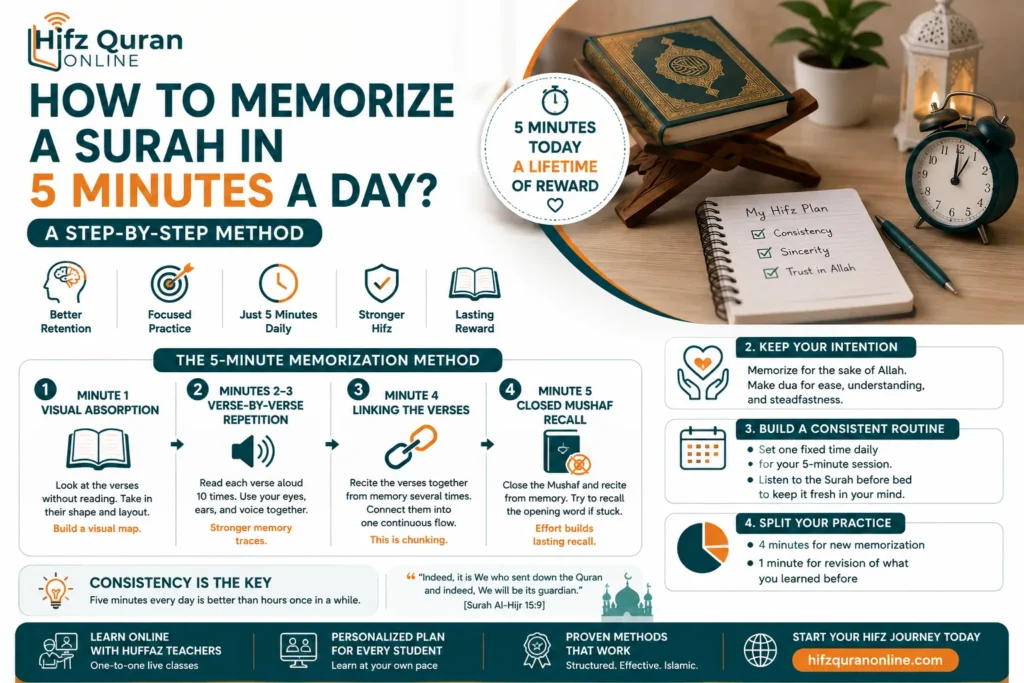
You don’t need hours of free time to make real progress in Quran memorization. Five focused minutes a day — applied correctly — can build a lasting Hifz habit, even for complete beginners.
The catch? Most people use those five minutes the wrong way. They read passively, rush through repetitions, or skip between Surahs without a system. This guide gives you a tested, structured method to memorize a Surah in 5 minutes a day that works with how your brain actually stores information.
Whether you’re memorizing Al-Fatiha for the first time or adding a new short Surah each week, this approach is designed to make every minute count.
1. Follow the 1-5 minutes Strtegy
Five minutes is enough time to commit a short passage to memory — but only if each minute does a specific job. The method below divides your session into five stages, each targeting a different layer of memory: visual, auditory, sequential, holistic, and retrieval.
Set your timer before you begin, remove your phone from arm’s reach, and open the same Mushaf you always use. Consistency of layout matters more than most people realize — your brain encodes not just words but the visual position of words on the page.
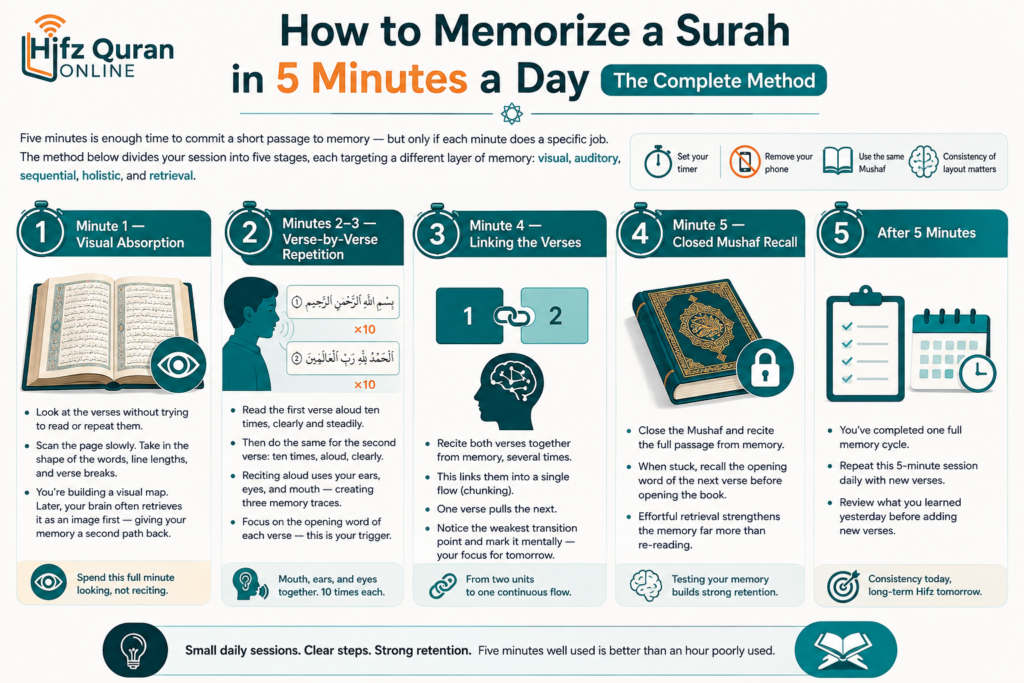
Minute 1 — Visual Absorption
Look at the verses you plan to memorize without trying to read or repeat them. Let your eyes scan the page slowly, taking in the shape of the words, the length of each line, and where the verses break.
This is building a visual map. When you later struggle to recall a verse, your brain often retrieves it as an image first — and having a clear mental picture of the page gives your memory a second path back to the text. Spend this full minute looking, not reciting.
Minutes 2–3 — Verse-by-Verse Repetition
Read the first verse aloud ten times at a steady, clear pace. Do not rush. Each repetition should be deliberate — mouth, ears, and eyes working together simultaneously.
Then move to the second verse and repeat the same process: ten times, aloud, clearly. Reciting aloud is not optional here.
Silent reading activates only your visual cortex; vocal recitation adds auditory and motor memory channels, creating three simultaneous memory traces instead of one. This is precisely why Hifz has always been an oral tradition.
Pay particular attention to the opening word of each verse — this is your trigger. If you can recall the first word, the rest of the verse typically follows automatically.
Minute 4 — Linking the Verses
Now recite both verses together from memory, without looking at the Mushaf, several times in a row.
This step changes how your brain categorizes the verses — from two separate units to a single continuous flow.
Memory researchers call this chunking: once items are linked, retrieving one automatically pulls the next. This is also the minute where you’ll notice which transition point is weakest. Mark it mentally; that’s your review focus for tomorrow.
Read also: Memory Training Methods That Actually Work
Minute 5 — Closed Mushaf Recall
Close the Mushaf and recite the full passage from memory.
When you get stuck, try to recall the opening word of the next verse before you open the book. The act of effortful retrieval — even when it fails — strengthens the memory trace far more than passive re-reading. This is called the testing effect, and it is one of the most well-documented findings in memory science.
If you still can’t remember, take a brief look, close the book again, and continue. Do not read through with the Mushaf open — that is review, not memorization.
Read also: How to Memorize a Surah in 1 Hour – A Practical 60-Minute Hifz Method
2. Keep Your Intention in Every Session
Throughout your memorization practice, keep your niyyah sincere: memorize the Surah to draw closer to Allah and preserve His words in your heart. A sincere intention can help you remain focused and consistent, especially when progress feels slow.
You can also take a few moments during your practice to make a simple dua, asking Allah to make the Quran easy for you to memorize, understand, and practice. This keeps your session connected to its purpose beyond simply completing a memorization target.
3. Build a Consistent Quran Memorization Routine
A fixed routine makes a five-minute memorization plan easier to maintain. Choose one time for active memorization and another for listening so Quran practice becomes a natural part of your day.
Set a Fixed Time for Memorization
Choose a consistent time that fits your daily schedule and reserve it for your five-minute Quran memorization session. It could be after Fajr, after Asr, or after Maghrib—the key is choosing a time you can maintain every day without interruption.
Listen Before Bed to Keep the Surah Fresh in Your Mind
Before sleeping, listen to the Surah from a skilled Quran reciter known for accurate pronunciation and Tajweed. Repeatedly hearing the same verses helps you become familiar with their sounds, rhythm, and correct recitation before the next day’s memorization session.
Why Listen Before Sleeping?
A short listening session before bed gives you another exposure to the verses without adding pressure to your five-minute memorization time. It also helps keep the Surah fresh in
Step Inside Our Virtual Classrooms
Don’t just take our word for it—see how our interactive sessions work! Watch the short clips below to experience our engaging teaching methods, live teacher-student interactions, and the supportive learning environment we bring to every student.
Memorize the Quran at Your Own Pace
Join our expert tutors and begin your Hifz journey with a personalized plan.
Start Your Free Trial4. Split Longer Surahs Into Smaller Sections to Simplify the Memorization Process
Make the memorization easier by breaking the Surah into small, manageable sections. You can start with a short Surah and memorize a few verses at a time. If you choose a longer Surah, do not try to memorize the whole page at once—divide it into smaller connected portions and focus on one portion during each session.
This makes the five-minute routine more focused and helps you build the Surah gradually through consistent repetition.your mind, making it easier to recognize and recall when you practice again.
5. Use the First Word of Each Verse as a Trigger for Recall
One of the most underused tools in Quran memorization is deliberate first-word anchoring. Before you begin the repetition phase, spend ten seconds scanning the opening word of each verse in the passage and saying it aloud once.
Words like قُلْ, وَإِذَا, إِنَّ, and لَا become entry points. Once your brain associates them with what follows, recalling the first word during Salah or review is usually enough to unlock the full verse. Many experienced Huffaz instinctively do this — beginners who consciously practice it close the gap much faster.
Read also: Blurting Memorization Techniques Applied to Quran Hifz
6. You Should Use the Same Mushaf Every Time
Your brain memorizes spatial information alongside verbal information. The position of a verse on the page — upper left, middle column, near the page break — becomes part of the memory.
Switching between a printed Mushaf, a phone app, and a digital screen forces your brain to re-encode the spatial layout from scratch each session. Pick one Mushaf and use it exclusively for your Hifz sessions. This single habit reduces the cognitive load of each session and speeds up recall during review.
If you’re looking for expert one-on-one guidance to build a consistent Hifz routine, the certified instructors at Hifz Quran Online offer personalized sessions at your pace —book a free trial class today.

7. Dedicate One Day Each Week to Review
Set aside one day each week for Muraja’ah (review) and do not memorize anything new that day. Use the session to recite everything you learned during the week from memory, identify verses that still feel weak, and repeat them until they become more secure. This weekly review helps strengthen retention and prevents new memorization from building on shaky recall.
8. Reward Yourself After Every Achievement, No Matter How Small
Every verse you memorize is a genuine accomplishment — treat it like one. The brain’s motivation system runs on dopamine, and dopamine is released when a goal is completed and acknowledged.
If you finish your five-minute session and immediately move on without pausing to recognize what you achieved, you are training your brain to associate Hifz with effort alone, not with satisfaction. That is a fast path to inconsistency.
Build a small reward into every session. It does not need to be elaborate. A cup of tea, five minutes of quiet, a mark on a progress chart, or simply saying alhamdulillah and sitting with the feeling of completion — these are all enough. What matters is the deliberate pause that tells your brain: this session mattered, and finishing it feels good.
For longer milestones — completing a full Surah, finishing a Juz, maintaining a thirty-day streak — give yourself a proportionally meaningful reward. Write it down before you start the streak so your brain has something concrete to anticipate. Students who set milestone rewards in advance are significantly more likely to maintain daily practice than those who rely on willpower alone.
The Prophet ﷺ reminded us that even a smile is sadaqah. Recognizing your own effort is not arrogance — it is gratitude for the ability Allah gave you to carry His words.
Memorize the Quran at Your Own Pace
Join our expert tutors and begin your Hifz journey with a personalized plan.
Start Your Free TrialCommon Mistakes That Cancel Your Progress
Avoid rushing repetitions, memorizing without Tajweed, skipping revision, or learning without understanding the meaning. Consistent, accurate repetition, regular review, proper pronunciation, and understanding the verses help make memorization stronger and more lasting.
Rushing Through Repetitions
Reading a verse ten times in twenty seconds is not repetition — it is noise. Each recitation must be slow enough for your auditory system to register it as a distinct event. If you find yourself speeding up, reset and slow down deliberately.
Memorizing Without Tajweed From Day One
Errors embedded during early memorization become structural — they get reinforced with every repetition. The effort required to unlearn a mispronunciation after weeks of repetition far exceeds the effort of learning correctly from the start.
From your very first session, listen to a qualified Qari such as Sheikh Al-Hussary or Al-Minshawi and match their pronunciation, particularly on letters like ض, ظ, ع, and ح where non-native speakers commonly err.
Skipping the Revision Session
The Prophet ﷺ said: “Keep reviewing the Quran, for it escapes from the hearts faster than a camel escapes from its rope.” (Sahih al-Bukhari)
New memorization without revision produces a leaky bucket. Dedicate at least one of your five daily minutes every three days to reviewing what you have already memorized. A verse you can’t recall after one week was never truly memorized — it was only temporarily held.
Memorizing Without Understanding the Meaning
Verses without meaning are sound patterns, and sound patterns fade. Even reading a one-line translation before your session creates semantic hooks — meaningful associations that your memory can anchor to.
Understanding that a verse is about mercy, warning, or a specific story changes it from abstract sound to meaningful content, and meaningful content is always retained longer.
Hifz Quran Online Academy, pairs every memorization session with basic tafsir context so students understand what they’re memorizing — not just how to say it. Start your free demo class here.

When 5 Minutes a Day Isn’t Enough?
The 5-minute method works well for short Surahs — Al-Ikhlas, Al-Falaq, Al-Nas, Al-Kawthar — and for daily maintenance of recently memorized passages. It is not designed for memorizing longer Surahs like Al-Baqarah or Al-Kahf from scratch.
If you’re tackling a Surah longer than one page, or if you’re a beginner still building your Tajweed foundation, extend your sessions to 20–30 minutes using the same structure: visual absorption, verse-by-verse repetition, linking, and closed-book recall — simply applied to more verses per session.
The principle stays the same. The time allocation scales with the length of the passage, not with the method itself..
Read also: How to Memorize Surah Duha? – A Step-by-Step Guide
See Our Classes in Action
Curious about what a 1-on-1 Hifz session looks like? Take a look at these real-time snippets from our daily classes to see our student-centered approach, Tajweed correction techniques, and online whiteboard tools in action.
Memorize the Quran at Your Own Pace
Join our expert tutors and begin your Hifz journey with a personalized plan.
Start Your Free TrialStart Your Hifz Journey With Hifz Quran Online
Memorize the Quran with confidence — starting today.
Without proper guidance, small errors in pronunciation and technique silently compound into habits that take months to fix. At Hifz Quran Online Academy, certified Ijazah-holding instructors supervise your memorization and Tajweed from session one, catching mistakes before they become ingrained.
Every student gets a personalized plan that fits their schedule — whether you have 5 minutes a day or 60. Your progress is tracked, your technique is corrected in real time, and your path to completing Hifz is mapped out clearly from the start.
Our Quran Courses
- Quran Memorization Course
- Quran Memorization and Hifz Course for Kids
- Online Quran Memorization Courses for Adults
- Quran Hifz Course for Ladies
- Quran Memorization Course for Men
- Saudi-Based Quran Memorization Courses
- Hifz Teachers

Memorize the Quran at Your Own Pace
Join our expert tutors and begin your Hifz journey with a personalized plan.
Start Your Free TrialConclusion
Memorizing a Surah in 5 minutes a day is not a shortcut — it is a disciplined system. Five minutes of structured, focused practice outperforms thirty minutes of passive reading every time.
The method is clear: one minute of visual absorption, two minutes of verse-by-verse repetition aloud, one minute linking the verses together, and one minute of closed-book self-testing. Anchor your memory with first-word triggers, always use the same Mushaf, and never memorize without Tajweed from the start.
Five minutes a day, done correctly, builds something that lasts.
FAQs
How do you memorize a Surah in 5 minutes a day?
Divide the session into five stages: spend the first minute looking at the verses to build a visual map, spend minutes two and three repeating each verse aloud ten times, spend minute four reciting both verses linked together from memory, and spend the final minute testing yourself with the Mushaf closed.
Which Surahs can realistically be memorized in 5 minutes a day?
Short Surahs of three to seven verses work best with this method — Al-Ikhlas, Al-Falaq, Al-Nas, Al-Kawthar, Al-Asr, and Al-Fil. Longer Surahs require extended sessions using the same structure but applied to more verses per sitting.
Is it better to memorize Quran in the morning or at night?
Most memorizers perform best in the early morning, particularly after Fajr, when the mind is clear and distractions are minimal. However, consistency of timing matters more than the time itself — your brain adapts to expecting the memorization task at whatever hour you train it.
Can I memorize the Quran without a teacher?
It is possible but not ideal. A qualified teacher catches Tajweed errors before they become embedded habits — errors that are significantly harder to correct after weeks of repetition. Self-taught memorizers often discover ingrained mispronunciations months into their Hifz, requiring them to re-memorize passages from scratch.
How do I stop forgetting what I’ve already memorized?
Regular revision is the only solution. Schedule one review session for every three new memorization sessions. A verse you cannot recall after one week was held in short-term memory, not long-term memory — it needs additional spaced repetition before it is truly memorized.
Does understanding the meaning really help memorization?
Yes — significantly. Meaning creates semantic associations that give your memory multiple retrieval paths back to the text. A verse you understand as a command, a promise, or a story is held differently in memory than an abstract sequence of sounds. Even a brief one-line translation read before your session measurably improves retention.
Related Articles
Memorizing Quran







Leave a Reply