 Memorizing Quran
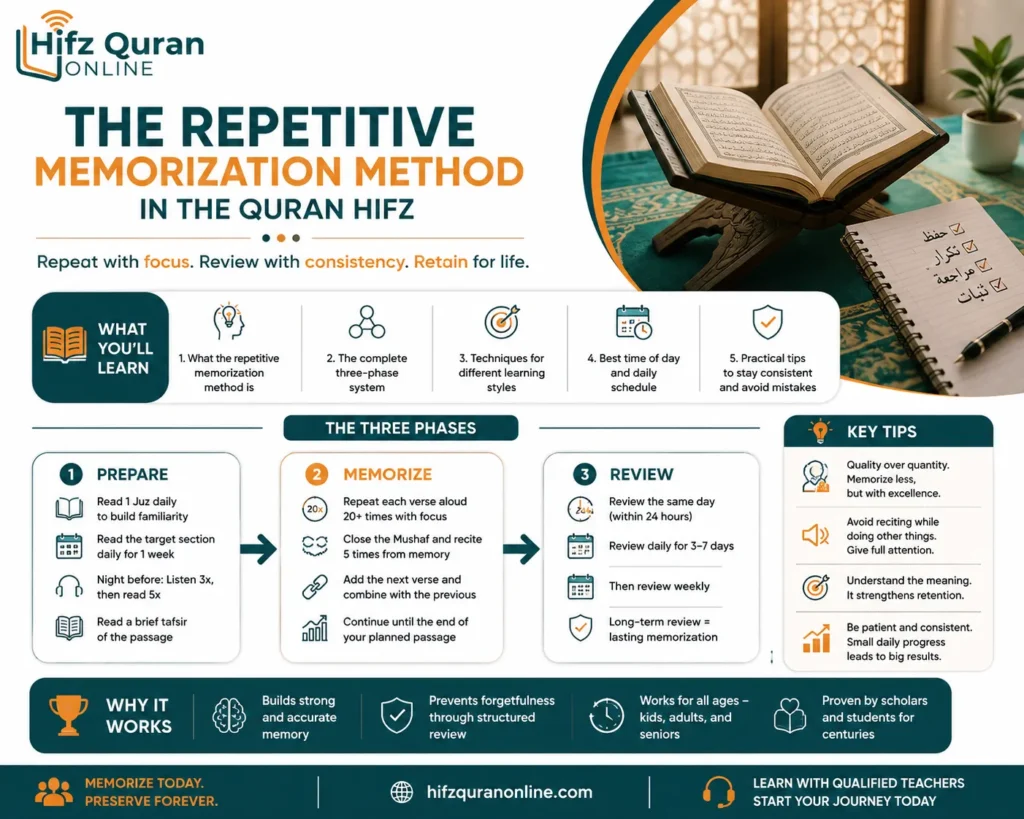
The repetitive memorization method is the single most evidence-backed approach to Quranic memorization — used by scholars and students alike for centuries, and proven to work for children, adults, and seniors equally. Most people who try to memorize the Quran don’t fail because they lack dedication. They fail because they rely on the wrong method: reading through verses once or twice, feeling like they’ve “got it,” then discovering the next morning that it’s almost completely gone.
This guide explains what the repetitive memorization method is, how to apply it in full across all three phases, and the practical techniques that make it stick.
What You’ll Learn in This Article
- What the repetitive memorization method is and why it outperforms other approaches
- The complete three-phase system: preparation, memorization, and review
- Specialized techniques — visual, auditory, written, and comprehension-based — for different learners
- The best time of day to memorize and how to structure your daily schedule
- Practical tips to stay consistent and avoid the most common mistakes
What Is the Repetitive Memorization Method for Quran?
The repetitive memorization method is a structured approach in which each verse is repeated a minimum number of times — typically 20 or more — before moving to the next, and groups of verses are then combined and repeated again to build a connected, durable memory.
It is not about reading through a passage many times and hoping something sticks. The method is deliberate: each verse is memorized in isolation first, then linked with what came before, and finally reviewed systematically over days and weeks. The goal is not speed — it is retention that doesn’t fade.
This distinguishes it from two weaker alternatives: reading an entire passage repeatedly as a block (which causes verses to drop out unnoticed), or counting repetitions without genuine focus (which produces shallow memory that breaks under pressure).
Read also: The Space Method for Memorizing the Quran To Retain Every Verse
The Three Phases of the Repetitive Memorization Method
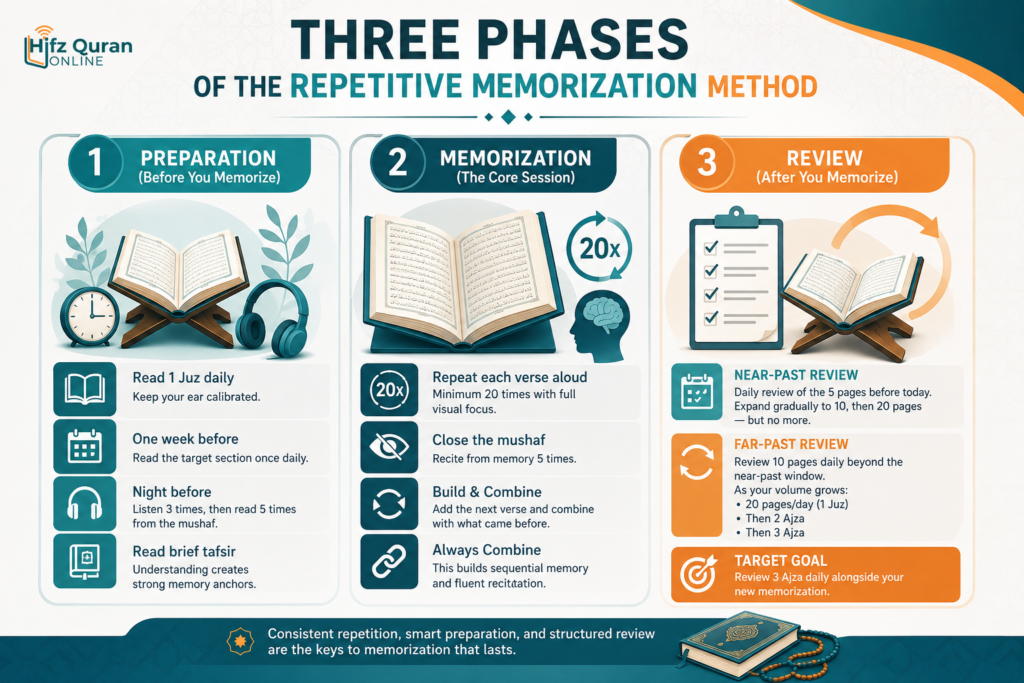
The repetitive memorization method is not simply “repeat a verse many times.” When applied properly for Quran, it consists of three distinct phases that work together: preparation before you memorize, the memorization session itself, and structured review after. Skipping any one of these phases is the most common reason memorization doesn’t hold.
Phase One: Prepare Your Mind Before You Memorize
Preparation is the phase most students ignore, and it is often the reason their memorization session goes poorly. The mind retains what it has already encountered, so the goal here is to make the passage familiar before you try to fix it in memory.
Begin with a daily Quran reading habit of at least one juz per day, read in a single sitting or across several. This keeps your ear calibrated to Quranic Arabic and builds the passive familiarity that makes new passages easier to absorb. A juz takes approximately 20 minutes to read at a measured pace.
One week before you plan to memorize a given section, start reading that section once daily from the mushaf. By the time you sit down to memorize it, you will have heard its rhythms and seen its structure seven times already.
The night before each memorization session, listen to your target passage three times through a proficient reciter — classical choices include Al-Husary, Abdul Basit, Al-Minshawi, Mustafa Ismail, or Al-Banna — then read it from the mushaf five more times. This nighttime preparation primes your memory so the morning session requires far less effort.
Finally, before beginning, read a brief tafsir of the passage. Understanding what the verses mean creates semantic anchors in memory that repetition alone cannot provide.
Phase Two: How to Run a Memorization Session Using Repetition
Begin by reading the thematic connections, word meanings, and key reflective points from the page margins if your mushaf provides them. Then notice the linguistic patterns that link verses to one another — these connections are what allow you to move between verses without stumbling.
Now begin the memorization itself. Take the first verse and repeat it aloud a minimum of 20 times, with full visual focus on the text. The 20-repetition floor is not arbitrary — two or three repetitions produce the feeling of familiarity, not the deep encoding that survives sleep. Do not mistake recognition for retention.
After 20 repetitions, close the mushaf and recite the verse from memory five times. If you stop at a word, open the mushaf, review it, close it again, and restart the five recitations from the beginning. This closing-and-reciting step is what transfers the verse from short-term to working memory.
Move to the second verse and repeat the same process. Then recite both verses together from memory five times. Add the third verse the same way, then combine all three and recite five times. Continue this build-and-combine pattern until you reach the end of your planned passage for the day.
The rule that separates this method from careless repetition: always combine what you’ve just memorized with what came before. This is what builds sequential memory — the kind that lets you recite without hesitation rather than reconstructing verse by verse.
Read also: The Space Method for Memorizing the Quran To Retain Every Verse
Phase Three: How to Review What You’ve Memorized So You Never Forget It
Memorizing without reviewing is like writing in sand at the tide line. The review phase has two tracks, and both must run concurrently.
Near-past review covers the 5 pages immediately preceding today’s session. Review these daily. As your total memorized volume grows, expand this near-past window gradually — first to 10 pages, then to 20 pages, but no further.
Far-past review covers everything you have memorized beyond the near-past window. You cannot review all of it daily, so the approach is systematic: review 10 pages of far-past material each day, working through the full body of your memorized Quran in rotation. As your volume grows, increase this to 20 pages per day (one juz), then two ajza, then three.
The target to aim for, once your memorization is well established, is to review three ajza per day in addition to your new memorization session. This is sustainable when built gradually — it cannot be imposed at the beginning.
These three phases work together to turn repetition into a sustainable Quran memorization system. If you want your child to memorize the Quran with a structured routine, consistent review, and guidance from qualified teachers,Hifz Quran Online Academy offers online Quran memorization for kids with personalized support designed around each child’s pace and learning needs. Enroll today and help your child build a strong, lasting relationship with the Quran.

Specialized Techniques That Reinforce the Repetitive Method In The Quran
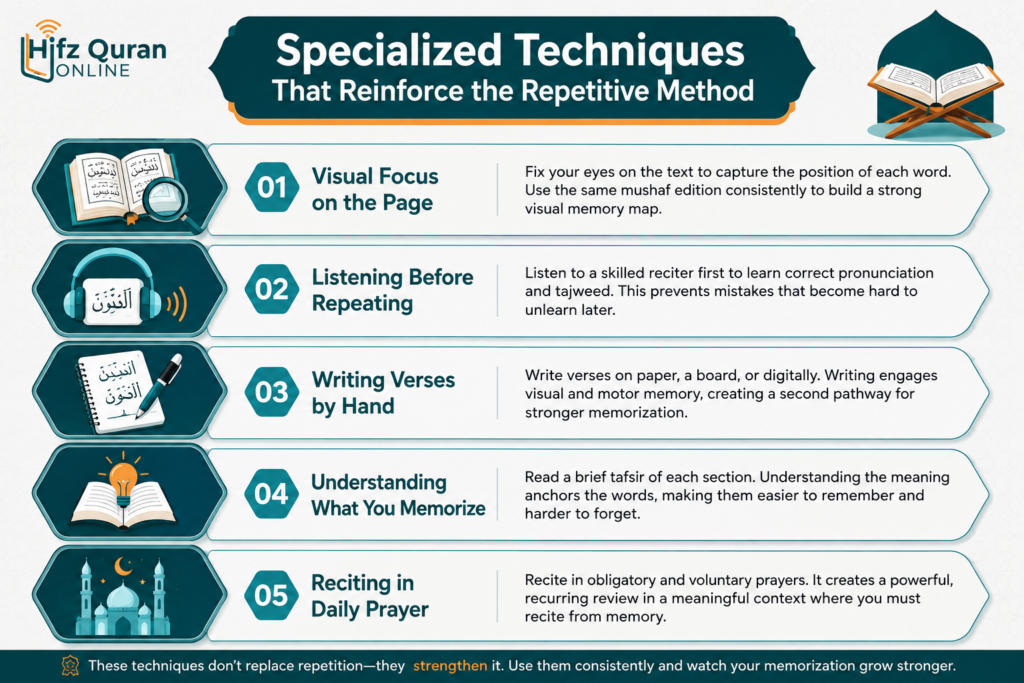
The core method above is the framework. The techniques below are tools you layer on top of it depending on how you learn best. No single technique replaces repetition — they all work in its service.
1. Visual Memorization: Fix Your Eyes on the Page Layout
Fix your eyes on the text for enough time to let your brain record the spatial position of each word on the page. Use a single mushaf edition consistently throughout your memorization journey — switching editions changes the layout and disrupts the visual map your memory has built. When you later recall a verse, you will often “see” its position on the page before you hear the words internally.
2. Auditory Memorization: Listen to a Reciter Before Repeating
Listen to the verse recited by a skilled teacher or reciter before repeating it. This method is especially effective for children and older adults. Hearing correct pronunciation before attempting repetition encodes proper tajweed from the start, which matters because incorrect pronunciation learned through repetition becomes very difficult to unlearn later.
3. Written Repetition: Memorizing Quran by Writing Verses by Hand
Write the verses by hand — on paper, a whiteboard, or digitally. The traditional method of writing on a wooden board (used widely in West African and Saharan Quran schools) is among the most effective implementations of this technique: the student hears the verse from the teacher, writes it, memorizes it, then recites it back for correction before erasing and moving on. Physical writing engages both visual and motor memory, creating a second encoding pathway that purely oral repetition does not reach.
4. Understanding Meaning Before Memorizing
Read a brief tafsir of every section you memorize. This does not replace repetition — it amplifies it. When you understand that a verse is describing a specific moment, command, or attribute of Allah, the words attach to meaning rather than floating as pure sound. Meaning-linked memories are significantly more resistant to forgetting than form-only memories.
5. Reciting in Daily Prayer
Recite memorized surahs and verses in your daily prayers, both obligatory and voluntary. This is one of the most powerful review mechanisms available because it creates a recurring, emotionally significant context for the memorized material — and it requires you to recite from memory under conditions where you cannot pause and look up a word.
Ready to build a consistent memorization routine? Our Online Quran Memorization Course for Adults helps you apply repetition and complementary memorization techniques through a structured, teacher-guided approach tailored to your pace and level. Start your journey toward memorizing the Quran with greater confidence, consistency, and understanding.

The Best Time to Memorize Quran According to The Repetitive Memorization Method
The optimal time for Quran memorization is the early morning, ideally after Fajr prayer. At this point, the mind has rested, the environment is typically quiet, and cognitive focus is at its daily peak. Memorization done in the morning tends to fix more durably than memorization done in the afternoon or evening.
A practical schedule for a focused student: memorize after Fajr, take a rest period, attend to daily responsibilities, then use any remaining time in the day for review — not for new memorization. Mixing new memorization into scattered evening sessions often produces shallow encoding that review sessions then have to repair.
The practical recommended daily rate for a student following the full three-phase method is one passage (half a page) per day, six days per week, with Friday as a rest day — no new memorization and no review. At this pace, a complete Quran can be memorized in approximately four years with durable, tested retention.
Step Inside Our Virtual Classrooms
Don’t just take our word for it—see how our interactive sessions work! Watch the short clips below to experience our engaging teaching methods, live teacher-student interactions, and the supportive learning environment we bring to every student.
Memorize the Quran at Your Own Pace
Join our expert tutors and begin your Hifz journey with a personalized plan.
Start Your Free TrialTypes Of Quran Memorization Methods Built on Repetition
Repetition is the common thread running through every proven Quranic memorization tradition. The methods differ in structure, but they all share one principle: a verse is not memorized until it has been repeated enough times to survive sleep, distraction, and the passage of days.
1. The Mauritanian Method Hundreds of Repetitions with Written Reinforcement
The Mauritanian method is one of the most famous repetition-based traditions in the Islamic world, practiced across West Africa and the Saharan region for centuries. Students repeat each verse not 20 times, but hundreds of times — continuing until the text is so deeply fixed that it cannot be shaken.
What makes this method particularly powerful is that it combines oral repetition with writing on a wooden board: the student hears the verse from the teacher, writes it on the board, memorizes it through repetition, recites it back for correction, then erases the board and moves on.
This dual encoding — through sound, sight, and physical writing simultaneously — is why students trained in the Mauritanian tradition tend to carry an exceptionally strong and durable Quran throughout their lives.
2. The 6336 Method: Visual Repetition That Builds Stronger Recall
The 6336 method is a Quran memorization technique that structures repetition around focused visual attention and a fixed numerical pattern — instead of repeating an entire page as one block, you divide the passage into smaller sections and apply a specific number of repetitions at each stage before gradually linking the sections together.
The numbers in the name refer to the repetition pattern used as you move from individual sections to combined passages.
This approach gives your memory multiple opportunities to encode the same passage: first through focused visual attention, then through repeated recitation, and finally through connecting each section to the next.
Because the method works with the structure of the page rather than relying on a particular type of passage, it can be applied to new memorization, longer pages, difficult sections, or passages that need additional reinforcement. Its main strength is turning repetition into a deliberate, step-by-step process rather than simply repeating the same passage from beginning to end.
3. The 7321 Method: Spaced Repetition for Long-Term Retention
The 7321 method is a spaced-repetition review system for Quran memorization that gives each newly memorized passage repeated opportunities to return to memory at gradually increasing intervals — instead of reviewing the same verse every day, you memorize it on the first day, then review it on the following day, two days later, three days later, and finally seven days later.
The sequence is simple: memorize → review after 1 day → review after 2 days → review after 3 days → review after 7 days.
Each review strengthens the memory while the increasing gaps give your brain a chance to retrieve the passage after it has begun to fade. This makes the method especially useful for maintaining previously memorized material without requiring the same amount of review every day.
The strength of the 7321 method is that it turns review into a predictable schedule rather than something you do only when you feel that you are forgetting. As your memorized portion grows, each new passage enters the same review cycle, creating a structured system for reinforcing Quranic verses over time.
Read also: The Scribble Memorization Method for Quran Hifz
Quran Memorization Apps Support the Repetitive Method
Quran memorization apps can make the repetitive method easier to follow by giving you precise control over how often you listen to and repeat each verse.
Instead of manually restarting a recording, you can select an ayah or a group of verses and have the app repeat them until you are ready to move forward. This makes it easier to follow the same repeat-and-combine process used in a structured memorization session.
Several apps are particularly useful for this purpose. Ayat by King Saud University allows you to repeat individual verses or selected passages as many times as needed and can be used offline after downloading the recitation.
Tikrar is designed specifically for Quran memorization and focuses on repetition, linking verses together, and systematic review. Other Quran memorization apps, including teacher-Mushaf applications, allow you to select a specific range of verses and repeatedly play the recitation so you can listen and recite along.
Apps are a strong support tool, but they cannot correct your tajweed, notice when you’re consistently stumbling on the same word, or adjust your plan when life gets in the way.
At Hifz Quran Online Academy, our ijazah-certified instructors do all of that — in live, one-on-one sessions built around the same repetitive method. If you’re ready to combine the convenience of online learning with the accountability of a real teacher, your first class is waiting.
[“Book Your Free Trial Class”]

See Our Classes in Action
Curious about what a 1-on-1 Hifz session looks like? Take a look at these real-time snippets from our daily classes to see our student-centered approach, Tajweed correction techniques, and online whiteboard tools in action.
Memorize the Quran at Your Own Pace
Join our expert tutors and begin your Hifz journey with a personalized plan.
Start Your Free TrialStart Memorizing the Quran Today with Expert Guidance
Knowing the method is the first step. Applying it consistently, with a qualified teacher correcting your tajweed and tracking your progress, is what turns intention into a completed Quran.
At Hifz Quran Online Academy, you work one-on-one with ijazah-certified instructors who use the structured repetitive method — preparation, memorization, and systematic review — in every session. Classes run online, on your schedule, for students of all ages and levels.
Our Quran Courses
- Quran Memorization Course
- Quran Memorization and Hifz Course for Kids
- Online Quran Memorization Courses for Adults
- Quran Hifz Course for Ladies
- Quran Memorization Course for Men
- Saudi-Based Quran Memorization Courses
- Hifz Teachers

Memorize the Quran at Your Own Pace
Join our expert tutors and begin your Hifz journey with a personalized plan.
Start Your Free TrialConclusion
The repetitive memorization method works because memory is not built by reading — it is built by structured, focused rehearsal followed by consistent review. Reading a verse twice and moving on is the reason most memorization fades by morning. Repeating a verse 20 or more times, combining it with what came before, and reviewing it daily across two tracks is the reason some students carry the complete Quran in memory for a lifetime.
The method applies to all learners. Children benefit from its clear structure and immediate sense of progress. Adults benefit from the comprehension layer that deepens retention. Older students benefit from the segmented approach that reduces the anxiety of large volumes. The framework is the same; the pace adjusts to the individual.
Begin with one passage — half a page — tomorrow after Fajr. Prepare the night before. Follow the build-and-combine pattern during the session. Review what you memorized yesterday before adding anything new. Repeat this until it becomes habit. The Quran is memorized one verse at a time, linked to the one before it, reviewed until the chain holds.
Frequently Asked Questions
What is the repetitive memorization method for Quran?
The repetitive memorization method means repeating each verse a minimum of 20 times until it is firmly fixed in memory, then combining it with previously memorized verses and repeating the group together. This build-and-link pattern is what creates durable sequential memory rather than isolated verse recall.
How many times should I repeat a verse before moving on?
Repeat each verse at least 20 times with focused attention before considering it memorized. Fewer repetitions — two or three — produce recognition, not retention. After 20 repetitions, close the mushaf and recite from memory five times before moving to the next verse.
Is it better to start memorizing from Surah Al-Baqarah or Juz Amma?
Both are valid starting points, and the choice depends on the individual. Juz Amma offers short surahs that build early confidence and a sense of achievement, though its verses require careful attention to similar-sounding passages. Al-Baqarah builds tolerance for long verses and is often recommended for students with previous Quran reading experience. There is no single correct answer — the method itself is more important than the starting point.
Can adults use the repetitive memorization method effectively?
Yes. The method works across all age groups. Adults benefit particularly from the comprehension layer — reading tafsir before memorizing — because meaning-linked memory is more stable than sound-only memory. The pace may be slower than a child’s, but the retention, when the method is followed correctly, is equally durable.
What is the best time of day to memorize the Quran?
The early morning after Fajr prayer is the optimal time for Quran memorization. The mind is rested, focus is high, and the early hours are typically free of distractions. Memorization done consistently at the same time each day also becomes a habit that sustains itself without requiring motivation each session.
How do I stop forgetting what I have already memorized?
Forgetting is controlled through systematic review, not through memorizing more. Run two review tracks simultaneously: daily review of the 5–20 pages immediately preceding your current position (near-past), and daily review of 10 pages cycling through everything memorized before that (far-past). Recite memorized surahs in your daily prayers to add a third, habitual review context.
Related Articles
Memorizing Quran






Leave a Reply