 Memorizing Quran
You’ve repeated the same verse thirty times and it still slips away the moment you close your Mushaf. The problem isn’t your memory — it’s your method. Your brain is built to remember places and images with extraordinary precision, yet most Hifz approaches ask it to work against its own wiring.
The space method for memorizing the Quran turns that wiring into your greatest memorization asset. It anchors Quranic verses to physical locations your brain already holds in permanent storage, making retrieval feel less like effort and more like walking through a familiar room.
This guide covers two complementary forms of the space method, how to apply each to real Quranic pages step by step, and how to scale up from a single surah to a full Juz’.
What you’ll learn in this article
- What the space method of memorization is — and its two distinct forms
- Why your brain retains locations better than words alone
- Step-by-step application of both spatial techniques to Quran memorization
- How to scale the method from one page to an entire Juz’
- A daily maintenance routine to prevent forgetting what you’ve fixed spatially
- Answers to the most common questions about this method
What the Space Method of Memorization Is and Why It Works for the Quran
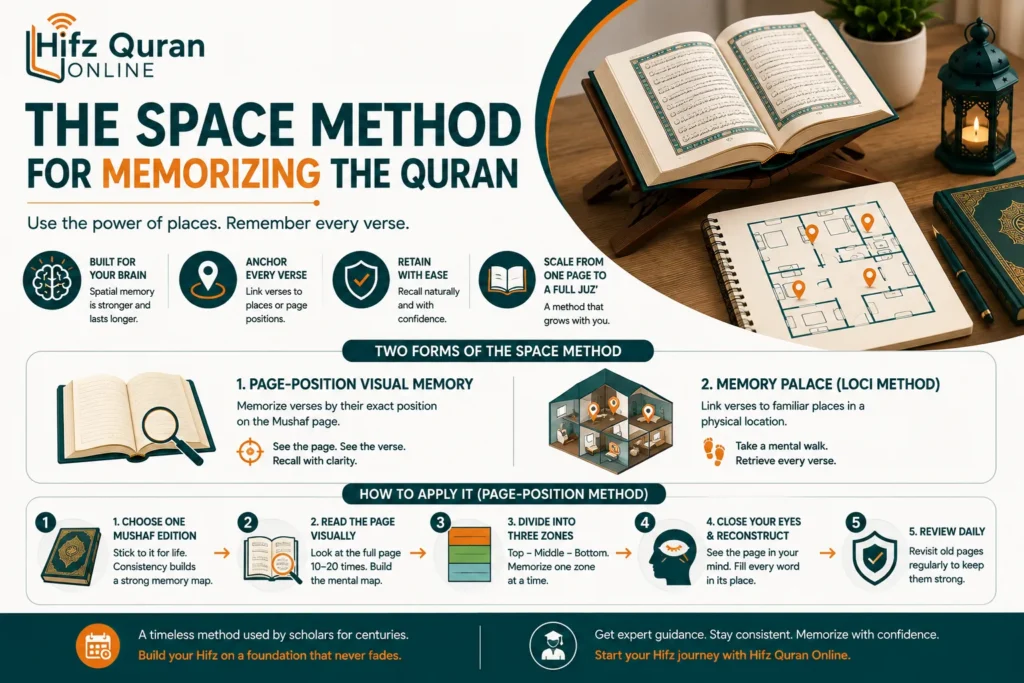
The space method of memorization uses physical locations to anchor information you want to remember long-term. Instead of repeating words in isolation, you attach them to places your brain has already mapped — rooms in your home, landmarks on a familiar route, specific zones on a physical page.
For Quran memorization specifically, the space method takes two complementary forms that are often confused:
Form 1 — Page-Position Visual Memory:
The verse is mentally photographed exactly where it sits on the Mushaf page — top, middle, bottom, left column, right column. Retrieving the verse means mentally returning to that location on the page and reading it from your internal image.
Form 2 — The Memory Palace (Loci Method):
Each verse or thematic passage is linked to a distinct physical location in a real space you know well — a room in your home, a station along a route. Recalling the verse means taking a mental walk through that space and reading what you’ve “placed” there.
Both methods exploit the same neurological advantage: the human brain processes and retains spatial and visual information in a separate memory system from verbal rote learning. Spatial memory is older, faster, and more durable. Hifz teachers have relied on this instinctively for centuries — the practice of sticking to one Mushaf edition is itself a form of page-position spatial memory, even when it isn’t named as such.
Which Form Should You Use?
Use page-position visual memory as your foundation — it applies to every verse automatically and costs nothing extra once you’ve committed to a single Mushaf. Layer the Memory Palace on top for long surahs, difficult passages, or sections where verses frequently get confused with each other.
Read also: The Scribble Memorization Method for Quran Hifz
How to Apply Page Position Visual Memory to Quran Memorization?
Page-position visual memory treats every Mushaf page as a fixed map. The goal is to photograph that map precisely enough that your mind can “read” it with your eyes closed.
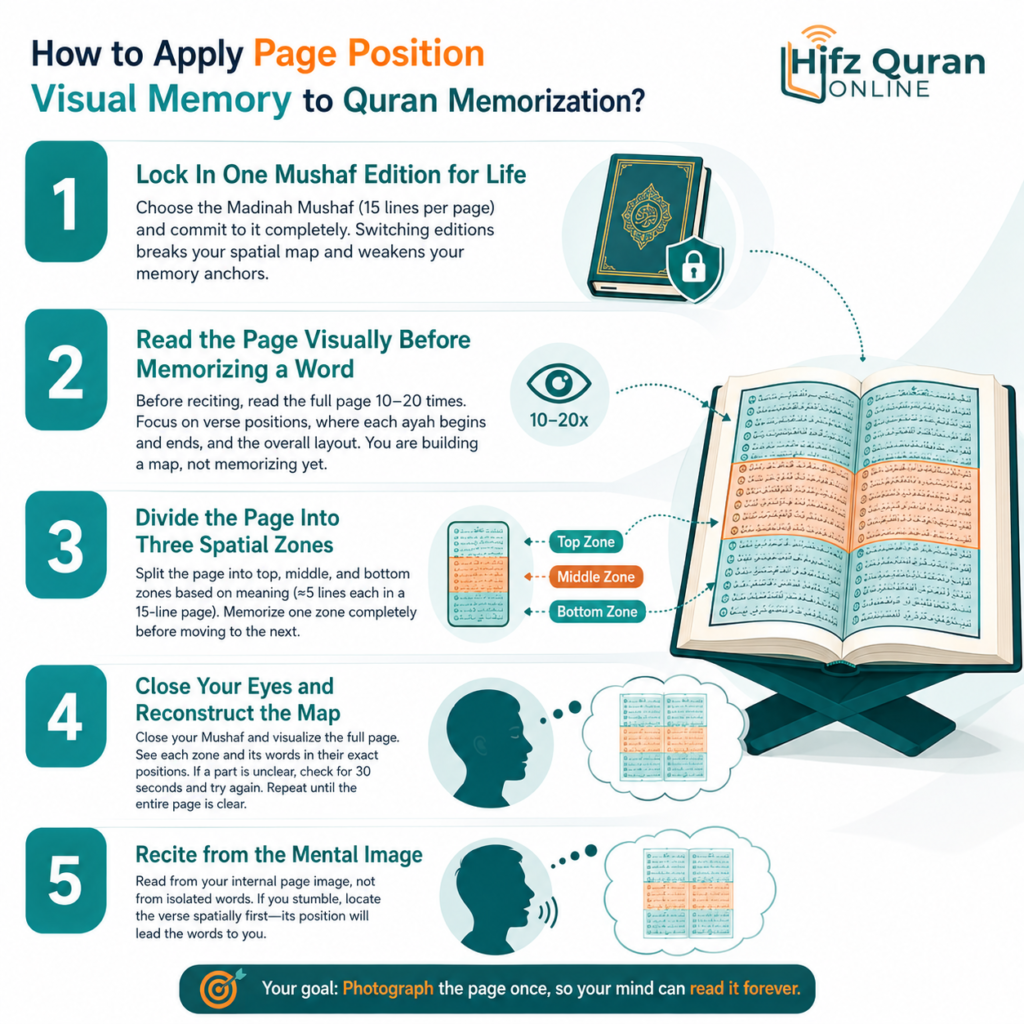
1. Lock In One Mushaf Edition for Life
This is the single most important constraint of the entire method, and it’s the step most students skip. If you switch between Mushaf editions you overwrite your existing spatial map with a new one. The position of every verse shifts, and the memory anchor breaks.
Choose the Madinah Mushaf (15 lines per page) if you are memorizing for the first time. Commit to it completely. Every page you memorize deposits a spatial image into long-term memory; that deposit only compounds if the page layout never changes.
2. Read the Page Visually Before Memorizing a Word
Before any recitation, look at the full page with deliberate attention. Scan the verse positions: which ayah begins at the top? Where does it end? Which verse sits exactly at the center line? Read the page from the Mushaf at a comfortable pace 10 to 20 times, letting your eyes absorb the layout as much as the words. The goal of these readings is not yet memorization — it is map-making.
3. Divide the Page Into Three Spatial Zones
Divide every page into three roughly equal horizontal zones — top, middle, and bottom. Each zone becomes a distinct memory location. A 15-line Madinah Mushaf page typically splits into three passages of approximately five lines each, aligned to thematic breaks in the verses.
Treat each zone as a separate unit for memorization. Memorize the top zone completely before moving to the middle, and the middle completely before moving to the bottom.
Read also: The Scribble Memorization Method for Quran Hifz – How It Works and When to Use It
4. Close Your Eyes and Reconstruct the Map
After your visual reading passes, close your Mushaf and close your eyes. Mentally project the page. See the top zone: which words are there, and where exactly do they sit? Move to the middle zone, then the bottom. If you can’t see a section clearly, open the Mushaf, look at that section deliberately for thirty seconds, and close it again. Repeat until the full page is visible in your mind’s eye.
5. Recite from the Mental Image
When reciting from memory, do not try to recall words in isolation. Instead, look at your internal page image and read from it as you would from the physical Mushaf. If you stumble, locate the verse spatially first — “it was in the lower-left of the middle zone” — and the words will follow.
Step Inside Our Virtual Classrooms
Don’t just take our word for it—see how our interactive sessions work! Watch the short clips below to experience our engaging teaching methods, live teacher-student interactions, and the supportive learning environment we bring to every student.
Memorize the Quran at Your Own Pace
Join our expert tutors and begin your Hifz journey with a personalized plan.
Start Your Free TrialHow to Apply the Memory Palace to Quran Memorization?
The Memory Palace (loci method) builds a physical environment in your imagination where Quranic passages live at specific addresses. It is especially powerful for long surahs and for distinguishing between verses that sound similar.
Choose a Location You Know in Complete Detail
Your childhood home, your current apartment, the mosque you attend daily — any space you can mentally walk through without effort. The richer your existing mental map of the space, the more reliable your anchoring will be.
Define a Fixed Route with Clear Stations
Choose a path through the space and mark five to ten stations: distinctive objects or zones you pass in the same order every time. A five-station example within one room: the door → the desk → the wardrobe → the bed → the window. Never reverse this route. The directional consistency is what prevents verse order from scrambling.
Anchor Each Passage to a Station with a Vivid Image
At each station, place a strong visual image that encodes the meaning of the verses stored there. The image does not need to be realistic — it needs to be memorable. For Surah Al-Naba’ (78:1–5), for example: at the door, picture the question “What are they asking about?” written in large gold letters across the wood, because the door is the entry point — just as the surah opens with a question about the great news.
Do not place more than one page of content at a single station. If the station becomes overloaded with verses, retrieval becomes unreliable.
Review by Walking, Not by Sitting
To revise, take your mental walk. Stand at the door of your imagined space and move through your route in order. Each station triggers its passage automatically — the brain retrieves the image, the image retrieves the verse. This walk-based review can be done during wudu, during your commute, or in the minutes before sleep.
At Hifz Quran Online Academy, our instructors integrate spatial review into weekly sessions — students walk their memory palace aloud with the teacher, who corrects the sequence and identifies which stations are holding weakly. It is one of the fastest methods for identifying and repairing retention gaps before they compound.

How to Scale the Space Method from One Page to a Full Juz’?
The most practical objection to the Memory Palace is: what happens when I run out of rooms? The answer is a three-tier spatial architecture that matches the structure of the Quran itself.
| Quranic Unit | Spatial Equivalent |
| One page (15 lines) | One room (3 stations = 3 zones: top, middle, bottom) |
| One hizb (10 pages) | One full home (each room = one page) |
| One juz’ (20 pages) | Your neighborhood route (each landmark = one page) |
This architecture means a student who has memorized one Juz’ can hold its entire structure along a single familiar walking route — 20 landmarks, each carrying one Mushaf page across three internal zones.
The practical implication: before you begin memorizing Juz’ 1, map your route and label your 20 landmarks. Assign each landmark to a page number. The structure exists before the content fills it, and expansion into Juz’ 2 simply means extending the route.
Read also: 8 Common Mistakes in Quran Memorization (And How to Fix Each One)
The Daily Maintenance Routine That Prevents Spatial Memories from Fading
Spatial memory is durable — but it is not permanent without review. The memory palace decays if you don’t walk it.
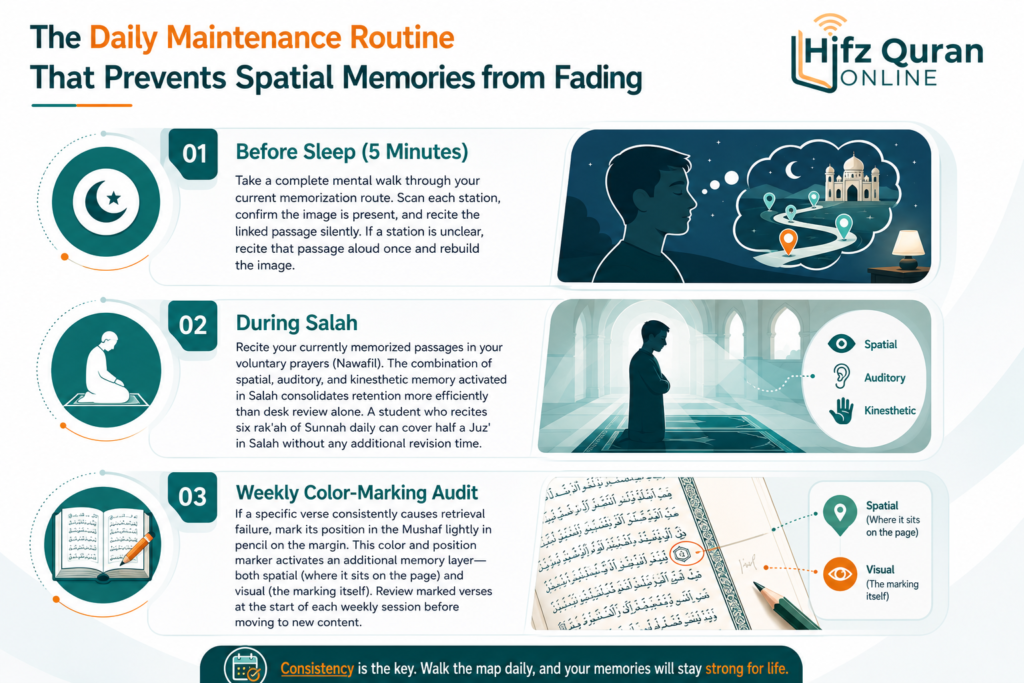
Before Sleep: Walk Through Your Memorization Route (5 Minutes)
Take a complete mental walk through your current memorization route. You do not need to recite every word aloud — scan each station, confirm the image is present, and recite the linked passage silently. If a station is unclear, recite that passage aloud once and rebuild the image.
During Salah: Recite Your Memorized Passages
Recite your currently memorized passages in your voluntary prayers (Nawafil). The combination of spatial, auditory, and kinesthetic memory activated in Salah consolidates retention more efficiently than desk review alone. A student who recites six rak’ah of Sunnah daily can cover half a Juz’ in Salah without any additional revision time.
Weekly Color-Marking Audit: Mark and Review Difficult Verses
If a specific verse consistently causes retrieval failure, mark its position in the Mushaf lightly in pencil on the margin. This color and position marker activates an additional memory layer — both spatial (where it sits on the page) and visual (the marking itself). Review marked verses at the start of each weekly session before moving to new content.
A structured teacher-led Hifz program makes this maintenance sustainable. At Hifz Quran Online Academy, students receive weekly retention tests that identify exactly which pages and stations are weakening, and revision targets are adjusted accordingly — so nothing slips through the gaps.
See Our Classes in Action
Curious about what a 1-on-1 Hifz session looks like? Take a look at these real-time snippets from our daily classes to see our student-centered approach, Tajweed correction techniques, and online whiteboard tools in action.
Memorize the Quran at Your Own Pace
Join our expert tutors and begin your Hifz journey with a personalized plan.
Start Your Free TrialStart Memorizing the Quran with a Method That Actually Works
If you have been repeating verses without a system, the space method is not just a technique — it is a shift in how your brain engages with the Quran. The verses stop being abstract strings of words and become living images anchored to places your memory never lets go.
Hifz Quran Online Academy’s instructors guide students through spatial memorization techniques from the very first session, combining page-position visual memory with structured Memory Palace building and weekly retention testing. Whether you are memorizing your first surah or recovering lost Hifz, our Ijazah-certified teachers build the system around your pace.
Our Quran Courses
- Quran Memorization Course
- Quran Memorization and Hifz Course for Kids
- Online Quran Memorization Courses for Adults
- Quran Hifz Course for Ladies
- Quran Memorization Course for Men
- Saudi-Based Quran Memorization Courses
- Hifz Teachers

Memorize the Quran at Your Own Pace
Join our expert tutors and begin your Hifz journey with a personalized plan.
Start Your Free TrialConclusion
The space method for memorizing the Quran works because it aligns with how your brain is already built — not against it. Page-position visual memory turns every Mushaf page into a permanent mental photograph. The Memory Palace anchors long passages to physical spaces you can walk through on demand. Used together, they address the two biggest failure points in Hifz: losing verses between sessions and confusing similar-sounding passages with each other.
The method scales cleanly from a single page to a complete Juz’, and daily review through Salah and a five-minute bedtime walk through your memory palace keeps what you’ve memorized from fading. Commit to one Mushaf edition, build your spatial architecture before filling it with content, and review by walking — not just by sitting and repeating.
Frequently Asked Questions About the Space Method for Quran Memorization
What is the space method of memorization?
The space method of memorization is a technique that anchors information to physical locations, making it easier to retrieve. For Quran memorization, it takes two forms: photographing the exact position of verses on a Mushaf page, and building a Memory Palace where passages are linked to rooms or stations in a familiar real-world environment.
Can the Memory Palace method really be used to memorize the Quran?
Yes. The Memory Palace assigns Quranic passages to fixed stations along a mental route through a familiar space. When you review, you walk the route and each station retrieves its linked passage. It is particularly effective for long surahs, difficult passages, and preventing verse confusion — and it scales from one page to an entire Juz’ using a simple three-tier spatial architecture.
Do I have to use the same Mushaf edition for spatial memorization to work?
Yes — this is non-negotiable. Spatial memory anchors each verse to its exact position on the page. Switching Mushaf editions repositions every verse, breaking all existing spatial anchors. Choose one edition before you begin — the 15-line Madinah Mushaf is the most widely used for this reason — and never change it.
How many verses should I place at each Memory Palace station?
No more than one page of Quran content per station. Each station in your Memory Palace should hold one of the three spatial zones of a page (top, middle, or bottom), meaning three stations per page. Overloading a station with too many verses makes retrieval unreliable and defeats the purpose of the spatial separation.
How do I review memorization using the space method?
For page-position memory, close your eyes and mentally project the page. Read from your internal image rather than trying to recall words in isolation. For the Memory Palace, take a mental walk through your route in order, letting each station retrieve its passage. A five-minute before-sleep walk and regular recitation in voluntary Salah are the two most effective daily review practices.
What should I do if I forget a verse that was spatially anchored?
Return to the physical Mushaf and locate the verse on the page. Look at its position deliberately — which zone, which line, left or right side — for thirty seconds. Close the Mushaf and rebuild the mental image before reciting. Repeated failure at a specific station usually means the image anchor at that station is too weak; strengthen it by adding a more vivid or unusual visual image to that location.
Related Articles
Memorizing Quran







Leave a Reply