 Memorizing Quran
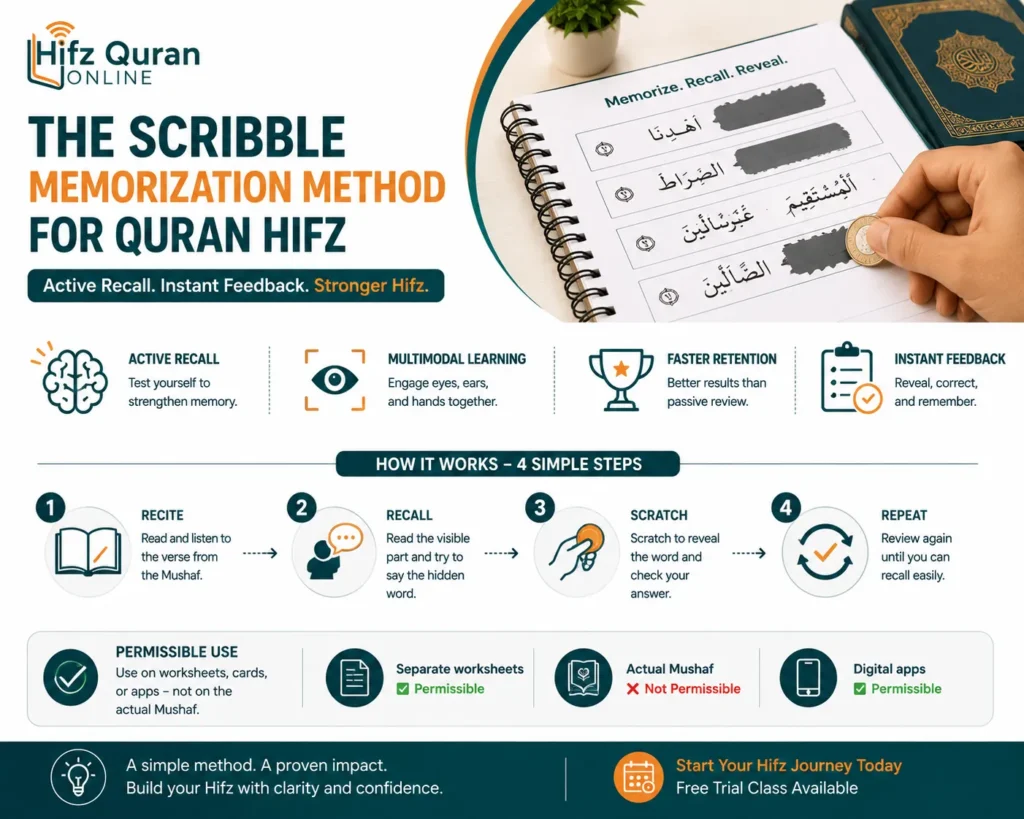
Most people who struggle with Hifz don’t lack dedication. They lack a feedback loop. You recite a verse, stumble on a word, and you’re not sure whether you actually knew it or were just reading along. The scribble memorization method — also called the scratch-off method — fixes exactly that by forcing genuine recall before the answer is revealed.
But does it work for the Quran? And is it even permissible to use? This article gives you a straight answer on both.
What Is the Scribble Memorization Method?
The scribble memorization method is a self-testing technique that uses a scratch-off layer — similar to a lottery ticket coating — to hide words or verse endings on a printed page. The student reads the visible portion, attempts to recall the hidden word from memory, then scratches away the coating to verify their answer.
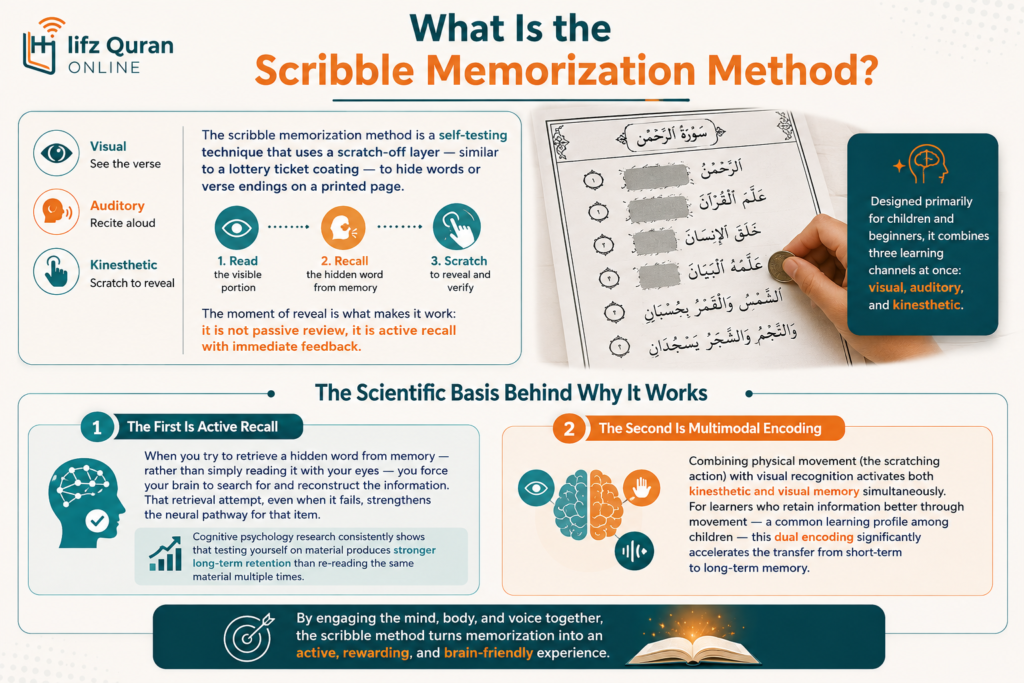
The moment of reveal is what makes it work: it is not passive review, it is active recall with immediate feedback.
The technique was designed primarily for children and beginners. It combines three learning channels at once: visual (seeing the printed verse), auditory (reciting aloud), and kinesthetic (the physical scratching motion). That combination is why it registers differently in the brain than simply re-reading a page.
The scientific basis behind why Scribble Method works
Two principles from educational psychology explain the method’s effectiveness.
Active Recall: Why Testing Yourself Beats Re-Reading?
When you try to retrieve a hidden word from memory — rather than simply reading it with your eyes — you force your brain to search for and reconstruct the information. That retrieval attempt, even when it fails, strengthens the neural pathway for that item.
Cognitive psychology research consistently shows that testing yourself on material produces stronger long-term retention than re-reading the same material multiple times.
Multimodal Encoding: Why the Physical Action Matters?
Combining physical movement (the scratching action) with visual recognition activates both kinesthetic and visual memory simultaneously. For learners who retain information better through movement — a common learning profile among children — this dual encoding significantly accelerates the transfer from short-term to long-term memory.
Read also: 8 Common Mistakes in Quran Memorization (And How to Fix Each One)
Is the Scribble Method Permissible for Quran Memorization?
This is the question most articles avoid, so we’ll answer it directly.
Writing on, scratching into, or applying a removable coating directly to an actual printed Mushaf is not permissible. The scholarly consensus holds that the Mushaf must be kept free of any additions, markings, or physical interference that could constitute disrespect toward the written words of Allah. This applies regardless of the intent behind it.
The method is fully permissible when applied to separate teaching materials — printed worksheets, cardboard panels, or laminated cards — that contain Quranic text produced specifically for this educational purpose. The distinction is clear: it is the physical Mushaf that holds the ruling of reverence, not every printed reproduction used in a pedagogical context.
If you are making your own scratch-off materials, the verse printout is a teaching tool, not a Mushaf. Applying the scratch-off coating to that worksheet is permissible.
The permitted vs. impermissible line — a practical decision rule
| Material | Permissible? |
| Separate printed worksheet or card created for teaching | ✅ Yes |
| Your own Mushaf, any commercially printed Mushaf, or any bound Quran | ❌ No |
| Digital app that simulates the scratch-off on a screen | ✅ Yes |
Keep this boundary clear when preparing or using scratch-off memorization materials.
Step Inside Our Virtual Classrooms
Don’t just take our word for it—see how our interactive sessions work! Watch the short clips below to experience our engaging teaching methods, live teacher-student interactions, and the supportive learning environment we bring to every student.
Memorize the Quran at Your Own Pace
Join our expert tutors and begin your Hifz journey with a personalized plan.
Start Your Free TrialHow to Apply the Scribble Method to Quran Memorization- A 4-Phase Protocol
This protocol applies the method within the permissible framework above. You will need: a printed worksheet of the surah or page you are memorizing, a scratch-off coating (a mixture of acrylic paint and dish soap works well), and a Mushaf to check pronunciation first.
Phase 1 — Recite Directly from the Mushaf
Before the worksheet, read the verses from your Mushaf several times. This is non-negotiable. The scratch-off phase tests recall of material you have already heard and read correctly — it does not teach correct pronunciation. If you memorize a mispronounced word, the scratch-off will confirm the error, not catch it. Correct recitation comes first.
Phase 2 — Attempt recall on the worksheet
Read the visible portion of each verse on the worksheet until you reach a hidden word. Stop. Say the word aloud before scratching. This attempt is the entire point of the method — skipping straight to the scratch defeats the exercise entirely. Your answer does not need to be correct for the method to work; the act of trying to retrieve the word is what strengthens the memory trace.
Phase 3 — Scratch the Coating and Check Your Answer Immediately
Scratch the coating slowly and check your answer. If you were correct, the confirmation reinforces your confidence and anchors the word visually.
If you were wrong, the correct word appears at exactly the moment your brain is most alert to it — immediately after a retrieval failure — which is when new information is most effectively encoded. This is why the immediate-feedback element is central to the method’s effectiveness.
Read also: 8 Common Mistakes in Quran Memorization (And How to Fix Each One)
Phase 4 — Recite the Full Passage From Memory Without the Worksheet
Set the worksheet aside and recite the entire passage from memory. This phase converts what was tested word-by-word into a complete, flowing recall. Do not skip it. The scratch-off phase identifies weak points; this phase integrates the passage.
If you are applying this method with a child, the achievement board variant is worth adding: a separate board where the child scratches off the surah name after completing it, revealing a symbol or visual reward underneath. This maps completion to a concrete, satisfying physical action and significantly strengthens motivation to continue.
At Hifz Quran Online Academy, our teachers structure daily Hifz sessions around active recall and immediate feedback — the same cognitive mechanisms that make the scribble method effective. If you want a guided system that combines these techniques with live Tajweed correction and structured muraja’ah, a free trial lesson lets you see how the method translates into a full Hifz curriculum.
Read also: Written Quran Memorization Techniques

Where the Scribble Method Works and Where It Breaks Down
Competing articles tend to present this method as universally applicable. It isn’t. Being honest about its scope saves you from wasting time applying it where it will not help.
Where Scribble Method Works Well:
- Juz’ Amma (the 30th Juz’) — short surahs where the full passage fits on one or two worksheets
- Individual verses with difficult word sequences
- Beginners and children who need immediate, tangible feedback
- The first 2–3 weeks of memorizing any new surah
Where Scribble Method becomes impractical:
- Long surahs (Al-Baqarah, Al-Imran) — the preparation time to produce worksheets for each page becomes unsustainable
- Advanced Hifz students who have already internalized the active recall habit
- Muraja’ah (revision) of large previously memorized portions — at that stage, the whiteboard-erasure method or Salah-based revision is faster and more scalable
The honest assessment: treat the scribble method as a starting-phase tool, not a complete Hifz system. It builds the active recall habit in the early stages. Once that habit is established, transition to more scalable techniques.
Memorize the Quran at Your Own Pace
Join our expert tutors and begin your Hifz journey with a personalized plan.
Start Your Free TrialDigital Alternatives That Achieve the Same Result as the Scribble Method
If preparing physical worksheets is not practical, several apps replicate the method digitally:
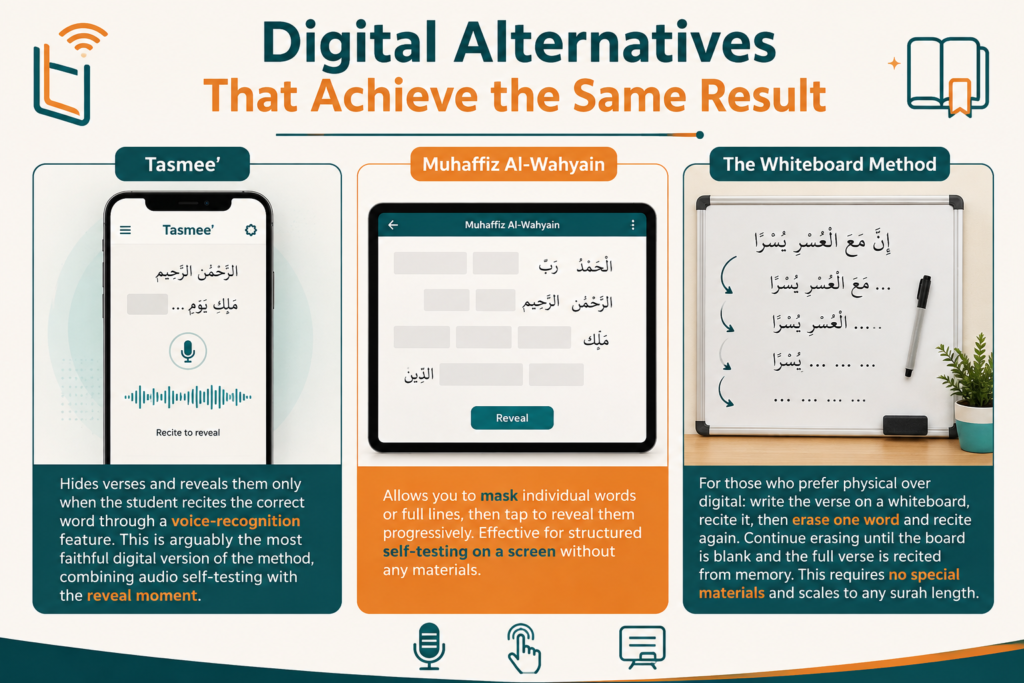
Tasmee’ — hides verses and reveals them only when the student recites the correct word through a voice-recognition feature. This is arguably the most faithful digital version of the method, combining audio self-testing with the reveal moment.
Muhaffiz Al-Wahyain — allows you to mask individual words or full lines, then tap to reveal them progressively. Effective for structured self-testing on a screen without any materials.
The whiteboard method — for those who prefer physical over digital: write the verse on a whiteboard, recite it, then erase one word and recite again. Continue erasing until the board is blank and the full verse is recited from memory. This requires no special materials and scales to any surah length.
See Our Classes in Action
Curious about what a 1-on-1 Hifz session looks like? Take a look at these real-time snippets from our daily classes to see our student-centered approach, Tajweed correction techniques, and online whiteboard tools in action.
Memorize the Quran at Your Own Pace
Join our expert tutors and begin your Hifz journey with a personalized plan.
Start Your Free TrialStart Your Hifz Journey With a Structured Online Program
The scribble method is a useful tool, but a tool alone does not complete Hifz. What completes Hifz is a structured system: new memorization targets, consistent muraja’ah cycles, and a teacher who catches errors before they become embedded.
At Hifz Quran Online Academy, Ijazah-certified instructors guide students through complete Hifz programs that combine the active recall principles behind the scribble method with systematic revision schedules and live Tajweed correction.
Our Quran Courses
- Quran Memorization Course
- Quran Memorization and Hifz Course for Kids
- Online Quran Memorization Courses for Adults
- Quran Hifz Course for Ladies
- Quran Memorization Course for Men
- Saudi-Based Quran Memorization Courses
- Hifz Teachers

Memorize the Quran at Your Own Pace
Join our expert tutors and begin your Hifz journey with a personalized plan.
Start Your Free TrialConclusion
The scribble memorization method works for Quran Hifz — when applied correctly. Its power comes from active recall and multimodal encoding, two well-supported principles of memory science. Applied to separate printed worksheets (never to the Mushaf itself), it is fully permissible and genuinely effective for Juz’ Amma and shorter surahs.
Its honest limitation: it is a phase-one technique. It builds the retrieval habit that makes Hifz stick in the early stages. As memorization advances into longer surahs, transition to more scalable methods — the whiteboard approach, Salah-based revision, or structured muraja’ah cycles with a teacher.
The principle behind the scribble method — test yourself before checking the answer — is worth keeping regardless of which technique you use.
Frequently Asked Questions
What is the scribble memorization method?
The scribble memorization method is a self-testing technique where words are hidden under a scratch-off coating on a printed page. The learner attempts to recall the hidden word from memory, then scratches the coating away to verify the answer.
It works by applying active recall — a retrieval attempt before the answer is revealed — which strengthens long-term memory retention more effectively than passive re-reading.
Is it permissible to use the scribble method with the Quran?
Using scratch-off coatings on a printed Mushaf is not permissible, as scholars hold that the Mushaf must be kept free from markings or physical interference. However, applying the method to separate printed worksheets created specifically for teaching is permissible. Digital apps that simulate the scratch-off effect on screen are also permissible.
Does the scribble method work for memorizing long surahs?
The method is best suited to short surahs and Juz’ Amma. For long surahs like Al-Baqarah, preparing fresh worksheets for each page becomes impractical. At that stage, the whiteboard-erasure method or structured muraja’ah with a teacher scales much more efficiently.
What is the best age to use the scribble method for Hifz?
The method is most effective for children aged 5–12, who benefit most from the kinesthetic and visual reinforcement. That said, beginners of any age who struggle with passive re-reading and need an active feedback mechanism will find it useful regardless of their age.
Can digital apps replace physical scratch-off worksheets for Hifz?
Apps like Tasmee’ and Muhaffiz Al-Wahyain replicate the core mechanism digitally and are fully permissible. They remove the preparation time and the cleanup, and the voice-recognition feature in Tasmee’ adds an audio verification layer that physical worksheets cannot match. For most learners, a digital version is the more practical option.


Leave a Reply