 Memorizing Quran

Most people try to shove entire pages into their memory like they’re stuffing a suitcase, then wonder why half the verses fall out.
Your brain isn’t always the problem — the method you’re using is. That’s where the 3×3 method for memorizing the Quran comes in.
What is the 3×3 method for memorizing the Quran? It’s a structured technique that breaks memorization into manageable pieces instead of overwhelming your brain with entire pages at once. Three verses. Three repetitions. Three steps. That’s literally it.
What You’ll Learn in This Article
- What the 3×3 Quran memorization method is and who created it
- A step-by-step walkthrough of each phase
- Why the method works based on how memory actually functions
- How to integrate Tajweed without derailing your progress
- Practical daily schedules for busy adults, students, and kids
What Is the 3×3 Method for Memorizing the Quran?
Sheikh Wisam Sharieff created the 3×3 method for memorizing the Quran to make the text accessible to every Muslim, regardless of age, background, or Arabic fluency.
The approach involves learning three verses at a time, repeating each one three times, and then joining all three into a single unit — three more times. Every session follows the same nine-step grid: three phases, three techniques per phase.
The Three Core Principles of the 3×3 Quran Memorization Method
The 3×3 Quran Memorization Method is built on three simple principles that make memorization more reliable and easier to retain over time. Rather than focusing only on repeating verses, it emphasizes how and when those repetitions happen.
Together, these principles help students develop accurate recall, smoother recitation, and long-term retention.
1. Purposeful Repetition
Every repetition in the method has a specific purpose rather than simply increasing the number of readings. The first five to seven recitations build familiarity with the verses and correct pronunciation.
The next three individual repetitions strengthen personal recall without relying on the Mushaf, while the final three linked repetitions train the brain to move naturally from one verse to the next. This structured approach develops both accuracy and fluency instead of mechanical repetition.
2. Connection Before Expansion
Many learners memorize each verse separately before attempting to connect them later. As a result, they often hesitate or make mistakes when transitioning between verses.
The 3×3 method avoids this problem by treating all three verses as a single memorization unit from the beginning. Students learn the connections between verses alongside the verses themselves, creating smoother and more confident recitation.
3. Consistency Over Intensity
Long-term Quran memorization depends far more on regular practice than on occasional intensive sessions. Memorizing a small, manageable portion every day allows the brain to consolidate new information before adding more.
In contrast, trying to memorize a large number of verses in one sitting often leads to faster forgetting and weaker retention. A steady routine of three verses each day builds lasting progress while keeping the workload sustainable for students of all ages.
Why the 3×3 Method Uses Three Verses and Three Repetitions
Three verses provide an ideal amount of new material for the brain to process without becoming overloaded. Research on working memory suggests that people can actively manage only a limited amount of new information at one time, making three connected verses a practical and sustainable daily target.
The three repetition cycles are equally intentional. They provide enough practice to strengthen recall and begin transferring the verses from short-term memory into long-term memory.
Fewer repetitions often leave the memorization too weak to retain, while excessive repetition can reduce concentration and lead to mental fatigue. By balancing a manageable memorization target with purposeful repetition, the 3×3 method helps students build accurate, lasting memorization without feeling overwhelmed.
Read more: How to Memorize the Quran in 4 Months?
Step-by-Step Guide to Applying the 3×3 Hifz Method
To get the full benefit of the 3×3 Hifz Method, complete each phase in the same order during every memorization session. Each step builds on the one before it, creating a strong foundation for accurate recitation and long-term retention.
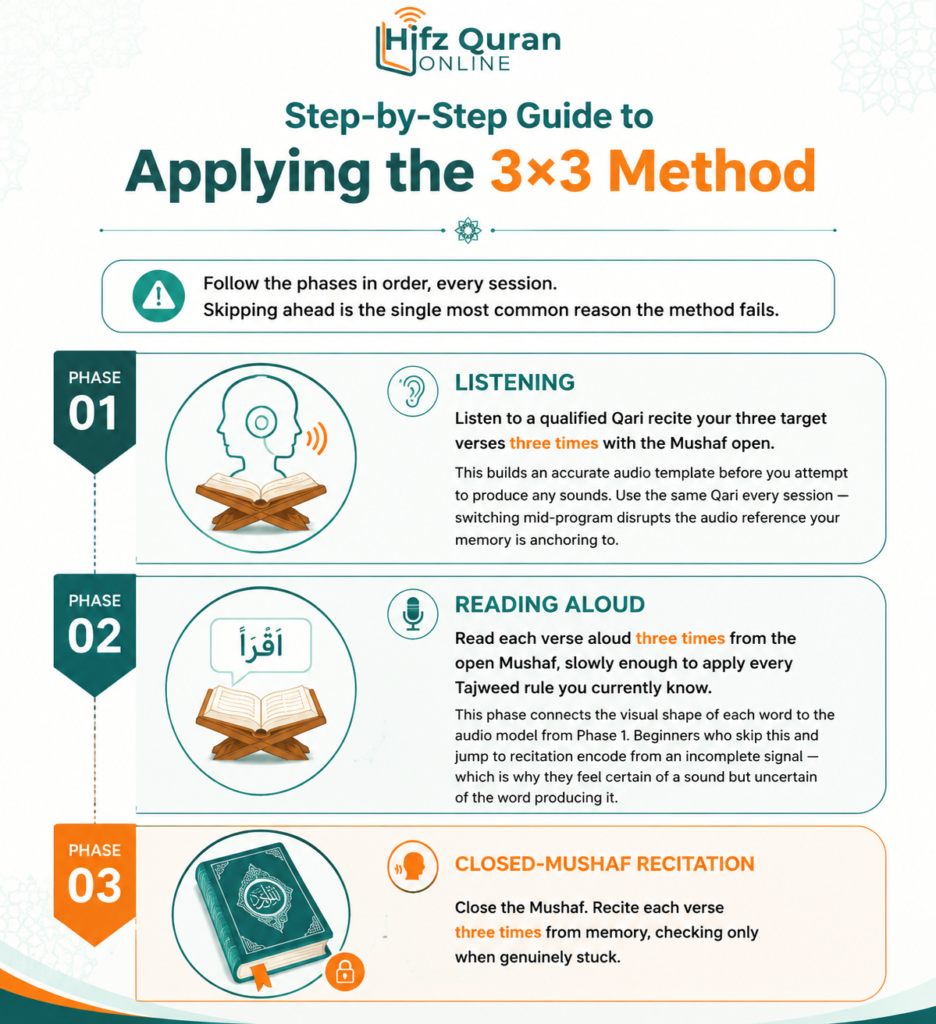
Skipping phases is one of the most common reasons students struggle to retain what they have memorized.
Phase 1: Listen Carefully
Begin by listening to a qualified Qari recite your three target verses three times while following along in the Mushaf. This creates an accurate mental model of the verses before you attempt to recite them yourself.
Using the same Qari throughout your memorization journey provides a consistent pronunciation, rhythm, and Tajweed reference, making it easier for your brain to recognize and reproduce the verses correctly.
Phase 2: Read Aloud from the Mushaf
Next, read each verse aloud three times while looking at the Mushaf. Recite slowly enough to apply every Tajweed rule you have already learned, paying attention to pronunciation and articulation.
This stage strengthens the connection between the written words, their correct sounds, and their meanings, laying the groundwork for confident memorization.
Phase 3: Recite from Memory
Close the Mushaf and recite each verse three times from memory. If you become genuinely stuck, briefly check the Mushaf before trying again. The goal is to recall the verses independently rather than relying on visual prompts.
Before moving to the next verse, make sure you can recite the current one three consecutive times without hesitation, without looking, and while applying the Tajweed rules you know.
If you make a mistake or hesitate, return to the previous phase for another round of reading before testing yourself again. This prevents weak memorization from accumulating and causing difficulties during later revision.
Phase 4: Connect the Verses
Once all three verses have been memorized individually, recite them together as one continuous passage three times without looking at the Mushaf. This step is essential because it trains the transitions between verses rather than treating each one as a separate piece of information.
Many students who skip this phase discover they can recite individual verses perfectly but hesitate when moving from one verse to the next. Linking the verses from the beginning creates smoother, more natural recitation and reduces transition errors during revision.
Read also: The 6446 Quran Memorization Method – A Complete Step-by-Step Guide
Phase 5: Complete Your Daily Review
Finish every memorization session by reviewing the material you learned during the previous one to three sessions. This immediate review reinforces recent memorization before it begins to fade and strengthens long-term retention through spaced repetition.
Building review into every session is one of the defining strengths of the 3×3 Hifz Method. New memorization without consistent revision often leads to rapid forgetting, while combining both allows students to make steady progress without sacrificing what they have already learned.
Book a free trial to start your Hifz path today

Step Inside Our Virtual Classrooms
Don’t just take our word for it—see how our interactive sessions work! Watch the short clips below to experience our engaging teaching methods, live teacher-student interactions, and the supportive learning environment we bring to every student.
Memorize the Quran at Your Own Pace
Join our expert tutors and begin your Hifz journey with a personalized plan.
Start Your Free TrialWhy the 3×3 Method Works
The 3×3 Quran Memorization Method is effective because it engages multiple learning processes instead of relying on repetition alone. By combining listening, reading, active recall, and daily review, it creates stronger memory connections that are easier to retain over time.
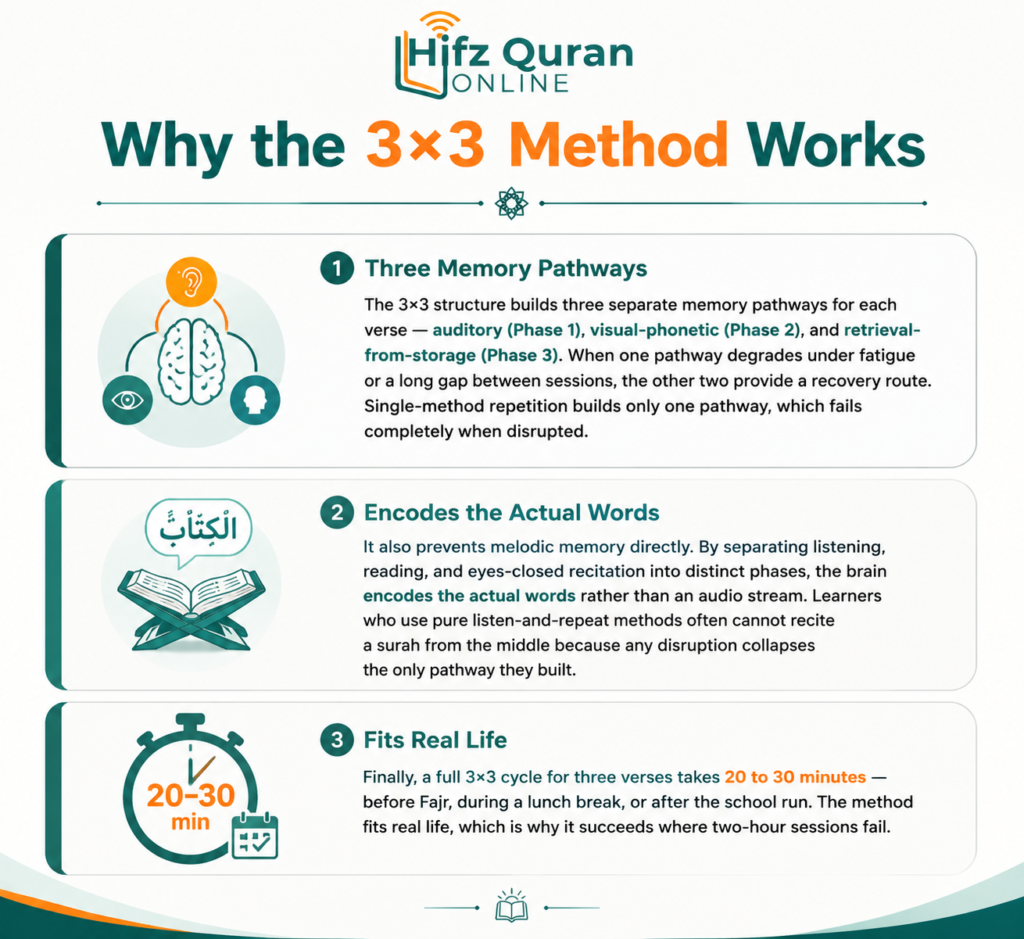
This structured approach helps students memorize more accurately while reducing the risk of forgetting.
1. It Builds Multiple Memory Pathways
Each phase of the method strengthens a different type of memory. Listening to a qualified Qari develops auditory memory, reading aloud from the Mushaf reinforces visual and phonetic recognition, and reciting from memory strengthens retrieval skills.
Because the verses are stored through several pathways, students are more likely to recall them successfully even after a break from memorization or during moments of uncertainty.
2. It Promotes Active Recall Instead of Passive Repetition
Simply listening to or reading verses repeatedly can create a false sense of confidence. The 3×3 Method requires students to close the Mushaf and retrieve each verse from memory, which is one of the most effective ways to strengthen long-term retention.
Every successful recall makes the memory more stable and easier to access during future revision.
3. It Prevents “Melodic Memory”
Some learners become dependent on the rhythm and melody of a reciter instead of memorizing the actual words. As a result, they may struggle to continue reciting if they pause or begin from the middle of a surah.
The 3×3 Method avoids this problem by separating listening, reading, and independent recitation into distinct phases. Students memorize the words themselves rather than relying solely on familiar sound patterns.
4. It Fits Easily into a Daily Routine
A complete 3×3 memorization cycle for three verses typically takes only 20 to 30 minutes. This makes it practical for students, working adults, and parents who have limited study time.
Whether completed before Fajr, during a lunch break, or in the evening, the method is designed to fit consistently into everyday life. That consistency is one of the biggest reasons it produces better long-term results than occasional, lengthy memorization sessions.
Read also: The Ottoman Hifz Method – How It Works, Who It’s For, and Why It Matters
Integrating Tajweed into the 3×3 Method
Tajweed and memorization are the same subject from two angles. Memorizing a verse with incorrect pronunciation means memorizing the error — and correcting it later requires un-learning and re-encoding, which costs significantly more effort than encoding correctly the first time.
When to Apply Tajweed in Each Phase
Phase 1 — audio absorption only, no production. Phase 2 — apply every Tajweed rule you currently know while reading aloud. Phase 3 — apply the same rules during recitation and self-correct immediately when you catch an error.
You do not need a full Tajweed course before starting. A working knowledge of nun sakinah rules, meem sakinah rules, and basic madd lengths covers most of what appears in Juz Amma and is sufficient to begin memorization. Add rules as you encounter new examples.
Review Structure
Pair the 3×3 daily session with the 1-3-7 review system: revisit each new group after one day, three days, and seven days. The 3×3 handles encoding; the 1-3-7 handles consolidation. Using either alone leaves a gap.
See Our Classes in Action
Curious about what a 1-on-1 Hifz session looks like? Take a look at these real-time snippets from our daily classes to see our student-centered approach, Tajweed correction techniques, and online whiteboard tools in action.
Start Your Memorization Today
A certified teacher corrects mispronunciations before they lock into long-term memory, tracks your review schedule, and adjusts your daily target based on real progress — things no app provides.
At Hifz Quran Online Academy, Ijazah-certified instructors guide students through the 3×3 method in one-on-one sessions with flexible scheduling across all time zones. Whether you are a complete beginner, a working adult, or a parent enrolling a child, the program moves at your pace.
Choose the program that fits your needs:
- Quran Memorization Course (comprehensive Hifz for all ages)
- Quran Memorization and Hifz for Kids
- Online Quran Memorization Courses for Adults
- Quran Hifz for Ladies.
Memorize the Quran at Your Own Pace
Join our expert tutors and begin your Hifz journey with a personalized plan.
Start Your Free Trial
Conclusion
The 3×3 Quran memorization method works because it matches how memory actually encodes information. It separates listening, reading, and recall into distinct phases. It encodes transitions from day one. It limits each session to three verses so working memory is never overloaded.
Choose three verses. Open the Mushaf. Start Phase 1. The only variable left is consistency — and consistency is far easier when the method is clear enough to follow without guesswork.
Frequently Asked Questions
What is the 3×3 method for memorizing the Quran?
The 3×3 method is a structured memorization system with three phases — listening, reading aloud, and closed-book recitation — each applied three times to a group of three verses. It builds multiple memory pathways simultaneously and encodes verse transitions from the first session.
Who created the 3×3 Quran memorization method?
Sheikh Wisam Sharieff developed the method to make Quran memorization accessible to all Muslims regardless of age, language background, or prior Arabic study.
How long does it take to memorize the Quran using the 3×3 method?
At three verses per day six days a week, completing the full Quran takes approximately six to seven years. At one page per day — roughly fifteen verses — it takes approximately fourteen months. The timeline depends on your daily target and consistency.
Can beginners with no Arabic use the 3×3 method?
Yes. Phase 1 — listening to a qualified Qari before reading — is specifically designed to build an accurate sound model for non-Arabic speakers. A beginner needs only enough Tajweed to read target verses accurately; a full course is not required to start.
What is melodic memory and how does the 3×3 method prevent it?
Melodic memory is knowing the audio pattern of a verse without encoding the individual words. It breaks down whenever a mistake disrupts the expected sound flow. The 3×3 method prevents it by forcing the brain to encode words through eyes-closed recall in Phase 3, not just the audio stream from Phase 1.
Related Articles
Memorizing Quran







Leave a Reply