 Memorizing Quran
| Key Takeaways |
| Surah Rahman contains 78 verses across 3 pages, making a 3-week structured plan achievable for most learners. |
| The repeating refrain “Fabiayyī āla’i Rabbikumā tukadhdhibān” appears 31 times, creating natural anchor points that dramatically accelerate memorization pace. |
| Listening to a single reciter consistently before and during memorization reduces Tajweed errors by reinforcing correct Makhraj patterns subconsciously. |
| New memorization of Surah Rahman should always be followed by same-day Muraja’ah to prevent verse sequence confusion within its rhythmically similar sections. |
| Non-Arabic speakers must divide Surah Rahman into 5 thematic blocks rather than arbitrary line counts to preserve meaning-context and reduce confusion between similar verses. |
Surah Rahman is one of the most beloved Surahs in the Quran — and for good reason. Its rhythmic beauty, its profound meaning, and its structural repetition make it uniquely approachable for memorization.
Yet many students who attempt to memorize it without a structured plan find themselves stuck, mixing up similar-sounding verses or losing retention after the first few days.
Knowing how to memorize Surah Rahman requires more than enthusiasm; it requires a method calibrated to its unique structure.
1. Understand What Makes Surah Rahman Unique
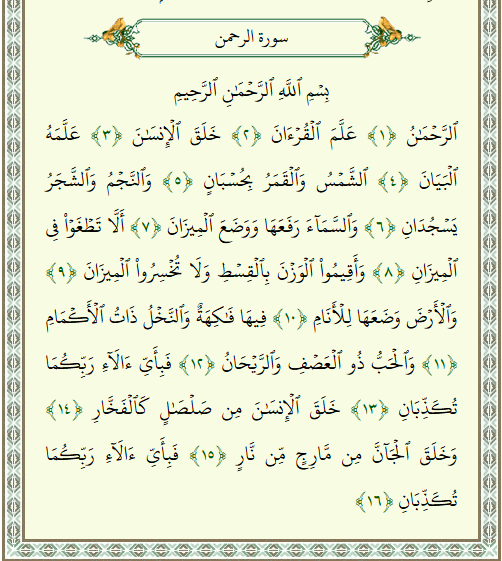
To memorize Surah Rahman effectively, you must first understand its structural architecture. Surah Rahman is built around a single repeating Ayah — “فَبِأَيِّ آلَاءِ رَبِّكُمَا تُكَذِّبَانِ” — “Fabiayyī āla’i Rabbikumā tukadhdhibān” — “Then which of the favors of your Lord would you deny?” (Surah Rahman 55:13). This refrain appears 31 times throughout the Surah, accounting for nearly 40% of its total verses.
This is not a memorization obstacle — it is a structural scaffold. Once this Ayah is locked into your muscle memory (typically within one focused session), it becomes a reliable anchor between every new verse cluster you learn.
The real memorization work shifts entirely to the unique verses between the refrains, which number around 47 Ayat.
Students at Hifz Quran Online Academy who approach Surah Rahman without this understanding almost always make the same error: they treat every verse as equally new and spend equal time on the refrain as on the unique Ayat.
This inflates their perceived workload by nearly double and causes early discouragement. Restructuring the work around the refrain’s rhythm is the single most impactful adjustment you can make.
If you’re exploring how to start memorizing Quran more broadly, this principle of understanding a Surah’s structure before beginning applies universally.
The Quran Memorization Course at Hifz Quran Online Academy provides a structured pathway from shorter Surahs like Rahman through to complete Hifz, with certified Huffaz who guide each student’s pace individually.
Enroll in our Quran Memorization Course for Adults with a free trial

2. Divide Surah Rahman into Memorization Blocks Before You Begin
Divide Surah Rahman into 5 thematic blocks before memorizing a single verse. This thematic approach — rather than arbitrary line-count division — preserves the meaning context that non-Arabic speakers rely on for retention.
| Block | Ayat Range | Theme | Approximate Unique Verses |
| Block 1 | 1–13 | Introduction + Creation blessings | ~7 unique Ayat |
| Block 2 | 14–30 | Creation of humans and jinn | ~9 unique Ayat |
| Block 3 | 31–45 | Day of Judgment warnings | ~8 unique Ayat |
| Block 4 | 46–61 | First garden of Paradise | ~8 unique Ayat |
| Block 5 | 62–78 | Second garden of Paradise + closing | ~8 unique Ayat |
Each block is your unit of new memorization — never break a block mid-session. Completing a full thematic unit before stopping creates stronger semantic anchors, which is one of the most consistently supported principles in memorization psychology.
For a deeper understanding of structuring your overall memorization schedule, the Quran memorization schedule guide at Hifz Quran Online Academy provides a comprehensive framework.
Shots Videos from Our Courses
Memorize the Quran at Your Own Pace
Join our expert tutors and begin your Hifz journey with a personalized plan.
Start Your Free Trial3. Lock in the Repeating Refrain Before Memorizing Anything Else
Memorize “Fabiayyī āla’i Rabbikumā tukadhdhibān” to perfection — including Tajweed, Makhraj, and Ghunnah — before attempting any other verse. This single step, which takes one focused session of 20–30 minutes, will save you hours of confusion later.
The Ghunnah on the Noon of “تُكَذِّبَانِ” and the correct pronunciation of the Hamzah in “آلَاءِ” are the two most common Tajweed errors non-Arabic speakers make with this refrain. Address them from day one. Record yourself reciting it and compare against your chosen reciter.
Once locked in, every time this refrain appears during your new memorization session, you recite it without effort or conscious attention — your mind is freed entirely to absorb the unique verse that preceded it.
This is the Rabṭ principle applied to repetition: using known anchors to connect and secure new material.
4. Choose a Reciter Should to Memorize Surah Rahman
Choose one reciter before beginning and commit to that voice for the entire Surah. For Surah Rahman specifically, reciters with measured Tarteel and clear Makhraj articulation — such as Sheikh Mahmoud Khalil Al-Husary or Sheikh Abdul Basit Abd us-Samad in his Murattal style — are particularly effective for memorization purposes.
Switching reciters mid-memorization creates what experienced Hifz instructors call “voice interference” — where your internal recitation becomes an inconsistent hybrid of two different melodic patterns, causing hesitation during retrieval.
This is especially damaging in Surah Rahman, where the rhythmic flow between unique verses and the refrain must be seamless. Our best reciter to memorize Quran guide expands on this selection process in detail.
Sheikh Mahmoud Khalil Al-Husary’s Muallim (teaching) recitation is particularly effective for this pre-memorization listening step.

Practical protocol: Listen to your chosen recitation of the full block you plan to memorize that day — at least 7–10 times — before you open the Mushaf.
This pre-loading imprints the correct Makhraj and melodic pattern before your eyes even see the text, dramatically reducing pronunciation errors from the start.
Memorize the Quran at Your Own Pace
Join our expert tutors and begin your Hifz journey with a personalized plan.
Start Your Free Trial5. Decide the Ideal Daily Memorization Target for Surah Rahman
For non-Arabic speaking adults, 5–8 unique Ayat per day is the realistic and sustainable target for Surah Rahman — not counting the refrain repetitions, which you already have memorized. This pace allows you to complete the Surah in approximately 6–9 days of new memorization, with adequate time for daily Muraja’ah.
Students enrolled in the Online Quran Memorization Courses for Adults at Hifz Quran Online Academy typically complete Surah Rahman within 3 weeks when following this target — this accounts for 6–9 days of new memorization and 10–15 days of structured revision.
Enroll in our Quran Memorization Course for Adults with a free trial

Pushing beyond 8 unique Ayat daily without proper revision leads to surface-level memorization that collapses within weeks.
| Student Profile | Recommended Daily Target | Estimated Completion |
| Adult non-Arabic speaker (30 min/day) | 5–6 unique Ayat | 8–10 days new memorization |
| Dedicated full-time student | 8–10 unique Ayat | 5–7 days new memorization |
| Child (with instructor guidance) | 3–5 unique Ayat | 10–14 days new memorization |
Samples Videos from Classes
Read Also: How to Memorize a Juz?
6. Apply the Rabṭ Technique to Prevent Sequence Confusion in Surah Rahman
Rabṭ — the technique of connecting the end of one Ayah to the beginning of the next — is non-negotiable in Surah Rahman. Its rhythmic similarity between verse clusters means that without deliberate Rabṭ practice, students frequently jump or repeat verses during retrieval without realizing it.
After memorizing each new unique Ayah, immediately practice reciting it flowing directly into the refrain, and then from the refrain directly into the next unique Ayah you plan to memorize tomorrow. This forward-connecting habit wires the sequence neurologically, not just the isolated verse.
A consistent observation from Hifz Quran Online Academy instructors: students who practice Rabṭ from their very first day of Surah Rahman memorization make significantly fewer sequence errors during their first full recitation test — the transition between Blocks 2 and 3 (around Ayat 30–35), where the theme shifts from creation to judgment, is the most common point of sequence confusion for those who neglect this technique.
For guidance on broader revision strategies that complement Rabṭ practice, how to revise memorized Quran provides a complete Muraja’ah framework.
Children benefit enormously from structured one-on-one support — the Quran Memorization and Hifz for Kids Course at Hifz Quran Online Academy is specifically designed around age-appropriate targets and attention spans for exactly this type of shorter Surah memorization.
Start your child’s Hifz today with a free lesson

7. Put the Correct Muraja’ah Schedule to Retain Surah Rahman After Memorization
Begin Muraja’ah of each block within the same day you memorize it — ideally within 4–6 hours. Waiting until the following morning allows the forgetting curve to begin eroding the new material, particularly the unique Ayat between refrains.
The 3-3-7 Muraja’ah Rule for Surah Rahman:
- Day of memorization: Recite the new block 3 times independently from memory
- Day 3 after memorization: Recite the cumulative memorized portion (all blocks completed so far) once
- Day 7 after memorization: Recite the full Surah from beginning to the point reached
Once the complete Surah is memorized, shift to reciting it fully in Salah — specifically in Qiyam al-Layl or Fajr prayer — at least 3 times per week.
Recitation in prayer introduces a retrieval condition that classroom rehearsal does not replicate, and it accelerates long-term retention significantly.
For the broader framework of maintaining what you’ve memorized beyond a single Surah, the how to memorize the Quran guide covers the full Hifz methodology in depth.
Our Students Reviews
Memorize the Quran at Your Own Pace
Join our expert tutors and begin your Hifz journey with a personalized plan.
Start Your Free TrialStart Your Surah Rahman Memorization with Certified Guidance at Hifz Quran Online Academy
A structured method transforms Surah Rahman from a challenging goal into an achievable milestone — but methodology matters most when paired with expert accountability.
Hifz Quran Online Academy offers:
- Certified Huffaz with verified credentials guiding every session
- Personalized 1-on-1 instruction adapted to your exact pace and level
- Flexible scheduling across all global time zones
- Structured methodology built specifically for non-Arabic speakers
- Dedicated courses for adults, children, and ladies
- A free trial lesson — book yours today and begin with expert guidance from your very first Ayah
Book your free trial lesson today

Read Also: How to Memorize Juz Amma?
Conclusion
Surah Rahman rewards those who approach it with structure, patience, and honesty about their starting point. Its repeating refrain is not a complication — it is an architectural gift that, when leveraged correctly, makes memorization faster and more durable than most students expect. The five-block thematic division, the single-reciter rule, daily Muraja’ah, and targeted Tajweed work are not optional add-ons; they are the method.
Memorizing Surah Rahman well means memorizing it in a way you can still recite flawlessly five years from now — in Salah, in front of a scholar, or alone in the quiet before Fajr. That standard is achievable. Begin with sincerity, apply the method, and trust the process. Insha’Allah, the words will settle.
Frequently Asked Questions About How to Memorize Surah Rahman
How Long Does It Take to Memorize Surah Rahman for a Non-Arabic Speaker?
Most dedicated non-Arabic speaking adults complete Surah Rahman’s new memorization in 6–10 days at 5–8 unique Ayat per day. Including structured Muraja’ah and consolidation, a fully stable memorization typically requires 3 weeks. Students with prior Hifz experience complete it faster; absolute beginners should plan 4 weeks for stable retention.
Is Surah Rahman Hard to Memorize Because of the Repeating Verse?
The repeating refrain actually makes Surah Rahman easier to memorize, not harder, when approached correctly. Memorize the refrain to perfection first, then it requires zero mental effort during sessions. The real memorization work covers approximately 47 unique Ayat — a manageable number even for students new to structured Hifz.
Should I Memorize Surah Rahman with or Without Understanding Its Meaning?
Learning the general meaning of each thematic block before memorizing it significantly improves retention for non-Arabic speakers. You do not need deep Tafsir study — a brief English translation review of each block before your session creates semantic anchors that make unique verses far easier to distinguish from one another, particularly within the Paradise sections.
Can I Memorize Surah Rahman Without a Teacher?
Self-directed memorization is possible, but the risk of ingraining Tajweed errors — particularly in Makhraj and Ghunnah application — is significant without expert correction. Errors embedded during memorization are far harder to correct later than errors caught early. Even a weekly check-in session with a certified instructor is substantially more effective than fully independent memorization for most non-Arabic speakers.
Related Articles
Memorizing Quran





Leave a Reply