 Memorizing Quran
You can memorize Surah Inshiqaq in about a week, even if you have only a few minutes a day. The trick is to split its 25 verses into small groups and learn them one at a time. Each group has its own topic and its own ending sound, so your ear helps you remember what comes next.
Many people start this surah with energy, then get stuck after a few days. Some mix up verses that look alike. Others forget what they learned last week. These problems are common, and they are easy to fix once you know where they come from.
This guide walks you through the whole process. You will see how the surah is built, what each part means, and how to learn it step by step.
You will also get a day-by-day plan, a slower pace for kids, and a simple way to review so the surah stays with you. Whether you are an adult starting Hifz or a parent helping your child, you can begin today.
Day 1: Listen To Surah Inshiqaq Until The Rhythm Sticks, Then Learn Verses 1 to 5
Start by finding a reciter with clear tajweed (تجويد). Listen to the whole surah a few times while you follow along in the mushaf. Then recite out loud with him and try to match his speed and sounds. Stay with this one reciter for the full week, because a new voice sends your ear mixed signals.
Next, read the meaning of verses 1 to 5 in the meaning guide below. Two lines are enough. Try to picture the sky splitting open in verse 1, since an image in your mind holds the words in place.
Now learn the group as a chain. Say verse 1, then verses 1 and 2, then verses 1 to 3, and keep going until you reach verse 5. When you can say all five without looking, recite them from memory 10 times in a row. If you slip, check the mushaf, fix it, and start counting from one again. Beads, a counter, or your fingers can help you keep track.
During the rest of the day, play the surah while you cook, drive, or get ready for bed. Short, frequent listening works better than one long session.
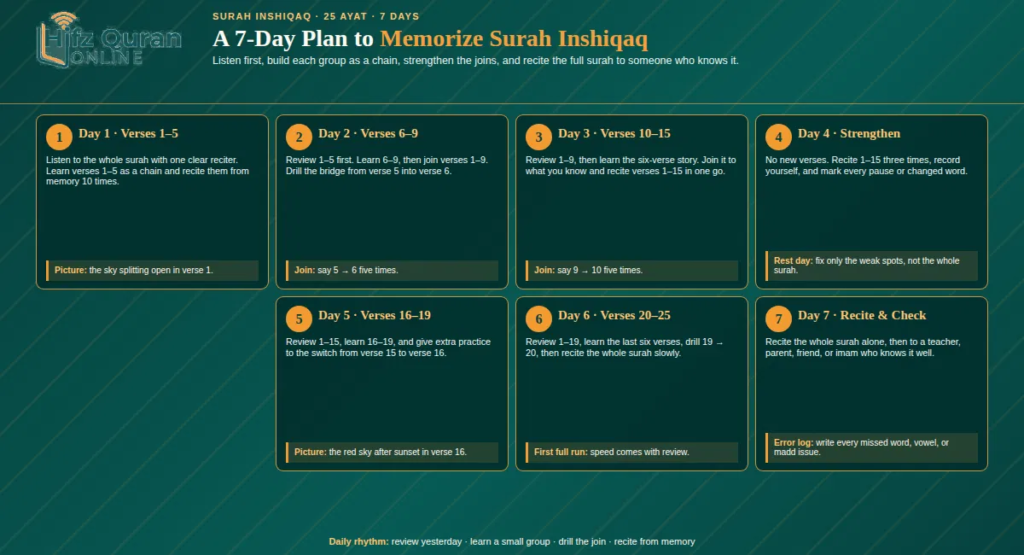
Day 2: Review Verses 1 to 5, Then Learn Verses 6 to 9
Before you learn anything new, recite verses 1 to 5 from memory. This shows you how much stayed overnight. If a verse is shaky, fix it now.
Read the meaning of verses 6 to 9, then learn them the same way you learned Day 1’s group. Build the chain, then recite the group 10 times from memory with no mistakes.
Today you also start joining groups. Recite from verse 1 all the way to verse 9. Then practice the spot where verse 5 turns into verse 6 on its own. Say verse 5 followed by verse 6, five times in a row. The ending sound changes at this point, which tells your ear that a new group has begun.
Day 3: Review Verses 1 to 9, Then Learn Verses 10 to 15
Warm up with verses 1 to 9 from memory. Then turn to the new group. This is the longest day, with six verses, so give it a few extra minutes. Verses 10 to 15 tell a short story about one person, so read the meaning first and follow the story from start to end. When the story makes sense, the order of the verses makes sense too.
Learn the group as a chain, recite it 10 times from memory, and then join it to what you know. Practice the switch from verse 9 to verse 10 five times. Finish by reciting verses 1 to 15 in one go.
Day 4: No New Verses, Just Join and Strengthen
Today is a rest day for new learning. Recite verses 1 to 15 from memory three times. Pay close attention to the two switches you have learned so far, from verse 5 to 6 and from verse 9 to 10. If you get stuck somewhere, do not start the whole surah again. Fix only that spot, then go back to the full recitation.
This is also a good day to record yourself. Play it back while you follow in the mushaf, and mark any verse where you paused or changed a word. Those verses go first in tomorrow’s review.
Day 5: Review Verses 1 to 15, Then Learn Verses 16 to 19
Learn the new group with the chain method and recite it 10 times from memory. Then spend extra time on the move from verse 15 to verse 16. Many people know both groups well but stall right here, because the topic and the sound both change at once. Say verse 15 into verse 16 five times in a row until it flows.
This group is easy to hold because it follows the real evening sky in order: first the red glow, then the night, then the full moon. Think of it as three oaths followed by one answer, which comes in verse 19. Since this is a short group of only four verses, use any spare minutes to go over the weakest spot from your recording on Day 4.
Day 6: Review Verses 1 to 19, Then Learn Verses 20 to 25
Learn these six verses as a chain and recite them 10 times from memory. Practice the switch from verse 19 to verse 20 five times. Then, for the first time, recite the whole surah from verse 1 to verse 25. Do not worry if it feels slow. Speed comes with review. Taking some time to review makes the surah stay in your mind.
Watch verse 24 closely, because it ends with “alim” (أَلِيمٍ) instead of the “-un” sound around it, and many learners slip there. When you reach verse 21, remember that it has a place of sajdah, so you will know to prostrate when you recite it later. Before you go to sleep, listen to the full surah once more from your reciter to help today’s verses settle.
Day 7: Recite the Whole Surah to Someone Who Knows It
Start by reciting the full surah on your own. Then recite it to someone who knows it well. A teacher is best, but a parent, a friend, or an imam can help too.
When you check yourself, you can catch a missing word. Small slips are harder to hear in your own voice, like a short vowel or a long sound (madd, مدّ) held for the wrong length. If you repeat a slip many times, it becomes a habit. Ask your listener to stop you at each mistake and write down the verses where you slipped. Start tomorrow’s review with those verses.
Want a set plan with daily lessons and review built in? Join our online Quran memorization course at Hifz Quran Online Academy and learn Surah Inshiqaq as part of Juz Amma.

A Slower Plan For Kids And Beginners
Kids and new readers can learn 2 or 3 verses a day. At 3 verses a day, they finish the new verses in about 9 days. Keep reviewing every day too. Try not to stop in the middle of an idea. For example, verses 6 and 7 go well together. Verses 5 and 6 do not.
Everyone learns at a different speed. Your pace depends on how well you read and how often you practice. Use these plans as a guide. For kids, keep each session short and stop before they get tired. Sit with your child and recite the verses together at first. Praise their effort, not just the result, so they want to come back the next day.
A small reward after finishing each group, like a sticker or a favorite snack, can keep them going. When they know the whole surah, let them recite it for the family, so they feel proud of what they did.
The 5 Verse Groups of Surah Al-Inshiqaq and Their Ending Sounds
Surah Inshiqaq splits into five groups, and each group is one full idea. Most groups also have their own ending sound, so you can often hear where a new group begins. Each group is one day’s lesson in the 7-day plan.
| Group | Verses | Ending sound | Topic |
|---|---|---|---|
| 1 | 1 to 5 | -at: inshaqqat (انشَقَّتْ), muddat (مُدَّتْ), takhallat (تَخَلَّتْ), huqqat (حُقَّتْ) | The sky and earth on the Last Day |
| 2 | 6 to 9 | -ih, then -ra: fa-mulaqih (فَمُلَاقِيهِ), bi-yaminih (بِيَمِينِهِ), yasira (يَسِيرًا), masrura (مَسْرُورًا) | The believer who gets the book in the right hand |
| 3 | 10 to 15 | -ih, then -ra and -ur: zahrih (ظَهْرِهِۦ), thubura (ثُبُورًا), sa’ira (سَعِيرًا), yahur (يَحُورَ), basira (بَصِيرًا) | The denier who gets the book behind his back |
| 4 | 16 to 19 | -aq: shafaq (الشَّفَقِ), wasaq (وَسَقَ), ittasaq (اتَّسَقَ), tabaq (طَبَقٍ) | Allah swears by the evening sky |
| 5 | 20 to 25 | mostly -un: yu’minun (يُؤْمِنُونَ), yasjudun (يَسْجُدُونَ), yukadhdhibun (يُكَذِّبُونَ), mamnun (مَمْنُونٍ) | People who refuse to believe |
Many guides tell you to learn “about five verses at a time.” Learning by group works better, because a full idea is much easier to remember than a random set of verses. The groups are not all the same size. Groups 2 and 4 have 4 verses each, and groups 3 and 5 have 6 each.
Groups 2 and 3 share the same ending sounds, so you need a different marker for them. Look at how they open. Group 2’s main verse starts with فَأَمَّا مَنْ (fa-amma man), “as for the one who,” in verse 7. Group 3 starts with وَأَمَّا مَنْ (wa-amma man) in verse 10. One shows the believer and the other shows the denier, so learn them as a pair.
Before Day 1, read only the last word of each verse out loud, from verse 1 to verse 25. You will hear a clear change in sound at verse 6, verse 16, and verse 20. Mark these spots, plus verse 10, with a light pencil line in your mushaf, so you can see where each group begins.
See Our Classes in Action
Curious about what a 1-on-1 Hifz session looks like? Take a look at these real-time snippets from our daily classes to see our student-centered approach, Tajweed correction techniques, and online whiteboard tools in action.
A Simple Tafsir of Surah Inshiqaq: A Short Guide To Each Group
These short notes sum up each group. They are based on well-known books of tafsir, like al-Tafsir al-Muyassar (التفسير الميسر) and Tafsir al-Sa’di (تفسير السعدي). You can also read a full tafsir of Surah Al-Inshiqaq.
Each note below matches one group from the table above. Read the note for a group on the day you plan to memorize it.
You don’t need to learn these notes by heart, because they are only there to help the Arabic words make sense. If a word is new to you, ask your teacher or check the tafsir links above.
Verses 1-5: The Sky And The Earth On The Last Day
The verses describe the sky and the earth at the Day of Judgement.
إِذَا ٱلسَّمَآءُ ٱنشَقَّتْ (1)
When the sky splits open,
وَأَذِنَتْ لِرَبِّهَا وَحُقَّتْ (2)
and listens to its Lord, as it must,
وَإِذَا ٱلْأَرْضُ مُدَّتْ (3)
and when the earth is spread out,
وَأَلْقَتْ مَا فِيهَا وَتَخَلَّتْ (4)
and throws out what is inside it and becomes empty,
وَأَذِنَتْ لِرَبِّهَا وَحُقَّتْ (5)
and listens to its Lord, as it must.
The sky splits open because Allah commands it. The earth is spread flat, and it throws out everything inside it, including the dead, until it is empty. Both the sky and the earth listen to their Lord and obey. “Adhinat” (أَذِنَتْ) means it listened and obeyed. “Huqqat” (حُقَّتْ) means it was right for it to obey, since Allah created it. Scholars say the earth is made level.
No mountains or hills are left. The verses open with “idha” (إِذَا), meaning “when,” and the listener waits to hear what comes next. This opening sets the scene for the Day of Judgment
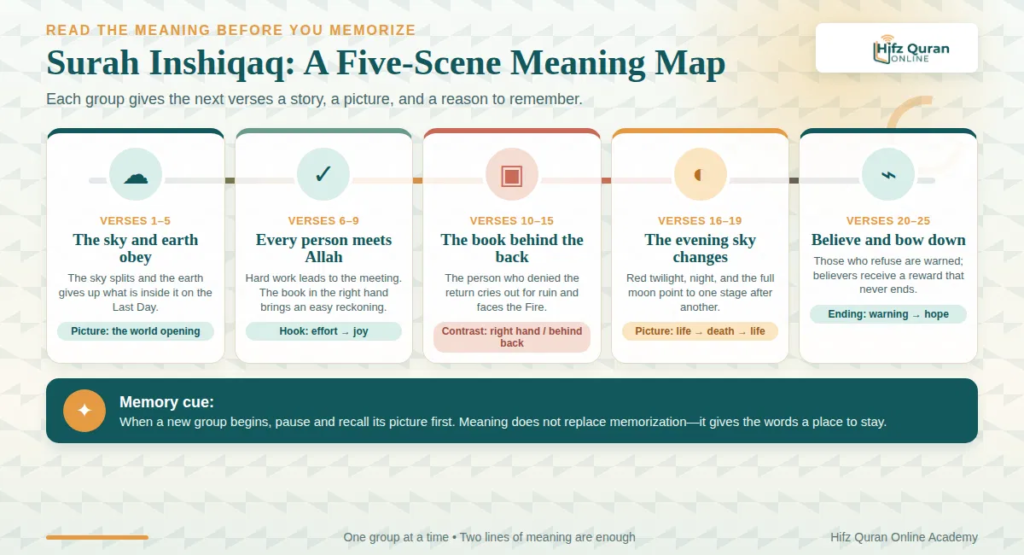
Verses 6-9: Every Person Will Meet Allah
The verses highlight the reward of man on the Day of Judgment.
يَٰٓأَيُّهَا ٱلْإِنسَٰنُ إِنَّكَ كَادِحٌ إِلَىٰ رَبِّكَ كَدْحًا فَمُلَٰقِيهِ (6)
O mankind, you are working hard toward your Lord, and you will meet Him.
فَأَمَّا مَنْ أُوتِىَ كِتَٰبَهُۥ بِيَمِينِهِۦ (7)
As for the one who is given his book in his right hand,
فَسَوْفَ يُحَاسَبُ حِسَابًا يَسِيرًا (8)
he will have an easy reckoning,
وَيَنقَلِبُ إِلَىٰٓ أَهْلِهِۦ مَسْرُورًا (9)
and he will return to his people full of joy.
Verse 6 speaks to every person. It says you are working hard toward your Lord, and you will meet Him. Some people will get their book of deeds in their right hand. Their judgment will be easy, and they will go back to their families full of joy.
“Kadh” (كَدْح) is hard work that takes real effort. Every person works for something, good or bad, every day.
What is an easy reckoning? Aisha reported in Sahih al-Bukhari that the Prophet ﷺ explained it: the deeds are only shown, with no close questioning. Getting the book in the right hand is a sign of success and honor. “His family” here means the believer’s people in Paradise.
Verses 10-15: The Person Who Got The Book Behind His Back
The verses mention the punishment of man on the Day of Judgement.
وَأَمَّا مَنْ أُوتِىَ كِتَٰبَهُۥ وَرَآءَ ظَهْرِهِۦ (10)
But as for the one who is given his book behind his back,
فَسَوْفَ يَدْعُوا۟ ثُبُورًا (11)
he will cry out for ruin,
وَيَصْلَىٰ سَعِيرًا (12)
and he will burn in a blazing Fire.
إِنَّهُۥ كَانَ فِىٓ أَهْلِهِۦ مَسْرُورًا (13)
He used to be happy among his people.
إِنَّهُۥ ظَنَّ أَن لَّن يَحُورَ (14)
He thought he would never return.
بَلَىٰٓ إِنَّ رَبَّهُۥ كَانَ بِهِۦ بَصِيرًا (15)
Yes, he will. His Lord was always watching him.
Some people will get their book from behind their back. They will cry out for ruin and enter the Fire. In this life, this person was happy with his family and did not think about the next life. He thought he would never go back to Allah. But Allah always saw everything he did.
Scholars explain that he takes his book in his left hand, from behind his back. In his fear, he calls out for “thubura” (ثُبُورًا), which means ruin. “Sa’ira” (سَعِيرًا) is a fire that burns very hard. To “yahur” (يَحُورَ) is to return. In verse 15, “bala” (بَلَىٰ) means “yes, he will.” It answers his false
Verses 16-19: Allah Swears By The Evening Sky
The verses confirms the stages of human life which are life, death and life again.
فَلَآ أُقْسِمُ بِٱلشَّفَقِ (16)
So I swear by the red glow after sunset,
وَٱلَّيْلِ وَمَا وَسَقَ (17)
and by the night and what it gathers,وَٱلْقَمَرِ إِذَا ٱتَّسَقَ (18)
and by the moon when it grows full,لَتَرْكَبُنَّ طَبَقًا عَن طَبَقٍ (19)
you will surely pass from one stage to another.
Allah swears by the red glow in the sky after sunset, called al-shafaq (الشَّفَق). He swears by the night and all it gathers, and by the full moon. Then verse 19 gives the point. People move from one stage to the next: life, death, and life again.
“Fala uqsimu” (فَلَا أُقْسِمُ) looks like “I do not swear.” In fact, it means “I swear,” with extra force. When it gets dark, the night gathers people and animals back to their homes. “Ittasaq” (اتَّسَقَ) describes the moon growing full in the middle of the month.
“Tabaqan ‘an tabaq” (طَبَقًا عَن طَبَقٍ) means one state after another. Like human life, each of these signs changes step by step.
Verses 20-25: People Who Refuse To Believe
The verses talk about the disbelievers who refuse to believe in Allah
فَمَا لَهُمْ لَا يُؤْمِنُونَ (20)
So what is wrong with them that they do not believe,
وَإِذَا قُرِئَ عَلَيْهِمُ ٱلْقُرْءَانُ لَا يَسْجُدُونَ ۩ (21)
and when the Quran is recited to them, they do not bow down?
بَلِ ٱلَّذِينَ كَفَرُوا۟ يُكَذِّبُونَ (22)
Rather, those who disbelieve keep denying.
وَٱللَّهُ أَعْلَمُ بِمَا يُوعُونَ (23)
And Allah knows best what they hide.
فَبَشِّرْهُم بِعَذَابٍ أَلِيمٍ (24)
So give them news of a painful punishment,
إِلَّا ٱلَّذِينَ ءَامَنُوا۟ وَعَمِلُوا۟ ٱلصَّٰلِحَٰتِ لَهُمْ أَجْرٌ غَيْرُ مَمْنُونٍۭ (25)
except those who believe and do good deeds. They will have a reward that never ends.
This group asks why some people do not believe. It asks why they do not bow down when they hear the Quran. These people keep denying. Allah knows what they hide. They are warned of a painful punishment. But those who believe and do good deeds get a reward that never ends.
Here, “yasjudun” (يَسْجُدُونَ) means to bow down and be humble before the Quran. “Yu’un” (يُوعُونَ) is what they gather and hide in their hearts. Normally, “bashshir” (فَبَشِّرْهُم) means “give good news.” Here, it warns.
A reward that is “ghayru mamnun” (غَيْرُ مَمْنُونٍ) is never cut off or made less. Then comes “illa” (إِلَّا), meaning “except,” which leaves the door open for anyone who believes.
Memorize the Quran at Your Own Pace
Join our expert tutors and begin your Hifz journey with a personalized plan.
Start Your Free TrialCommon Mistakes When Memorizing Surah Inshiqaq
Most mistakes in this surah happen in four places. Three come from verses that look alike. One is about how to say a letter when you stop. Learn these early, and you can avoid them.
These slips are common, so don’t worry if you make them. Even people who have memorized many surahs trip in these spots. Read about each mistake before you start that group. Then, during review, slow down when you reach these verses. Fixing a slip early is much easier than fixing a habit later.
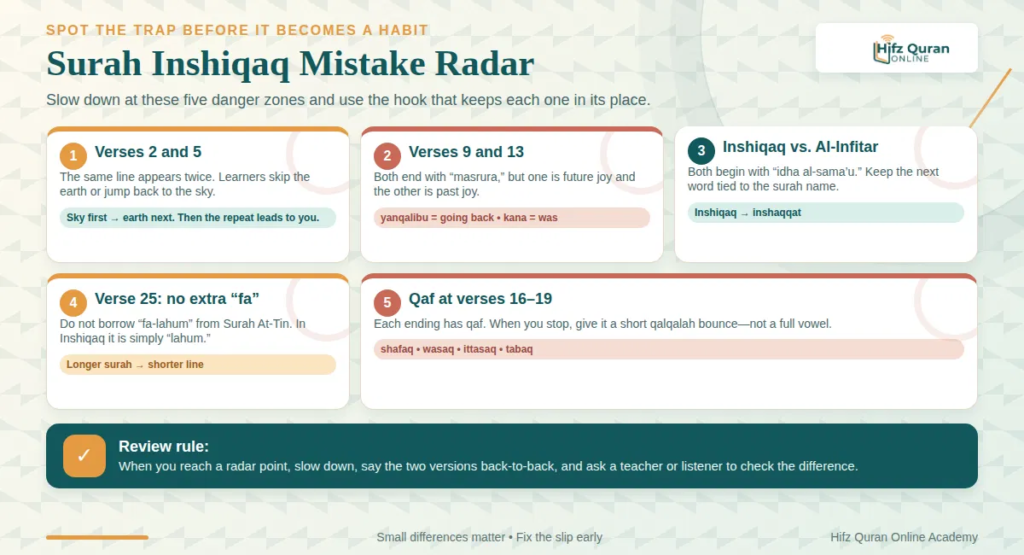
Mistake 1: Mixing up verse 2 and verse 5
Verse 2 and verse 5 are the same: “wa adhinat li-rabbiha wa huqqat” (وَأَذِنَتْ لِرَبِّهَا وَحُقَّتْ). Some people jump from verse 2 to verse 6. They skip the verses about the earth. Others go back to the sky after verse 5.
To remember it: the first time, this line ends the part about the sky. The second time, it ends the part about the earth. Sky first, then earth.
Pay attention to what comes right after each one. After verse 2, a new “wa idha” (وَإِذَا) starts: “wa idha al-ardu muddat” (وَإِذَا الْأَرْضُ مُدَّتْ). After verse 5, the surah turns to people: “ya ayyuha al-insanu” (يَا أَيُّهَا الْإِنسَانُ). So the first repeat leads to the earth, and the second leads to you. Practice verses 1 to 6 together a few times until the order feels natural.
Mistake 2: Mixing Up Verse 9 And Verse 13
Both verses end with “masrura” (مَسْرُورًا), which means “full of joy.” But they talk about two different people.
- Verse 9: “wa yanqalibu ila ahlihi masrura” (وَيَنقَلِبُ إِلَىٰ أَهْلِهِ مَسْرُورًا). The believer goes back to his family full of joy, in the next life.
- Verse 13: “innahu kana fi ahlihi masrura” (إِنَّهُ كَانَ فِي أَهْلِهِ مَسْرُورًا). The denier was happy with his family, in this life.
Think of it as future joy vs. past joy. Then you won’t swap them.
The verbs help you here. Verse 9 uses “yanqalibu” (يَنقَلِبُ), which is about going back, so it looks ahead. Verse 13 uses “kana” (كَانَ), which means “was,” so it looks back. The small word before “ahlihi” (أَهْلِهِ) also changes: “ila” (إِلَىٰ) means “to” in verse 9, and “fi” (فِي) means “among” in verse 13. Say both verses one after the other a few times to hear the difference.
Mistake 3: Mixing up the first verse with Surah Al-Infitar
Surah Al-Infitar (الانفطار) also starts with “idha al-sama’u” (إِذَا السَّمَاءُ). But it goes on with “infatarat” (انفَطَرَتْ). Surah Al-Inshiqaq goes on with “inshaqqat” (انشَقَّتْ).
To keep them apart, link “inshaqqat” (انشَقَّتْ) to the name of the surah, Al-Inshiqaq (الانشقاق).
This mix-up is common because both surahs are in Juz Amma and both describe the Last Day. Al-Infitar is surah 82, just two surahs before Al-Inshiqaq. Its next verse talks about the stars falling apart: “wa idha al-kawakibu intatharat” (وَإِذَا الْكَوَاكِبُ انتَثَرَتْ). Al-Inshiqaq goes on with the sky obeying its Lord instead. If you know both surahs, recite the first two verses of each, one after the other, to train your ear.
Mistake 4: Adding An Extra Letter To Verse 25
Verse 25 ends with “lahum ajrun ghayru mamnun” (لَهُمْ أَجْرٌ غَيْرُ مَمْنُونٍ). Surah At-Tin (95:6) has almost the same line. But At-Tin adds one letter at the start: “fa-lahum” (فَلَهُمْ).
In Surah Al-Inshiqaq, there is no “fa” (فَـ). People who know At-Tin well often add it by habit. A teacher will catch this right away.
The mix-up happens because both verses start the same way, with “illa alladhina amanu” (إِلَّا الَّذِينَ آمَنُوا). Surah Fussilat (41:8) also has this line with no “fa,” just like Al-Inshiqaq.
Here is an easy hook: Al-Inshiqaq is the longer surah, but its line is the shorter one. When you reach the end of verse 25, pause for a second before you say “lahum” (لَهُمْ). After a week of correct practice, the right version usually sticks.
Mistake 5: Not Bouncing The Qaf At The End Of Verses 16-19
All four verses in group 4 end with the letter qaf (ق): shafaq (الشَّفَقِ), wasaq (وَسَقَ), ittasaq (اتَّسَقَ), tabaq (طَبَقٍ). Qaf is a qalqalah (قلقلة) letter. When you stop on it, it gets a small bounce. Listen to how your reciter says these four endings and copy him.
The five qalqalah letters are qaf (ق), ta (ط), ba (ب), jim (ج), and dal (د), and many students learn them with the phrase “qutbu jad” (قُطْبُ جَدٍّ).
The bounce is strongest when you stop at the end of a verse, like here. Be careful not to turn the bounce into a full vowel, such as “shafaqa” or “shafaqi.” Qaf is also a heavy letter, so say it from the back of the mouth with a full, deep sound. When you stop on “tabaq” (طَبَقٍ), drop the ending “-in” sound and stop on the qaf alone.
Our certified Hafiz tutors at Hifz Quran Online Academy teach one-on-one online and know these spots well. Book a class, and your tutor will check each one in your recitation.

How To Review Surah Inshiqaq So You Don’t Forget It
Review keeps the surah strong long after you finish. Most people forget a surah because they stop reviewing it, not because they learned it badly. A little review at the right times keeps every verse in place. Follow these three stages in order.
While You Are Still Memorizing: Review Before You Learn
Each day, say yesterday’s verses before you start new ones. If you skip this, new verses push out old ones. Keep this review short, just one or two clean recitations. If yesterday’s verses feel weak, fix them before you add anything new. Moving on too fast means you build on a shaky base.
Once you know more groups, review the last two days, not just yesterday. This habit takes only a few minutes a day, but it saves you from relearning later. Say the verses from memory first, and only open the mushaf to check. Join yesterday’s verses to the ones before them, so the links between groups stay strong.
If one verse keeps slipping, write its number on a sticky note and say it a few extra times. On a busy day with little time, do the review and skip the new verses. A day spent only on review still moves you forward.
After You Finish: Follow This Review Schedule
Recite the whole surah from memory on these days:
| When | What to do |
| Day 1 | Recite the whole surah once |
| Day 3 | Recite the whole surah once |
| Day 7 | Recite the whole surah once |
| Day 14 | Recite the whole surah once |
| Day 30 | Recite the whole surah once |
| After day 30 | Recite it once a week |
The gaps between reviews get longer because your memory gets stronger each time. This idea is called spaced repetition, and many Hifz teachers use it. Set a reminder on your phone for each review day, so you don’t miss one.
Recite from memory first, then check the mushaf to find any slips. If you make more than one or two mistakes on a review day, add an extra review two days later.
For The Long Term: Two Habits That Keep The Surah Fresh In Your Mind
After the first month, the surah needs less time but steady care. The goal now is to keep it part of your normal week. These two habits make that easy, even on busy days.
- Recite it in your prayers. The surah fits well in one or two rak’ahs (ركعات). You review it without extra time.
- Recite it to someone now and then. Small mistakes creep back over time. A listener helps you catch them early.
Try reciting it in a different prayer each day, such as Maghrib one day and Isha the next. Reciting in prayer also helps you think about the meaning as you stand before Allah.
Your listener can be a family member who reads along in the mushaf. You can also pair it with Al-Mutaffifin or Al-Buruj in your prayers, so the surahs around it stay strong too. Teaching the surah to a child or a friend is another great way to keep it.
Forgot a verse weeks later? Relearn only its group, then join it back in. For a full review system, read how to memorize Quran without forgetting.
Should You Memorize Surah Inshiqaq Alone Or With A Teacher?
You can learn this surah alone if you read Arabic well, know basic tajweed, and have good audio. Many people do. It works best if you have memorized other surahs before and can stick to your review without someone checking on you.
A teacher adds what is hard to get alone. They keep you on your plan when you feel tired, and they tell you which surah to learn next. They also know where students usually slip, so they can warn you before it happens. For kids and beginners, a teacher is often what keeps them going until the end.
Not sure which suits you? Try memorizing on your own during the week and meet a teacher once or twice to check your work.
Read also: How To Learn Surah Kasuar
Step Inside Our Virtual Classrooms
Don’t just take our word for it—see how our interactive sessions work! Watch the short clips below to experience our engaging teaching methods, live teacher-student interactions, and the supportive learning environment we bring to every student.
Memorize the Quran at Your Own Pace
Join our expert tutors and begin your Hifz journey with a personalized plan.
Start Your Free TrialWhy Memorize Surah Inshiqaq With Hifz Quran Online Academy?
Hifz Quran Online Academy focuses on one thing: helping you memorize the Quran well and keep it. When you join, you get:
- Certified Hafiz tutors. Every tutor has memorized the whole Quran and holds Ijazah (إجازة).
- One-on-one online classes. Your tutor works with you alone, so your classes fit your level.
- Tajweed fixed as you learn. Your tutor hears every verse and corrects mistakes on the spot.
- A proven review system. Your classes mix new verses, recent verses, and older surahs, so you don’t forget.
- Courses for kids and adults. Start with one surah, move to Juz 30, or aim for the whole Quran.
- A free trial class. Meet your tutor and see how a lesson works before you decide.
Sign up for a free trial class and start memorizing Surah Inshiqaq with a certified Hafiz tutor.

Our Quran Courses
Have a look at our Quran courses and choose the best for your level and situtation.
- Quran Memorization Course
- Quran Memorization and Hifz Course for Kids
- Online Quran Memorization Courses for Adults
- Quran Hifz Course for Ladies
- Quran Memorization Course for Men
- Saudi-Based Quran Memorization Courses
- Hifz Teachers
Conclusion
Surah Inshiqaq looks long at first, but its shape makes it easy to hold. Five short groups, each with its own sound, carry you from the first verse to the last.
The method is simple. Hear the surah before you try to memorize it. Know the story behind each group. Build each group verse by verse, then link it to what you already know.
The mistakes in this surah are known in advance, and that is good news. You don’t have to find them the hard way. Mark the look-alike verses in your mushaf before you start, and give them extra practice.
Finishing the surah is only half the work. Keeping it is the other half. A little review every day protects the time you put in, and reciting it in salah keeps it alive.
Be patient with yourself. Some days will feel easy, and some will feel slow. A small amount every day adds up faster than you expect. When this surah feels solid, move on to the next one in Juz Amma. With a clear plan and a good teacher, each new surah gets easier than the last.
FAQs
Have a question in mind about Surah Inshiqaq, check these questions and their answers or send us a message.
How Long Does It Take To Memorize Surah Inshiqaq?
Most adults who read Arabic well can memorize Surah Inshiqaq in about 7 days. At 3 verses a day, it takes 9 to 11 days. Plan to spend more time on review than on new verses.
Is There A Sajdah In Surah Inshiqaq?
Yes. Surah Inshiqaq has a sajdah at verse 21. Abu Hurayrah recited this surah in the Isha prayer and bowed down. He said he had bowed down in it behind the Prophet ﷺ. This report is in Sahih al-Bukhari (766).
Which Surah Should I Memorize After Surah Inshiqaq?
After Surah Inshiqaq, most learners move to Surah Al-Buruj (البروج), the next surah in the mushaf. If you are memorizing Juz Amma from the end, the next one is Surah Al-Mutaffifin (المطففين).
What Is The Best Time Of Day To Memorize Surah Inshiqaq?
The best time to memorize Surah Inshiqaq is a time you can keep every day. Many learners take new verses after Fajr. They review in the evening before sleep.
Do I Need To Know Tajweed Before Memorizing Surah Inshiqaq?
You need to read the Arabic letters correctly before you memorize Surah Inshiqaq. You can learn the tajweed rules as you go. Fixing a sound early is much easier than fixing it after hundreds of repeats.
Can I Memorize Surah Inshiqaq If I Don’t Speak Arabic?
Yes. Many non-Arabic speakers memorize Surah Inshiqaq. What matters is saying each letter correctly, not knowing the language. Read is it possible to memorize the Quran to see how they learn.
Can You Read Surah Inshiqaq To Make Childbirth Easier?
No authentic hadith links Surah Inshiqaq to childbirth or sets a time to read it for this. Some later scholars said its first verses helped, based on experience. You may read any part of the Quran and make du’a (دعاء) for ease. Just don’t believe it has a special virtue that has no proof.






Leave a Reply