 Memorizing Quran

To learn Surah Kausar, read one verse 10 times. Then add the next verse and join them. When you know all 3 verses, read the whole surah 10 times without looking. That is the whole method.
Surah Kausar is the shortest surah in the Quran. This makes it the perfect place to start. It is often the first surah a child learns, the first one a new Muslim reads in prayer, and the first step for anyone who dreams of memorizing the whole Quran.
But learning it fast is only half the job. You also want to say every letter right, know what the words mean, and keep the surah in your memory for life. Many learners memorize it in one day and then forget it, or make small mistakes they never notice.
This guide helps you avoid both. It works for adults, kids, and people who don’t read Arabic yet.
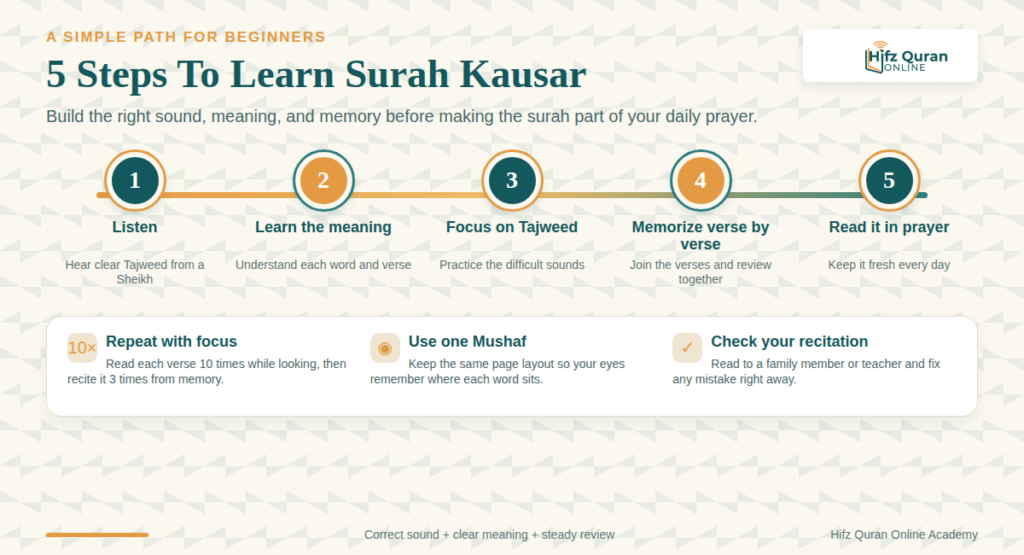
Step 1: Listen To The Surah From A Sheikh With Clear Tajweed
Choose a Sheikh who recites slowly and clearly, such as Sheikh Al-Husary in his teaching recitation. Listen to Surah Kausar at least 3 times while you follow the text with your finger. Pay close attention to how he says each letter and where he stops.Your ear learns the right sound first, so your tongue copies it later without mistakes.
You can find his recitation on most Quran apps or on YouTube. Use headphones so you can hear each sound clearly. After a few listens, pause after each verse and repeat what you heard.
Then listen once more without looking at the text. If you can follow the words in your head, you are ready for the next step.
Step 2: Read A Simple Tafsir And Learn The Meaning Of The Words
Tafsir means the explanation of the Quran. Read a short, simple tafsir of Surah Kausar before you start memorizing. Learn what words like al-Kawthar, wanḥar, and al-abtar mean, and why Allah sent this surah.
When you know the meaning, each verse is easier to picture and remember. You will find the meaning of each verse and its key words in the next section of this guide.
A good choice for beginners is the short version of Tafsir Ibn Kathir on Surah Al-Kawthar. Read the English meaning of each verse out loud once. Write the meaning of the hard words in a small notebook.
Before you read each verse, think about what it says. If something is not clear, ask a teacher or someone who knows the Quran well.
Step 3: Focus On The Main Tajweed Rules In The Surah
Surah Kausar is short, but it has some key tajweed rules. These include the nasal sound on the double noon, the heavy ra at the end of each verse, and the small bounce on the ba in al-abtar. Learn these rules before you memorize.
It is much easier to learn a word right the first time than to fix it later. Each rule is explained in the tajweed section below.
Listen to the Sheikh again and try to hear each rule in his voice. Mark each rule in your Mushaf with a pencil or a colored dot.
Practice the hard words alone, one at a time, until they sound right. Read slowly, because speed causes most tajweed mistakes. Record yourself and compare your voice to the Sheikh’s.
Step 4: Memorize One Verse At A Time And Review Them Together
Start with the first verse. Read it 10 times while looking, then cover the text and say it 3 times. When you know it well, move to the second verse and learn it the same way.
Then read verses 1 and 2 together 5 times without looking. Joining the verses this way helps you move from one to the next without stopping.
Next, learn the third verse the same way and join it to the first two. Finish by reading the whole surah, starting with Bismillah ar-Rahman ar-Rahim, 10 times without looking.
You know the surah when you can read it 3 times in a row with no pauses and no peeking.
Use the same Mushaf every time, so your eyes remember where each word sits on the page. Take a short break of 1 or 2 minutes between verses.
If you get stuck, look at the first word only, then cover it again. Say each word clearly, even when you feel sure you know it. When you are done, read the whole surah to a family member and ask them to follow along.
Step 5: Read The Surah In Your Prayer
Once you know Surah Kausar, read it after Al-Fatiha in your prayers. Try to do this in at least one prayer every day for the first 2 weeks. Reading it in prayer is a form of worship. It also keeps the surah fresh, because you review it each day without needing extra time.
Start with your sunnah prayers, where you can read at your own pace. Read the surah slowly and think about its meaning as you go.
If you forget a word during prayer, finish with another surah you know well. Then go back and practice that verse after you pray. Over time, reading it in prayer will feel easy and natural.
Surah Kausar In Arabic, English, And Meaning
Knowing what the words mean makes them easier to remember. When you understand a verse, your mind holds on to the idea, and the words follow.
The table below shows each verse in Arabic, how to say it in English letters, and what it means. Read across each row slowly before you start memorizing.
| Verse | Arabic | How to say it | Meaning |
| 1 | إِنَّا أَعْطَيْنَاكَ الْكَوْثَرَ | Innā a’ṭaynāka al-kawthar | We have given you al-Kawthar (a lot of good). |
| 2 | فَصَلِّ لِرَبِّكَ وَانْحَرْ | Fa-ṣalli li-rabbika wanḥar | So pray to your Lord and make a sacrifice. |
| 3 | إِنَّ شَانِئَكَ هُوَ الْأَبْتَرُ | Inna shāni’aka huwa al-abtar | The one who hates you is the one cut off. |
In verse 1, Allah speaks about Himself as “We.” This is a way of showing His greatness in Arabic, and it does not mean there is more than one God. In verse 2, the word “so” links the prayer to the gift in verse 1. Because Allah gave so much, the right response is to thank Him through worship. Verse 3 then gives the Prophet ﷺ comfort by showing who the real loser is.
An Easy Trick To Remember The Order
Many learners know all three verses but mix up which one comes first. A simple story in your head can fix this. Each verse does a different job, and those jobs follow a natural order. Once you see the order, it is hard to forget.
- A gift. Allah gave the Prophet ﷺ a lot of good.
- A thank-you. So pray and make a sacrifice.
- A promise. His enemy will be forgotten, not him.
If you forget what comes next, think “gift, thank-you, promise.” You can also teach this to kids as a short story: someone gets a gift, says thank you, and then hears good news.
The first word of each verse can also guide you. Verse 2 starts with “fa,” which means “so,” and it only makes sense after something has been given. Verses 1 and 3 both start with “inna,” so the surah opens and closes with the same sound, with the thank-you in the middle.
Words That Need A Closer Look in the Surah
Some words in Surah Kausar carry more meaning than a short English word can show. Knowing their roots helps you feel the full meaning when you read. It also makes the surah more personal and easier to reflect on in prayer. Here are the three words most worth learning.
- Al-Kawthar (الكوثر): This word comes from the Arabic root for “a lot.” The added letters make it stronger, so it means good that is very large and keeps going. It covers every blessing Allah gave the Prophet ﷺ in this life and the next.
- Wanḥar (وانحر): This comes from a word for the upper chest of an animal, where it is sacrificed. Most scholars say it means offering a sacrifice for Allah alone, not for idols, as some people did at that time. It is linked to the sacrifice Muslims make on Eid al-Adha.
- Al-abtar (الأبتر): In Arabic, this describes something whose tail or end has been cut off. People used it to insult a man with no sons, saying his name would end with him. In this verse, Allah shows that it is the Prophet’s ﷺ enemy who will be cut off from good and forgotten.
- means a person who will leave nothing good behind.
Step Inside Our Virtual Classrooms
Don’t just take our word for it—see how our interactive sessions work at Hifz Quran Online Academy! Watch the short clips below to experience our engaging teaching methods, live teacher-student interactions, and the supportive learning environment we bring to every student.
Memorize the Quran at Your Own Pace
Join our expert tutors and begin your Hifz journey with a personalized plan.
Start Your Free TrialQuick Facts About Surah Kausar
Surah Kausar may be short, but it has a special place in the Quran. Knowing a few facts about it helps you find it fast in your Mushaf and remember where it fits. These facts also make good questions to test kids after they learn the surah.
- Number: Surah 108, in Juz’ 30, the last part of the Quran, also called Juz’ Amma
- Page: page 602 in the standard Madinah Mushaf
- Verses: 3
- Words: 10
- Size: the shortest surah in the Quran
- Other spellings: Kawthar, Kauthar
- Last letter of each verse: ra (ر), which gives the surah its smooth rhyme
What Does Surah Kausr Mean In The Quran?
Al-Kawthar means a large, lasting good that Allah gave the Prophet ﷺ. The Prophet ﷺ explained that it is a river in Paradise that Allah promised him.
He shared this meaning on the day the surah was sent. He dozed off for a moment while sitting with his companions in the mosque.
He then lifted his head with a smile and told them a surah had just been sent to him. He recited Surah Kausar and asked if they knew what al-Kawthar was. He then said it is a river in Paradise that Allah promised him. This is reported in Sahih Muslim (hadith 400a).
In the same hadith, the Prophet ﷺ said there is a pond linked to this river. His followers will come to drink from it on the Day of Judgment. In another hadith, he said the water of al-Kawthar is whiter than milk and sweeter than honey, as reported in Jami’ at-Tirmidhi (hadith 2542).
Why Surah Kausar Was Revealed
Knowing the story behind a surah gives each verse a clear meaning. It also helps you feel what the Prophet ﷺ felt when these words came to him. Surah Kausar was sent at a hard time in his life.
The Prophet’s ﷺ sons died when they were babies. In Arab culture at that time, a man’s name and honor lived on through his sons. His enemies in Makkah used this to mock him. They called him abtar, meaning his name would be cut off and forgotten after he died.
Many scholars say the man who said this was Al-‘As ibn Wa’il, one of the leaders of Quraysh.
Allah sent this surah to comfort the Prophet ﷺ and turned the insult back on his enemies. What the surah promised came true.
Today, the Prophet’s ﷺ name is called out in the adhan around the world every day, while the men who mocked him are barely remembered. You can read the full story in Tafsir Ibn Kathir on Surah Al-Kawthar.
How To Teach Surah Kausar To Kids Step By Step
The best way to teach Surah Kausar to a child is in short daily sessions of 5 to 10 minutes, with lots of listening and one verse at a time. Young kids learn by hearing more than by reading. Follow these steps in order, and keep each lesson light and short.
Step 1: Choose A Fixed Time And A Quiet Place
Kids feel safe when things happen the same way each day. Pick a time you can keep for at least two weeks, like right after Fajr, after school, or before bed. Choose a moment when your child is calm, not hungry or tired.
Turn off the TV, put phones away, and sit close so your child can see your mouth when you speak. Tell your child ahead of time when Quran time will start. A small warning, like “Quran time in 5 minutes,” helps them get ready.
Keep a small cushion or prayer mat just for these lessons. Your child will start to link that spot with learning the Quran. Try to be on time every day, because kids notice when the plan changes.
Step 2: Let Your Child Listen For A Few Days
Before you teach a single word, let your child hear the surah many times. Play it in the car, during play time, or at bedtime. Choose a slow, clear reciter so the sounds are easy to copy. Many kids know half of the surah before the first lesson even starts.
Use the same reciter every time so your child hears the same tune. Keep the volume low and calm, like soft music in the room.
You do not need to ask your child to repeat anything yet. Just let the sound become familiar. If your child starts to hum or say parts of it, smile and tell them how well they are doing.
Step 3: Explain The Meaning In Simple Words
Kids remember what they understand. Keep the meaning to one or two sentences, in words your child already uses. You might say: “Allah gave the Prophet ﷺ a beautiful river in Jannah.
So we say thank you to Allah by praying.” For older kids, share why the surah was sent and ask how the Prophet ﷺ might have felt.
Ask your child simple questions to check they understand. For example, “What did Allah give the Prophet ﷺ?” or “How do we say thank you to Allah?” Let them draw a picture of a river in Jannah if they enjoy drawing.
Talk about things Allah has given your own family too. This helps your child see that saying thank you to Allah is part of their own life.
Step 4: Teach One Verse At A Time
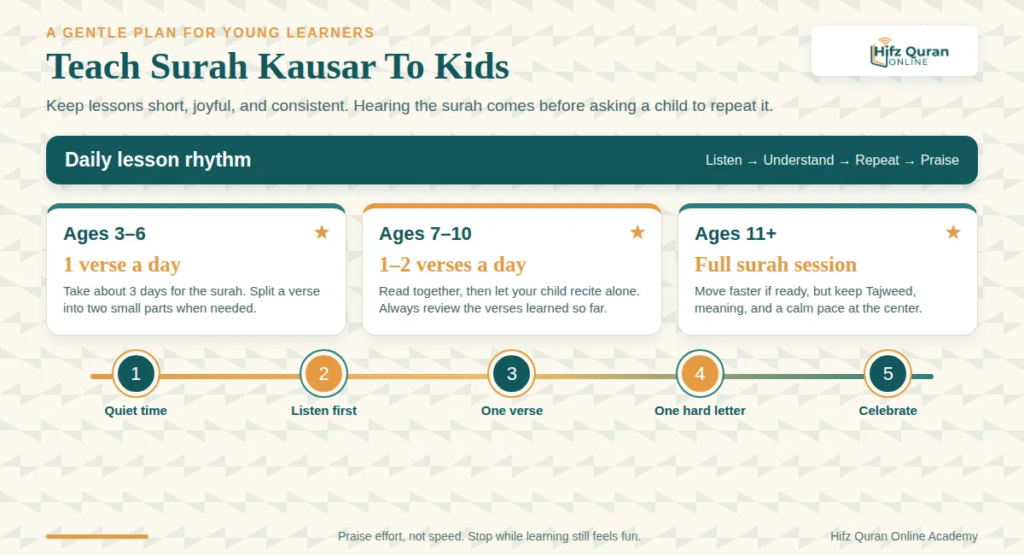
Small steps keep kids happy and help them feel they are winning. Children aged 3 to 6 do well with one verse a day, so 3 days for the whole surah. Kids aged 7 to 10 can learn one or two verses a day. Most children aged 11 and up can learn the full surah in one session.
Use the same routine each day. First, you read the verse while your child listens. Next, you read it together. Then your child reads it alone while you listen. End each lesson by reading every verse learned so far.
For very young kids, split a verse into two short parts and teach each part on its own. Older kids can follow the words in a Mushaf with their finger as you read.
Do not move to a new verse until your child can say the last one without help. If one verse takes two days, that is fine. Going slow now saves time later.
Step 5: Fix One Hard Letter Each Day
Some letters in Surah Kausar are hard for young kids, especially if Arabic is not their first language. The most common trouble spots are ع in a’ṭaynāka, ث in al-kawthar, and ح in wanḥar.
Do not correct every small mistake at once, or your child may feel upset. Fix one sound per day. Say the word slowly, let your child watch your mouth, and have them copy you. Praise them the moment they get it right.
Turn practice into a game to keep it fun. You can ask your child to say the sound in a quiet voice, then in a loud voice. For ث, show them how to put the tip of the tongue between the teeth. For ح, ask them to breathe out like they are fogging up a mirror.
A small mirror can help your child see their own mouth while they practice.
Step 6: Reward Effort And Celebrate Progress
Kids stay excited when they can see how far they have come. Use a sticker chart with a sticker for each verse and a big star for the full surah. Let your child recite for a grandparent, a sibling, or family on a video call. Praise effort, not speed, because learning slowly and correctly is better than learning fast with mistakes.
Use kind words that name what your child did well. For example, say “You said al-Kawthar so clearly today!” instead of only “Good job.” Plan a small treat when they finish the whole surah, like a trip to the park. Avoid giving big gifts for every small step, so the reward stays special. Most of all, show your child that you are proud of them.
Step 7: Let Your Child Pray Next To You
Once your child knows the surah, let them read it after Al-Fatiha while you pray beside them. Kids feel proud when they use what they learned. Praying together also shows them that the Quran is part of everyday life. Over time, this habit keeps the surah fresh in their memory.
Start with one prayer a day, so it does not feel like too much. Let your child read out loud at first so you can hear them. If they make a mistake, gently fix it after the prayer ends.
You can also let older kids lead a short prayer at home with younger siblings. This gives them a sense of pride and a reason to keep the surah strong.
Step 8: Adjust when your child struggles
Every child learns at a different pace, so a slow start is normal. If your child gets bored, cut the session to 3 minutes and stop while they are still having fun. If they mix up the verses, go back to joining verse 1 and verse 2 before adding verse 3.
If they forget the next day, start each lesson by reading yesterday’s verse 3 times before adding anything new. If your child has a hard day, stop early and try again tomorrow.
Try to notice what time of day your child learns best, and move the lesson there. Some kids do better when they can move around, so let them walk while they repeat.
Never use the Quran as a punishment, because your child should always connect it with good feelings. Stay calm, even when progress feels slow. If you still feel stuck after a few weeks, a trained teacher can help find what is getting in the way.
Teaching your child at home? If you’d like extra support, the Online Quran Memorization Course for Kids at Hifz Quran Online Academy pairs your child with a certified Hafiz for gentle, one-on-one lessons at their own pace.

Tajweed Rules In Surah Kausar
Tajweed means reading the Quran the right way, giving each letter its correct sound. Surah Kausar is short, but it has several key rules that you will use again in almost every other surah.
Learning them here gives you a strong start. The rules below follow the Hafs reading, which is the most common reading in the world. Scholars teach that Muslims should avoid clear mistakes that change the meaning of the Quran’s words.
Tajweed is the tool that helps you do this. It also makes your reading sound beautiful and calm, the way the Prophet ﷺ recited. You do not need to learn every rule at once. Start with the ones in this surah, and you will see them again and again as you learn more.
Nasal Sound On The Double Noon (Ghunnah)
Ghunnah is a soft humming sound that comes from the nose. You hear it in إِنَّا (verse 1) and إِنَّ (verse 3), where the noon has a shadda (نّ), which means it is doubled. Hold this humming sound for 2 counts, about the time it takes to bend and open one finger twice.
To check yourself, gently hold your nose while you say it. If the sound stops, you are doing it right, because the sound should come from your nose.
The same rule applies to a meem with a shadda (مّ), like in the word ثُمَّ. You will meet both of these in many other surahs, so it is worth getting right now. Try saying “inn” slowly and feel the buzz in your nose.
Do not hold it longer than 2 counts, or it will sound dragged out. Listen to how your chosen Sheikh says it, and copy the length exactly.
Clear Noon In “Wanḥar” (Izhar)
Izhar means “to make clear.” In وَانْحَرْ (verse 2), the noon has no vowel and comes right before the letter ḥa (ح). Because ḥa is a throat letter, the noon must be said clearly, with no humming and no blending.
Say “wan” and then move straight to “ḥar.” A common mistake is to add a nasal sound to the noon, which makes it sound like “wang-ḥar.”
There are six throat letters that cause this rule: ء, ه, ع, ح, غ, and خ. Whenever a noon with no vowel comes before any of them, you say the noon clearly. You already know another example from Surah Al-Fatiha, in the word أَنْعَمْتَ.
You can also hear it at the end of Surah Quraysh, in مِنْ خَوْفٍ. Once you spot this pattern, you will find it all over the Quran.
Bouncing Sound On The Ba (Qalqalah)
Qalqalah is a small echo or bounce that happens on five letters when they have no vowel: ق, ط, ب, ج, د. In الْأَبْتَرُ (verse 3), the ba (ب) has no vowel, so it gets a light bounce. Say “al-ab” with a tiny pop on the b, then continue to “tar.”
The bounce here is small because the ba sits in the middle of the word. Do not turn it into an extra vowel, like “al-aba-tar.” Many teachers help students remember these five letters with the Arabic phrase قُطْبُ جَدٍّ (quṭbu jad). The bounce gets stronger when you stop on one of these letters at the end of a verse.
You can hear this strong bounce at the end of الْفَلَقِ in Surah Al-Falaq. To practice, say “ab” on its own a few times, then add “tar.” Keep your lips closed for a moment on the b before you let it go.
Heavy Ra In Every Verse
The letter ra (ر) can be heavy or light. A heavy ra is said with a full, deep sound, with the back of the tongue raised a little. A light ra is thin and soft. In Surah Kausar, every ra is heavy.
| Word | When | Why the ra is heavy |
| لِرَبِّكَ | Always | The ra has a fatha. The kasra belongs to the lam before it, so do not make the ra light. |
| الْكَوْثَرْ, وَانْحَرْ, الْأَبْتَرْ | When you stop at the end of the verse | The ra loses its vowel, and the letter before it has a fatha, so the ra stays heavy. |
| وَانْحَرْ | When you join verse 2 to verse 3 | The ra keeps its sukoon, and the letter before it has a fatha, so it stays heavy. |
Because all three verses end with a heavy ra, the surah has a strong, even rhyme. If one ending sounds lighter than the others, check that ra again. A simple test is to round your lips a little as you say it.
A ra with a kasra, like in other surahs, would be light, so this surah is a good place to learn the heavy sound first. Record your reading and listen to each verse ending side by side.
Heavy Ṭa In “A’ṭaynāka” (أَعْطَيْنَاكَ)
Some Arabic letters are always heavy, and ṭa (ط) is one of them. In أَعْطَيْنَاكَ (verse 1), say the ṭa with a full, deep sound, as if your mouth is slightly rounded. It should sound different from the light ta (ت) you hear later in الْأَبْتَرُ.
Mixing up these two letters is a common mistake for English speakers, since English has only one “t” sound. There are seven letters that are always heavy, remembered by the phrase خُصَّ ضَغْطٍ قِظْ. To say ṭa, press the tip of your tongue behind your top teeth and raise the back of your tongue.
Your voice should sound deeper, almost like it comes from a bigger space in your mouth. Practice the pair “ta, ṭa, ta, ṭa” until you can hear the difference. Then go back and read the full word.
Doubled Letters (Shadda)
A shadda (ّ) on a letter means it is said twice: once to close the sound and once to open it. In Surah Kausar, you will see it on the ba in لِرَبِّكَ and the lam in فَصَلِّ.
Press on the letter for a moment before moving on: “rab-bika” and “ṣal-li.” If you rush, the word loses its doubled sound and can change in meaning.
The noon in إِنَّا and إِنَّ also has a shadda, which is why it gets the ghunnah sound. A good way to practice is to tap your hand once for each half of the doubled letter. Kids enjoy this, and it helps them feel the pause.
Look out for the small “w” shape above a letter in your Mushaf, since that is the shadda sign. Each time you see it, slow down for that letter.
Clear Lam In “Al-” (Lam Qamariyyah)
In الْكَوْثَرَ and الْأَبْتَرُ, the lam in “al-” is said clearly. This happens when the next letter is one of the “moon letters,” like kaf (ك) and hamza (أ). So you say “al-kawthar” and “al-abtar,” with the lam fully heard. In other words, the lam is not swallowed, as it would be in a word like “ash-shams.”
Arabic letters are split into 14 moon letters and 14 sun letters. With sun letters, the lam is silent and the next letter is doubled instead.
Your Mushaf gives you an easy clue. If the lam has a small sukoon sign on top, say it clearly. If the lam has no mark and the next letter has a shadda, skip the lam.
Stretch The Long Vowels (Madd)
Madd means stretching a vowel sound. The natural madd lasts 2 counts. You will find it on the long “ā” in إِنَّا, أَعْطَيْنَاكَ, and شَانِئَكَ. Keep each stretch the same length, so your reading sounds smooth and even. Stretching too short makes the word sound rushed, and stretching too long changes the rule.
A natural madd happens when a long letter (ا, و, or ي) follows a matching short vowel. Use your fingers to count at first, then let your ear take over. Notice that the “ay” in أَعْطَيْنَاكَ is not stretched, because it is a soft sound and not a long vowel.
Other surahs have longer madds of 4 or 6 counts, but Surah Kausar only has the 2-count kind. This makes it a great place to learn a steady, even stretch.
Tajweed Rules At A Glance
This table puts every rule in one place, so you can check yourself quickly before you recite.
| Rule | Word | What to do |
| Ghunnah | إِنَّا، إِنَّ | Hum through the nose for 2 counts |
| Izhar | وَانْحَرْ | Say the noon clearly, no humming |
| Qalqalah | الْأَبْتَرُ | Small bounce on the ba |
| Heavy ra | لِرَبِّكَ، الْكَوْثَرْ، وَانْحَرْ، الْأَبْتَرْ | Full, deep ra sound |
| Heavy ṭa | أَعْطَيْنَاكَ | Deep ṭa, different from ت |
| Shadda | لِرَبِّكَ، فَصَلِّ | Press on the doubled letter |
| Clear lam | الْكَوْثَرَ، الْأَبْتَرُ | Say the lam in “al-“ |
| Natural madd | إِنَّا، أَعْطَيْنَاكَ، شَانِئَكَ | Stretch for 2 counts |
Use this table as a checklist each time you practice. Read the surah once, then go down the list and ask yourself if you got each rule right.
Pick the rule you find hardest and focus on it for the day. You can print the table and keep it next to your Mushaf. If you are not sure about a rule, ask a teacher to listen to you read.
Common Mistakes When Reading Surah Kausar
Many beginners make mistakes in Surah Kausar because some Arabic sounds are not found in English. The tongue often uses the closest English sound instead. Here are the five mistakes teachers hear most, with a simple way to fix each one.
a. Saying ع as a plain “a” in أَعْطَيْنَاكَ
The ‘ayn (ع) is a deep sound that comes from the middle of the throat. Many beginners drop it and say a plain “a” instead. To fix this, tighten the middle of your throat a little, then say “a.”
b. Saying ث as “s” in الْكَوْثَرَ
The tha (ث) sounds like “th” in “think.” To say it, put the tip of your tongue between your teeth. “Kawsar” is wrong, and the spelling “Kausar” comes from this mistake.
c. Saying ح as a soft “h” in وَانْحَرْ
The ḥa (ح) is a strong, breathy sound from the throat. It is different from the soft “h” in English. To fix this, breathe out hard, like fogging up a mirror.
d. Saying ص as a light “s” in فَصَلِّ
The ṣad (ص) is a heavy, full “s” sound. Beginners often say it like the light “s” in “sun.” Raise the back of your tongue to make the sound deeper.
e. Skipping the hamza in شَانِئَكَ
There is a small catch in the throat before “aka” in this word. Say shāni’aka, with a quick stop, like the break in “uh-oh.” Skipping it makes the word sound like “shāniaka,” which is wrong.
It is hard to hear your own mistakes, since your ear gets used to the way you speak. You can record yourself and compare your reading to a Sheikh, or ask someone who reads well to listen to you.
New to Arabic sounds? The teachers at Hifz Quran Online Academy teach non-Arabic speakers and can help you fix these letters from your first lesson. If there is no teacher near you, you can memorize the Quran online with live, one-on-one help.

How To Never Forget Surah Kausar
To never forget Surah Kausar, review it on a set schedule and keep reading it often after you memorize it. Even short surahs can fade if you stop reading them for a few weeks.
The good news is that a short surah needs only a minute or two of review each day. These simple habits will help you keep it for life.
Memorize the Quran at Your Own Pace
Join our expert tutors and begin your Hifz journey with a personalized plan.
Start Your Free Trial1. Review The Surah On A Schedule
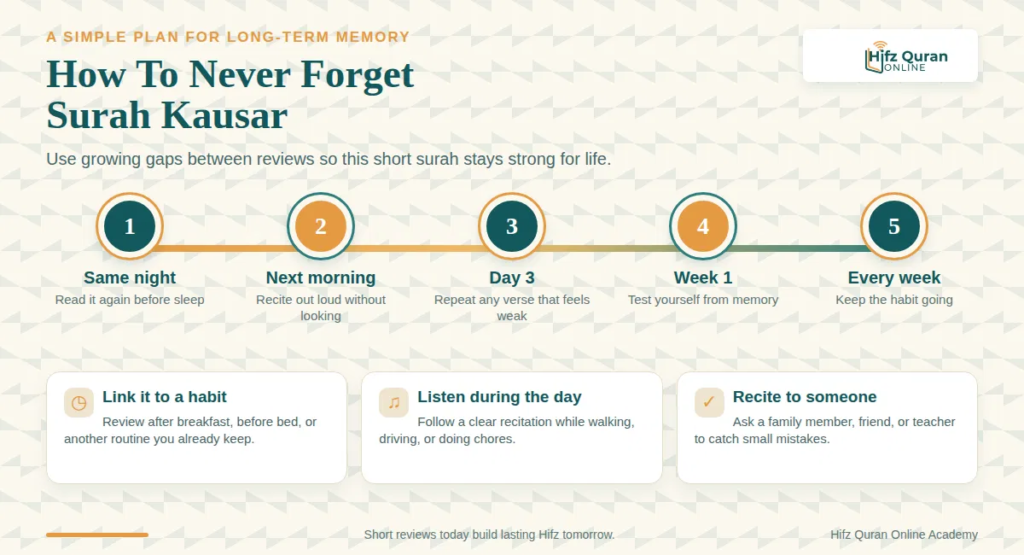
Your memory holds on to things better when you review them with growing gaps of time. Read the surah again the same night you learn it. Then read it the next morning, 3 days later, and 1 week later.
After that, a quick review once a week is enough to keep it strong. Each review moves the surah deeper into your long-term memory.
Set reminders on your phone for each review day so you don’t miss one. If you forget a review, do it as soon as you remember and carry on from there. Read the surah out loud during each review, not only in your head.
Pay attention to any word that makes you pause, and read that verse a few extra times. Over a month, these short reviews add up to a surah you know well.
2. Link Your Review To A Daily Habit
It is easy to forget to review when it has no set time. Pick something you already do every day, like waking up, eating breakfast, or getting into bed. Read Surah Kausar right after that habit, every time.
After a few days, the habit will remind you on its own. This takes less than a minute and needs no extra planning.
Choose a habit that happens at the same time each day, so your review stays steady. You can put a small note or sticker in that spot as a reminder at first. Families can do this together, with everyone reading the surah after dinner.
Once the habit feels natural, you can remove the note. Many people find they keep the habit for years without trying.
3. Listen To the Surah During The Day
Listening is a light way to review without opening a Mushaf. Play the surah from the same Sheikh while you drive, walk, or do chores. Try to say the words along with him in your head. If you can follow every word, your memory is strong. If you get lost, it is a sign to review that verse again.
Make a short playlist with Surah Kausar and the other surahs you know. Play it on a loop so you hear each one several times.
Listening also helps your tajweed stay correct, since you keep hearing the right sounds. Use clear audio and a calm volume so you can catch each letter. Even 5 minutes of listening a day can make a big difference.
4. Test Yourself In Different Ways In The Surah
Reading from the start each time can hide weak spots. Try starting from verse 2 or verse 3 without help. You can also ask someone to read one verse and then you say the next one. Another test is to write the surah from memory, word by word. These checks show you which part needs more practice.
Try reading the surah a little faster than usual to see if any words slip. You can also read it very slowly, focusing on each tajweed rule. Kids enjoy a game where a parent stops in the middle and they finish the verse.
Test yourself at a random time of day, not only during your usual review. If you pass every test, you can be sure the surah is well memorized.
5. Recite The Surah To Someone Each Week
Reading to another person keeps you honest about how well you know the surah. Choose a family member, a friend, or a teacher, and recite it to them once a week. Ask them to follow along in the Mushaf.
They can catch a missed word or a small change in sound. This also helps you keep your tajweed right over time.
Pick the same day each week, like Friday, so it becomes part of your routine. If you live alone, you can recite to a friend over a phone or video call. Ask your listener to be honest, even about small mistakes.
Thank them and fix any mistake right away, while it is fresh. You can also take turns, so you listen to their reading too.
6. Write Down Every Time You Read Surah Kausar To Track Your Progress
Writing down your reviews makes it easy to see if you are keeping up. Use a small notebook or a notes app on your phone.
Each time you review, write the date and whether you read it with no mistakes. If you see a gap of more than a week, add an extra review. When you learn more surahs, you can add them to the same log.
Keep the log simple, with just the date, the surah name, and a tick or a cross. Look back at it each week to spot surahs you have not reviewed in a while. For kids, a colorful chart on the wall works better than a notebook.
Seeing a long line of ticks can motivate you to keep going. Your log also becomes a record of how much of the Quran you have learned.
For a full review plan you can use for every surah, read our guide on how to memorize the Quran without forgetting.
How Long It Takes To Learn Surah Kausar
Most adults who read Arabic learn it in 15 to 30 minutes. Kids and people using English letters may need 2 to 5 short sessions. It depends on your age, how well you know Arabic sounds, and if you have heard it before.
Getting the tajweed right can take a little longer than learning the words. Some people need a few extra days to master sounds like ع and ح.
If you cannot read Arabic letters yet, it helps to start with a beginner’s reading book like the Noorani Qaida first. Short, daily practice is faster than one long session once a week. Try not to compare your pace with others, since each person learns in their own way.
Short, daily practice is faster than one long session once a week. For more tips on speeding up your progress, read our guide on how to memorize Quran fast.
See Our Classes in Action
Curious about what a 1-on-1 Hifz session looks like? Take a look at these real-time snippets from our daily classes to see our student-centered approach, Tajweed correction techniques, and online whiteboard tools in action.
Memorize the Quran at Your Own Pace
Join our expert tutors and begin your Hifz journey with a personalized plan.
Start Your Free TrialLearn Surah Kausar And More With Hifz Quran Online Academy
Surah Kausar is a great first surah, and the right teacher can help you go much further. At Hifz Quran Online Academy, certified Huffaz teach kids and adults in live, one-on-one online classes. Your teacher listens to every verse, fixes your mistakes, and builds a plan that fits your pace.
Here is what you get when you join:
- A certified Hafiz as your teacher in every class
- One-on-one lessons, so all the attention is on you or your child
- Flexible times that fit your time zone and daily routine
- Lessons made for non-Arabic speakers, so you can start even if Arabic is new to you
- Programs for every age, including the Online Quran Memorization Course for Kids and Online Quran Memorization Courses for Adults
Start with one short surah today, and grow step by step toward full Hifz.
Book your free trial class today. There is no commitment.

Our Quran Courses
Can’t decide which course is right for you? Take a look at our courses and pick the one that fits you best:
- Quran Memorization Course
- Quran Memorization and Hifz Course for Kids
- Online Quran Memorization Courses for Adults
- Quran Hifz Course for Ladies
- Quran Memorization Course for Men
- Saudi-Based Quran Memorization Courses
- Hifz Teachers
Conclusion
Every Hafiz started with one short surah. Surah Kausar can be yours. It is only 3 verses long, yet it teaches you how to listen, how to understand, how to read with tajweed, and how to keep what you learn.
The skills you build with this surah will help you with every surah that comes next. Once you know how to break a verse into parts, join verses together, and review on a schedule, longer surahs will feel much less hard. Each new surah you add will make the next one easier.
Most of all, remember why you are learning. Surah Kausar reminds us that Allah gives a great deal of good, and that the right response is to thank Him through prayer. Each time you read it, you are taking part in that thank-you.
Learn it today, read it in your prayer tonight, and pick the next surah tomorrow.
FAQs
Here are the most common questions and their answers about learning Surah Kausar.
Can I Learn Surah Kausar If I Don’t Read Arabic?
Yes. You can start with the English letters in the table above while listening to a reciter. Over time, try to learn the Arabic letters, since some sounds can’t be written well in English.
Is Bismillah Part Of Surah Kausar?
Bismillah is read at the start of Surah Kausar, but it is not counted as one of its 3 verses. The Prophet ﷺ read Bismillah before reciting this surah, as reported in Sahih Muslim.
Was Surah Kausar Revealed In Makkah Or Madinah?
Scholars differ on this. Many count it as a Makkan surah. Others say it came in Madinah, based on the hadith of Anas ibn Malik.
What Surah Should I Learn After Surah Kausar?
Learn Surah Al-Kafirun (109), which comes right after it, or Surah Al-Ma’un (107), which comes right before it. Learning surahs in order helps you link them in your memory. If you plan to keep going, seehow long it takes to become a Hafiz.
Do I Need A Teacher To Learn Surah Kausar?
You can memorize Surah Kausar on your own, but a teacher helps you say every letter correctly. Many sounds in the surah are hard to check by ear alone. Even one short session with a teacher can catch mistakes before they become habits.
Can I Use An App To Learn Surah Kausar?
Yes. Many Quran apps let you repeat one verse as many times as you want, which is helpful for memorizing. Choose an app that shows the Arabic text and plays a clear, slow reciter.
Can I Recite Surah Kausar From Memory Without Wudu?
Yes. Most scholars say you can recite the Quran from memory without wudu. Wudu is needed to touch the Mushaf and to pray.
Can I Read Surah Kausar In Both Rak’ahs Of My Prayer?
Yes. You can read the same surah in both rak’ahs, and your prayer is still valid. Still, it is good to learn more short surahs so you can change what you read.







Leave a Reply