 Memorizing Quran

To learn how to memorize Surah Al Fajr, split its 30 verses into 3 parts and learn a few verses each day. Repeat each verse 10 to 15 times until you can recite it without looking. Then connect it to the verses you have already memorized. Most learners who read Arabic well can complete the surah in 10 to 13 days with about 30 minutes of daily practice.
Surah Al-Fajr is longer than most surahs people learn first. Many learners start strong, get stuck in the middle, and then find the first verses fading. The 9 steps below solve that by using the surah’s own patterns, so each verse leads you to the next one.
This plan works for adults, teens, and parents helping their children. You only need to read Arabic letters correctly. Follow the steps in order.
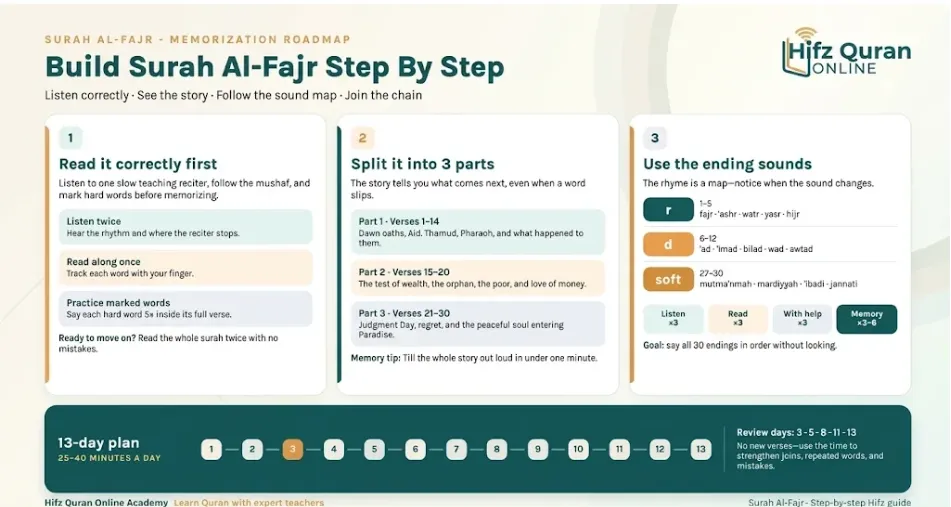
1. Listen To The Surah And Read It Correctly
Your first job is to make sure you can read every word of Surah Al-Fajr without mistakes. Do not try to memorize anything yet. It is much harder to fix a wrong word once it is memorized. This step usually takes one or two sessions.
Choose one reciter and stay with them. A slow teaching recitation works best, such as Sheikh Al-Husary’s Mushaf al-Mu’allim recitation of Surah Al-Fajr.
Sheikh Mahmoud Khalil Al-Husary recorded it to teach correct recitation, and his recordings are used for memorization around the Muslim world. Using one voice gives your memory one clear model to copy.
Listen to the whole surah twice without reading, so you get used to its rhythm and where the reciter stops. On the third listen, read along and follow each word with your finger. Mark any word that feels hard to say. If Arabic is not your first language, expect more marked words here, and that is normal.
For extra practice, the teaching recitation with repetition repeats each verse so you can follow along.
Practice each marked word 5 times on its own, then say it inside its full verse. This short, focused repetition is the same principle behind the repetitive memorization method.
Finish by reading the whole surah out loud by yourself and checking it against the tajweed rules below. If any of these rules are new to you, start with the basic tajweed rules every student should learn before starting hifz, including ghunnah and the rules of noon sakinah that cover idgham.
| Rule | What it sounds like | Where it appears |
|---|---|---|
| Strong bounce (qalqalah) | A clear echo when you stop on ق ط ب ج د | End of verses 6–14: ‘ad (بِعَادٍ), ‘imad (الْعِمَادِ), bilad (الْبِلَادِ), wad (بِالْوَادِ), awtad (الْأَوْتَادِ), fasad (الْفَسَادَ), ‘adhab (عَذَابٍ), mirsad (لَبِالْمِرْصَادِ) |
| Light bounce | A small echo in the middle of a word | yukhlaq (يُخْلَقْ) (8), ibtalahu (ابْتَلَاهُ) (15–16), mutma’innah (الْمُطْمَئِنَّةُ) (27), fadkhuli (فَادْخُلِي) (29) |
| Nasal sound (ghunnah) | A hum through the nose for 2 counts | inna (إِنَّ) (14), fa-amma (فَأَمَّا) (15), jamma (جَمًّا) (20), jahannam (بِجَهَنَّمَ) (23), an-nafs (النَّفْسُ) (27) |
| Blending (idgham) | One sound flows into the next | qasamun li-dhi (قَسَمٌ لِّذِي) (5) with no hum. Radiyatan mardiyyah (رَاضِيَةً مَّرْضِيَّةً) (28) with a hum. |
| The “l” in “al” | Said, or blended into the next letter | Said in wal-fajr (وَالْفَجْرِ) and wal-watr (وَالْوَتْرِ). Blended in wash-shaf’ (وَالشَّفْعِ) and wal-layl (وَاللَّيْلِ). |
The verse-ending words in the first row are shown as they are written in the mushaf. When you stop on them, the last letter loses its vowel and takes a sukun, and that is where the strong bounce happens.
Take the time to get these right now. A rule you apply wrongly today gets repeated every time you review the surah, which is why memorizing with incorrect tajweed is one of the hardest mistakes to undo later.
You are ready for step 2 when you can read the whole surah from the mushaf twice in a row with no mistakes.
Memorizing the Holy Quran is much easier to learn from a person than by yourself. In our Quran Memorization Course at Hifz Quran Online Academy, your tutor hears each rule as you read and corrects it on the spot, so you start memorizing with clean recitation.

2. Split The Surah Into Its 3 Parts
Surah Al-Fajr tells one story in 3 parts. When you know the story, you always know what comes next, even if a word slips.
Start by reading a simple translation of the whole surah once. Then learn the 3 parts and the smaller scenes inside each one. These scenes become your daily lessons in step 8.
| Part | Verses | The story | Scenes to learn |
| 1 | 1–14 | Allah swears by the dawn and the nights. Then He shows how the people of ‘Ad, Thamud, and Pharaoh were destroyed for doing wrong. | The oaths (1–5)’Ad and Iram (6–8)Thamud and Pharaoh (9–10)What happened to them (11–14) |
| 2 | 15–20 | People think wealth means Allah honors them and being poor means He has let them down. Yet they ignore the orphan and the poor, and they love money too much. | The test of rich and poor (15–16)The blame (17–20) |
| 3 | 21–30 | On the Day of Judgment, the earth is crushed and people feel regret. The peaceful soul is called back to Allah and into Paradise. | The Day comes (21–23)Regret and punishment (24–26)The peaceful soul (27–30) |
Now tell the story out loud in your own words, scene by scene, in under one minute.
For example: “Allah swears by the dawn and the night. He asks, did you see what happened to ‘Ad? Their city had pillars like no other…” As you tell it, picture each scene: the dawn breaking, Thamud cutting homes into rock, angels standing in rows. Pictures are easier to remember than words.
Make it stick by teaching it. Tell the story to someone else, such as a child, a friend, or a family member. If you can explain it clearly to another person, it is fixed in your own mind too.
Memorize the Quran at Your Own Pace
Join our expert tutors and begin your Hifz journey with a personalized plan.
Start Your Free Trial3. Learn How The Verses End
Each part of Surah Al-Fajr has its own ending sound. These sounds act like a map. If you start saying a verse that ends with the wrong sound, you will notice right away.
| Verses | Ending sound | The endings |
| 1–5 | “r” | fajr (الْفَجْرِ), ‘ashr (عَشْرٍ), watr (الْوَتْرِ), yasr (يَسْرِ), hijr (حِجْرٍ) |
| 6–12 | “d” | ‘ad (بِعَادٍ), ‘imad (الْعِمَادِ), bilad (الْبِلَادِ), wad (بِالْوَادِ), awtad (الْأَوْتَادِ), bilad (الْبِلَادِ), fasad (الْفَسَادَ) |
| 13–14 | Closing pair | ‘adhab (عَذَابٍ), mirsad (لَبِالْمِرْصَادِ) |
| 15–20 | Rhyming pairs | akraman (أَكْرَمَنِ) / ahanan (أَهَانَنِ) · yatim (الْيَتِيمَ) / miskin (الْمِسْكِينِ) · lamma (لَّمًّا) / jamma (جَمًّا) |
| 21–26 | Mixed | dakka (دَكًّا), saffa (صَفًّا), dhikra (الذِّكْرَىٰ), hayati (لِحَيَاتِي), ahad (أَحَدٌ), ahad (أَحَدٌ) |
| 27–30 | Soft | mutma’innah (الْمُطْمَئِنَّةُ), mardiyyah (مَّرْضِيَّةً), ‘ibadi (عِبَادِي), jannati (جَنَّتِي) |
Work on one group at a time. Say only its endings, in order, 3 times. Pay attention to where the sound changes. The switch from “r” to “d” at verse 6 marks the start of the nations’ stories. The soft endings at verse 27 mark the final scene.
You are ready for step 4 when you can say all 30 endings in order without looking.
4. Mark The Words That Repeat
Some words in Surah Al-Fajr appear more than once. If you know exactly where they are, they help you. If you don’t, they cause mix-ups.
Use a mushaf you can mark, or print a page of the surah. Highlight each repeated word below in one color.
| Repeated word | Verses | How to tell them apart |
| rabbuka (رَبُّكَ) — your Lord | 6, 13, 14, 22 | It marks each big turn: the question (6), the punishment (13), the warning (14), the Day (22). In verse 14 it is read rabbaka (رَبَّكَ). |
| fil-bilad (فِي الْبِلَادِ) — in the land | 8, 11 | Verse 8 is about ‘Ad only. Verse 11 is about all three nations. |
| fa-yaqulu rabbi (فَيَقُولُ رَبِّي) — he says, my Lord | 15, 16 | Verse 15 ends with honor, akraman (أَكْرَمَنِ). Verse 16 ends with being let down, ahanan (أَهَانَنِ). |
| kalla (كَلَّا) — No! | 17, 21 | The first kalla starts the blame. The second starts the Day of Judgment. |
| Double words | 21, 22 | dakkan dakka (دَكًّا دَكًّا) and saffan saffa (صَفًّا صَفًّا) always come in twos. |
| yawma’idhin (يَوْمَئِذٍ) — on that Day | 23 (twice), 25 | It tells you that you are inside the scenes of Judgment Day. |
| ahad (أَحَدٌ) — anyone | 25, 26 | Punishment, ‘adhabahu (عَذَابَهُ), comes in verse 25. Chains, wathaqahu (وَثَاقَهُ), come in verse 26. |
| udkhuli (ادْخُلِي) — enter | 29, 30 | “Enter among My servants,” fadkhuli fi ‘ibadi (فَادْخُلِي فِي عِبَادِي), comes first. “Enter My Paradise,” wadkhuli jannati (وَادْخُلِي جَنَّتِي), comes last. |
Then practice the look-alike pairs side by side. Read verse 8, then verse 11, and say out loud what makes them different. Do the same for 15 and 16, and for 25 and 26.
Give each pair a short memory rule. When two verses look alike, a few simple words can tell you which one comes first. Say the rule to yourself before you recite the pair.
- Verses 8 and 11: “One nation, then all three.”
- Verses 15 and 16: “Good news first, bad news second.”
- Verses 25 and 26: “First punished, then tied up.”
If a rule doesn’t stick for you, make your own. The best rule is one that makes sense to you.
5. Repeat Each Verse 10 To 15 Times
Now you start memorizing. Every new verse goes through the same 4-stage loop. It moves you from hearing, to reading, to saying it from memory.
| Stage | What to do | Times |
| Listen | Play the verse and follow the words with your finger. | 3 |
| Read out loud | Read from the mushaf. Copy the reciter’s sounds exactly. | 3 |
| Say with help | Cover the verse and say it. Peek at the first word only if you get stuck. | 3 |
| Say from memory | No peeking at all. | 3 to 6 |
The last stage depends on the verse’s length. Short verses, such as 1–4, 7, 10, 21, and 26–30, need 3 times. Medium verses need 4. Long verses, such as 8, 9, 15, 16, and 23, need up to 6.
If you make a mistake in the last stage, start its count again from zero. Only correct repetitions count.
Long verses are easier if you split them in half. Learn each half with the loop, then join them:
- Verse 15:
- فَأَمَّا الْإِنسَانُ إِذَا مَا ابْتَلَاهُ رَبُّهُ / فَأَكْرَمَهُ وَنَعَّمَهُ فَيَقُولُ رَبِّي أَكْرَمَنِ
- fa-amma al-insanu idha ma ibtalahu rabbuhu / fa-akramahu wa na”amahu fa-yaqulu rabbi akraman
- Verse 16:
- وَأَمَّا إِذَا مَا ابْتَلَاهُ / فَقَدَرَ عَلَيْهِ رِزْقَهُ فَيَقُولُ رَبِّي أَهَانَنِ
- wa amma idha ma ibtalahu / fa-qadara ‘alayhi rizqahu fa-yaqulu rabbi ahanan
- Verse 23:
- وَجِيءَ يَوْمَئِذٍ بِجَهَنَّمَ / يَوْمَئِذٍ يَتَذَكَّرُ الْإِنسَانُ وَأَنَّىٰ لَهُ الذِّكْرَىٰ
- wa jee’a yawma’idhin bi-jahannam / yawma’idhin yatadhakkaru al-insanu wa anna lahu adh-dhikra
Each verse usually takes 3 to 5 minutes. To see how this fits into one focused session, read our guide on how to memorize a surah in 1 hour.
6. Join The Verses Together
A verse learned alone will slip away. You need to link each new verse to the ones before it, like links in a chain. The order matters here, so follow it exactly:
- Learn verse 1 with the loop.
- Learn verse 2 with the loop, then say verses 1–2 together 3 times.
- Learn verse 3 with the loop, then say verses 1–3 together 3 times.
- Keep adding one verse at a time until the day’s scene is complete.
- End the session by saying the whole scene 5 times without looking.
Most learners lose their place where one scene or part ends and the next begins, so strengthen these joins on purpose.
Start each session by saying the last 2 verses from yesterday 3 times, then go straight into today’s first new verse. When you start Part 2, say verses 13–15 together 3 times. When you start Part 3, say verses 19–21 together 3 times.
Check your chain from any point. Ask someone to name a random verse number, such as 17. Start from that verse and keep going to the end of the scene. If you can start from any verse, your chain is strong.
If you keep forgetting at the same spot, our Online Quran Memorization (Hifz) courses can help. Your tutor listens as you join the verses, finds the exact place where the chain breaks, and gives you a drill to fix it.

7. Watch For The 8 Common Mistakes
Keep this list next to you while you memorize. The look-alike verses are covered in step 4. These are the other errors Surah Al-Fajr learners make most often.
| Mistake | Verse | What learners say | What is correct | Why |
| Wrong form of “O” | 27 | ayyuha (أَيُّهَا) | ayyatuha (أَيَّتُهَا) | It speaks to the soul, an-nafs (النَّفْسُ), which is a feminine word in Arabic. |
| Wrong form of “your Lord” | 28 | rabbika (رَبِّكَ) | rabbiki (رَبِّكِ) | It still speaks to the soul. |
| Wrong form of “which” | 8 | alladhi (الَّذِي) | allati (الَّتِي) | It describes the city of Iram. |
| Verb from another surah | 18 | wa la yahuddu (وَلَا يَحُضُّ) | wa la tahaddoona (وَلَا تَحَاضُّونَ) | The first form belongs to Surah Al-Ma’un and Surah Al-Haqqah. Watch this if you know either surah. |
| Mixing up two verse openings | 22, 23 | Swapping the two openings | Verse 22: wa ja’a rabbuka (وَجَاءَ رَبُّكَ)Verse 23: wa jee’a yawma’idhin (وَجِيءَ يَوْمَئِذٍ) | Both start with a similar word, but each verse has its own form. |
| Swapping two endings | 19, 20 | Putting jamma in verse 19 or lamma in verse 20 | Verse 19: akla lamma (أَكْلًا لَّمًّا)Verse 20: hubban jamma (حُبًّا جَمًّا) | Eating goes with lamma. Loving wealth goes with jamma. |
| Adding a “ya” sound when stopping | 4, 9 | yasri or bil-wadi | yasr (يَسْرِ) and bil-wad (بِالْوَادِ) | Neither word has a “ya” sound at the end when you stop. |
| Skipping Part 2 | 14 → 21 | Going from la-bil-mirsad (لَبِالْمِرْصَادِ) straight to kalla idha dukkat (كَلَّا إِذَا دُكَّتِ) | Verse 14 is followed by verse 15, fa-amma al-insanu (فَأَمَّا الْإِنسَانُ) | The part join in step 6 helps stop this. |
Read through this table once before each session, and keep it open beside your mushaf while you recite. When you make one of these mistakes, put a small mark next to that row so you can see which errors keep coming back.
If the same row collects three or more marks, spend a few minutes drilling just that verse with the loop from step 5 before moving on.
Have a closer look inside our real classes
Watch how our teachers help children build strong recitation skills in the Quran Learning Course for Kids at Hifz Quran Online Academy. In this lesson, a young student learns to recite Surah Al-Qiyamah correctly, verse by verse, with guidance from the teacher.
8. Follow The 13-Day Plan
This step puts steps 5, 6, and 7 into a daily schedule. It is built for learners who read Arabic correctly and have 25 to 40 minutes a day.
Each session has three parts. Begin with a 5-minute warm-up, using the verse endings from step 3 and the daily join from step 6. Spend the next 15 to 25 minutes on the day’s new verses. Use the last 5 to 10 minutes for the review listed in the table below.
In the review column, “×3” means 3 times from memory with no mistakes.
| Day | Part | New verses | Review |
| 1 | 1 | 1–5 | Tell the full story of the surah once |
| 2 | 1 | 6–8 | Verses 1–5 ×3 |
| 3 | 1 | 9–10 | Verses 1–8 ×2 |
| 4 | 1 | 11–14 | Verses 6–10 ×3 |
| 5 | 1 | Review day | Verses 1–14 ×3 |
| 6 | 2 | 15–16 | Verses 1–14 ×1 |
| 7 | 2 | 17–20 | Verses 15–16 ×3 |
| 8 | 2 | Review day | Verses 15–20 ×3, then 1–20 ×1 |
| 9 | 3 | 21–23 | Verses 15–20 ×2 |
| 10 | 3 | 24–26 | Verses 21–23 ×3 |
| 11 | 3 | 27–30 | Verses 21–26 ×3 |
| 12 | 3 | Review day | Verses 21–30 ×3, then 1–20 ×1 |
| 13 | All | Review day | Verses 1–30 ×3, then say it once to another person |
On review days, do not learn new verses. Use the extra time to drill the pairs from step 4 and the mistakes from step 7.
How To Finish the Plan In 10 Days
The 10-day plan is for learners who already know several surahs from Juz’ Amma and can learn about 5 verses in one session without losing them the next day. If that sounds like you, join three pairs of days from the 13-day table:
- Days 2 and 3 become one session: learn verses 6–10, the full story of ‘Ad, Thamud, and Pharaoh.
- Days 6 and 7 become one session: learn verses 15–20, all of Part 2.
- Days 9 and 10 become one session: learn verses 21–26, the scenes of the Day of Judgment.
These merged sessions take longer, usually 40 to 50 minutes, so plan them for a day when you have more time. Keep all 4 review days, even on the faster plan. They are what make the surah last.
Watch for one warning sign. If you can’t say the previous day’s verses cleanly at the start of a session, you are moving too fast. Switch back to the 13-day plan for the rest of the surah. Finishing a few days later is far better than finishing early and forgetting half of it.
How To Slow the Plan Down
A slower plan works well for beginners, children, and busy adults who can only give 10 to 15 minutes a day. Give each row of the table 2 days instead of 1:
- First day: learn the new verses with the loop from step 5.
- Second day: say those verses from memory, then join them to the verses before them using the chain from step 6.
This turns the plan into about 3 to 4 weeks, and it works just as well. For young children, you can also split a scene into smaller pieces. For example, teach verses 1–3 one day and verses 4–5 the next. What matters most is steady practice, not speed.
What If You Miss A Day?
Do not try to catch up by learning two days’ verses in one session. That usually leads to forgetting both. Instead, use your next session for review only: say the verses from your last two sessions 3 times each from memory. The day after, continue the plan from the row where you stopped.
On days when you know you will be busy, do a 5-minute minimum. Say the verse endings of your current part and the last 2 verses you learned. This small habit keeps the surah fresh and often stops a missed day from happening at all.
What If You Miss A Week?
Treat your first session back as a check-up. Recite each part you learned from memory, and sort the verses into three groups: strong, shaky, and forgotten.
Spend one or two sessions rebuilding the shaky and forgotten verses with the loop and the chain. Then restart the plan at the beginning of the last scene you learned, not from day 1.
If you miss a week after finishing the surah, during the review stage in step 9, say the whole surah once a day for the next 7 days. Then return to your normal review schedule.
For more ways to speed up your progress across the Quran, see how to memorize Quran fast.
9. Review So You Don’t Forget
Learning the surah is half the job. Keeping it is the other half. Memory fades fastest in the first few weeks, so review is most frequent at the start.
| When | What to do |
| Days 14–30 | Say the whole surah once a day. Saying it in prayer counts: verses 1–14 in the first rak’ah and 15–30 in the second. |
| Months 2–3 | Say the whole surah at least 3 times a week. Say the verse endings once a week. |
| After month 3 | Add it to your weekly Juz’ Amma review. |
Check yourself regularly. Once a week in the first month, recite the surah to a family member or friend while they follow in the mushaf, because other people catch mistakes you can’t hear.
You can also record yourself reciting from memory, then play it back while reading the mushaf and mark any word you got wrong.
If a part starts to fade, you don’t need to start the whole surah over. Find the exact verses that feel weak and run only those through the loop from step 5. Then rebuild the chain from step 6, starting 2 verses before the weak spot, and say the full part 3 times to lock it back in.
For a full review system you can use with every surah you learn, read how to memorize Quran without forgetting.
When you finish day 13, book a free recitation review. Say Surah Al-Fajr from memory to a tutor, and leave with a clear list of any words or rules to fix.
Read also: How to Memorize Surah Al-Fatiha
Facts about Surah Al-Fajr
Knowing a few facts about Surah Al-Fajr gives you a clear picture of it before you begin.
| Fact | Details |
| Name | Al-Fajr, which means “The Dawn.” It is named after its first word, wal-fajr. |
| Place in the Quran | The 89th surah, in Juz’ 30 (Juz’ Amma) |
| Number of verses | 30 verses in the count used in most printed mushafs. Other counting schools count 29 or 32, but the words are the same. |
| Where it was revealed | Makkah, in the early years of Islam |
| Order of revelation | The 10th surah revealed, after Surah Al-Layl and before Surah Ad-Duha |
| Other name | Sometimes called “Al-Fajr wa Layalin ‘Ashr” (The Dawn and Ten Nights), after its opening |
| Its partner surah | It forms a pair with Surah Al-Balad, the surah right after it |
What the opening oaths mean. The surah begins with Allah swearing by the dawn, ten nights, the even and the odd, and the night as it passes.
Many scholars of tafsir, including Ibn Kathir, explain the ten nights as the first ten days of Dhul Hijjah, the days of Hajj. Some scholars give other views, such as the last ten nights of Ramadan.
When it was revealed. Surah Al-Fajr was revealed early in the Makkan period. At that time, the leaders of Makkah were proud of their wealth and believed it showed Allah’s approval, while being poor meant His disfavor.
The surah’s stories of ‘Ad, Thamud, and Pharaoh showed that strength and wealth do not last when people do wrong.
Is Surah Al-Fajr A Good Surah To Start Memorizing The Quran?
No, Surah Al-Fajr is not a good first surah for a complete beginner, but it is an excellent next step after you have memorized a few short surahs. Its 30 verses are a lot to hold if you have never memorized before, and starting too big can make a new learner lose heart.
Most teachers suggest a simple path. Begin with Surah Al-Fatiha, because you recite it in every prayer.
Then learn the short surahs at the end of Juz’ Amma, such as Al-Ikhlas, Al-Falaq, and An-Nas. These teach you how memorizing feels, how to repeat, and how to review, without the pressure of a long surah.
You are likely ready for Surah Al-Fajr when:
- You have memorized several short surahs and can still recite them well.
- You can read Arabic from the mushaf smoothly, without sounding out each letter.
- You can memorize 3 to 5 verses in one session and remember them the next day.
When you reach that point, Surah Al-Fajr is a very good choice. Its clear story makes it easier to follow than many surahs of the same size. Finishing it also builds real confidence, because it proves you can hold a longer surah from start to end.
See Our Classes in Action
Curious about what a 1-on-1 Hifz session looks like? Take a look at these real-time snippets from our daily classes to see our student-centered approach, Tajweed correction techniques, and online whiteboard tools in action.
Memorize the Quran at Your Own Pace
Join our expert tutors and begin your Hifz journey with a personalized plan.
Start Your Free TrialMemorize Surah Al-Fajr With Hifz Quran Online Academy
Memorizing the words of Allah is a beautiful goal, and you don’t have to do it alone. Many of our students started just like you, with a surah they loved and a worry that they might forget it. With a caring tutor by your side, each verse becomes easier, and every small step forward feels like something to be proud of.
Here is how we support you in our Online Quran Memorization (Hifz) course at Hifz Quran Online:
- One-to-one live classes: your tutor gives you their full attention, listens to each verse you recite, and gently corrects mistakes as they happen.
- Ijazah-certified tutors: you learn from Huffaz who studied at known Islamic universities and explain things in clear, simple English.
- Male and female tutors: you or your children can learn with a tutor you feel truly comfortable with.
- A plan made around your life: your tutor sets your daily verses and review days to match your level, your pace, and your schedule.
- Classes at any hour: learn early in the morning, late at night, or on weekends, from 2 to 7 days a week.
- Learn from anywhere: join from your phone, tablet, or computer, wherever you are.
- A certificate to celebrate: each course ends with a certificate signed by your supervisor, marking how far you have come.
- Family discounts: learn together as a family and save when more than one person joins.
Your first class is free, and there is no pressure. Simply recite whatever you know of Surah Al-Fajr, even if it is only a few verses. Your tutor will listen kindly, help you fix your first mistakes, and build a plan with you to finish this surah and continue through Juz’ Amma at a pace that feels right.

Our Quran Courses
Have a look at our available Quran courses and book your trial.
- Quran Memorization Course
- Quran Memorization and Hifz Course for Kids
- Online Quran Memorization Courses for Adults
- Quran Hifz Course for Ladies
- Quran Memorization Course for Men
- Saudi-Based Quran Memorization Courses
- Hifz Teachers
Conclusion
Memorizing Surah Al-Fajr is a real milestone in your Hifz journey. By learning how to memorize Surah Al Fajr through the method in this guide, from understanding the story to marking repeated words, you have built a system you can trust and use for almost every surah you learn next.
Some days may have felt slow, and some verses may have taken longer than others, but every repetition counted. What you have built is not only a memorized surah but also the patience and focus that Hifz requires.
Take a moment to think about what you have learned by heart. You carry a surah that speaks about justice, about the duty to care for the orphan and the poor, and about the Day when every person will see the result of their choices.
These are lessons you can return to each time you recite. Let them shape how you act, not only how you recite, so that your memorization brings you closer to living the Quran’s message. Your next goal is simple. Keep Surah Al-Fajr strong with the review plan in step 9, and choose your next surah when you feel ready.
Each new surah will feel a little easier than the last. Over time, these surahs will join together into a growing part of the Quran that you hold in your heart. May Allah make your journey easy and accept every verse you learn.
FAQs
Seeking more knowledge on Surah Al-Fajr, read these questions and answers.
What Affects How Long It Takes To Memorize Surah Al-Fajr?
The biggest factors are how smoothly you read Arabic, how much time you give each day, and how many surahs you have memorized before. A learner who already knows much of Juz’ Amma will usually move faster than someone on their second or third surah.
Should I Memorize Surah Al-Fajr From The Beginning Or The End?
Start from the beginning. The surah tells a story in order, and each part builds on the one before it. Learning the end first can make the middle harder to place.
Can Children Memorize Surah Al-Fajr?
Yes, children can memorize Surah Al-Fajr, usually after a few shorter surahs. Keep sessions short, about 10 to 15 minutes, and tell them the stories of ‘Ad, Thamud, and Pharaoh before each lesson.
Do I Need To Understand Every Arabic Word To Memorize Surah Al-Fajr?
No. But learning a handful of key words makes a big difference. Words such as rabb (Lord), mal (wealth), yatim (orphan), miskin (poor person), and nafs (soul) help you follow the story as you recite.
What Is The Best Time Of Day To Memorize Surah Al-Fajr?
Many learners find that early morning works best, after Fajr prayer, when the mind is fresh and the house is quiet. The most important thing is to use the same time every day.
How Do I Keep My Motivation Through The Full 13 Days?
Track your progress so you can see it grow. Tick off each row of the 13-day plan when you finish it, and recite what you have learned to someone at the end of each part. Seeing the surah come together, one part at a time, is often the best reason to keep going.
Can I Memorize Surah Al-Fajr Using An App?
Yes, an app is helpful for listening and repeating verses. Try to read from one printed mushaf, or one app with the same page layout, so your eyes remember where each verse sits on the page.
Which Surah Should I Memorize After Surah Al-Fajr?
If you are learning Juz’ Amma from the end toward the start, the next surah isAl-Balad (90) if you haven’t learned it yet, thenAl-Ghashiyah (88).






Leave a Reply