 Memorizing Quran

The best short surahs to memorize are Al-Kawthar, Al-Asr, An-Nasr, Al-Ikhlas, Al-Falaq, and An-Nas. They have only 3 to 6 verses each, which makes them quick to learn. Al-Kawthar is the shortest surah in the Quran, with just 3 verses and about 10 words.
Short surahs are the small chapters of the Quran. Most of them are in Juz Amma, the last part of the Quran. The 33 short surahs most people learn for prayer range from 3 verses to 29 verses. Their verses are short and easy to repeat, even in the longer ones.
Muslims say short surahs every day in their prayers. In each prayer, you say Al-Fatihah first. In the first two rak’ahs, you then add a short surah or a few verses. This is why short surahs are often the first part of the Quran that kids, new Muslims, and other beginners learn.
The reward starts from the first try. The Prophet ﷺ said that a person who finds the Quran hard to read gets a double reward (Sahih al-Bukhari 4937). So even slow progress with a short surah counts.
A. Short Surahs with 3 to 5 Verses
These nine surahs are the shortest in the Quran, with only 3 to 5 verses each. They are the best place to start for kids, new Muslims, and anyone who is just beginning. Most of them are also among the surahs people say most often in prayer.
| # | Surah | Verses | What it is about |
| 1 | Al-Kawthar (108) | 3 | Allah gave the Prophet ﷺ much good, so he should pray and give sacrifice |
| 2 | Al-Asr (103) | 3 | People are in loss, except those who believe, do good, and help each other stay true and patient |
| 3 | An-Nasr (110) | 3 | When help from Allah comes, praise Him and ask for His forgiveness |
| 4 | Al-Ikhlas (112) | 4 | Allah is One, and nothing is like Him |
| 5 | Quraysh (106) | 4 | The Quraysh should worship the Lord who fed them and kept them safe |
| 6 | Al-Falaq (113) | 5 | We ask Allah to protect us from harm around us |
| 7 | Al-Masad (111) | 5 | What happens to Abu Lahab and his wife for fighting the Prophet ﷺ |
| 8 | Al-Fil (105) | 5 | How Allah stopped the army with the elephant |
| 9 | Al-Qadr (97) | 5 | The Night of Decree is better than a thousand months |
B. Short Surahs with 6 to 9 Verses
These ten surahs have 6 to 9 verses each, so they take a little more time to learn. This group includes Al-Fatihah, the one surah you must say in every rak’ah. It also includes An-Nas and Al-Kafirun, which many people say often in their daily prayers.
| # | Surah | Verses | What it is about |
| 10 | An-Nas (114) | 6 | We ask Allah to protect us from the evil whisper |
| 11 | Al-Kafirun (109) | 6 | Believers and disbelievers do not share the same worship |
| 12 | Al-Ma’un (107) | 7 | A warning to people who forget their prayer and refuse small help to others |
| 13 | Al-Fatihah (1) | 7 | Praise of Allah and a prayer for guidance. You say it in every rak’ah |
| 14 | Ash-Sharh (94) | 8 | After hard times comes ease |
| 15 | At-Takathur (102) | 8 | Wanting more and more keeps people busy until they die |
| 16 | Az-Zalzalah (99) | 8 | The last earthquake, when every small deed is shown |
| 17 | At-Tin (95) | 8 | Allah made people in the best form |
| 18 | Al-Bayyinah (98) | 8 | The clear proof, and the best and worst of people |
| 9 | Al-Humazah (104) | 9 | A warning to people who mock others and store up money |
C. Short Surahs with 11 to 15 Verses
These four surahs have 11 to 15 verses each. They are a good next step once the shorter surahs feel easy. Their verses are still short, but there are more of them to link together.
| # | Surah | Verses | What it is about |
| 20 | Al-Adiyat (100) | 11 | Running horses, and people who are not thankful to their Lord |
| 21 | Al-Qari’ah (101) | 11 | The Day of Judgment and the weighing of deeds |
| 22 | Ad-Duha (93) | 11 | Allah tells the Prophet ﷺ that He has not left him |
| 23 | Ash-Shams (91) | 15 | Whoever keeps their soul pure wins, and whoever spoils it loses |
D. Short Surahs with 17 to 29 Verses
These ten surahs have 17 to 29 verses each and finish most of Juz Amma. They take the most time to learn on this list. Their verses are short and have a strong rhythm, which helps you remember them.
| # | Surah | Verses | What it is about |
| 24 | At-Tariq (86) | 17 | Every soul has a guard watching over it |
| 25 | Al-A’la (87) | 19 | Praise your Lord, the Most High |
| 26 | Al-Alaq (96) | 19 | The first words sent down, “Read in the name of your Lord” |
| 27 | Al-Infitar (82) | 19 | When the sky breaks open, and all deeds are written |
| 28 | Al-Balad (90) | 20 | The hard road of freeing slaves and feeding the poor |
| 29 | Al-Layl (92) | 21 | People who give and people who hold back |
| 30 | Al-Buruj (85) | 22 | The believers who were hurt for their faith, and Allah sees all |
| 31 | Al-Inshiqaq (84) | 25 | When the sky tears open, and each person gets their book of deeds |
| 32 | Al-Ghashiyah (88) | 26 | The great Day, and the two places people will go |
| 33 | At-Takwir (81) | 29 | When the sun is rolled up, and what happens on the Last Day |
You do not need all 33 surahs to pray, since Al-Fatihah and one short surah are enough. Still, each new surah you learn lets you add more variety to your prayers. Most learners start with the first group, move down the list step by step, and keep reviewing the ones they already know.
Memorize the Quran at Your Own Pace
Join our expert tutors and begin your Hifz journey with a personalized plan.
Start Your Free TrialWhich Short Surahs Should You Learn First?
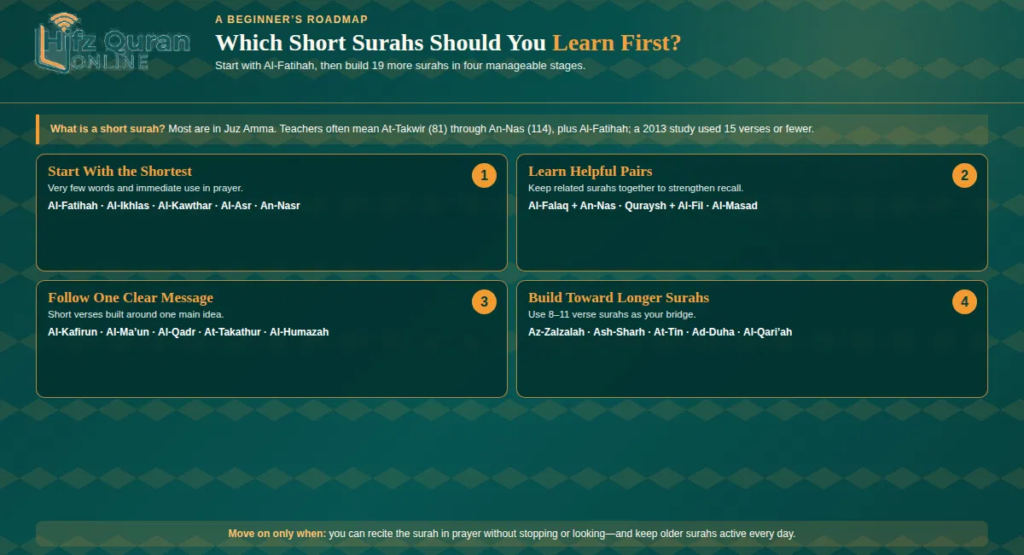
Start with Al-Fatihah, since you need it in every prayer. After that, learn 19 more surahs in four small stages. This order is a little different from the full list above. It puts surahs with fewer words first and keeps surahs that belong together side by side.
Stage 1: The first five surahs
Begin with Al-Fatihah, then Al-Ikhlas, Al-Kawthar, Al-Asr, and An-Nasr. These five have very few words, and you can use them in your prayers right away. Once you know them, you can already pray with a different surah in each rak’ah.
Stage 2: Surahs that go in pairs
Next, learn Al-Falaq and An-Nas together, then Quraysh and Al-Fil together, and finish with Al-Masad. Al-Falaq and An-Nas start the same way, so learning them back to back helps you keep them apart. Quraysh and Al-Fil tell one linked story, so each one helps you remember the other.
Stage 3: Surahs with a clear message
Now move on to Al-Kafirun, Al-Ma’un, Al-Qadr, At-Takathur, and Al-Humazah. Each of these has 5 to 9 short verses built around one main idea. Take extra care with Al-Kafirun, because its lines are almost the same and easy to say out of order.
Stage 4: The bridge to longer surahs
Finish with Az-Zalzalah, Ash-Sharh, At-Tin, Ad-Duha, and Al-Qari’ah. These have 8 to 11 verses, so they prepare you for the longer surahs on the list. Learn Ad-Duha and Ash-Sharh close together, since one comes right after the other in the Quran.
When to move to the next surah
Move on only when you can say a surah in prayer without stopping or looking. Keep saying your older surahs in your daily prayers so you do not forget them. When all 20 feel easy, you are ready for the other 13 surahs on the list.
A surah with fewer verses is not always easier to learn. Three things make a surah harder: how many words it has, how long its verses are, and whether it sounds like another surah.

Have a closer look inside our real classes
Watch how our teachers help children build strong recitation skills in the Quran Learning Course for Kids at Hifz Quran Online Academy. In this lesson, a young student learns to recite Surah Al-Qiyamah correctly, verse by verse, with guidance from the teacher.
Surahs With More Words Take Longer To Learn
Some surahs have fewer verses but more words. An-Nasr has 3 verses and 19 words, while Al-Ikhlas has 4 verses and only 15 words, based on counts from Quran Way. So Al-Ikhlas is often quicker to learn, even though it has one more verse.
The same is true further down the list. Al-Masad has 5 verses and 23 words, and Al-Ma’un has 7 verses and 25 words, so they take about the same effort. When you pick your next surah, look at the number of words, not just the number of verses.
a. Surahs With Long Verses Need More Practice
A few long verses can take more work than many short ones. Al-Bayyinah has 8 verses, but some of them are long. Many people find it harder than Al-Adiyat, which has 11 short verses. In Al-Bayyinah, verses 5 and 8 are the longest, so give them extra time. To learn a long verse, split it into two or three small parts.
The small marks printed above the words in the Quran show where you can pause. These marks are good places to split a long verse. You can also listen to where your reciter pauses and stop in the same places. Learn each part on its own, then join them together.
Say the full verse many times before you move on to the next one. When you say a long verse in prayer, go slowly so you do not skip any words.
b. Surahs That Start The Same Way Are Easy To Mix Up
Some surahs start in almost the same way. Al-Infitar and Al-Inshiqaq both begin with “Idha as-sama’u,” which means “When the sky.” To keep them apart, learn them one after the other and practice the words right after that opening.
At-Takwir and Az-Zalzalah also begin with “Idha,” which means “When.” It helps to write the first few words of each look-alike surah side by side. Seeing them together makes the small differences easier to remember.
How To Memorize Short Surahs And Keep Them
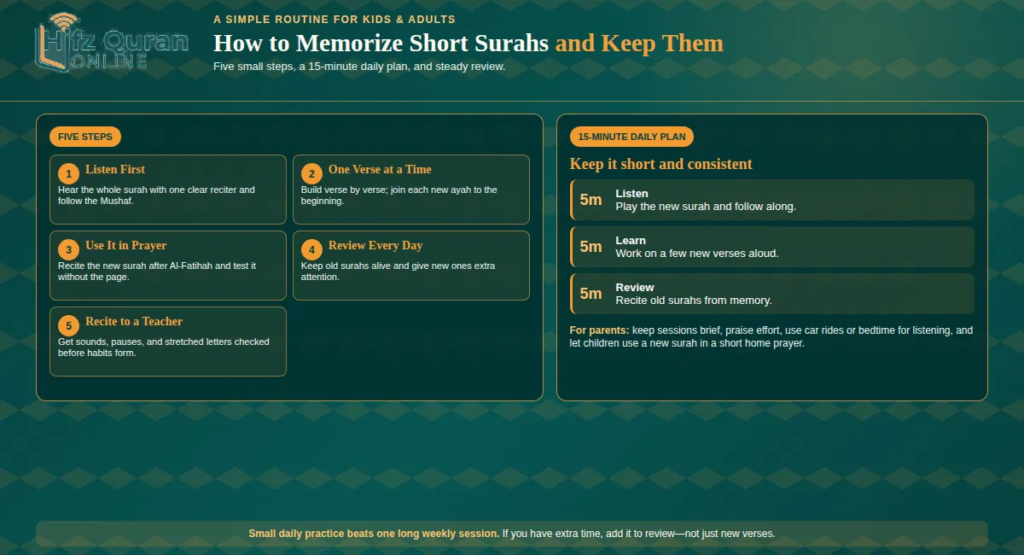
Anyone can memorize a short surah with the right daily habit. The five steps below work for kids and adults. After the steps, you will find a simple daily plan and tips for parents.
The steps take only a few minutes a day. They also build habits you will need later for longer surahs. When you are ready to go further, see our tips on how to memorize Quran fast without losing accuracy.
Step 1: Listen To The Whole Surah First
Listen to the whole surah many times before you try to say it. Play it while you get ready, drive, or cook. When you sit down to learn, follow the words with your finger as the reciter reads. Pick one good reciter and stay with that reciter, so you learn one clear way to say each word.
Listening first lets your ear learn the sounds before your tongue tries them. Slow, clear reciters are best for learners, such as the teaching recordings of Shaykh al-Husary or Shaykh al-Minshawi.
Many apps can loop one surah, so it plays again without you pressing anything. By the last few listens, try to say a word or two along with the reciter. If you do not read Arabic yet, use transliteration only as a bridge, and move to the Arabic letters as soon as you can.
Step 2: Learn One Verse At A Time
Say the first verse out loud until you can say it three times in a row with no mistakes. Then learn the second verse the same way. Now say verses one and two together. Keep adding one verse and always start again from the top.
For example, with Al-Asr you say verse 1, then verses 1 and 2, then all three. Most mistakes happen where one verse ends and the next begins, so spend extra time on those spots.
Read the meaning of each verse first, so you know what you are saying. Look at the verse while you read it, then cover the page to test yourself. If you slip, start your count again from zero.
To fix a weak join, say the last words of one verse and the first words of the next several times in a row. Stop for the day once a few verses are solid, rather than pushing on when you feel tired.
Step 3: Recite The New Surah In Your Next Prayer
Use the new surah in your very next prayer. This tests you without the page in front of you. If you stop or forget a word, go back to the surah after the prayer and fix that spot. Reciting it in prayer also turns your learning into worship right away.
A short surah fits well after Al-Fatihah in the first two rak’ahs of any prayer. Sunnah prayers are a calm place to try a surah you just learned. Recite it slowly and clearly, the same way you practiced. If you lead others in prayer, wait until the surah is strong. Over the week, try to use it in several different prayers.
Step 4: Review Your Old Surahs Every Day
Old surahs fade if you do not use them, even short ones. Each day, recite every surah you know out loud, from memory. Give your newest surahs extra attention in their first week, since they are the easiest to lose.
Once your list grows, split it across the days of the week. Recite at a calm pace, because rushing hides small mistakes. Use review time for the surahs you rarely recite in prayer. If a surah gives you trouble, review it again the next day. Review is also Quran recitation, so it brings reward too.
Step 5: Recite To A Teacher
After you learn a surah, recite it to a teacher. A teacher can hear mistakes you cannot hear yourself. Ask the teacher to check your sounds, the letters you stretch, and where you pause.
Try to recite to your teacher at least once a week. Ask about any letter that feels hard, like the deep sounds made in the throat. Write down what your teacher corrects, and fix those spots first in your next review. Before you move to a new surah, ask your teacher if the last one is ready. Be patient with corrections, because each fix now prevents a habit that could last for years.
On days without a teacher, record yourself and listen back while you read along. You can also recite to a family member who follows the text. If you do not have a teacher nearby, find out how to memorize the Quran online with a live teacher.
Mistakes To Avoid While Memorizing Short Surahs
Most mistakes in short surahs come from how people learn them, not from the surahs themselves. Here are five common ones and how to fix each.
Learning only from English letters
English letters cannot show some Arabic sounds, like ع, ح, ق, and ض. They also do not show which sounds to stretch. If you say a word wrong many times in prayer, it becomes a habit. Use English letters only for a short time, listen to a good reciter, and ask a teacher to check you early.
Dropping small words
Small words like “wa” (and), “fa” (so), and “thumma” (then) are easy to skip or swap. Missing one can change the meaning of a verse. When you review, check these small words on purpose, not just the long ones.
Learning the words without the meaning
It is harder to remember words you do not understand. Read a simple meaning of each surah before you start, like the short notes in the list above. When you know what a verse says, it is easier to remember what comes next.
Using a different copy of the Quran each time
Your eyes remember where each verse sits on the page. If you switch between different copies of the Quran, that picture changes each time. Try to use the same printed copy or the same app page every time you learn.
Moving on before a surah is solid
It feels good to learn new surahs fast, but old ones can slip away. A surah is solid when you can say it in prayer without stopping. Until then, keep practicing it before you add a new one.
Which Short Surahs To Say In Your Prayers
Once you know a few short surahs, you can use them in every prayer you pray. Some surahs also have a special place in certain prayers, which makes them worth learning early.
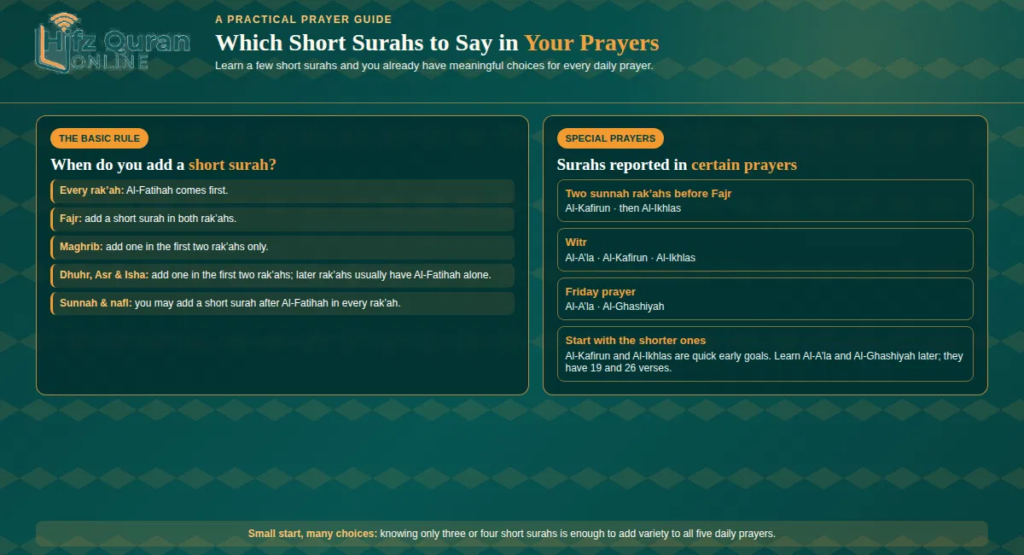
The Basic Rule For Every Prayer
Recite Al-Fatihah in every rak’ah of every prayer. In the first two rak’ahs, add a short surah or a few verses after it. One short surah, like Al-Kawthar, is enough.
In the third and fourth rak’ahs, recite only Al-Fatihah. This is what the Prophet ﷺ usually did (Sahih al-Bukhari 776).
Here is how this works in each daily prayer:
| Prayer | Number of rak’ahs | Add a short surah in |
| Fajr | 2 | Both rak’ahs |
| Dhuhr | 4 | The first 2 rak’ahs only |
| Asr | 4 | The first 2 rak’ahs only |
| Maghrib | 3 | The first 2 rak’ahs only |
| Isha | 4 | The first 2 rak’ahs only |
Memorize the Quran at Your Own Pace
Join our expert tutors and begin your Hifz journey with a personalized plan.
Start Your Free TrialLearn Short Surahs With A Teacher At Hifz Quran Online Academy
You can learn a short surah on your own. It is much harder to know if you are saying it right. Small mistakes in sounds, stretched letters, and pauses are easy to miss when no one is listening. Hifz Quran Online Academy gives you a teacher who listens to every verse, so you learn each surah the right way from the start.
Here is what you get:
- Teachers who are huffaz with ijazah. Every teacher has memorized the whole Quran, holds an ijazah, and graduated from a known Islamic university.
- One-to-one live classes. Your class is just you and your teacher, so every minute goes to your recitation and your mistakes get fixed early.
- Male and female teachers. Girls, women, and families can choose a female teacher.
- Classes at any hour. You can book classes 24/7, from 2 to 7 days a week, including weekends. This makes it easy to fit lessons around school, work, and prayer times.
- Recordings to practice with. You get recordings of skilled reciters, so you can listen to one clear voice between classes, just like step 1 in this article.
- Learn on any device. Join your class on Zoom or Skype from a computer, iPhone, or Android phone.
- A certificate when you finish. Each course comes with a certificate signed by the academy’s supervisors.
- Family discounts. Parents who enroll more than one child can save with family packages.
Parents can start their children in the Quran memorization course, which follows the same steps you read about in this article. Adults and new Muslims can begin with the surahs they need most for prayer, starting with Al-Fatihah.
Our Quran Courses
Looking for a Quran course? Check our available Quran courses.
- Quran Memorization Course
- Quran Memorization and Hifz Course for Kids
- Online Quran Memorization Courses for Adults
- Quran Hifz Course for Ladies
- Quran Memorization Course for Men
- Saudi-Based Quran Memorization Courses
- Hifz Teachers
Book your first class with Hifz Quran Online Academyand learn your first short surah this week.
Conclusion
Short surahs are the part of the Quran you will use most in your life. This list gives you 33 of them, from Al-Kawthar with 3 verses to At-Takwir with 29. You do not need all 33 to pray. Al-Fatihah and one short surah are enough for a full prayer, and every surah you add gives you more to choose from.
Start with Al-Fatihah and the first 20 surahs, one small stage at a time. Look at the number of words, not just the number of verses, when you pick your next surah.
Learn one verse at a time, say each new surah in your very next prayer, and review your old surahs every day. As you grow, learn the surahs the Prophet ﷺ chose for certain prayers, like Al-Kafirun and Al-Ikhlas for the sunnah of Fajr.
Most of all, do not learn alone for too long. A teacher can hear the small mistakes you cannot hear yourself and help you fix them before they become habits. With steady practice and the right help, a list of 33 names becomes 33 surahs you can say with confidence in every prayer.
FAQs
Searching for more information about the shortest surahs in the Quran, read these questions and answers.
What Is The Shortest Surah In The Quran?
The shortest surah in the Quran is Al-Kawthar (108). It has 3 verses and about 10 words. Al-Asr and An-Nasr also have 3 verses, but they have more words.
How Many Short Surahs Do I Need For Prayer?
To pray, you need Al-Fatihah and at least one short surah, like Al-Ikhlas. Learning 10 to 20 short surahs lets you use a different surah in each prayer.
What Are The 30 Short Surahs Of The Quran?
The 30 short surahs are usually Al-Fatihah plus the shortest surahs of Juz Amma. On this page, they are all 33 surahs except Al-Inshiqaq, Al-Ghashiyah, and At-Takwir.
Can I Say Short Surahs In Any Order In Prayer?
Yes. Most scholars say your prayer counts even if the order is mixed. Following the order of the Quran is still better, and some scholars do not like the reverse order.
Is Al-Fatihah A Short Surah?
Yes. Al-Fatihah has 7 verses, so it is a short surah. It is also the one surah you must say in every rak’ah.
Which Short Surah Has The Most Reward?
Al-Ikhlas has a very special reward. The Prophet ﷺ said it is equal to one third of the Quran (Sahih al-Bukhari 5013). It is also one of the easiest surahs to learn.
Related Articles
Memorizing Quran





Leave a Reply