 Memorizing Quran

Every Muslim wants to carry some of the Quran in their heart. But with 114 surahs, it can be hard to know where to begin. Should you start with the short ones? The ones with the biggest reward? The ones you need for prayer?
This guide gives you a clear place to start and a simple path to follow. You will find the 10 most important surahs in the Quran, the reason for their order, and the proof from the Sunnah behind each one. You will also learn how to memorize them in a way that lasts.
1. Al-Fatihah: The Greatest Surah in the Quran
Al-Fatihah (Surah 1) has seven verses and opens the Quran. Every Muslim starts here.
The Prophet ﷺ said:
«لَا صَلَاةَ لِمَنْ لَمْ يَقْرَأْ بِفَاتِحَةِ الْكِتَابِ»
“There is no prayer for a person who does not recite Al-Fatihah.”
(Sahih al-Bukhari 756, Sahih Muslim 394)
He also called it the greatest surah in the Quran:
«لَأُعَلِّمَنَّكَ سُورَةً هِيَ أَعْظَمُ السُّوَرِ فِي الْقُرْآنِ… الْحَمْدُ لِلَّهِ رَبِّ الْعَالَمِينَ»
“I will teach you a surah that is the greatest surah in the Quran… Al-ḥamdu lillāhi rabbil-‘ālamīn.”
(Sahih al-Bukhari 4474)
Allah calls it “the seven often-repeated verses” in the Quran itself:
(وَلَقَدْ آتَيْنَاكَ سَبْعًا مِّنَ الْمَثَانِي وَالْقُرْآنَ الْعَظِيمَ)
“And We have given you seven of the often-repeated verses and the great Quran.”
(Quran 15:87)
In a hadith qudsi, Allah says He answers His servant after each verse of Al-Fatihah recited in prayer:
«قَسَمْتُ الصَّلَاةَ بَيْنِي وَبَيْنَ عَبْدِي نِصْفَيْنِ، وَلِعَبْدِي مَا سَأَلَ، فَإِذَا قَالَ الْعَبْدُ: الْحَمْدُ لِلَّهِ رَبِّ الْعَالَمِينَ، قَالَ اللَّهُ تَعَالَى: حَمِدَنِي عَبْدِي»
“I have divided the prayer between Myself and My servant into two halves, and My servant will have what he asks for. When the servant says, ‘All praise is for Allah, Lord of the worlds,’ Allah says, ‘My servant has praised Me.’”
(Sahih Muslim 395)
You recite it at least 17 times a day in the five prayers. That means a small mistake also gets repeated 17 times a day. Take extra care with sounds English speakers find hard, like the “ḥ” in al-ḥamd and the “ḍ” in aḍ-ḍāllīn.
Say these sounds slowly until they feel natural. It also helps to pause briefly at the end of each verse, the way the Prophet ﷺ recited it:
«كَانَ رَسُولُ اللَّهِ ﷺ يُقَطِّعُ قِرَاءَتَهُ، يَقْرَأُ: الْحَمْدُ لِلَّهِ رَبِّ الْعَالَمِينَ، ثُمَّ يَقِفُ، الرَّحْمَنِ الرَّحِيمِ، ثُمَّ يَقِفُ»
“The Messenger of Allah ﷺ would recite verse by verse. He would say, ‘All praise is for Allah, Lord of the worlds,’ then pause. Then, ‘The Most Merciful, the Most Kind,’ then pause.”
(Jami’ at-Tirmidhi 2927, Sunan Abi Dawud 4001)
2. Al-Ikhlas: Equal to One Third of the Quran
Al-Ikhlas (Surah 112) has four verses about the oneness of Allah. It is the shortest surah on this list, and most people can learn it in one sitting.
The Prophet ﷺ said Al-Ikhlas is equal to one third of the Quran:
«قُلْ هُوَ اللَّهُ أَحَدٌ تَعْدِلُ ثُلُثَ الْقُرْآنِ»
“Say, He is Allah, the One, is equal to one third of the Quran.”
(Sahih Muslim 811)
«وَالَّذِي نَفْسِي بِيَدِهِ، إِنَّهَا لَتَعْدِلُ ثُلُثَ الْقُرْآنِ»
“By the One in whose hand my soul is, it is equal to one third of the Quran.”
(Sahih al-Bukhari 5013)
One companion recited it often because he loved how it describes Allah. When the others asked him why, he said:
«لِأَنَّهَا صِفَةُ الرَّحْمَنِ، وَأَنَا أُحِبُّ أَنْ أَقْرَأَ بِهَا»
“Because it describes the Most Merciful, and I love to recite it.”
The Prophet ﷺ replied:
«أَخْبِرُوهُ أَنَّ اللَّهَ يُحِبُّهُ»
“Tell him that Allah loves him.”
(Sahih al-Bukhari 7375)
Because it is so short, it is often the first surah people learn after Al-Fatihah. Once you know it, you can recite it in your next prayer.
3. Al-Falaq: Protection from Outside Harm
Al-Falaq (Surah 113) has five verses. It asks Allah to protect you from harm that comes from outside, such as magic and envy:
(وَمِن شَرِّ النَّفَّاثَاتِ فِي الْعُقَدِ وَمِن شَرِّ حَاسِدٍ إِذَا حَسَدَ)
“And from the evil of those who blow on knots, and from the evil of an envier when he envies.”
(Quran 113:4–5)
The Prophet ﷺ said no verses like Al-Falaq and An-Nas had ever been seen:
«أَلَمْ تَرَ آيَاتٍ أُنْزِلَتِ اللَّيْلَةَ لَمْ يُرَ مِثْلُهُنَّ قَطُّ؟ قُلْ أَعُوذُ بِرَبِّ الْفَلَقِ، وَقُلْ أَعُوذُ بِرَبِّ النَّاسِ»
“Have you not seen the verses sent down tonight? Nothing like them has ever been seen: Say, I seek refuge in the Lord of daybreak, and Say, I seek refuge in the Lord of mankind.”
(Sahih Muslim 814)
He also said that reciting Al-Ikhlas, Al-Falaq, and An-Nas three times in the morning and three times in the evening is enough to protect you from everything:
«قُلْ: قُلْ هُوَ اللَّهُ أَحَدٌ وَالْمُعَوِّذَتَيْنِ حِينَ تُمْسِي وَحِينَ تُصْبِحُ ثَلَاثَ مَرَّاتٍ، تَكْفِيكَ مِنْ كُلِّ شَيْءٍ»
“Say Qul huwa Allahu ahad and the two surahs of refuge three times in the evening and in the morning. They will be enough for you against everything.”
(Sunan Abi Dawud 5082)
You can start this morning and evening habit as soon as you know these three surahs. It takes only a few minutes a day.
4. An-Nas: Protection from the Whispers of Shaytan
An-Nas (Surah 114) has six verses. It asks Allah to protect you from the whispers of Shaytan, the harm that comes from inside your own heart and mind:
(مِن شَرِّ الْوَسْوَاسِ الْخَنَّاسِ الَّذِي يُوَسْوِسُ فِي صُدُورِ النَّاسِ)
“From the evil of the whisperer who withdraws, who whispers into the hearts of people.”
(Quran 114:4-5)
Every night before sleep, the Prophet ﷺ blew into his hands, recited Al-Ikhlas, Al-Falaq, and An-Nas, and wiped over his body:
«كَانَ إِذَا أَوَى إِلَى فِرَاشِهِ كُلَّ لَيْلَةٍ جَمَعَ كَفَّيْهِ، ثُمَّ نَفَثَ فِيهِمَا، فَقَرَأَ فِيهِمَا: قُلْ هُوَ اللَّهُ أَحَدٌ، وَقُلْ أَعُوذُ بِرَبِّ الْفَلَقِ، وَقُلْ أَعُوذُ بِرَبِّ النَّاسِ، ثُمَّ يَمْسَحُ بِهِمَا مَا اسْتَطَاعَ مِنْ جَسَدِهِ… يَفْعَلُ ذَلِكَ ثَلَاثَ مَرَّاتٍ»
“Every night when he went to bed, he would put his palms together, blow into them, and recite Qul huwa Allahu ahad, Qul a’udhu bi rabbil-falaq, and Qul a’udhu bi rabbin-nas. Then he would wipe as much of his body as he could with them… He did this three times.”
(Sahih al-Bukhari 5017)
He also told Uqbah ibn Amir to recite the surahs of refuge after every prayer:
«أَمَرَنِي رَسُولُ اللَّهِ ﷺ أَنْ أَقْرَأَ بِالْمُعَوِّذَاتِ دُبُرَ كُلِّ صَلَاةٍ»
“The Messenger of Allah ﷺ told me to recite the surahs of refuge after every prayer.”
(Sunan Abi Dawud 1523)
Since you will usually recite these three surahs together, learn them as a set. Practice them in the same order each time, so moving from one to the next feels smooth.
5. Al-Kafirun: The Surah of Clear Faith
Al-Kafirun (Surah 109) has six verses about holding firm to your faith.
The Prophet ﷺ told a companion to recite it before sleep. He said it frees a person from shirk, which means worshipping anything besides Allah:
«اقْرَأْ: قُلْ يَا أَيُّهَا الْكَافِرُونَ، ثُمَّ نَمْ عَلَى خَاتِمَتِهَا، فَإِنَّهَا بَرَاءَةٌ مِنَ الشِّرْكِ»
“Recite Qul ya ayyuhal-kafirun, then sleep at its end, for it frees you from shirk.”
(Sunan Abi Dawud 5055, graded sahih by al-Albani)
He also recited it with Al-Ikhlas in the two rak’ahs after circling the Ka’bah:
«كَانَ يَقْرَأُ فِي الرَّكْعَتَيْنِ: قُلْ هُوَ اللَّهُ أَحَدٌ، وَقُلْ يَا أَيُّهَا الْكَافِرُونَ»
“In the two rak’ahs, he would recite Qul huwa Allahu ahad and Qul ya ayyuhal-kafirun.”
(Sahih Muslim 1218)
He recited them together in the two Sunnah rak’ahs after Maghrib as well:
«مَا أُحْصِي مَا سَمِعْتُ رَسُولَ اللَّهِ ﷺ يَقْرَأُ فِي الرَّكْعَتَيْنِ بَعْدَ الْمَغْرِبِ وَفِي الرَّكْعَتَيْنِ قَبْلَ صَلَاةِ الْفَجْرِ بِقُلْ يَا أَيُّهَا الْكَافِرُونَ وَقُلْ هُوَ اللَّهُ أَحَدٌ»
“I cannot count how many times I heard the Messenger of Allah ﷺ recite Qul ya ayyuhal-kafirun and Qul huwa Allahu ahad in the two rak’ahs after Maghrib and the two rak’ahs before Fajr.”
(Jami’ at-Tirmidhi 431)
In Witr, he recited Al-A’la, Al-Kafirun, and Al-Ikhlas:
«كَانَ رَسُولُ اللَّهِ ﷺ يُوتِرُ بِسَبِّحِ اسْمَ رَبِّكَ الْأَعْلَى، وَقُلْ لِلَّذِينَ كَفَرُوا، وَاللَّهُ الْوَاحِدُ الصَّمَدُ»
“The Messenger of Allah ﷺ used to pray Witr with Sabbih isma rabbikal-a’la, Qul ya ayyuhal-kafirun, and Qul huwa Allahu ahad.”
(Sunan Abi Dawud 1423)
If you add Al-A’la (Surah 87) to your list, you can pray Witr the same way.
The surah repeats some phrases. That makes it quick to learn, but also easy to mix up:
(لَا أَعْبُدُ مَا تَعْبُدُونَ وَلَا أَنتُمْ عَابِدُونَ مَا أَعْبُدُ وَلَا أَنَا عَابِدٌ مَّا عَبَدتُّمْ وَلَا أَنتُمْ عَابِدُونَ مَا أَعْبُدُ)
“I do not worship what you worship. Nor do you worship what I worship. Nor will I worship what you have worshipped. Nor will you worship what I worship.”
(Quran 109:2-5)
Pay attention to which phrase comes first in each line. Notice that verse 4 says “‘ābidun mā ‘abadtum,” not “a’budu mā ta’budūn,” which is the line people mix up most.
Read also: How to Memorize Surah Al-Kafirun
6. Al-Mulk: The Surah that Speaks Up for Its Reader
Al-Mulk (Surah 67) has thirty verses. It is about Allah’s control over all things and life as a test, and both ideas appear in its opening verses:
(تَبَارَكَ الَّذِي بِيَدِهِ الْمُلْكُ وَهُوَ عَلَىٰ كُلِّ شَيْءٍ قَدِيرٌ الَّذِي خَلَقَ الْمَوْتَ وَالْحَيَاةَ لِيَبْلُوَكُمْ أَيُّكُمْ أَحْسَنُ عَمَلًا ۚ وَهُوَ الْعَزِيزُ الْغَفُورُ)
“Blessed is He in whose hand is all control, and He has power over all things. He created death and life to test which of you is best in deeds. He is the Almighty, the Forgiving.”
(Quran 67:1-2)
The Prophet ﷺ said a surah of thirty verses spoke up for a man until he was forgiven:
«إِنَّ سُورَةً مِنَ الْقُرْآنِ ثَلَاثُونَ آيَةً شَفَعَتْ لِرَجُلٍ حَتَّى غُفِرَ لَهُ، وَهِيَ سُورَةُ تَبَارَكَ الَّذِي بِيَدِهِ الْمُلْكُ»
“There is a surah in the Quran of thirty verses that interceded for a man until he was forgiven. It is the surah Tabarakalladhi biyadihil-mulk.”
(Jami’ at-Tirmidhi 2891, Sunan Abi Dawud 1400)
Tabarak is another name for Al-Mulk. A report from Ibn Mas’ud also describes it as the surah that protects from punishment in the grave:
«مَنْ قَرَأَ تَبَارَكَ الَّذِي بِيَدِهِ الْمُلْكُ كُلَّ لَيْلَةٍ مَنَعَهُ اللَّهُ عَزَّ وَجَلَّ بِهَا مِنْ عَذَابِ الْقَبْرِ، وَكُنَّا فِي عَهْدِ رَسُولِ اللَّهِ ﷺ نُسَمِّيهَا الْمَانِعَةَ»
“Whoever recites Tabarakalladhi biyadihil-mulk every night, Allah will protect him by it from the punishment of the grave. In the time of the Messenger of Allah ﷺ, we used to call it al-Māni’ah (the protector).”
(An-Nasa’i, ‘Amal al-Yawm wal-Laylah 711)
Learn a few verses a day. Each night before bed, recite all the verses you know so far. That way, your review becomes part of your nightly routine.
7. As-Sajdah: A Surah of the Night and of Friday
As-Sajdah (Surah 32) has thirty verses. It is about creation, the Day of Judgment, and the humble believer. The surah gets its name from verse 15, which describes believers falling down in prostration:
(إِنَّمَا يُؤْمِنُ بِآيَاتِنَا الَّذِينَ إِذَا ذُكِّرُوا بِهَا خَرُّوا سُجَّدًا وَسَبَّحُوا بِحَمْدِ رَبِّهِمْ وَهُمْ لَا يَسْتَكْبِرُونَ)
“Only those believe in Our verses who, when they are reminded of them, fall down in prostration and glorify the praise of their Lord, and they are not arrogant.”
(Quran 32:15)
The Prophet ﷺ would not sleep until he recited As-Sajdah and Al-Mulk:
«كَانَ النَّبِيُّ ﷺ لَا يَنَامُ حَتَّى يَقْرَأَ: الم تَنْزِيلُ، وَتَبَارَكَ الَّذِي بِيَدِهِ الْمُلْكُ»
“The Prophet ﷺ would not sleep until he recited Alif Lam Mim Tanzil and Tabarakalladhi biyadihil-mulk.”
(Jami’ at-Tirmidhi 2892)
In Fajr on Friday, he recited As-Sajdah and Al-Insan:
«كَانَ النَّبِيُّ ﷺ يَقْرَأُ فِي الْجُمُعَةِ فِي صَلَاةِ الْفَجْرِ: الم تَنْزِيلُ السَّجْدَةَ، وَهَلْ أَتَى عَلَى الْإِنْسَانِ حِينٌ مِنَ الدَّهْرِ»
“On Friday, in the Fajr prayer, the Prophet ﷺ used to recite Alif Lam Mim Tanzil As-Sajdah and Hal ata ‘alal-insani hinun minad-dahr.”
(Sahih al-Bukhari 891)
Many learners finish Al-Mulk first, then start As-Sajdah. Since both are recited at night, you can add new verses of As-Sajdah to the same bedtime routine.
8. Al-Kahf: the Surah of Fridays
Al-Kahf (Surah 18) has 110 verses. The Prophet ﷺ said whoever memorizes its first ten verses will be protected from the Dajjal:
«مَنْ حَفِظَ عَشْرَ آيَاتٍ مِنْ أَوَّلِ سُورَةِ الْكَهْفِ عُصِمَ مِنَ الدَّجَّالِ»
“Whoever memorizes ten verses from the beginning of Surah Al-Kahf will be protected from the Dajjal.”
(Sahih Muslim 809)
Another narration of the same hadith says “from the end of Al-Kahf,” so some people learn both. Begin with the first ten. In a long hadith about the Dajjal, the Prophet ﷺ said that whoever meets him should recite the opening verses of Al-Kahf over him:
«فَمَنْ أَدْرَكَهُ مِنْكُمْ فَلْيَقْرَأْ عَلَيْهِ فَوَاتِحَ سُورَةِ الْكَهْفِ»
“Whoever of you meets him, let him recite over him the opening verses of Surah Al-Kahf.”
(Sahih Muslim 2937)
A separate hadith promises light between two Fridays for whoever reads Al-Kahf on Friday:
«مَنْ قَرَأَ سُورَةَ الْكَهْفِ فِي يَوْمِ الْجُمُعَةِ أَضَاءَ لَهُ مِنَ النُّورِ مَا بَيْنَ الْجُمُعَتَيْنِ»
“Whoever reads Surah Al-Kahf on Friday, light will shine for him between the two Fridays.”
(Al-Hakim 3392, graded sahih by al-Albani in Sahih al-Jami’ 6470)
Once, a companion was reciting Al-Kahf when a cloud came down over him. The Prophet ﷺ said it was peace sent down because of the Quran:
«تِلْكَ السَّكِينَةُ تَنَزَّلَتْ بِالْقُرْآنِ»
“That was tranquility (sakīnah), which came down because of the Quran.”
(Sahih al-Bukhari 5011)
The surah tells four stories: the young men of the cave, the owner of two gardens, Musa and al-Khidr, and Dhul-Qarnayn. Scholars explain that they show four tests people face: in faith, wealth, knowledge, and power.
Each story is its own section, so you can memorize the surah one story at a time. Read the whole surah from the mushaf each Friday while you memorize it slowly. Week by week, the later verses will feel familiar before you even start them.
9. Al-Baqarah: The Longest Surah in the Quran
Al-Baqarah (Surah 2) has 286 verses, more than any other surah. The Prophet ﷺ said Shaytan runs away from a house where Al-Baqarah is recited:
«لَا تَجْعَلُوا بُيُوتَكُمْ مَقَابِرَ، إِنَّ الشَّيْطَانَ يَنْفِرُ مِنَ الْبَيْتِ الَّذِي تُقْرَأُ فِيهِ سُورَةُ الْبَقَرَةِ»
“Do not make your houses into graves. Shaytan runs away from the house in which Surah Al-Baqarah is recited.”
(Sahih Muslim 780)
Inside it are two short passages with their own reward. The first is Ayat al-Kursi:
(اللَّهُ لَا إِلَٰهَ إِلَّا هُوَ الْحَيُّ الْقَيُّومُ ۚ لَا تَأْخُذُهُ سِنَةٌ وَلَا نَوْمٌ…)
“Allah, there is no god but Him, the Ever-Living, the Sustainer of all. Neither drowsiness nor sleep overtakes Him…”
(Quran 2:255)
The Prophet ﷺ asked Ubayy ibn Ka’b which verse in the Book of Allah is the greatest. When Ubayy answered with Ayat al-Kursi, the Prophet ﷺ struck his chest and said:
«وَاللَّهِ لِيَهْنِكَ الْعِلْمُ أَبَا الْمُنْذِرِ»
“By Allah, may knowledge bring you joy, Abul-Mundhir!”
(Sahih Muslim 810)
The second passage is the last two verses of the surah:
(آمَنَ الرَّسُولُ بِمَا أُنزِلَ إِلَيْهِ مِن رَّبِّهِ وَالْمُؤْمِنُونَ…)
“The Messenger believes in what was sent down to him from his Lord, and so do the believers…”
(Quran 2:285-286)
The Prophet ﷺ said they are enough for whoever recites them at night:
«مَنْ قَرَأَ بِالْآيَتَيْنِ مِنْ آخِرِ سُورَةِ الْبَقَرَةِ فِي لَيْلَةٍ كَفَتَاهُ»
“Whoever recites the last two verses of Surah Al-Baqarah at night, they will be enough for him.”
(Sahih al-Bukhari 5009)
You do not have to finish Al-Baqarah to learn these passages. Add them as soon as you know the short daily surahs. Then recite Ayat al-Kursi after your prayers and the last two verses before sleep.
The full surah takes time and patience. Most people begin it after the first seven surahs on this list feel strong.
10. Aal-Imran: The Second of the “Two Bright Ones”
Aal-Imran (Surah 3) has 200 verses. It is named after the family of Imran, and it tells the story of Maryam’s birth, which begins with her mother’s prayer:
(إِذْ قَالَتِ امْرَأَتُ عِمْرَانَ رَبِّ إِنِّي نَذَرْتُ لَكَ مَا فِي بَطْنِي مُحَرَّرًا فَتَقَبَّلْ مِنِّي ۖ إِنَّكَ أَنتَ السَّمِيعُ الْعَلِيمُ)
“When the wife of Imran said, ‘My Lord, I have vowed to You what is in my womb, devoted to Your service, so accept it from me. You are the All-Hearing, the All-Knowing.’”
(Quran 3:35)
It also tells the story of the Battle of Uhud, starting at verse 121:
(وَإِذْ غَدَوْتَ مِنْ أَهْلِكَ تُبَوِّئُ الْمُؤْمِنِينَ مَقَاعِدَ لِلْقِتَالِ ۗ وَاللَّهُ سَمِيعٌ عَلِيمٌ)
“And remember when you left your family in the early morning to place the believers in their positions for battle. Allah is All-Hearing, All-Knowing.”
(Quran 3:121)
The Prophet ﷺ called Al-Baqarah and Aal-Imran “the two bright ones.” He said they will come on the Day of Judgment like two clouds, pleading for the one who recited them:
«اقْرَءُوا الزَّهْرَاوَيْنِ: الْبَقَرَةَ وَسُورَةَ آلِ عِمْرَانَ، فَإِنَّهُمَا تَأْتِيَانِ يَوْمَ الْقِيَامَةِ كَأَنَّهُمَا غَمَامَتَانِ، أَوْ كَأَنَّهُمَا غَيَايَتَانِ، أَوْ كَأَنَّهُمَا فِرْقَانِ مِنْ طَيْرٍ صَوَافَّ، تُحَاجَّانِ عَنْ أَصْحَابِهِمَا»
“Recite the two bright ones, Al-Baqarah and Surah Aal-Imran. On the Day of Judgment, they will come like two clouds, or two shades, or two flocks of birds in rows, pleading for those who recited them.”
(Sahih Muslim 804)
Since he named the two together, many learners memorize Aal-Imran right after Al-Baqarah. By then, you already have a strong daily habit, which makes a long surah easier to manage.
Why Do These Surahs Come In This Order?
The list follows three simple ideas. Together, they help you spend your time on the surahs that matter most right now. This order is a guide, not a fixed rule from the Sharia. You can change it to fit your life. For example, someone who leads prayer at home may need more surahs early on.
A new Muslim may want to focus only on prayer needs at first. Starting with surahs you will use right away also keeps you motivated, since you see the benefit every day.
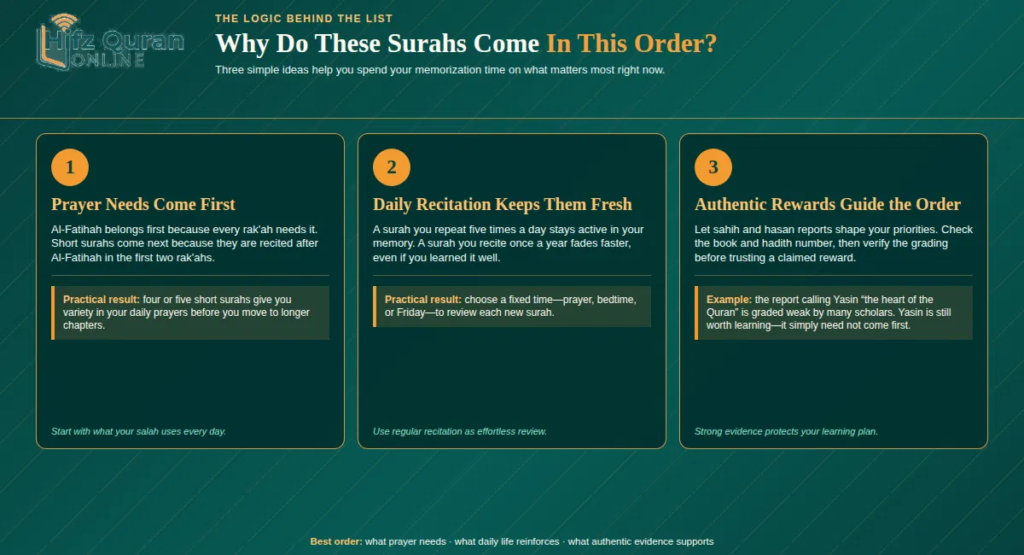
Reason 1: Learn the Surahs Your Prayer Needs First
Every rak’ah needs Al-Fatihah, so nothing should come before it. Short surahs are next, because it is Sunnah to recite a surah after Al-Fatihah in the first two rak’ahs.
With four or five short surahs, you can pray all day without repeating the same one each time. Long surahs add great reward, but your prayer is complete without them. That is why they can wait.
Short surahs from the end of the Quran are the easiest place to begin. Most have only a few short ayat, so you can learn one quickly and use it in your very next prayer.
Having several ready also lets you follow another Sunnah: making the first rak’ah a little longer than the second. You can do this by reciting a longer short surah first and a shorter one after it. Until you learn your first surah, remember that your prayer is still valid with Al-Fatihah alone.
Reason 2: Surahs You Recite Every Day Are Easier To Remember
A surah you recite five times a day stays fresh in your mind. One you recite once a year fades fast, even if you learned it well. Short surahs and night surahs come early for this reason. Each time you recite them, you review them without extra work. Before you pick a new surah, choose a set time to recite it, like a daily prayer, bedtime, or Friday.
Linking a new surah to something you already do makes the habit easy to keep. You do not have to find extra time, because the review happens inside your normal day.
A long surah has no daily slot like this, so it needs its own review time in your schedule. It helps to note which surah you plan to recite in which prayer. That simple plan stops you from falling back on the same one or two surahs every time.
Reason 3: Choose Surahs With Rewards Proven in Authentic Hadith
Many rewards shared online do not come from strong hadith. Scholars grade each hadith as sahih (authentic), hasan (good), or da’if (weak). Only sahih and hasan reports should shape your order. Surah Yasin is a clear example, since the hadith calling it “the heart of the Quran” (Sunan at-Tirmidhi 2887) has been graded weak by many scholars, including al-Albani.
Yasin is still the word of Allah and worth learning, but it does not need to come before surahs with proven rewards. Some reports are even worse than weak, because scholars found them to be made up, a grade called mawdu’. These often spread through forwarded messages that give no book name or number at all.
A missing reference is a warning sign, not a small detail. When your time is limited, it makes sense to put it where the reward is sure. To check a reward yourself, look for the book name and hadith number. Then look up its grade on sunnah.com or ask a teacher.
Have a closer look inside our real classes
Watch how our teachers help children build strong recitation skills in the Quran Learning Course for Kids at Hifz Quran Online Academy. In this lesson, a young student learns to recite Surah Al-Qiyamah correctly, verse by verse, with guidance from the teacher.
Memorize the Quran at Your Own Pace
Join our expert tutors and begin your Hifz journey with a personalized plan.
Start Your Free TrialBest Surahs for Prayer: What To Recite According to the Sunnah
The Sunnah does not set one surah for each daily prayer. Any surah you recite after Al-Fatihah is valid. But for some prayers, the Prophet ﷺ had surahs he liked to recite, and following him brings extra reward.
| Prayer | What the Prophet ﷺ recited | Source |
|---|---|---|
| Two Sunnah rak’ahs before Fajr | Al-Kafirun and Al-Ikhlas | Sahih Muslim 726 |
| Jumu’ah (Friday prayer) | Al-Jumu’ah and Al-Munafiqun | Sahih Muslim 877 |
| Jumu’ah and Eid | Al-A’la and Al-Ghashiyah | Sahih Muslim 878 |
| Eid | Qaf and Al-Qamar | Sahih Muslim 891 |
| Maghrib (at times) | At-Tur | Sahih al-Bukhari 765 |
| Isha (while traveling) | At-Tin | Sahih al-Bukhari 767 |
The Sunnah for Witr and for Fajr on Friday is covered above, under Al-Kafirun and As-Sajdah. For your everyday prayers, the last ten surahs of the Quran give you plenty of choice. They run from Al-Fil (105) to An-Nas (114). Add Al-Asr (103) and Al-Qadr (97) for more.
For long night prayers, begin with Al-Mulk. As your memory grows, add parts of Al-Baqarah and Aal-Imran.
How Do You Memorize A Surah? 8 Simple Steps
To memorize a surah, listen to it, break it into small parts, and repeat each part out loud. Then check yourself the next day and once a week.
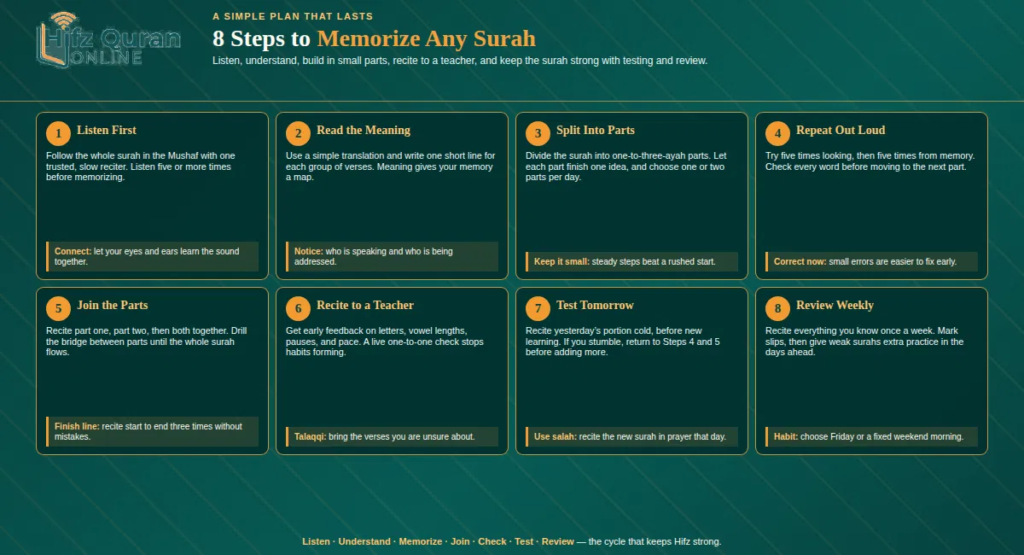
Step 1: Listen To The Surah From A Trusted Reciter
Listen to the whole surah several times from a trusted reciter, and follow along in the mushaf as you listen. At this stage, you are not trying to memorize yet. You are getting to know the sound, the rhythm, and the shape of each verse.
Choose a reciter with a slow, clear style, so every letter is easy to hear. A teaching recitation, such as Sheikh al-Husary’s muallim recitation, is made for learners. Stay with the same reciter for the whole surah, because a new voice and tune can confuse your memory.
Move your finger under each word as the reciter says it. This links what you hear to what you see on the page. If the audio feels too fast, many apps let you slow it down. Five or more full listens is a good start before moving on.
Step 2: Read A Simple Translation
Read a simple English translation of the surah, so you know what each verse means. You do not need a long tafsir book for this step. A clear, easy translation is enough to give you the main idea.
Knowing the meaning gives the surah a story you can follow. When you know what comes next in the story, the next verse is easier to recall. Pay attention to who is speaking in each verse, and who is being spoken to.
Write one short line in your own words for each group of verses. For example, “Allah is One” or “seek protection from evil.” These notes act like a map of the surah. If a verse confuses you, ask a teacher to explain it before you begin memorizing.
Step 3: Split the Surah Into Small Parts
Divide the surah into small parts of one to three verses each. Small parts are easier to learn well, and each one gives you a quick win. Trying to learn a whole page at once often leads to weak, patchy hifz.
Let the meaning guide where you split. Keep verses that finish one idea together in the same part. A very long verse can be a part all on its own, while very short verses can be grouped in threes.
Mark each part lightly in pencil in your mushaf, or write the verse numbers in a notebook. Then decide how many parts you will learn each day. Beginners often do well with one or two parts a day. Steady small steps lead further than a big start that runs out of energy.
Step 4: Repeat Each Part Out Loud
Recite the first part out loud several times while you look at the mushaf. Then close it and say the same part from memory. Saying it aloud uses your eyes, your tongue, and your ears together, so it sticks better than reading silently.
A simple pattern is five times looking, then five times from memory. If you get stuck while the mushaf is closed, open it, check the word, and start the part again from the beginning. Do not move on until you can say the part with no mistakes.
Copy the reciter’s pace from Step 1 as closely as you can. After each round from memory, check every word against the page. Small errors are much easier to fix now than after you have repeated them for a week.
For more ways to repeat and join verses quickly, see our guide on how to memorize Quran fast.
Step 5: Join the Parts Into One Surah
Once two parts are solid on their own, link them. Recite part one, then part two, then both together without a break. Add each new part the same way, until the whole surah flows as one.
The weak point is usually the gap between parts. Practice that spot by saying the last few words of one part and the first few words of the next, over and over. This builds a bridge, so you do not stop and search for the next verse.
Before you call the surah done, recite it from start to end three times in a row with no mistakes. If one join keeps breaking, go back and drill only that bridge. A surah is ready when it flows from beginning to end without effort.
Step 6: Recite The Surah To A Teacher
Recite the new surah to a teacher as soon as you can say it on your own. Early checking stops small mistakes from becoming habits. A wrong vowel repeated for a month is much harder to fix than one caught on the first day.
A teacher listens for things that are easy to miss alone. These include where each letter comes from in the mouth, the right length of long vowels, and where to pause in a verse. They can also tell you if your pace is too fast to recite clearly.
A teacher also decides when a surah is truly ready, so you do not move on too soon. Over time, they can raise or lower your daily amount to match how fast you learn. Knowing someone will hear you in the next class gives you a steady reason to practice every day.
Step 7: Test Yourself The Next Day
The next day, recite yesterday’s portion from memory before you learn anything new. This tells you how much stayed with you overnight. Sleep helps the brain store what you learned, so the next-day check shows what was truly kept.
Do this test cold, without reading or listening to the portion first. If it comes out smoothly, you are ready for your next new part. If you stumble, go back to Steps 4 and 5 for that portion before you add more.
Make a quick note of any verse that gave you trouble. Then use the new surah in one of your prayers that day. Reciting it in salah gives you an extra review and a real reason to keep it strong.
Step 8: Review Everything Once a Week
Once a week, recite everything you have memorized so far. New surahs get lots of attention, while older ones are easy to forget. A weekly review keeps every surah in your list active.
Pick a fixed day, such as Friday or a weekend morning, so the review becomes a habit. You can recite it in voluntary prayers or sit and recite it on its own. As your list grows, split the review across two or three days so it never feels too heavy.
Mark any surah where you paused or slipped. Give those surahs extra practice during the week ahead. Over time, this simple weekly check is what keeps your hifz from fading.
Step 6 is the one most people skip, because finding a teacher nearby is hard.
Hifz Quran Online Academy connects you with a qualified teacher online. You can recite your new surah from home in the same week you learn it.

How Can Beginners, Kids, And Adults Follow This Plan?
The order of the list works for everyone. What changes is how fast you move and how you practice.
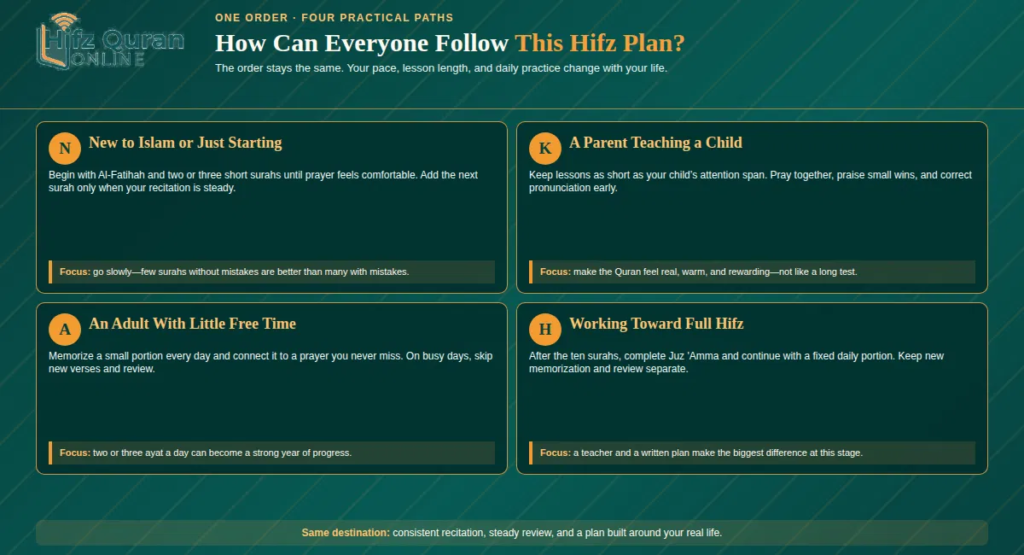
New to Islam or just starting
Focus on Al-Fatihah and two or three short surahs until your prayer feels comfortable. It can be tempting to rush ahead, so go slowly. A few surahs recited well are worth more than many recited with mistakes. When prayer feels natural, add the next short surah.
A Parent Teaching a child
Keep lessons short, about as long as your child can stay focused. Pray together at home, so your child hears the surah used in real life. Praise small wins, like one new verse or one word said correctly. Children often memorize fast. Your main job is to keep them interested and fix their pronunciation early.
An adult with little free time
A small portion every day works better than a big portion once in a while. Link your memorizing to something you never miss, like one of your daily prayers. Two or three verses a day add up to a lot over a year. On busy days, skip new verses and just review.
A small portion every day works better than a big portion once in a while. Link your memorizing to something you never miss, like one of your daily prayers. Two or three verses a day add up to a lot over a year.
On busy days, skip new verses and just review. If you doubt whether memorizing is realistic with a full schedule, read is it possible to memorize the Quran.
Working toward full Hifz
After the ten surahs, finish Juz ‘Amma, then move through the Quran with a fixed daily portion. Keep new memorizing and review as two separate parts of your day. At this stage, a teacher and a written plan make the biggest difference.
At this stage, a teacher and a written plan make the biggest difference. Through its Online Quran Memorization course, Hifz Quran Online Academy builds a plan around your level and follows your progress each week.

What Habits Make You Forget The Surahs You Memorized?
Most people forget surahs because of small habits, not because they cannot memorize. The good news is that each habit is easy to fix once you notice it. Watch out for these five:
- Switching between different prints of the mushaf. Your memory links each verse to its spot on the page, so stick with one copy.
- Reviewing only in your head. Silent review hides mistakes, so recite out loud even when you are alone.
- Taking on too much at once. A heavy portion gets skipped on busy days, so pick an amount you can finish every day.
- Mixing up verses that sound alike. Some verses in different surahs share the same words, so mark them in your mushaf and review them side by side.
- Reciting too fast. Speed makes it easy to drop words without noticing, so keep a steady pace and give every letter its right.
Each habit is easy to fix once you notice it. For a full revision system, read our guide on how to memorize Quran without forgetting.
See Our Classes in Action
Curious about what a 1-on-1 Hifz session looks like? Take a look at these real-time snippets from our daily classes to see our student-centered approach, Tajweed correction techniques, and online whiteboard tools in action.
Memorize the Quran at Your Own Pace
Join our expert tutors and begin your Hifz journey with a personalized plan.
Start Your Free TrialStart Memorizing With a Qualified Teacher At Hifz Quran Online Academy TODAY
The surahs on this list are waiting for you. The hardest part is taking the first step, and you do not have to take it alone. Here is what you get when you learn with Hifz Quran Online Academy:
- Live, one-to-one classes with a teacher who is a hafiz and holds an Ijazah
- A teacher who listens to every verse and fixes your mistakes on the spot
- A memorization plan that fits your level, so you never have to guess what to learn next
- Classes at any hour of the day, from 2 to 7 times a week
- Lessons on your phone or computer, from anywhere
- Male and female teachers, so children, sisters, and adults can all learn with comfort
Your child could learn Al-Fatihah correctly this month. You could finally finish Al-Mulk, or begin the journey to full Hifz. Every verse you learn now stays with you in every prayer, for the rest of your life.
Book your first class with Hifz Quran Online Academy today and recite your first verse to a teacher this week.

Our Quran Courses
Check our Quran memorization courses and start memorization your first surah.
- Quran Memorization Course
- Quran Memorization and Hifz Course for Kids
- Online Quran Memorization Courses for Adults
- Quran Hifz Course for Ladies
- Quran Memorization Course for Men
- Saudi-Based Quran Memorization Courses
- Hifz Teachers
Conclusion
Knowing which surahs to memorize first makes the whole journey easier. Start with Al-Fatihah, since every prayer depends on it. Next, learn Al-Ikhlas, Al-Falaq, An-Nas, and Al-Kafirun.
You will use these short surahs every day. Then move to Al-Mulk and As-Sajdah for your night routine. Later, work toward Al-Kahf, Al-Baqarah, and Aal-Imran. Along the way, learn Ayat al-Kursi and the last two verses of Al-Baqarah.
The order is simple to follow. Your prayer comes first, and the surahs you recite often come early, so they stay with you. Every surah on the list also has a reward proven in authentic hadith.
To keep what you learn, take small portions and recite them out loud. Test yourself the next day, and review everything once a week. A teacher can catch the mistakes you cannot hear.
The best time to start is before your next prayer. Pick the first surah on the list you do not know yet. Learn one verse today, and recite it tonight. Every hafiz started with small steps like these.
FAQs
These are the questions learners ask most when choosing which surahs to memorize first. Each answer is short and direct, so you can find what you need quickly.
How Long Does It Take To Memorize A Short Surah?
Most people can memorize a short surah like Al-Ikhlas or Al-Kawthar in one sitting. A longer surah like Al-Mulk usually takes a few weeks at a few verses a day.
Can I Memorize Surahs If I Don’t Speak Arabic?
Yes, you can memorize surahs without speaking Arabic. Many huffaz around the world learned the Quran before they understood Arabic. Learning to read the Arabic letters first makes it much easier.
What Should I Do If I Forget A Surah I Memorized?
If you forget a surah, go back to the mushaf and relearn the weak parts a few verses at a time. Then recite the whole surah out loud to someone until it feels secure.
What Is The Best Time Of Day To Memorize The Quran?
The best time to memorize the Quran is a time you can keep every day. Many teachers suggest early morning after Fajr, when your mind is fresh and the house is quiet.
At What Age Can A Child Start Memorizing Surahs?
A child can start memorizing surahs as soon as they can repeat short phrases, often around age three or four. At this age, listening and repeating works better than reading.
Do I Need To Learn Tajweed Before I Memorize Surahs?
You do not need to finish a Tajweed course before you memorize surahs. It helps to learn the basic rules at the same time, so you memorize each word the right way from the start.
Do I Need Wudu To Recite Surahs From Memory?
Most scholars say you can recite surahs from memory without wudu, as long as you are not in a state of major impurity. Wudu is needed to touch the mushaf, according to most scholars.






Leave a Reply