 Memorizing Quran

How to memorize Quran in 5 years is a question many Muslims ask. They want to become huffaz, but they also have jobs, school, or children to care for. Five years is a good fit for a busy life. You don’t need to quit anything to do it.
The good news is simple. Over five years, the whole Quran comes down to 5 to 10 lines a day. You study six days a week. Each day takes about 45 to 75 minutes, split into short sessions.
So why do so many people start and then stop? Most plans count ayahs, not lines. They keep the same speed for five years. And they leave review for “later.” After a year, the first surahs start to slip away, and the student gives up.
This guide fixes those problems. You’ll get a pace that grows as your memory gets stronger. You’ll get a daily schedule, a three-part review system, and a weekly test with a teacher. You’ll also learn how to deal with verses that look alike.
This is the same plan we use in one-to-one classes at Hifz Quran Online Academy. It takes you from your first line to your last review.
Step 1: Choose The 15-Line Madani Mushaf And Plan Your Hifz By Lines
The 15-line Madani mushaf is the copy most huffaz use. People also call it the Hafiz mushaf. Each juz is 20 pages, and Juz Amma is about 23. The whole Quran is 604 pages, or about 9,000 lines.
This mushaf is printed by the King Fahd Complex in Madinah, and you’ll find the same layout in mosques and homes around the world. Since every copy matches, your teacher can say “page 50,” and you both look at the same lines.
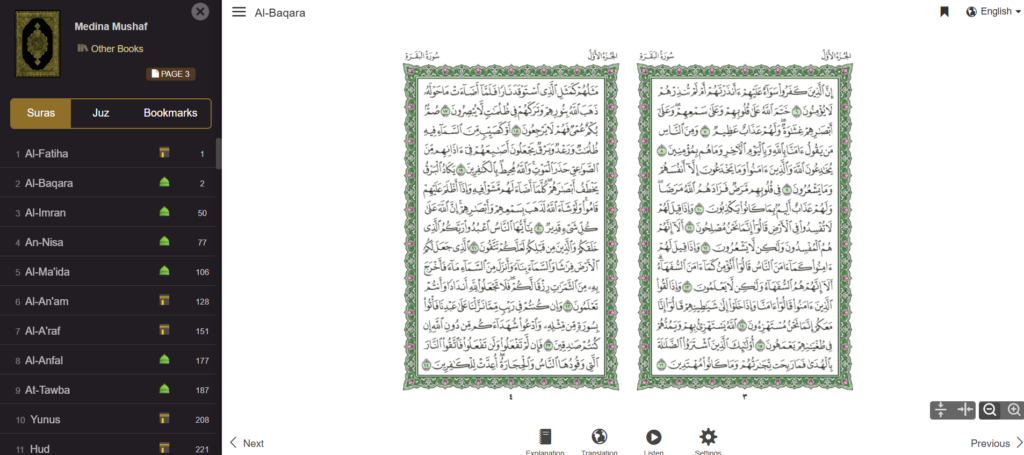
Most copies also mark each juz and hizb in the margin, which helps you see where you are. You can buy it in many sizes, from a large desk copy to a small one that fits in a bag. Choose one with print that is easy on your eyes, since you’ll read from it every day for years.
Why Counting Lines Works Better Than Counting Ayahs
Ayahs are not the same length. Some ayahs in Juz Amma are only a few words. Ayat al-Dayn in Surah Al-Baqarah fills almost a full page by itself. If you plan “3 ayahs a day,” you might get two lines one day and a whole page the next.
Lines don’t have this problem. Ten lines is always ten lines. That makes your daily goal fair and easy to track.

Look at Surah Al-Kawthar: it has three ayahs, yet it takes up less than two lines. Lines also help you plan your time. Once you know how long 5 lines take you, you can plan your whole week.
What if a long ayah runs past your line goal? Finish the ayah instead of stopping in the middle. Then take those extra lines off tomorrow’s goal.
Why You Should Use The Same Mushaf For All 5 Years
Your eyes remember where each ayah sits on the page. You may picture it at the top, or on the left side. If you switch to a new print or an app with a different layout, that memory breaks. Pick one printed copy and stay with it.
Many huffaz remember a page almost like a photo. When they get stuck, they “see” the next ayah in their mind. This only works if the page always looks the same.
If you also use an app, choose one that shows the same 15-line Madani pages, and use it only for listening or quick checks. Keep your printed copy in one place, like next to your prayer mat, so it’s always ready. If it gets old or torn, buy the same print again so nothing changes.
Step 2: Follow A 4-Stage Pace – Start At 5 Lines A Day And Build Up To 10
Most huffaz don’t learn at one speed. The first months are slow because you are still building the habit. Later, your ear gets used to the words of the Quran, and you learn faster. This plan follows that path and starts from Juz Amma.
| Stage | Months | What you learn | New lines a day (6 days a week) | New pages a week | Time a day |
| 1. Foundation | 1 to 6 | Juz 30 and 29 | 5 lines | 2 pages | About 45 min |
| 2. Build | 7 to 24 | Juz 28 to 19 | 8 lines | About 3 pages | About 60 min |
| 3. Grow | 25 to 48 | Juz 18 to 1 | 10 lines | 4 pages | About 75 min |
| 4. Review | 49 to 60 | The whole Quran | No new lines | None | 60 to 75 min |
Each stage already has short breaks built in. After every juz, you stop for 3 days of review. After every 5 juz, you take a full week to review.
Stage 1 (Months 1 To 6): Juz 30 And 29 At 5 Lines A Day
This stage covers about 43 pages. Your main goal here is the habit. You want a routine you can keep for five years.
Juz Amma is a good place to begin. You already read many of its surahs in your prayers. So you get extra review without extra time.
Juz Amma has 37 surahs, from An-Naba to An-Nas, and Juz 29 adds 11 more, from Al-Mulk to Al-Mursalat. Many students start with An-Nas and work back toward An-Naba, so the surahs get longer step by step. Short surahs also give you quick wins, since you can finish a whole surah in just a few days.
Even if 5 lines starts to feel easy, keep the number the same for now. Use any spare minutes to say the lines aloud a few more times.
Stage 2 (Months 7 To 24): Juz 28 To 19 At 8 Lines A Day
This stage covers ten juz. By now, your routine feels normal, and your memory can hold more each day. You will also start to see more verses that look alike. Start a notebook for them now.
Juz 28 is made up of Madani surahs such as Al-Mujadila and Al-Hashr, which give rules for the Muslim community. As you move back toward Juz 19, you’ll reach well-known surahs like Ya-Sin,Al-Furqan, and Ash-Shu’ara. Ash-Shu’ara repeats the same pair of ayahs eight times, after its stories of the prophets, so keep count as you learn them.
This stage lasts 18 months, so it’s normal for your energy to drop somewhere in the middle. When that happens, keep your lines steady and look back at how many juz you’ve already finished.
Brothers who want a teacher for this stage can join the Quran memorization classes for men at Hifz Quran Online Academy. Your teacher raises your daily lines only when your review is strong enough to hold them.

Stage 3 (Months 25 To 48): Juz 18 To 1 At 10 Lines A Day
This stage has the longest surahs: Al-Baqarah,Aal Imran, and An-Nisa. Their ayahs are long, and the schedule is tight. If you fall behind, don’t add more lines each day. Let this stage run into year five instead.
Al-Baqarah alone fills about two and a half juz. Many of its passages deal with laws, like fasting,trade, and divorce, so knowing the topic of each passage helps you keep the order straight. When one ayah runs over several lines, learn it in short parts, then join the parts once each one is solid.
Plan lighter weeks around Ramadan, exams, or travel before they arrive. And there’s a nice reward at the end: your last new page is Al-Fatiha, the surah you already know best.
Want To Start With Al-Baqarah Instead Of Juz Amma
That works too. Just go in the other order and keep the same number of lines. The first months will feel harder, though. Al-Baqarah has longer ayahs and harder words than Juz Amma.
Some students start here because Al-Baqarah is the hardest part, and the rest feels lighter after it. Others simply want to follow the mushaf from page 1. Either way, expect slower progress on paper in the first months, and don’t let that worry you.
Ask your teacher to check your pace after your first juz, and drop to fewer lines if you need to. Whichever order you pick, keep it until you finish, because jumping between juz makes your review hard to track.
If you want to see how other timelines compare, read our guide on how long it takes to become a hafiz.
Memorize the Quran at Your Own Pace
Join our expert tutors and begin your Hifz journey with a personalized plan.
Start Your Free TrialStep 3: Split Your Day Into 3 Study Times
Short sessions spread through the day work better than one long one. Your brain needs time between sessions to lock in what you learned. Every session matches one review layer, which we explain in the next section.
| Session | What you do | Months 1 to 6 | Months 7 to 24 | Months 25 to 48 |
| After Fajr | Learn new lines | 20 min | 20 min | 25 min |
| After Dhuhr or Asr | Review recent pages | 10 min | 15 min | 15 min |
| After Maghrib or Isha | Review old pages | 15 min | 25 min | 35 min |
| Total | About 45 min | About 60 min | About 75 min |
After Fajr: Memorize Your New Lines (20 To 25 Minutes)
Your mind is fresh, and the house is quiet. Start by listening to the day’s lines for about 5 minutes. Pick a reciter with clear tajweed, like Sheikh Mahmoud Khalil Al-Husary. Our guide to the best reciter to memorize Quran can help you choose.
Then learn the lines. Once you can say them from memory, write them out by hand. Writing helps you notice small things, like an ayah that starts with “wa” and not “fa.”
The early morning also holds a special blessing, since the Prophet ﷺ asked Allah to bless his ummah in its early mornings. Sit in the same spot each day, so your body knows it’s time to study. Put your phone on silent, or leave it in another room until you finish.
Learn one line at a time. Look at it, say it without looking, and only then move to the next line. Every few lines, go back to the start and say all of them together.
Midday: Review Your Recent Pages (10 To 15 Minutes)
This session is short. You can do it on a lunch break or between classes. You can also read your recent pages in your sunnah prayers.
Say the pages from memory first, and open the mushaf only to check yourself. If you can, recite out loud, even in a soft voice at your desk. Set an alarm for this session, because a busy day can make it slip away.
Can’t open a mushaf at work? Ask a family member to follow along on a phone call while you recite. Any page you stumble on here is a good one to read again in the evening.
Evening: Review Your Old Pages (15 To 35 Minutes)
Read your old pages, best of all in your night prayers. When you pray, you have no mushaf in front of you. That is the real test of your hifz.
The last third of the night is a special time for this, as the Prophet ﷺ told us that Allah comes down to the lowest heaven then and answers those who call on Him. Don’t rush through your old pages. A steady pace lets you hear small slips you’d miss if you read too fast.
Go through your old pages in the same order every time, and mark where you stop with a ribbon or a note. If you lead your family in Maghrib or Isha, read from your old pages there too.
Before Sleep: Listen To Tomorrow’s Lines (About 5 Minutes)
Play tomorrow’s lines once or twice before bed. You aren’t learning them yet. But many students find the next morning goes much faster.
Use the same reciter you listen to after Fajr, so the sound stays the same. Follow along with your eyes in the mushaf while you listen. Don’t try to say the lines yet; just let your ears take them in.
Keep the volume low, and put the phone away as soon as you finish. Then say your evening adhkar and go to sleep, because good sleep helps your brain hold on to what you learned that day.
Step Inside Our Virtual Classrooms
Don’t just take our word for it—see how our interactive sessions work! Watch the short clips below to experience our engaging teaching methods, live teacher-student interactions, and the supportive learning environment we bring to every student.
Step 4: Review In Three Layers Every Day
The three-layer review system splits your daily review into three parts. The first is new lines, called sabaq. The second is recent pages from the last 30 days, called sabqi. The third is older pages, called manzil. You do all three every study day.
Layer 1 – New Lines (Sabaq): What You Learn Today
Before you start, read a short tafsir of the lines, such as Tafsir al-Muyassar. When you know the meaning, the words are easier to remember.
After you learn the new lines, read yesterday’s lines and today’s lines together. This links the two parts, so you don’t get stuck where one ends and the next begins.
Before you close the mushaf, say the new lines from memory three times in a row with no mistakes. If you slip even once, start the count again. Check the tajweed signs on the page as well, such as where to stretch a sound or where to stop.
A few hours later, say today’s lines once more to see if they stayed with you. Count them as done only when you can still say them the next morning.
Layer 2 – Recent Pages (Sabqi): The Last 30 Days
Recent pages are what you learned in the last 30 days. Each day, read the last 7 days in full. Then go through the rest of the 30 days bit by bit across the week.
These pages feel strong because they are new. But they are the easiest to lose. If you skip them, they can fade in a few weeks.
The Prophet ﷺ warned that the Quran slips away faster than a camel from its rope, and that is most true of new pages. Read your newest pages first each day, because they are the weakest. Go a little slower here than you do with old pages, so small gaps show up.
When you find a weak line, say it five times on its own, then read the whole page again. By day 30, each page should feel as easy as a surah you’ve known for years.
Layer 3 – Old Pages (Manzil): Everything Older Than 30 Days
Old pages are everything older than 30 days. You go through them in a cycle, so every page comes back often. The amount grows as your hifz grows:
- In months 1 to 6, review 2 to 3 pages a day.
- In months 7 to 24, review half a juz a day, which is 10 pages.
- In months 25 to 48, review three quarters of a juz a day, which is 15 pages.
- In year five, review 1 to 2 juz a day.
Split your old pages into equal daily parts, so you always know what to read. Write the plan on a card and tick off each day’s part when you finish it.
As you add more juz, it takes longer to go around once, so keep an eye on your cycle. Many teachers aim to cover all old pages in about a month or less. Read some old pages to your teacher too, because mistakes in old pages are easy to miss on your own.
The 30-Day Rule: When A Page Moves From Recent To Old
A page moves to the old layer after 30 days. But it has to pass your weekly test with one mistake or less. If it doesn’t, it stays with your recent pages for another week. This rule keeps weak pages from hiding at the back of your hifz.
Keep a simple chart with each page number and the date you learned it. When a page reaches 30 days, mark it “ready” and ask your teacher to test it that week. Pages that pass get a check mark and join your old-page cycle.
Pages that fail stay on your recent list and get a little extra time each day. Over the months, this chart also shows you which surahs are your strongest and which need more care.
Busy Day? Protect Your Review In This Order
Some days you won’t have time for everything. On those days, keep your old pages first, your recent pages second, and your new lines last. Missing new lines costs you one day. Missing old pages for weeks means you may have to learn them again.
Even on a short day, try to give your old pages 10 minutes. You can review in small bits too, like one page while you wait in line or sit in the car. If you can’t read at all, listen to your old pages on the way to work.
If busy days keep coming, lower your new lines for a while instead of cutting your review. Then raise them again once life calms down.
Step 5:Take A Test With Your Teacher Once A Week
The seventh day of the week is test day. You don’t learn new lines. Instead, you read to your teacher, who checks your hifz and writes down your mistakes. Without this check, weak pages stay hidden until you forget them in prayer.
What Your Teacher Checks In The Weekly Test (20 To 30 Minutes)
A good weekly test takes 20 to 30 minutes. Your teacher listens to the new lines from that week. Then they read the start of an ayah from an old page, and you carry on from there. They do this twice. They also check one pair of verses that look alike, and they listen for tajweed mistakes in your madd, ghunnah, and letter sounds.
Hold the test on the same day each week, so it becomes part of your routine. Don’t review just before it starts, because the goal is to see what you truly remember. Recite at your normal pace, the way you would in prayer.
If you get stuck, wait for your teacher’s hint instead of looking at the mushaf. At the end, ask for one thing to work on during the coming week.
Memorize the Quran at Your Own Pace
Join our expert tutors and begin your Hifz journey with a personalized plan.
Start Your Free TrialRead also: How to Memorize Quran in 4 Years?
How To Keep A Mistake Log
Write down each mistake in a notebook. Note three things: the page, the kind of mistake, and the date. A mistake might be a word you forgot, two verses you mixed up, or a tajweed error.
After a few weeks, you’ll see patterns. Maybe one surah keeps slipping. Maybe you make the same sound mistake again and again.
Use a small notebook just for this, or a simple sheet on your phone. Give each kind of mistake a short code, like F for a forgotten word, M for mixed-up verses, and T for tajweed. Fill in the log right after the test, while you still remember every slip.
Write down the exact word or line, not just the page, so you know what to fix. Once a month, count your mistakes and compare the total with the month before.
How to fix the mistakes in your log
Your log is only useful if each mistake leads to a clear action. Use these simple rules to decide what to do with every mistake you write down:
- If a page has 3 or more mistakes, move it back to your recent pages for a week.
- If you mix up the same two verses twice, add them to your notebook and practice them every day.
- If you make the same tajweed mistake again, fix it in your new lines first. Then fix it in your old pages as you review.
Work on each mistake within a day or two, before it sets in. Cross it off your log only after you’ve said that line right in two tests in a row. If your mistakes keep going up for two weeks, talk to your teacher about slowing your pace.
A full log is nothing to feel bad about, since it shows you exactly where to work. Ask your teacher to look over it once a month and help you plan the weeks ahead.
You can’t hear mistakes that you always make. That’s why this test needs a teacher. Sisters can join the Quran Hifz classes for sisters at Hifz Quran Online Academy, where qualified female Huffaz teach the classes and help you stay on track with your plan.

Step 6: Learn Verses That Look Alike As A Pair
Some verses show up in more than one place in the Quran with small changes. Scholars call them mutashabihat. One word may change, the order may change, or just one letter. These verses cause more mistakes than anything else in the middle years.
Examples Of Similar Verses That Students Often Mix Up
In Al-Baqarah 2:58, Allah tells Bani Israel to enter the gate bowing first, then to say “hittah.” The verse ends with “wa sanazeedul-muhsineen.” In Al-A’raf 7:161, the order is turned around, and the ending has no “wa.”
These two verses also start differently. Al-Baqarah 2:58 begins “wa idh qulna udkhulu,” while Al-A’raf 7:161 begins “wa idh qeela lahumu-skunu.”
Here is another pair. Al-Baqarah 2:35 says “wa kula minha raghadan haythu shi’tuma.” Al-A’raf 7:19 says “fa kula min haythu shi’tuma.” It uses “fa” instead of “wa,” and the word “raghadan” is not there.
A third well-known set is about Pharaoh’s people killing the sons of Bani Israel. Al-Baqarah 2:49 says “yudhabbihuna abna’akum,” and Ibrahim 14:6 adds a “wa” to make “wa yudhabbihuna. “Al-A’raf 7:141 uses a different verb, “yuqattiluna.” Changes this small are easy to miss, which is why these verses need extra care.
How To Stop Mixing Up Similar Verses
Similar verses get mixed up when your memory stores them as one verse instead of two. These four habits help you keep each verse clear and tied to its own surah:
- Keep a notebook. Write both verses side by side and underline what is different.
- When you learn the second verse, read the first one right after it.
- Link each difference to something you remember about that surah.
- Use a book that explains these verses, such as al-Kirmani’s Al-Burhan fi Tawjih Mutashabih al-Quran.
Give each surah its own color in your notebook, so the differences jump out. Make up a short rule you can say to yourself, like “raghadan stays in Al-Baqarah.” Before you start reciting, remind yourself which surah you are in, because that alone stops many slips.
Read through your list of pairs once a week, apart from your normal review. And don’t try to learn every similar verse in the Quran at once; work only on the pairs you have already reached.
The best time to work on a pair is the day you meet the second verse. If you wait until both are old pages, they are often already mixed up.
Step 7: Use The Fifth Year Only For Review
In year five, you learn no new pages. You review the whole Quran over and over. You also go back to any juz that showed up often in your mistake log. You end the year with 45 days of full review.
How To Know Your Hifz Is Complete
Your hifz is complete when you can read any juz your teacher picks, from memory, in one sitting, with no long pauses. Until then, keep reviewing.
A good final check is to recite the whole Quran to your teacher, a few juz at a time, over several weeks. Another sign is being able to lead araweeh or long night prayers with confidence. Ask your teacher to choose each juz at random, so you can’t prepare for just one part.
Some students then go on to earn an ijazah, a certificate from a teacher whose chain of teachers goes back to the Prophet ﷺ. Many families also mark the day with a small gathering to thank Allah. Finishing doesn’t mean stopping, though. The Prophet ﷺ compared the one who knows the Quran by heart to the owner of tied camels, who keeps them only as long as he keeps them tied.
Why The Plan Includes A Full Review Year
Months 25 to 48 leave very little room. Being sick, traveling, or a slow month can push you into year five. This year gives you that room, and your review stays safe.
Many hifz plans fail because they leave no space for real life. With this year built in, one lost month won’t break everything. Think of it as a safety net, not a reward for being slow.
Keep a note of any weeks you lose along the way, so you know how much of this year you’ve already used. If most of it is gone by month 48, ask your teacher how to spread out your final review.
Finished all 604 pages on time? Use the spare months to make every juz as strong as your best one. You can also practice reading several juz in a single day to build up your stamina. To compare this pace with shorter and longer plans, see our guide on how long it takes to memorize the Quran.
When To Pause New Lines And Focus Only On Review
Sometimes the best way to move forward is to stop adding new lines for a while. A pause is not a failure. It’s a normal part of hifz, and planning for it protects the pages you’ve already worked hard to learn.
Pausing new lines doesn’t mean stepping away from the Quran, since you still recite every day. Over five years, almost every student needs a few breaks like this. Spotting the signs early lets you take a short break instead of a long one.
It also stops small problems from growing into weeks of lost pages. Below, you’ll find what to look for, how long to stop, and how to get going again.
Signs You Need A Short Review Break
Watch for these signs in your daily study and weekly tests:
- Your new lines take about twice as long as usual to stick.
- You can’t finish your daily old pages, and the leftovers keep piling up.
- Several pages fail your weekly test at the same time, not just one or two.
- You start to stumble on short surahs you recite in prayer every day.
- You dread your study time, or you feel tired as soon as you open the mushaf.
One sign on its own may just mean a bad day. Two or more in the same week mean it’s time to pause.
Your mistake log can warn you too, especially if one kind of mistake suddenly shows up more often. Ask your teacher to speak up if they notice these signs, since they may see them before you do. Don’t wait for every sign to appear before you act.
An early break of a few days often saves you weeks of fixing later. Pay attention to how you feel during prayer as well, and take note if you hesitate more than usual.
Life Events That Call For A Planned Pause
Some pauses are easy to see coming. A new baby, a house move, exam season, or a long trip can all take away your study time. Instead of letting things fall apart, decide ahead of time to stop new lines and keep only your review.
Ramadan suits a planned pause too. Many students use the month to recite more of what they already know, both in night prayers and in their own reading.
Tell your teacher about big events as soon as you know about them. Together, you can pick a start date and an end date for the break. Write both dates in your planner, so the pause has a clear finish.
Hard times can also come without warning, like the loss of someone you love. In those weeks, it’s fine to cut back to just a few old pages a day, because even a little keeps your link with the Quran alive.
How Long To Pause And What To Do During It
A short pause of 3 to 7 days is enough for most warning signs. A longer pause of 2 to 4 weeks fits bigger life events or a full slowdown in your tests.
Keep your study times the same during a pause. Use the minutes you’d normally spend on new lines to work on the weakest pages in your mistake log. If you can, read those pages to your teacher more often until they feel solid again.
Set an end date before the pause starts, so a short break doesn’t drift into months. If the warning signs are still there when that date comes, add one more week and check again. Keep filling in your mistake log the whole time, so you can see whether things are getting better.
A pause is also a good chance to catch up on your old-page cycle if it has fallen behind. Some students even finish the break ahead of where they started.
How To Restart After A Pause
Don’t jump straight back to your full daily lines. For the first week, learn about half your usual amount. If your weekly test goes well, return to your normal number the week after.
Before your first new lines, recite the last page you learned before the break. This reconnects you with the place where you left off. In your first two weeks back, watch your old pages closely, since new lines will start taking time away from them again.
If old pages begin to slip, stay at half your lines for one more week. Be patient with yourself while your rhythm comes back.
When To Rebuild Your 5-Year Plan
If you keep needing long pauses, your pace may be too fast for your life right now. Sit down with your teacher and count how many months you’ve lost. If the gap is bigger than your review year, build a new plan with fewer lines a day, even if it takes six or seven years.
Allah does not burden a soul beyond what it can bear. A slower plan you can keep is better than a fast one you have to abandon.
Changing your plan simply makes it fit the life you actually have. When you choose your new number of lines, base it on the time you really have each day, not the time you wish you had. Keep the same three review layers in the new plan, and change only your new lines.
Set a date to look at the plan again in six months. If life gets easier by then, you can raise your lines and finish sooner.
Mistakes That Slow Your Hifz Down
Some habits add months or even years to a plan. Watch out for these.

Memorizing Silently Instead Of Out Loud
When you read in your head, you only use your eyes. Reading out loud also uses your ears and mouth. You remember more, and you catch sound mistakes early.
You don’t need to be loud; a clear, low voice is enough. Saying the words aloud also shows you where you rush or swallow letters. The Prophet ﷺ told us to beautify the Quran with our voices, and that starts with actually using your voice.
Try recording yourself once a week and listening back. You’ll often hear slips you never noticed while reading.
Doubling Your Lines To Catch Up After Missed Days
It’s tempting to learn twice as many lines to catch up. But both parts usually end up weaker. If you miss one day, just accept the delay. If you miss a full week, treat it as a pause and restart the way the section above explains.
Your brain can only take in so much new text in one sitting. When you push past that, the second half of the lines often fades by the next day. Then you spend extra days fixing what you rushed.
Doubling up also eats into the time for your recent and old pages. Keep to your normal number, and let the extra time built into the plan take care of the delay.
Measuring Progress By Pages Instead Of Mistakes
A student with 15 juz and lots of mistakes is behind a student with 12 strong juz. Track your weekly mistakes, not just your page count.
Page counts feel good because they are easy to see and share. A page you can’t recite clearly still needs work, even if it’s ticked off. Look at both numbers side by side each month.
When pages go up and mistakes stay low, you’re on track. When pages go up but mistakes climb too, it’s time to slow down.
Switching Teachers Or Methods Too Often
Each change starts your routine over. A new teacher also doesn’t know your weak spots yet. Choose one teacher and one method, and give them at least one full stage.
Every teacher has their own way of testing and correcting. Moving between them can leave you unsure which rules to follow. Some reasons to change are real, though, like missed classes or a teacher who rarely corrects you.
If you do switch, share your mistake log and page chart with your new teacher. That way, they can pick up right where the last one stopped.
Want to learn faster without losing what you know? Read our tips on how to memorize Quran fast.
How To Stay Consistent With Your Hifz For 5 Years
Five years is a long time. Some months you’ll feel strong, and some months you won’t. Good habits carry you through the hard months.
Motivation comes and goes, so don’t build your plan on it. Build it on routine instead, so you study even on days you don’t feel like it. Write down why you started on the first page of your notebook.
Read that reason again whenever your energy drops. The habits below can help you keep going when it does.
Study A Little Every Day Instead Of A Lot At Once
The Prophet ﷺ said that the deeds Allah loves most are the ones done often, even if they are small. This is in Sahih al-Bukhari and Sahih Muslim. Five lines a day for months will take you further than three pages a day that stop after a few weeks.
Even the Quran itself came down in parts, over time, so people could take it in slowly. A small daily goal is easy to start, even on tired days. Missing one day is simple to fix, but missing many in a row makes it hard to begin again.
Try marking each study day on a calendar. As the chain of marks grows, you’ll have one more reason not to break it.
Remember The Reward You Earn For Every Letter You Recite
Each letter you read from the Quran brings a reward, and that reward is multiplied ten times. This comes from a hadith in Jami at-Tirmidhi. Your listening, learning, and review all count.
In the same hadith, the Prophet ﷺ explained that Alif Lam Mim counts as three letters, not one. Hifz means you repeat the same ayahs hundreds of times, so this reward keeps adding up with every review.
Hard days count too. The one who reads with difficulty and struggles through it gets a double reward. And the Prophet ﷺ said the best of people are those who learn the Quran and teach it.
Get Help From Family, Friends, And Your Teacher
Learn with a family member or a friend. Give yourselves a small treat when you finish a juz. Keep your intention for Allah alone. And stay away from sins, which scholars have long said make memory weaker.
Tell a few people close to you about your goal, so they can cheer you on. Ask your family to keep the house quiet during your study times. If no one near you is doing hifz, check in with your teacher or other students between classes.
Most of all, ask Allah for help often. He has told us that He made the Quran easy to remember, so ask Him to make it easy for you.
Words are not enough?! Look and Judge
Watch how our teachers guide young learners in the Quran Memorization Course for Kids at Hifz Quran Online Academy. In this lesson, a student memorizes Surah An-Nazi’at step by step, using a simple method that makes each verse easier to remember.
Memorize the Quran at Your Own Pace
Join our expert tutors and begin your Hifz journey with a personalized plan.
Start Your Free TrialStart Your 5-Year Hifz Plan With Hifz Quran Online Academy
A plan on paper is easy. Sticking to it for five years is the hard part. A teacher who tracks your review, tests you each week, and catches your mistakes makes the difference.
When you join Hifz Quran Online Academy, you get:
- Live one-to-one classes, so your teacher hears only you and catches every mistake.
- Certified Huffaz as teachers, trained in a clear hifz method.
- A personal 5-year plan, with daily lines that fit your level and your time.
- A review system built into every class, so the start of the Quran stays as strong as the end.
- Separate classes for men, and classes for sisters taught by qualified female Huffaz.
- Tajweed correction from your very first line.
- Class times that fit your time zone, your job, and your family.
- Fair fees, and a free trial lesson so you can try before you commit.
Students in more than 40 countries already learn with us. Book your free trial lesson today and start your first 5 lines with a teacher by your side.

Our Quran Courses
Have a closer look at our available Quran courses.
- Quran Memorization Course
- Quran Memorization and Hifz Course for Kids
- Online Quran Memorization Courses for Adults
- Quran Hifz Course for Ladies
- Quran Memorization Course for Men
- Saudi-Based Quran Memorization Courses
- Hifz Teachers
Conclusion
You can memorize the Quran in 5 years even with a full and busy life. You don’t need hours each day. You need a clear pace, set study times, and review that you protect on your busiest days.
The plan starts with one 15-line mushaf and just 5 lines a day. As your memory grows, you move to 8 lines and then 10 lines. By about month 48, you have learned every page. The fifth year is for review, so sickness, travel, or exams don’t stop you from reaching your goal.
Review is what holds the plan together. Each day, you go over your new lines, your recent pages, and your old pages. Once a week, a teacher tests you and helps you turn mistakes into a short fix list. And when you meet verses that look alike, you learn them as a pair right away.
So where do you begin? Choose your mushaf. Set your three daily study times. Then learn your first 5 lines today. Keep a steady pace, read to a teacher, and keep your intention pure. Five years from now, you could be reciting the whole Quran from memory.
FAQs
Know more about your Quran 5-year plan; read the questions and answers.
Is Memorizing The Quran In 5 Years Realistic For A Working Adult?
Yes, it is realistic for a working adult to memorize the Quran in 5 years. The daily work is split into three short sessions, so it fits around your job and your prayers.
Do I Need To Understand Arabic To Memorize The Quran?
No, you don’t need to understand Arabic to memorize the Quran. Many huffaz learn it before they learn the language. Still, reading a short tafsir in your own language helps you learn faster and remember longer.
Should I Learn Tajweed Before I Start Hifz?
Yes, you should learn basic tajweed before or alongside hifz. If you say the words right from the first line, you won’t lock in mistakes that are hard to fix later.
Can A Child Memorize The Quran In 5 Years?
Yes, a child can memorize the Quran in 5 years, and many finish sooner. Children do best with short sessions at the same time each day and a teacher who fixes their sounds early.
Can Sisters Memorize The Quran Online With A Female Teacher?
Yes, sisters can memorize the Quran online with a female teacher. Hifz Quran Online Academy offers Hifz classes for ladies, taught by qualified female Huffaz, at times that fit your day.
What Should I Do If I Start Forgetting Pages I Learned?
If you start forgetting pages, stop new lines for a few days and review the weak part. Keep it with your recent pages until it passes a weekly test with one mistake or less.







Leave a Reply