 Memorizing Quran
| Key Takeaways |
| Most dedicated students complete full Quran memorization in 3 to 5 years, depending on daily time commitment and consistency. |
| Memorizing 1 page daily covers all 604 pages in approximately 3 years, including structured revision time. |
| Non-Arabic speakers typically need 30–60 extra minutes per page compared to native Arabic speakers due to pronunciation challenges. |
| The revision-to-new-memorization ratio of 5:1 is the most reliable predictor of long-term Hifz retention success. |
| Adults who begin with a certified instructor reach stable retention up to 40% faster than self-directed learners. |
How long does it take to memorize the Quran? It is the first question every sincere student asks — and the honest answer is: it depends far less on talent than on structure. After years of teaching non-Arabic speakers, I have seen students complete their Hifz in under 2 years, and others still working after 7.
The difference almost always comes down to daily consistency, a sound revision system, and proper guidance from the very first lesson.
How Long Does It Take to Memorize the Quran?
For most committed adult non-Arabic speakers dedicating 45–90 minutes daily, completing the Quran typically takes between 3 and 5 years. Children who begin between ages 7–12 often finish in 2–4 years.
For younger students, our Quran Memorization and Hifz for Kids Course pairs each child with a certified Hafiz who adjusts pacing as the child progresses through the Juz’.
Start your child’s Hifz today with a free lesson
How Many Pages Is the Quran?
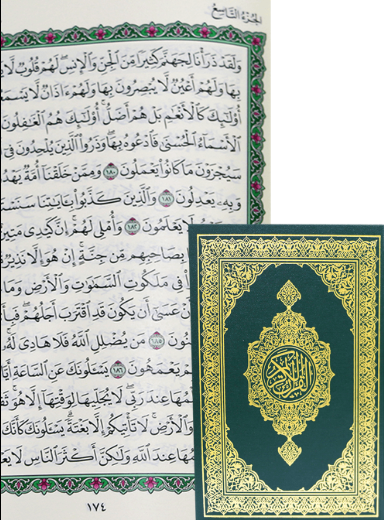
The Quran contains 604 pages across 30 Juz’ (parts), with each Juz’ averaging approximately 20 pages. This is the foundational number every student must internalize before estimating their memorization timeline.
Your daily page target, multiplied across weeks and months, produces your realistic completion date — everything else follows from this arithmetic.
Understanding the structure also prevents one of the most common planning errors I observe: students who set a daily target based on enthusiasm rather than capacity.
At Hifz Quran Online Academy, we assess each new student’s natural memorization pace in the first two weeks before assigning any fixed daily target. Starting with the right number saves months of frustration later.
The 604-page figure also assumes you are using a Hafs ‘an ‘Asim recitation Mushaf — the standard 15-line Medina Mushaf used in most structured Hifz programs worldwide. Students using different print editions should verify page counts with their instructor before building any schedule.
What Is a Realistic Daily Memorization Target for Non-Arabic Speakers?
A realistic daily memorization target for non-Arabic speakers is half a page to one full page per day — not more, especially in the first six months. This range produces between 180 and 365 new pages per year in raw memorization, which must then be balanced against structured Muraja’ah (revision) time to ensure nothing is lost from earlier portions.
If you are exploring a structured program, our Quran Memorization Course at Hifz Quran Online Academy is built specifically around this evidence-based pacing — with certified Huffaz who calibrate each student’s daily target individually.
Book a free trial to start your Hifz path today

The table below maps common daily targets to expected completion timelines, based on the Quran’s 604 pages and accounting for revision load:
| Daily New Memorization | Weekly New Pages | Estimated Completion |
| ¼ page per day | ~1.75 pages | ~7 years |
| ½ page per day | ~3.5 pages | ~3.5 years |
| 1 page per day | ~7 pages | ~2–2.5 years* |
| 1.5 pages per day | ~10.5 pages | ~1.5 years* |
| 2 pages per day | ~14 pages | ~1–1.5 years* |
These shorter timelines require intensive daily revision sessions and are realistically achievable only by full-time students or those with prior Arabic fluency.
Shots Videos from Our Courses
Memorize the Quran at Your Own Pace
Join our expert tutors and begin your Hifz journey with a personalized plan.
Start Your Free TrialHow Many Pages to Memorize the Quran in 1, 2, or 3 Years?
Completing Hifz in 1 year requires memorizing approximately 1.65 pages per day — which is demanding even for full-time students.
In 2 years, the target drops to around 0.83 pages daily, a genuinely achievable goal for motivated adults with 60–90 daily minutes available.
In 3 years, you need only 0.55 pages per day, which is the most sustainable pace for working adults and parents.
Each of these timelines has dedicated planning resources. You can review a detailed breakdown for the how to memorize the Quran in 1 year, 2-year, and 3-year plans on our blog, each with day-by-day schedule templates.
The non-negotiable principle across all timelines is the revision ratio. New memorization without equivalent revision is not Hifz — it is temporary retention. The classical standard, supported by every major memorization methodology, is reviewing 5 previously memorized pages for every 1 new page learned.
How Does Age Affect How Long Quran Memorization Takes?
Age significantly influences memorization speed but does not determine whether Hifz is achievable. Children between 7 and 12 years typically memorize faster because their brains are in peak neuroplastic development — the same verse that takes an adult 40 minutes to secure may take a child 15. However, children require more external structure and consistency from a teacher and family.
Adults bring compensating strengths: deeper comprehension, stronger motivation, and the ability to connect meaning to memorization — a technique called Tadabbur (reflection on meaning) that actually accelerates retention when applied correctly.
| Age Group | Typical Daily Capacity | Realistic Timeline |
| Children (7–12) | 0.5–1.5 pages | 2–4 years |
| Teens (13–17) | 1–2 pages | 1.5–3 years |
| Adults (18–40) | 0.5–1 page | 3–5 years |
| Adults (40+) | 0.25–0.75 pages | 4–7 years |
For adult learners, our Online Quran Memorization Courses for Adults apply a specialized methodology that accounts for adult learning psychology and working schedules.
Enroll in our Quran Memorization Course for Adults with a free trial

For a thorough discussion of how developmental stage shapes the Hifz path, see our article on the best age to memorize the Quran.
What Role Does Muraja’ah Play in Determining Your Total Timeline?
Muraja’ah — the systematic revision of previously memorized portions — is not a supplementary activity. It is the structural backbone of lasting Hifz, and failing to account for it is the single reason most students’ timelines collapse.
A student who memorizes 1 new page daily without dedicated revision will find their earlier Juz’ deteriorating within weeks.
The Prophet Muhammad ﷺ emphasized the importance of maintaining the Quran, as recorded in Sahih al-Bukhari, hadith 5033:
“Keep on reciting the Quran, for, by Him in Whose Hand my life is, it escapes (from memory) faster than a camel does from its tying ropes.”
This hadith is not a warning to discourage — it is a technical instruction about Muraja’ah frequency. The Muraja’ah-to-new-memorization ratio of 5:1 (5 revision pages for every 1 new page) is the standard most certified instructors apply.
This means that on a day when you memorize 1 new page, you should also review 5 previously memorized pages.
Practical Muraja’ah systems require careful scheduling. Our full guide on how to revise memorized Quran walks through weekly and monthly revision cycles in detail.
What Daily Schedule Allows You to Memorize the Quran Most Effectively?
The most effective daily Hifz schedule allocates Fajr time for new memorization and later prayers — particularly ‘Asr or after Isha — for Muraja’ah revision. This is not arbitrary. Students who memorize after Fajr at Hifz Quran Online Academy consistently demonstrate stronger retention in follow-up sessions compared to those who delay new memorization to evening hours. The mind is clearest immediately after sleep, before daily noise accumulates.
A sustainable 90-minute daily schedule for a working adult targeting 1 page per day might look like this:
| Time Block | Activity | Duration |
| After Fajr | New memorization (1 page) | 45 minutes |
| After ‘Asr or Isha | Muraja’ah (5 pages) | 40 minutes |
| Weekly (Friday) | Full Juz’ review | 60–90 minutes |
For complete weekly and monthly schedule templates, our Quran memorization schedule guide provides day-by-day structures matched to different daily time budgets.
Our Quran Hifz Course for Ladies also offers female-only sessions with certified female instructors.
Samples Videos from Classes
Which Factors Can Extend or Shorten Your Memorization Timeline?
Several variables directly affect how long your Hifz takes — understanding them lets you plan realistically rather than set targets that collapse under real-life pressure.
1. Does Having a Teacher Shorten the Timeline?
Yes — significantly. Self-directed memorization without a qualified instructor is the most common source of timeline extension. Tajweed errors that go uncorrected in early Juz’ must be unlearned later, which consumes weeks or months.
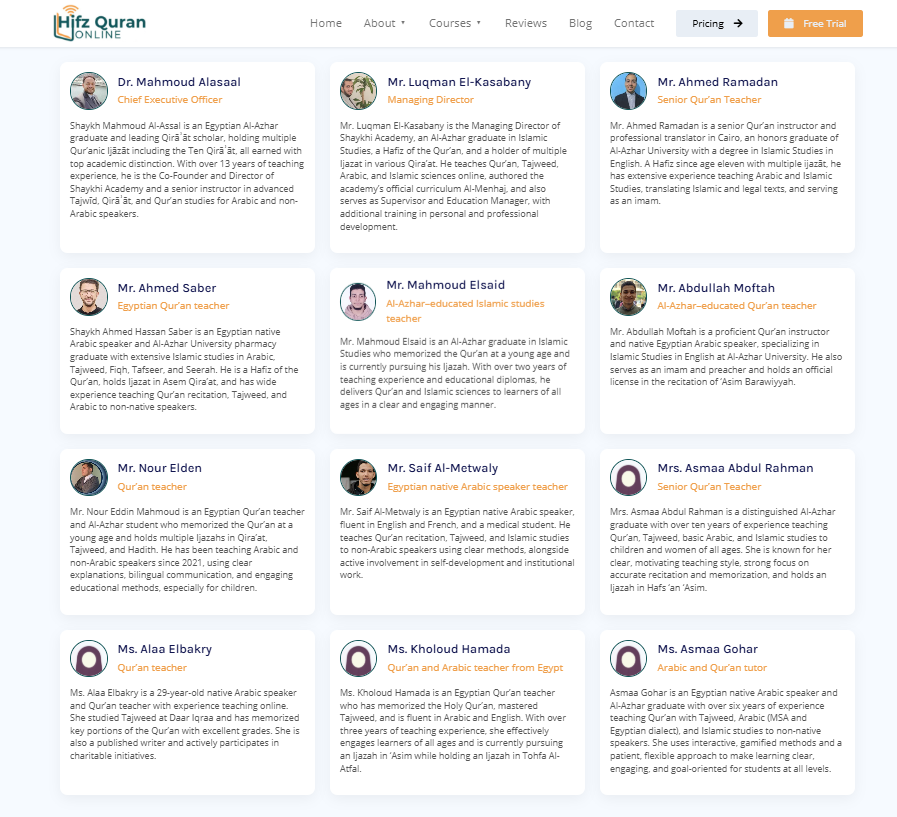
A certified Hafiz catches Makhraj (articulation point) and Sifat al-Huruf (letter characteristics) errors before they become habits.
Meet our Ijazah-certified Azhari teachers
2. Does Consistency Matter More Than Daily Volume?
Absolutely. A student who memorizes half a page every single day will outperform one who memorizes 2 pages three days per week.
Irregular memorization breaks the Rabṭ — the sequential connection between verses — and forces more re-memorization. Consistency preserves the neurological pathways that make retention durable.
3. What About Arabic Language Familiarity?
Non-Arabic speakers typically spend 30–50% more time per page than native Arabic speakers in the early Juz’. This gap narrows after the first 5–10 Juz’ as phonological familiarity builds.
Students who invest in foundational Tajweed before beginning Hifz recover this time investment within 6 months.
For absolute beginners who have not yet learned to read Arabic fluently, the Al-Menhaj Book — authored by Luqman ElKasabany and developed by instructors with 25+ years of experience — provides the proper reading foundation before Hifz begins.
Our Students Reviews
Memorize the Quran at Your Own Pace
Join our expert tutors and begin your Hifz journey with a personalized plan.
Start Your Free TrialRead Also: How Many People Have Memorised the Quran?
Start Your Quran Memorization with Expert Guidance at Hifz Quran Online Academy
Knowing your timeline is only the beginning — the right methodology and a qualified teacher determine whether that timeline holds.
Hifz Quran Online Academy offers:
- Certified Huffaz with verified credentials and structured Hifz methodology
- Personalized 1-on-1 instruction tailored to your exact pace and schedule
- Dedicated programs for adults, children, and ladies
- Flexible scheduling across all global time zones
- Structured curriculum designed specifically for non-Arabic speakers
- Free trial lesson — no commitment required
Book your free trial today and begin with a clear, realistic plan built around your life.
Choose the program that fits your needs:
- Quran Memorization Course (comprehensive Hifz for all ages)
- Quran Memorization and Hifz for Kids
- Online Quran Memorization Courses for Adults
- Quran Hifz for Ladies.
Book your free trial lesson today

Read Also: How Long Does It Take To Become A Hafiz?
Conclusion
How long it takes to memorize the Quran is ultimately determined by three things: the consistency of your daily commitment, the soundness of your revision system, and the quality of your instruction. Most non-Arabic speaking adults complete their Hifz in 3 to 5 years — not because the task is slow, but because lasting memorization requires a pace that the mind can actually sustain.
The students who finish are rarely the most gifted. They are the ones who showed up every morning after Fajr, reviewed their previous pages faithfully, and trusted a structured process over raw ambition. Insha’Allah, with the right foundation in place, that can be you.
Read Also: How Long Does It Take to Memorize the Quran and Become a Hafiz?
Frequently Asked Questions About How Long It Takes to Memorize the Quran
How long does it take to memorize the Quran for a complete beginner?
A complete beginner who cannot yet read Arabic fluently should budget 6–12 months for foundational reading and Tajweed before beginning Hifz. After that, dedicated memorization typically takes 3–5 years for non-Arabic speaking adults at a sustainable pace of half to one page daily with consistent Muraja’ah revision maintained throughout.
Can a working adult with limited time realistically complete Quran memorization?
Yes — working adults regularly complete Hifz with as little as 45–60 minutes daily, provided those minutes are structured. Memorizing a quarter-page after Fajr and reviewing 1–2 pages in the evening produces steady progress. Over 5–6 years, this disciplined minimal-time approach produces a complete, well-retained Hifz.
Is memorizing the Quran harder for non-Arabic speakers?
Non-Arabic speakers face a steeper initial curve — pronunciation, phoneme recognition, and script reading all require dedicated effort. However, this disadvantage largely disappears after the first 3–5 Juz’. Many non-Arabic speakers develop stronger conscious Tajweed awareness than native speakers precisely because they cannot rely on intuition and must learn every rule deliberately.
What is the fastest someone has memorized the Quran?
Accounts of exceptional students completing memorization in 1 year or fewer exist, but these involve full-time Hifz study — 6–8 hours daily — with constant teacher supervision. For students balancing work, family, or school, this timeline is not realistic. Instructors typically advise against rushing, as compressed timelines often produce weak retention that requires years of repair work afterward.
How do I know if I am memorizing too fast or too slow?
A reliable test: close your Mushaf and recite your most recently memorized portion from memory without hesitation. If you stumble more than twice per page, you are moving too fast. If you can recite the last 3 pages fluently without opening the Mushaf, your pace is sound. Your teacher’s weekly assessment is the most reliable ongoing indicator of sustainable progress.
Related Articles
Memorizing Quran





Leave a Reply