 Memorizing Quran

Surah Mulk memorization becomes much easier when you combine repetition, listening, understanding, small portions, and consistent revision. Surah Al-Mulk is the 67th chapter of the Quran, located in Juz 29, and contains 30 verses. Its length makes it a realistic goal for both beginners and experienced Quran learners when approached with a structured plan.
If you are wondering how to memorize Surah Mulk in one day, it is possible for someone who already has strong Quranic reading skills and can dedicate several focused hours to repetition. For most learners, however, spreading memorization across seven to fourteen days gives the verses more time to settle into long-term memory.
The goal should not simply be to finish Surah Al-Mulk once. Strong Hifz means being able to recall the verses accurately after the initial memorization, which requires daily revision alongside learning new verses.
1. Recite Surah Al-Mulk Every Night Before Sleeping
One of the simplest ways to build familiarity with Surah Al-Mulk is to make its recitation part of your nightly routine. Reading the Surah before sleeping gives you a consistent opportunity to see and hear the same verses every day.
The supplied material also highlights the well-known virtue associated with regularly reciting Surah Al-Mulk. A hadith reports that a 30-verse surah, identified as Surah Tabarak, intercedes for its companion until he is forgiven. Another narration is commonly cited regarding its protection from the punishment of the grave.
These virtues can provide meaningful motivation, but memorization should still be approached as a structured learning process. Recite the Surah attentively rather than treating the nightly reading as background repetition.
Practitioner tip: Keep the same Mushaf beside your bed and use it consistently. Familiarity with the visual position of verses can become an additional memory cue.
2. Understand the Meaning Before Memorizing
Understanding the meaning of a verse gives your memory something to connect to. Instead of treating every Arabic word as an isolated sound, learn what the verse is saying and identify the idea that connects it to the verses around it.
Surah Al-Mulk repeatedly draws attention to Allah’s dominion, creation, power, accountability, and the consequences of rejecting the truth. Recognizing these themes can help you remember why one verse follows another.
Read a reliable translation or accessible tafsir before beginning a new portion. Then briefly summarize the meaning in your own words.
This is particularly useful when you learn Surah Mulk word by word, because understanding the role of each word helps you remember its position rather than relying only on sound.
3. Repeat Each Verse at Least 5–10 Times
Repetition is one of the central techniques for Surah Mulk memorization. Begin with the first verse and repeat it several times until the wording becomes familiar. Then introduce the next verse while continuing to recite the previous one.
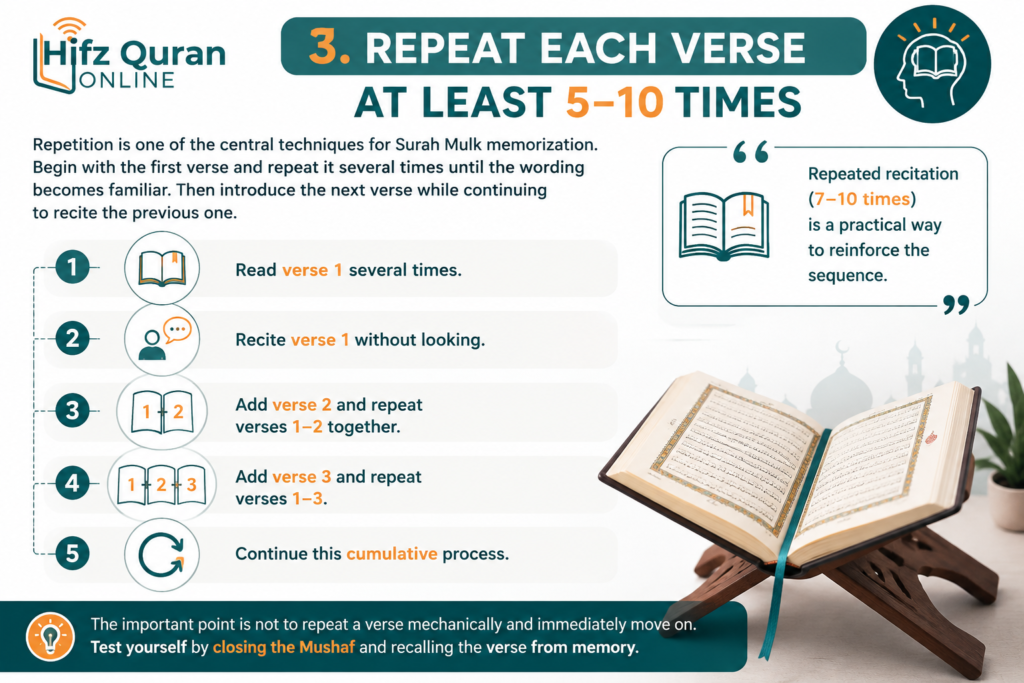
A simple pattern is:
- Read verse 1 several times.
- Recite verse 1 without looking.
- Add verse 2 and repeat verses 1–2 together.
- Add verse 3 and repeat verses 1–3.
- Continue this cumulative process.
The supplied memorization material recommends repeated recitation, including seven to ten repetitions, as a practical way to reinforce the sequence.
The important point is not to repeat a verse mechanically and immediately move on. Test yourself by closing the Mushaf and recalling the verse from memory.
4. Listen to One Qari While Memorizing
Listening can reinforce pronunciation, rhythm, and the sequence of words. Choose one qualified Qari and listen to the same recitation repeatedly while following the Arabic text.
You can listen to reciters such as:
- Abdul Rahman Al-Sudais
- Mishary Rashid Alafasy
- Maher Al-Muaiqly
Following one reciter consistently can prevent your memory from switching between different melodic patterns while you are still learning the Surah.
For difficult verses, listen first, read along, then recite with the audio. Finally, turn the audio off and test yourself independently.
A useful rule: use audio to support memorization, not replace active recall. You should eventually be able to recite without the recording.
5. Divide Surah Al-Mulk Into Small Portions
Trying to memorize all 30 verses at once can make the task feel larger than it actually is. Divide the Surah into smaller portions and give each portion a clear target.
One practical three-part division is:
| Portion | Verses | Suggested Focus |
| Part 1 | 1–10 | Allah’s dominion, creation, and the warning |
| Part 2 | 11–20 | Accountability, reflection, and Allah’s power |
| Part 3 | 21–30 | Allah’s provision, guidance, and final questions |
Another approach is to use five smaller clusters of roughly five to seven verses. Smaller clusters can be particularly useful when a learner struggles to hold several new verses in working memory.
The best division is the one that allows you to recite the complete portion accurately before moving forward.
Read also: How to Memorize Surah Baqarah – A Practical Step-by-Step Hifz Plan
6. Learn Surah Al-Mulk Word by Word
Word-by-word Quran memorization means connecting individual Arabic words to their pronunciation, meaning, and position within the verse. This can be especially helpful for learners who are not native Arabic speakers.
Rather than seeing a verse as one long sequence of unfamiliar sounds, identify its individual words and notice repeated vocabulary and sentence structures.
This becomes particularly useful toward the end of Surah Al-Mulk. Several verses in the final section use recurring rhetorical structures, including variations of أَمَّنْ هَٰذَا (am-man hādhā), meaning “or who is it?”
Recognizing such repetition changes the task. Instead of memorizing every verse as completely new information, you begin to recognize a familiar structure with different endings and details.
That pattern recognition is one of the most useful techniques for learners who want to learn Surah Mulk word by word.
If you find it difficult to connect words, verses, and repeated patterns on your own, Hifz Quran Online Academy’s Quran Memorization Course provides structured guidance with experienced Quran teachers who can help you memorize accurately, strengthen your Tajweed, and build a consistent revision routine. Start your Quran memorization journey with guided, personalized support.

7. Use a Surah Mulk Memorization Planner
A planner turns a general goal into specific daily tasks. Instead of writing “memorize Surah Al-Mulk” on your schedule, decide exactly which verses you will learn, which verses you will review, and when you will test yourself.
The 7 Day Surah Mulk Memorization Planner
| Day | New Memorization | Revision |
| Day 1 | Verses 1–5 | Repeat 1–5 |
| Day 2 | Verses 6–10 | Review 1–5 + new 6–10 |
| Day 3 | Verses 11–15 | Review 1–10 + new 11–15 |
| Day 4 | Verses 16–20 | Review 1–15 + new 16–20 |
| Day 5 | Verses 21–24 | Review 1–20 + new 21–24 |
| Day 6 | Verses 25–30 | Review 1–24 + new 25–30 |
| Day 7 | No new verses | Recite all 30 verses |
This is a framework rather than a rule. If a portion is not secure, spend another day on it rather than moving forward simply because the planner says so.
For beginners with less available time, a 14-day plan with smaller daily portions may be more sustainable.
Read also: Surah Yaseen Memorization – A Step-by-Step Plan to Learn Surah Yaseen Easily
Step Inside Our Virtual Classrooms
Don’t just take our word for it—see how our interactive sessions work! Watch the short clips below to experience our engaging teaching methods, live teacher-student interactions, and the supportive learning environment we bring to every student.
Memorize the Quran at Your Own Pace
Join our expert tutors and begin your Hifz journey with a personalized plan.
Start Your Free Trial8. Revise Before Learning New Verses
Revision should not wait until you have completed Surah Al-Mulk. It should begin on the first day.
Before learning new verses, recite everything you have already memorized from the beginning. For example, if you have reached verse 15, start the session by testing verses 1–15 before adding verse 16.
This cumulative approach exposes weak sections early. It also prevents a common Hifz mistake: becoming very confident with today’s verses while gradually forgetting those learned several days earlier.
A practical daily session can follow this order:
- Review: Recite previously memorized verses.
- New lesson: Learn the next small portion.
- Connection: Recite the old and new portions together.
- Testing: Close the Mushaf and recite independently.
If you are working with an online Hifz teacher, reciting the memorized portion aloud to your teacher adds another layer of accountability and allows pronunciation or memorization mistakes to be corrected early.
9. Recite the Memorized Verses in Salah
Using memorized Quran in Salah gives you another opportunity to retrieve the verses without looking at the Mushaf. This makes memorization active rather than purely visual.

Once a portion is sufficiently secure, include it in your prayers where appropriate. Reciting from memory in Salah can help you identify places where you thought a verse was strong but actually needed more revision.
You can also recite the Surah outside Salah for additional practice. The objective is to create multiple natural opportunities throughout the day to retrieve what you have learned.
Common mistake: Do not use Salah as your first test immediately after memorizing a completely new portion. Strengthen the verses first, then use them in prayer as reinforcement.
10. Test Yourself and Get a Teacher’s Feedback
The final step is to test whether you can actually retrieve Surah Al-Mulk without prompts. Reading the verses repeatedly can create a feeling of familiarity, but familiarity is not the same as memorization.
Close the Mushaf and recite the portion from memory. If possible, record yourself or recite to a teacher, parent, friend, or Hifz partner.
A qualified teacher can identify mistakes that you may not notice yourself, particularly in pronunciation, similar phrases, verse endings, and transitions between verses.
This is where an online Hifz program can make the process more structured. Instead of memorizing alone and wondering whether your recitation is accurate, you can follow a personalized memorization and revision plan with regular teacher feedback.
11- Use some Quran memorization methods to memorize Surah Al-Mulk
Using a structured memorization method can make Surah Al-Mulk easier to learn and review. Instead of relying on unplanned repetition, choose a method that gives each repetition a clear purpose and helps you move gradually from reading to independent recall.
You do not have to use the same technique for every verse. Try the following methods and choose the one that best matches your memorization pace and learning style.
Read also: How to Memorize Surah Duha? – A Step-by-Step Guide
Use the Repetitive Hifz Method
The repetitive Hifz method uses repeated recitation to make the words and sequence increasingly familiar. Choose one or two verses from your Surah Al-Mulk portion and repeat them several times while looking at the Mushaf, then repeat them again from memory.
Do not measure progress by the number of repetitions alone. The real test is whether you can close the Mushaf and reproduce the verses correctly without a prompt.
Use the 10×10 Hifz Method
The 10×10 Hifz method can be useful when you need more intensive repetition. Repeat a target verse ten times while looking at the Mushaf, then attempt repeated recitation from memory before connecting it to the next verse.
For Surah Al-Mulk, apply the method to one small group of verses rather than trying to process all 30 verses in a single session. This keeps the repetition focused and makes mistakes easier to identify and correct.
Can You Memorize Surah Mulk in One Day?
Yes, Surah Al-Mulk can be memorized in one day by an experienced learner, but most beginners will benefit from spreading the memorization over seven to fourteen days. A one-day intensive approach requires several hours of concentrated repetition and works best when the learner already has familiarity with Quranic Arabic pronunciation.
For a beginner, speed should not be the only measure of success. A slower memorization schedule with daily revision is more practical when the goal is long-term retention.
If you choose the one-day approach, continue reviewing the Surah every day afterward rather than assuming that completing it once means it has been permanently memorized.
What Are the Benefits of Memorizing Surah Al-Mulk?
The benefits of memorizing Surah Al-Mulk include strengthening your connection with the Quran, improving recitation fluency, and allowing you to recite the Surah regularly from memory.
The Surah is also associated with significant virtues in hadith, including the narration describing a 30-verse surah as interceding for its companion until he is forgiven.
Surah Al-Mulk also encourages reflection on Allah’s creation, dominion, power, and human accountability. Understanding these themes can make memorization more meaningful than simply committing Arabic words to memory.
Read also: How to Memorize Surah Al Kahf? – A Practical Step-by-Step Hifz Guide
See Our Classes in Action
Curious about what a 1-on-1 Hifz session looks like? Take a look at these real-time snippets from our daily classes to see our student-centered approach, Tajweed correction techniques, and online whiteboard tools in action.
Start Your Surah Al-Mulk Memorization With Expert Guidance
You do not need to memorize Surah Al-Mulk alone or guess which technique will work best for you. A structured online Hifz program can help you set an appropriate daily target, correct recitation mistakes, and build revision into your memorization from the beginning.
If you want a personalized approach to Surah Mulk memorization, explore the programs available at Hifz Quran Online Academy and begin building a consistent Hifz routine.
[Book Your Free Trial Session]
Our Quran Courses
- Quran Memorization Course
- Quran Memorization and Hifz Course for Kids
- Online Quran Memorization Courses for Adults
- Quran Hifz Course for Ladies
- Quran Memorization Course for Men
- Saudi-Based Quran Memorization Courses
- Hifz Teachers
Memorize the Quran at Your Own Pace
Join our expert tutors and begin your Hifz journey with a personalized plan.
Start Your Free Trial
Conclusion
Surah Al-Mulk contains 30 verses, making it a manageable Surah to add to your Hifz journey when you use a clear method. The most effective approach is not simply to repeat the Surah as quickly as possible, but to combine listening, understanding, word-by-word learning, small portions, cumulative revision, and regular testing.
Whether you choose a one-day intensive plan, a seven-day schedule, or a more gradual two-week approach, consistency matters more than speed. Make Surah Al-Mulk part of your daily Quran routine, revise what you have already learned, and allow your memorization to become stronger through repeated recall.
Read also: How to Memorize Surah Baqarah – A Practical Step-by-Step Hifz Plan
Frequently Asked Questions About Surah Mulk Memorization
How long does it take to memorize Surah Al-Mulk?
For many beginners, seven to fourteen days is a practical timeframe when practicing consistently for around 15–30 minutes daily. Learners with stronger Quranic Arabic skills may memorize it faster, while those new to Quran memorization may need more time.
Can I memorize Surah Mulk in one day?
You can memorize Surah Al-Mulk in one day if you already have strong Quranic reading skills and can dedicate several focused hours to repetition. For most beginners, a seven- to fourteen-day plan is more realistic for lasting memorization.
What is the easiest way to memorize Surah Mulk?
The easiest approach is to divide the 30 verses into small portions, listen to one reciter, understand the meaning, repeat each verse several times, connect new verses to previous ones, and revise daily.
Should I learn Surah Mulk word by word?
Yes. Learning Surah Al-Mulk word by word can help you recognize vocabulary, sentence structures, repeated phrases, and transitions between verses. This is particularly useful for non-Arabic speakers.
What are the benefits of memorizing Surah Al-Mulk?
Memorizing Surah Al-Mulk allows you to recite it regularly without looking at the Mushaf, strengthens Quranic recall and recitation fluency, and supports a deeper connection with its themes. Hadith literature also records important virtues associated with Surah Tabarak.
Should I revise Surah Mulk after memorizing it?
Yes. Revision is essential for long-term retention. Continue reciting the entire Surah regularly after completing the initial memorization rather than treating the final verse as the end of the learning process.
Related Articles
Memorizing Quran






Leave a Reply