 Memorizing Quran

Most people who set out to memorize the Quran receive the same advice: repeat each verse until it sticks. And most quietly suspect their memory is not strong enough for 604 pages — so they stop before they truly start.
The problem is not your memory. It is the method. The visual Quran memorization technique takes the opposite path: instead of piling up repetitions and hoping they hold, it strengthens the memory itself — imprinting each page of the mushaf as a mental image you can read back at will. This guide explains exactly how it works, the three-dimensional system behind it, a step-by-step daily practice sequence, and how it compares with the memory palace, and classic auditory repetition.
How Your Brain Actually Stores Quran Memorization?
Before choosing any memorization method, it helps to understand what your brain does with information — and why most people’s memorization fades.
Human memory divides into two systems: short-term and long-term. Short-term memory holds information temporarily — it stores the names of people you meet briefly, details from a lecture you haven’t reviewed.
Long-term memory stores information that persists without constant use. You can recall your mother’s maiden name without ever rehearsing it, because it is anchored in long-term memory through repeated use, emotional significance, and meaning.
The brain filters what it keeps. New information enters short-term memory first; the brain then decides whether to promote it to long-term storage or discard it. The deciding factor is connection: information linked to other information — through meaning, emotional weight, or repeated retrieval — gets promoted.
Information that arrives as an isolated stream of sounds, with no hooks to hold it, gets discarded. This is exactly why rote repetition alone produces memorization that fades: it floods short-term memory with sounds but gives the brain no reason to promote them.
Read also: The Best Way to Memorize the Quran for Non-Arabic Speakers?
Identify Your Best Quran Memorization Method
Not everyone memorizes the Quran in the same way. Some learners naturally remember what they see, others retain information by listening, while many learn best through active recitation and repetition. Identifying your strongest learning style can help you choose a memorization method that feels more natural and sustainable.
One simple way to discover your preferred approach is to reflect on how you’ve successfully learned other things in the past—whether it was a language, a new skill, or even navigating unfamiliar places. The patterns you already use in everyday learning often carry over into Quran memorization.
Are You a Visual Learner?
Before trying a visual memorization technique, consider whether you naturally rely on images and spatial memory.
- You remember where on a page you read something, even if you temporarily forget the exact wording.
- You can mentally picture familiar places, such as your room or your daily route, with little effort.
- You recognize faces more easily than names.
- You prefer visual maps over spoken directions.
If several of these sound familiar, visual memorization may be a good fit. If not, don’t worry—visual memory can be strengthened with practice.
Read also: What Is the Best Way to Memorize the Quran?
The Picture Superiority Effect and Why Visual Memory Outlasts Sound
The human brain stores visual information with significantly greater detail and longevity than spoken or written words alone. This is known in cognitive science as the picture superiority effect.
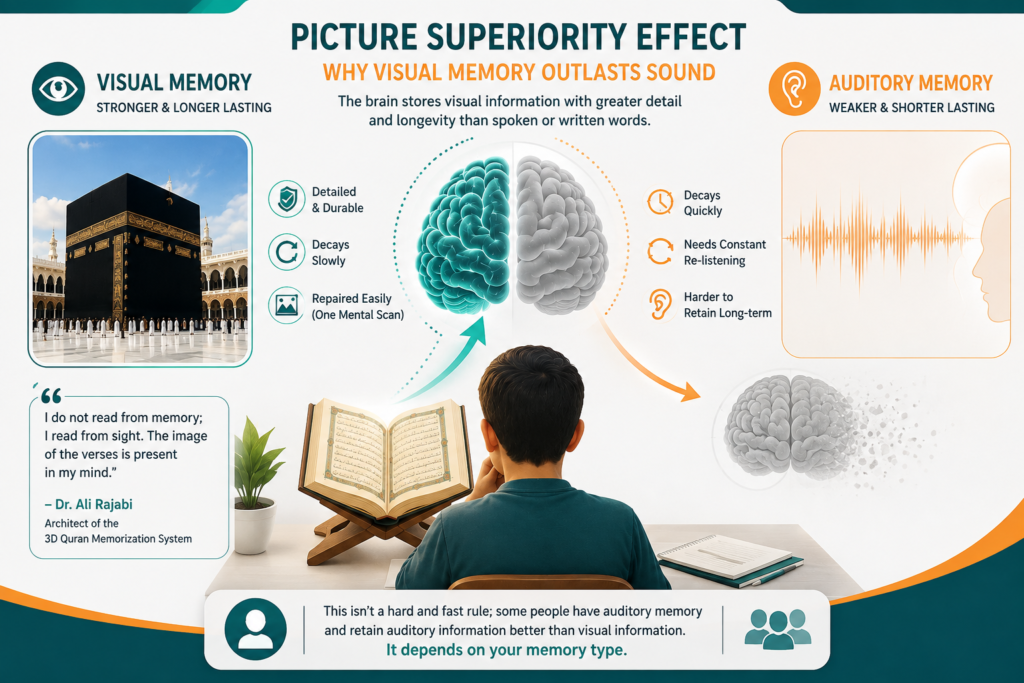
When you think of the Kaaba, you do not retrieve an audio description — you see an image. Dr. Ali Rajabi, a scholar and architect of the 3D Quran memorization system, observed this in his own hifz: “Many people asked me how I recite the Quran from memory so easily and quickly. I would answer: ‘I do not read from memory; I read from sight.’ The image of the verses is present in my mind.”
Visual memory decays slowly and is repaired easily — a single mental scan of the page refreshes the image. Auditory memory, by contrast, requires constant re-listening to stay sharp. This is the structural reason visual memorization produces more durable hifz over time.This isn’t a hard and fast rule; some people have auditory memory and retain auditory information better than visual information. It depends on your memory type.
Read also: The Best Way to Memorize the Quran for Non-Arabic Speakers?
What Is the Visual Quran Memorization Technique?
The visual Quran memorization technique is an approach that treats the mushaf page as a fixed visual address. Instead of relying on phonetic repetition alone, the learner builds a precise mental copy of each page’s layout — the Uthman Taha script, the line breaks, where each verse begins and ends — and every verse acquires a spatial location: this page, this line, this position.
When you later recall a verse, you are not replaying a sound you heard a hundred times. You are reading a location stored in your visual memory — a far more stable and retrievable kind of knowledge.
This matters practically: a learner using pure auditory methods can typically only start recitation from the beginning of a surah or section, because the memory is organized as a linear sound chain. A learner using visual memorization can start mid-page, mid-verse, or at any point — because each line has its own address in the mental image.

The 3D Quran Memorization Method Three Dimensions of Memory
The most structured visual memorization system currently in use is Dr. Ali Rajabi’s three-dimensional (3D) method. It is called three-dimensional because it deliberately recruits three complementary memory systems instead of relying almost entirely on repetition.
Traditional rote memorization depends mainly on auditory repetition. The 3D method distributes the learning process across three interconnected memory dimensions, allowing each one to reinforce the others and create stronger long-term retention.
Dimension 1: Visual Memory — Mental Mapping of Verses
Visual memory is the foundation of the method. The learner memorizes not only the words but also the exact layout of each Mushaf page, giving every verse a fixed visual location. Dr. Rajabi refers to this as the mental mapping of verses.
The learner studies each line carefully—its word shapes, where it begins and ends, its length, and its position on the page—then closes their eyes to reconstruct the image before checking it against the Mushaf. This process continues until the mental picture becomes stable.
For this reason, using a single Mushaf throughout the entire Hifz journey is essential. Switching between different print editions changes the page layout and weakens the visual map that has already been built. A standard Uthman Taha Mushaf is typically recommended because of its consistent formatting.
Dimension 2: Conceptual Memory — Organizing Meaning
The second dimension strengthens memorization through understanding. Before memorizing a page, the learner reads a brief and reliable tafsir or translation to understand the overall message of the verses.
Rather than remembering isolated sentences, the mind organizes verses into meaningful categories—stories, commands, promises, warnings, or descriptions of the Hereafter. These conceptual connections provide additional retrieval paths, making it easier to recover a verse if its exact wording momentarily slips from memory.
Dimension 3: Auditory Memory — Reinforcing Recall
Unlike traditional memorization methods, auditory memory is not the primary driver of learning but a reinforcement tool. Reciting aloud with proper Tajweed and listening consistently to a single reciter helps strengthen the visual and conceptual memories that have already been established.
Using the same reciter throughout the memorization journey keeps the auditory pattern stable, while frequently switching between different voices can interfere with consistent recall.
Integrating the Three Dimensions Perceptual Memory
As visual, conceptual, and auditory memory begin working together, many learners naturally develop what Dr. Rajabi describes as perceptual memory. Instead of functioning as a separate fourth dimension, it is the result of the first three operating in harmony.
The learner begins to associate the page layout, the meaning of the verses, and their familiar recitation with vivid mental scenes—particularly in narrative passages such as the stories of Prophet Musa or Prophet Ibrahim. During revision, recall often feels like mentally replaying a sequence of connected scenes rather than searching for isolated words.
| Memory Dimension | Primary Role | Learning Activity | Benefit |
| Visual Memory | Foundation | Memorize the page layout and verse positions | Fast visual recall and accurate verse location |
| Conceptual Memory | First Support | Understand and organize verses by meaning | Stronger long-term retention and logical recall |
| Auditory Memory | Second Support | Recite consistently with one reciter | Reinforces visual and conceptual memory |
| Perceptual Memory | Integrated Outcome | Naturally combines images, meaning, and sound | Smooth, scene-based recall during recitation |
At Hifz Quran Online Academy, our instructors guide you through all three dimensions of the 3D method — visual mapping, conceptual understanding, and auditory reinforcement — in structured one-to-one sessions tailored to your learning style.
[Start Your Free Trial Session]

Memorize the Quran at Your Own Pace
Join our expert tutors and begin your Hifz journey with a personalized plan.
Start Your Free TrialRead also: The 3:10 Hifz Technique – What It Is and How It Works
Measure Your Memorization Capacity Before You Start
One of the most common reasons hifz attempts fail is setting a daily target based on aspiration rather than reality. This produces either burnout (target too high) or stagnation (target too low). Before beginning, invest one hour in a capacity test.
Clear one hour. Choose a surah you rarely recite — avoid surahs you already know partially. Memorize as much as you can in that hour with full attention. Then measure how many pages you completed.
Divide that number by four. The result is your daily target.
The division-by-four rule exists because what you memorize intensively in one hour will fade within an hour if not properly consolidated. The goal is not to maximize how much you push in — it is to maximize what stays. A smaller, well-consolidated daily portion builds cumulative hifz. A large daily portion that fades and must be re-learned builds frustration.
Adjust the target after your first two weeks: increase it slightly if you find retention solid, reduce it if you notice consistent forgetting between sessions.
Step Inside Our Virtual Classrooms
Don’t just take our word for it—see how our interactive sessions work! Watch the short clips below to experience our engaging teaching methods, live teacher-student interactions, and the supportive learning environment we bring to every student.
Memorize the Quran at Your Own Pace
Join our expert tutors and begin your Hifz journey with a personalized plan.
Start Your Free TrialVisual Quran Memorization Step by Step The Daily Practice Sequence
Understanding the method is not the same as owning it. Here is the three-stage daily practice routine drawn from both the 3D method and established hifz practice.
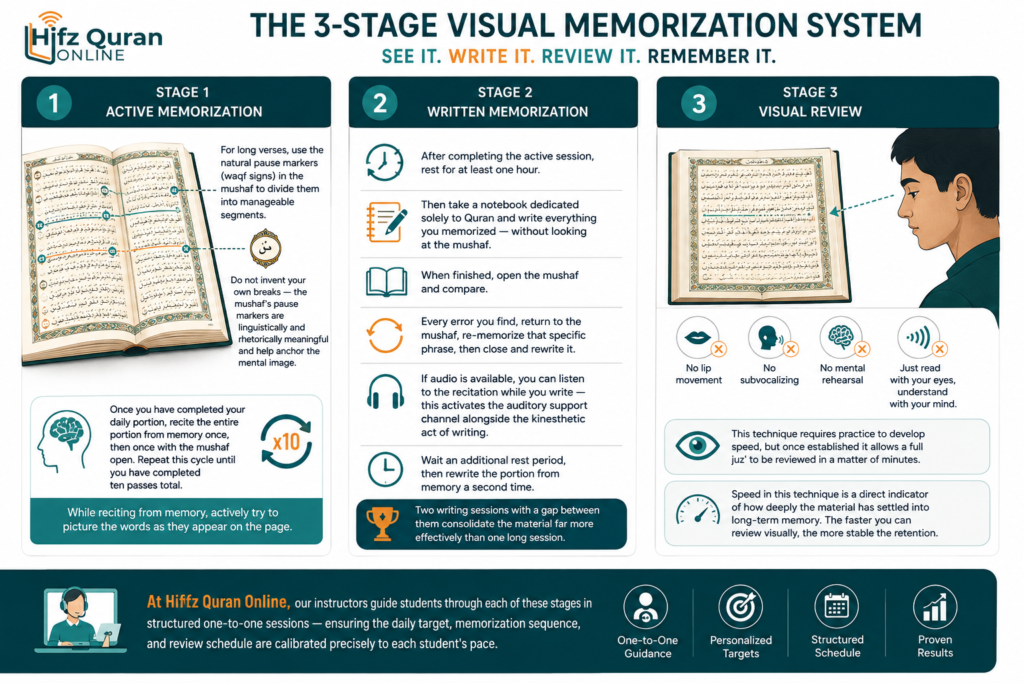
Stage 1: Use Visual-Verbal Memorization During Your Active Session
Begin with understanding. Read the tafsir or translation of your portion before attempting any memorization. This loads the conceptual dimension before the visual work begins.
Then work verse by verse:
- Read the first verse two or three times from the mushaf.
- Close the mushaf and recite from memory.
- Open and check — correct any error immediately.
- Repeat until the verse is clean.
- Move to the second verse and do the same.
- After memorizing the second verse, recite verse one then verse two together from memory without reopening the mushaf.
- Add each new verse cumulatively — always recite from the first verse of your portion to the most recent one you have memorized before moving to the next.
For long verses, use the natural pause markers (waqf signs) in the mushaf to divide them into manageable segments. Do not invent your own breaks — the mushaf’s pause markers are linguistically and rhetorically meaningful and help anchor the mental image.
Once you have completed your daily portion, recite the entire portion from memory once, then once with the mushaf open. Repeat this cycle until you have completed ten passes total. While reciting from memory, actively try to picture the words as they appear on the page.
Stage 2:Write It Down After a Break to Test Your Memorization
After completing the active session, rest for at least one hour. Then take a notebook dedicated solely to Quran and write everything you memorized — without looking at the mushaf. When finished, open the mushaf and compare.
Every error you find, return to the mushaf, re-memorize that specific phrase, then close and rewrite it. If audio is available, you can listen to the recitation while you write — this activates the auditory support channel alongside the kinesthetic act of writing.
Wait an additional rest period, then rewrite the portion from memory a second time. Two writing sessions with a gap between them consolidate the material far more effectively than one long session.
Stage 3: Review the Page Visually to Strengthen Retention
The visual review technique is the most time-efficient revision method in this system. Run your eyes across the mushaf page — reading only with your eyes, without moving your lips, without subvocalizing, and without rehearsing the words mentally. Simply read with your eyes and understand with your mind.
This technique requires practice to develop speed, but once established it allows a full juz’ to be reviewed in a matter of minutes. Speed in this technique is a direct indicator of how deeply the material has settled into long-term memory. The faster you can review visually, the more stable the retention.
At Hifz Quran Online Academy, our instructors guide students through each of these stages in structured one-to-one sessions — ensuring the daily target, memorization sequence, and review schedule are calibrated precisely to each student’s pace.
Transferring New Memorization to Long-Term Memory
Memorizing new verses is only the first step. The real challenge is moving them from fragile short-term memory into stable long-term retention so they remain accessible months and years later.
This transition depends less on repeating the same page endlessly and more on using consistent retrieval, structured revision, and regular recitation in different contexts. The following practices help consolidate newly memorized Quran into lasting memory while protecting previously learned portions from being forgotten.
Recite New and Old Memorization in Your Daily Prayers
Divide your memorized material into two categories: new (anything memorized in the last three days) and old (everything before that). Create a simple two-column schedule and distribute both across your five daily prayers. Reciting in salah applies active retrieval under real conditions — which is one of the most effective ways to transfer material from short-term to long-term storage.
Keep your revision from the mushaf as a separate daily practice (your wird). The prayer recitation and the mushaf wird serve different functions and should not be conflated.
Maintain a Structured Revision Log
Keep a simple record of what you review each day, noting the surahs or pages completed, any recurring mistakes, and the date of the review. A revision log helps ensure that every memorized portion returns regularly instead of being reviewed randomly or neglected over time.
As your memorization grows, organize your revision into a rotating schedule that allows all previously memorized material to be revisited consistently. Portions where you make repeated mistakes should simply appear more frequently in the rotation until they become stable.
The exact review cycle will vary depending on how much Quran you have memorized, but consistency is far more important than following a fixed number of days.
Visual Memorization vs. Auditory Memorization Six Practical Differences
Although both auditory and visual memorization can help you retain the Quran, they produce very different recall patterns over time. Auditory memorization relies primarily on the flow of sound and repeated listening, while visual memorization builds a stable mental image of the Mushaf page. The comparison below highlights the practical differences between these two approaches and explains why many experienced Huffaz develop strong visual memory alongside regular recitation.
| Feature | Auditory Memorization | Visual Memorization |
| Primary cue | Melody sequence | Page location and layout |
| Mid-page retrieval | Difficult — requires restarting from top | Direct — any line has a fixed address |
| Similar verses (mutashabihat) | Frequently confused due to phonetic overlap | Isolated by distinct physical placement |
| Fatigue | High — requires heavy vocal repetition | Lower — relies on calm mental recall |
| Decay pattern | Fades rapidly without constant listening | Decays slowly; repaired by a single visual scan |
| Long-term outcome | Memory chain that breaks if one link weakens | An internal mushaf you can read from anywhere |
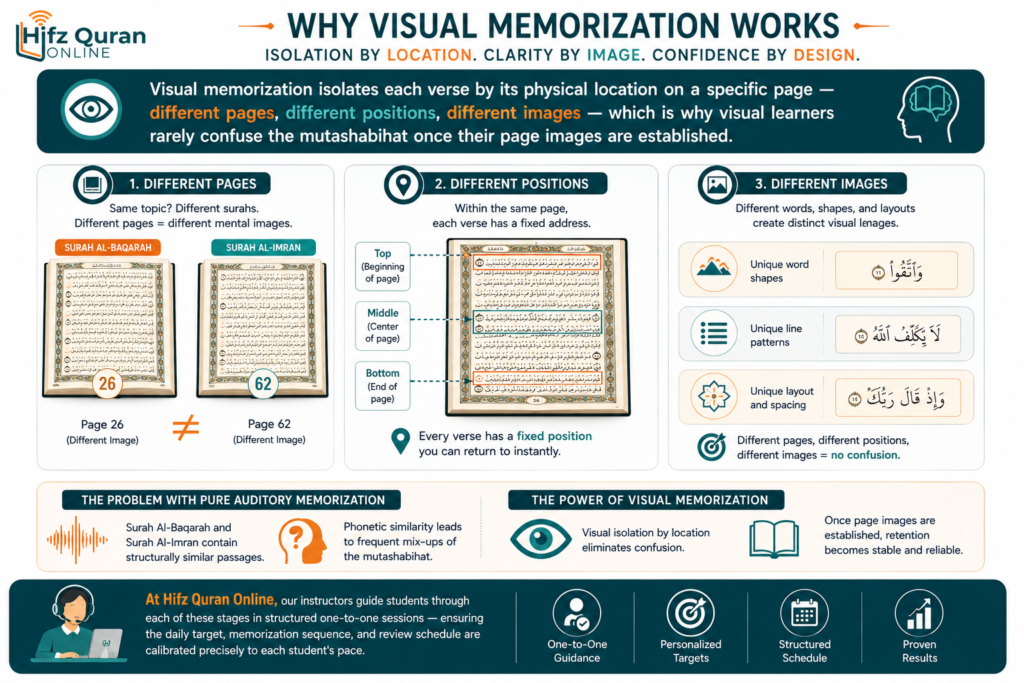
The critical weakness of pure auditory memorization is its vulnerability to similar-sounding verses — the mutashabihat. Surah Al-Baqarah and Surah Al-Imran both contain structurally similar passages that students frequently swap during recitation, not from carelessness, but because the phonetic similarity is genuinely high.
See Our Classes in Action
Curious about what a 1-on-1 Hifz session looks like? Take a look at these real-time snippets from our daily classes to see our student-centered approach, Tajweed correction techniques, and online whiteboard tools in action.
Memorize the Quran at Your Own Pace
Join our expert tutors and begin your Hifz journey with a personalized plan.
Start Your Free TrialStart Your Hifz Journey with Structured Visual Guidance
The visual Quran memorization technique works. But method alone is not enough — calibration matters. The capacity test has to be honest. The daily target has to be realistic. The page images have to be checked by a teacher who can catch errors in wording that your own recitation won’t reveal to you.
At Hifz Quran Online Academy, our instructors build your hifz plan from your capacity, not from a generic schedule. You’ll receive one-to-one sessions with qualified teachers who guide the visual memorization sequence, check your page retention, and structure your review system — so what you memorize stays memorized.
Our Quran Courses
- Quran Memorization Course
- Quran Memorization and Hifz Course for Kids
- Online Quran Memorization Courses for Adults
- Quran Hifz Course for Ladies
- Quran Memorization Course for Men
- Saudi-Based Quran Memorization Courses
- Hifz Teachers
[Book your free trial session]

Conclusion
The visual Quran memorization technique works because it aligns with how human memory actually functions: images outlast sounds, meaning strengthens retention, and a mental map gives every verse a permanent address. The 3D method — visual, conceptual, and auditory memory working in sequence — is the most complete implementation of this approach currently available.
The daily practice routine (visual-verbal session → rest → written session → rest → visual review) gives you a concrete, repeatable structure. And the division-by-four capacity rule ensures your daily target is one you can actually consolidate, not one that collapses under its own weight.
The difference between hifz that survives and hifz that fades is not how much you push in. It is how strongly you have built the container.
At the same time, no memorization method can replace consistency. Visual mapping, understanding the meaning, and structured revision are tools that make learning more effective, but lasting Hifz is built through regular practice over months and years.
Even a small daily portion, reviewed carefully and retained well, is more valuable than rapid memorization that quickly fades. Choose one Mushaf, follow a realistic routine, review what you have learned before adding more, and allow each page to become firmly established before moving on. Over time, these steady habits transform individual verses into a lifelong, reliable connection with the Quran.
Frequently Asked Questions
What is the visual Quran memorization technique?
The visual Quran memorization technique is a method that trains the learner to imprint each mushaf page as a mental image, giving every verse a fixed location — this page, this line, this position. Recall works by reading that mental image rather than replaying a sound, which produces more durable and flexible retention.
Is visual memorization better than auditory memorization for hifz?
Visual memorization produces stronger long-term retention and better handling of similar-sounding verses (mutashabihat). Auditory memorization provides faster initial familiarity with rhythm and pronunciation. The 3D method treats auditory memory as a supporting channel, not the foundation — combining both while making visual memory the lead.
Do I need to be a visual learner to use this technique?
No. While natural visual thinkers take to it quickly, visual memory is trainable for most people. The page-mapping exercises in the 3D method develop the visual faculty through practice, not through innate ability.
How long does it take to see results with visual Quran memorization?
Most students begin retaining page images clearly after two to three weeks of consistent daily practice. The technique has a learning curve — the first few sessions feel slow — but once the page-mapping habit is established, retention becomes faster and more stable with each passing week.
Can I use this method alongside a traditional hifz program?
Yes, and it integrates well. The one essential rule: use only one mushaf edition throughout. If your hifz program uses a specific Uthman Taha print, that print becomes your only reference for all visual memorization work.
What is the single biggest mistake visual Quran memorization students make?
Switching between different mushaf editions. Every page layout change destroys the stored visual addresses and forces the learner to remap pages they had already imprinted. Choose one standard edition before you begin — and stay with it.







Leave a Reply