 Memorizing Quran
Do you want to memorize Surah Abasa but don’t know where to start? Many people try to learn it one line at a time. They repeat each verse again and again. Then, a week later, most of it is gone.
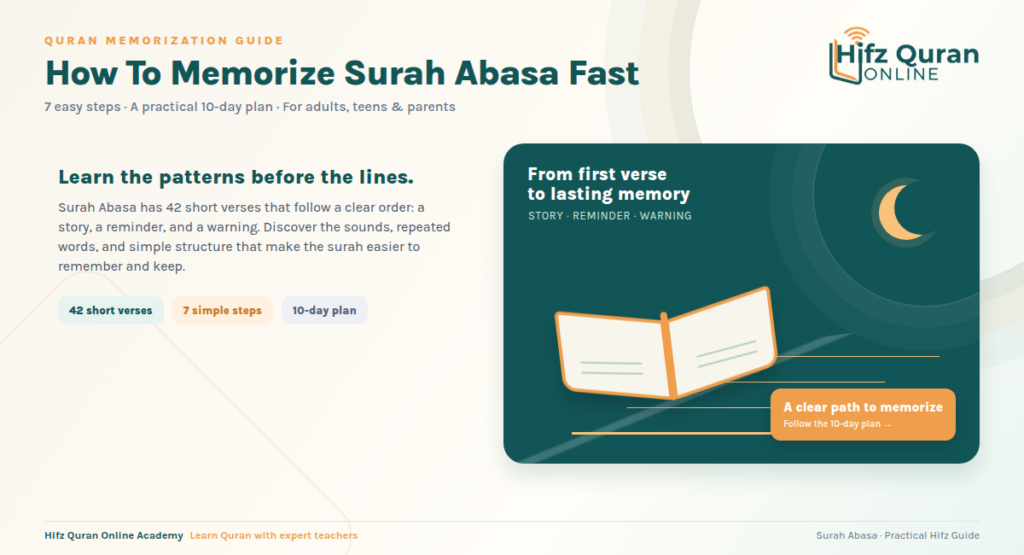
Surah Abasa makes this easier than you might think. It has 42 short verses, and they follow a clear order. The surah tells a story, then gives a reminder, then gives a warning. Each part has its own sound at the end of its verses. Some words also come back more than once, like signs on a road.
Learn these parts and patterns first, and the verses become much easier to keep. The meaning tells you what comes next, so you guess less.
This guide gives you 7 simple steps. You will learn how to split the surah, which words to watch for, and how many times to repeat each verse. You will also get a 10-day plan you can copy and a short list of mistakes to avoid. It works for adults, teens, and parents helping their kids.
Step 1: Learn The Story Of Surah Abasa
Surah Abasa is the 80th surah of the Quran. It has 42 verses. It is in Juz ‘Amma, the last part of the Quran, and it was revealed in Makkah.
The surah starts with a true story. A blind man named Ibn Umm Maktum came to the Prophet ﷺ. He asked the Prophet to guide him. At that time, the Prophet was talking with a leader of Quraysh.
The Prophet turned away from the blind man and kept talking to the leader. Then Allah revealed this surah. Aishah tells this story in Jami’ at-Tirmidhi, hadith 3331. A similar report is in the Muwatta of Imam Malik.
Ibn Umm Maktum later became a respected companion. He gave the call to prayer at dawn. The Prophet told people they could keep eating suhur until they heard his call. You can read this in Sahih al-Bukhari 1918.
The Prophet also put him in charge of Madinah two times while he was away. This is in Sunan Abi Dawud 2931.
Read this story before you start. Once you know it, the first 10 verses feel like a story you are telling.
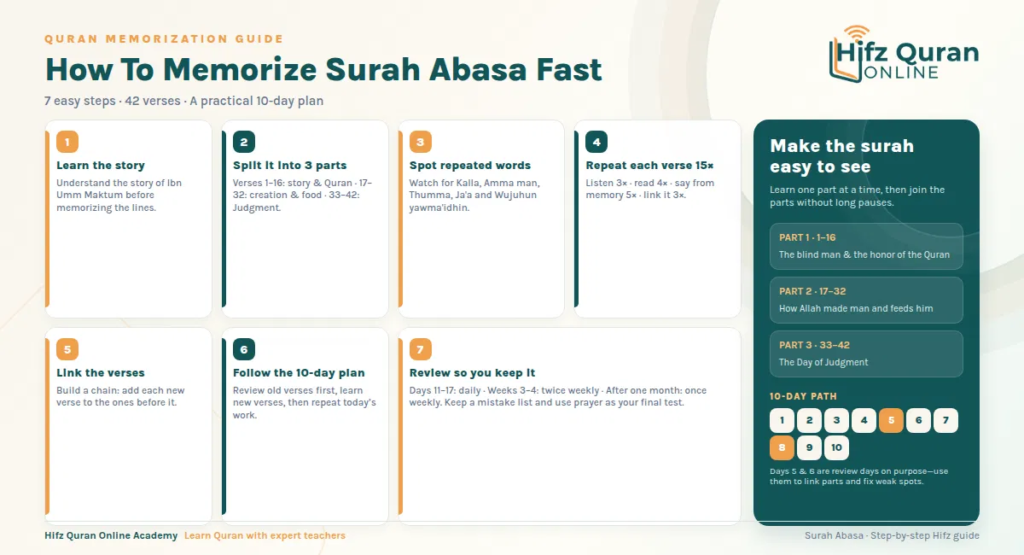
Step 2: Split Surah Abasa Into 3 Parts
Surah Abasa has 3 natural parts. Each part has its own topic and its own sound at the end of the verses. When the sound changes, a new part has started.
| Part | Verses | What it is about | End sound |
| 1 | 1 to 16 | The blind man and the honor of the Quran | “-a,” then “-ah” from verse 11 |
| 2 | 17 to 32 | How Allah made man and feeds him | “-ah,” then “-a” from verse 25 |
| 3 | 33 to 42 | The Day of Judgment | “-ih,” then “-ah” from verse 38 |
- Part 1 (verses 1 to 16): the story and the Quran: Verses 1 to 10 tell the story of the blind man. Verses 11 to 16 say the Quran is a reminder, kept in honored, pure pages.
- Part 2 (verses 17 to 32): creation and food: This part starts with “Qutila al-insanu ma akfarah.” It means “woe to man, how ungrateful he is.” It follows man’s life from birth to death and back to life. Then it asks him to look at his food: rain, soil, and crops.
- Part 3 (verses 33 to 42): the Day of Judgment: This part starts with a loud blast. People run away from their own family. It ends with two kinds of faces, happy ones and dark ones. It is the shortest part and the easiest to picture.
Learning one part at a time is how a good Hifz course is built. If you want that structure with a teacher, the Quran memorization course at Hifz Quran Online Academy follows the same part-by-part path.
Step 3: Learn The Repeated Words Before The Verses
Some words in Surah Abasa show up more than once. Learn these words first. They work like signs that tell you where you are in the surah.
a. “Kalla” (كَلَّا) Tells You A New Topic Is Starting
“Kalla” (كَلَّا) means “no, never.” It shows up 2 times. Each time, one topic ends and a new one begins.
- Verse 11: كَلَّآ إِنَّهَا تَذْكِرَةٌ (Kalla innaha tadhkirah), “No! It is a reminder.”
The story of the blind man ends. Now the surah talks about the Quran. - Verse 23: كَلَّا لَمَّا يَقْضِ مَآ أَمَرَهُۥ (Kalla lamma yaqdi ma amarah), “No! He has not done what Allah told him.”
The story of man’s life ends. Next, the surah talks about man’s food.
“Kalla” is a strong word that stops a wrong idea. In this surah, you will find it only in these 2 places. Listen closely to how it sounds in each verse. In verse 11, you stretch the “la” a little longer, because a hamza comes right after it. In verse 23, you say it short.
Easy way to remember: the first “Kalla” comes after the blind man. The second “Kalla” comes before the food.
b. “Amma Man” (أَمَّا مَن) Shows Two Different People (Verses 5 To 10)
“Amma man” (أَمَّا مَن) means “as for the one who.” It shows up 2 times, once for each person.
- Verses 5 and 6: أَمَّا مَنِ ٱسْتَغْنَىٰ فَأَنتَ لَهُۥ تَصَدَّىٰ (Amma mani staghna, fa anta lahu tasadda)
This is the rich man. You turned toward him. - Verses 8 to 10: وَأَمَّا مَن جَآءَكَ يَسْعَىٰ وَهُوَ يَخْشَىٰ فَأَنتَ عَنْهُ تَلَهَّىٰ (Wa amma man ja’aka yas’a, wa huwa yakhsha, fa anta ‘anhu talahha)
This is the blind man. You turned away from him.
Verse 7 sits between these two parts, and it still talks about the rich man. That means each man gets 3 verses: verses 5 to 7 for the rich man and verses 8 to 10 for the blind man. The rich man always comes first in this part.
The second “Amma man” starts with “wa” (وَ), which means “and” or “but.” Hearing that “wa” tells you the blind man’s part has begun.
Easy way to remember: “lahu” (لَهُۥ) means toward him. “‘Anhu” (عَنْهُ) means away from him.
c. “Thumma” (ثُمَّ) Counts The Steps Of Man’s Life (Verses 20 To 22)
“Thumma” (ثُمَّ) means “then.” It starts 3 verses in a row.
- Verse 20: ثُمَّ ٱلسَّبِيلَ يَسَّرَهُۥ (Thumma s-sabila yassarah), “Then He made his path easy.”
- Verse 21: ثُمَّ أَمَاتَهُۥ فَأَقْبَرَهُۥ (Thumma amatahu fa aqbarah), “Then He made him die and put him in a grave.”
- Verse 22: ثُمَّ إِذَا شَآءَ أَنشَرَهُۥ (Thumma idha sha’a ansharah), “Then He will raise him when He wills.”
These 3 verses come right after verse 19, which tells how man was made from a small drop. The order follows real life, so it is hard to mix up. A person lives first, then dies, then is raised again. Watch out for one more “thumma” in verse 26: ثُمَّ شَقَقْنَا ٱلْأَرْضَ شَقًّا (Thumma shaqaqna al-arda shaqqa). That one is about the earth and the food passage, not about man’s life.
Easy way to remember: count on 3 fingers. Path, grave, rising.
d. “Ja’a” (جَآءَ) Means “Came” And Shows Up 3 Times
The word “came” (جَآءَ) shows up in 3 places.
- Verse 2: أَن جَآءَهُ ٱلْأَعْمَىٰ (An ja’ahu al-a’ma), “when the blind man came to him.”
- Verse 8: وَأَمَّا مَن جَآءَكَ يَسْعَىٰ (Wa amma man ja’aka yas’a), “the one who came to you eagerly.”
- Verse 33: فَإِذَا جَآءَتِ ٱلصَّآخَّةُ (Fa idha ja’ati as-sakhkhah), “when the loud blast comes.”
The end of the word changes each time, and the change tells you who it is about. In verse 2, “ja’ahu” (جَآءَهُ) ends with “hu” (ـهُ), which means “him.” In verse 8, “ja’aka” (جَآءَكَ) ends with “ka” (ـكَ), which means “you.”
In verse 33, “ja’ati” (جَآءَتِ) ends with “ti” (ـتِ), because it is about the blast, “as-sakhkhah” (ٱلصَّآخَّةُ). So verses 2 and 8 tell the same moment, first as a story and then as speech to the Prophet ﷺ.
Easy way to remember: the first 2, “ja’ahu” (جَآءَهُ) and “ja’aka” (جَآءَكَ), are about the blind man. The last one, “ja’ati” (جَآءَتِ), starts the Day of Judgment.
e. “Wujuhun Yawma’idhin” (وُجُوهٌ يَوْمَئِذٍ) Starts The Two Groups Of Faces
“Wujuhun yawma’idhin” (وُجُوهٌ يَوْمَئِذٍ) means “faces on that day.” It shows up 2 times near the end.
- Verse 38: وُجُوهٌ يَوْمَئِذٍ مُّسْفِرَةٌ (Wujuhun yawma’idhin musfirah), “Some faces that day will shine.”
- Verse 40: وَوُجُوهٌ يَوْمَئِذٍ عَلَيْهَا غَبَرَةٌ (Wa wujuhun yawma’idhin ‘alayha ghabarah), “Other faces that day will have dust on them.”
Each group of faces gets 2 verses. The happy faces are in verses 38 and 39: they shine, laugh, and are full of joy. The dark faces are in verses 40 and 41: they have dust on them and are covered in darkness.
Verse 42 then tells you who the dark faces belong to. Keep the two groups apart in your mind, and you will not mix their words.
Easy way to remember: the second time has 2 extra words. It starts with “wa” (وَ) and adds “‘alayha” (عَلَيْهَا). When you hear them, you know the happy faces are done and the dark faces have begun.
Memorize the Quran at Your Own Pace
Join our expert tutors and begin your Hifz journey with a personalized plan.
Start Your Free TrialRead also: How to Learn Surah Al-Falaq
Step 4: Repeat Each Verse 15 Times
Repeat each verse 15 times in 4 stages. This moves the verse from your ears into your memory.
- Listen to it 3 times while you look at the text.
- Read it out loud 4 times from the mushaf.
- Say it from memory 5 times. If you get stuck, look once and start the count again.
- Say it 3 times with the verse before it.
Short verses may stick after 10 times. Long ones, like verse 37, may need more than 15. Use this rule: move on only when you can say the verse from memory 3 times in a row with no pause.
Use one reciter for the whole surah. A new voice changes the rhythm, and your memory has to adjust again.
Have a closer look inside our real classes
Watch how our teachers help children build strong recitation skills in the Quran Learning Course for Kids at Hifz Quran Online Academy. In this lesson, a young student learns to recite Surah Al-Qiyamah correctly, verse by verse, with guidance from the teacher.
Step 5: Link The Verses Together
Linking means joining each new verse to the ones before it. Many people skip this step. That is why they can say each verse alone but get stuck when they recite the whole surah.
Link verses like a chain:
- After verse 2, say verses 1 and 2 together.
- After verse 3, say verses 1 to 3.
- Keep going until the whole part flows.
Then link the parts. Say verses 15 and 16, then go straight into verses 17 and 18. Practice this jump until it feels easy. Do the same where Part 2 meets Part 3.
When you slip, go back only to the verse or jump where you stopped. Practice it, then put it back in the chain. Our guide on how to memorize a surah in 1 hour shows how to use this in one focused session.
It is hard to hear your own small pauses. A tutor can hear them right away. The Quran tutors at Hifz Quran Online Academy listen to each part and fix your links and tajweed early.

Step 6: Follow The 10-Day Plan
This 10-day plan covers one small piece each day. Every day has the same order. Review old verses first. Learn new verses. Then say today’s verses once more before you stop.
| Day | Review first | Learn | Finish by |
| 1 | Nothing yet | Verses 1 to 7 | Saying 1 to 7 twice |
| 2 | Verses 1 to 7 | Verses 8 to 16 | Saying Part 1 twice |
| 3 | Part 1 twice | Verses 17 to 23 | Saying 17 to 23 twice |
| 4 | Part 1 once, 17 to 23 twice | Verses 24 to 32 | Saying Part 2 twice |
| 5 | Parts 1 and 2 | Nothing new, only link Part 1 to Part 2 | Saying 1 to 32 with no stops |
| 6 | Verses 1 to 32 | Verses 33 to 37 | Saying 33 to 37 twice |
| 7 | Verses 1 to 37 | Verses 38 to 42 | Saying the whole surah once |
| 8 | Whole surah 3 times | Fix the verses on your mistake list | Saying the whole surah with no mistakes |
| 9 | Whole surah | Say it in your prayer or to a listener | Writing down any new slips |
| 10 | Whole surah | Final test, twice, with no mushaf | Starting the review plan in Step 7 |
Days 5 and 8 have no new verses on purpose, because they give your memory time to join the parts and fix weak spots. Try to do each day’s work at the same time, such as after Fajr, so it becomes a habit.
Use the same mushaf every day, because your eyes will start to remember where each verse sits on the page. If you miss a day, don’t skip ahead; just pick up from the day you missed and add one day to the plan.
Before you move to the next day, make sure you can say all of today’s verses from memory with no long pauses.
The 7-day plan for fast readers
Do you already read Arabic well? Then you can aim to finish in 7 days. Join Days 3 and 4. Join Days 6 and 7. Skip Day 9. Keep the “review first” rule every day. Each time you stop or slip, write down the verse number. On Day 8, practice only those verses.
Step 7: Review So You Keep The Surah For Good
Review keeps Surah Abasa in your memory after the 10 days end. In 1885, Hermann Ebbinghaus studied how fast people forget.
He found that new things fade quickly without review. In 2015, two researchers, Jaap Murre and Joeri Dros, ran his test again. Their results were close to his.
Use this simple review plan:
- Days 11 to 17: say the whole surah once a day.
- Weeks 3 and 4: say it twice a week.
- After one month: say it once a week.
Your prayer is the best place to review. You have no mushaf to look at, so it is a true test. If you stop during prayer, add that verse to your mistake list.
For a full review system, read our guide on how to memorize Quran without forgetting. It explains how to split your time between new verses and review.
Review is often the first step people drop, because no one checks on them. At Hifz Quran Online Academy, tutors set regular review sessions. Surah Abasa, and every surah you learn after it, stays fresh.
Mistakes To Avoid In Surah Abasa
These slips happen often in this surah. Watch for them from the first day.
- Verses 3 and 7 both end with “yazzakka.” Verse 3 is about the blind man. Verse 7 is about the rich man.
- In verses 11 and 12, “tadhkirah” (a reminder) comes first. “Dhakarah” (he remembers it) comes next.
- In verses 27 to 31, grain comes first. Then grapes and plants, olives and palms, thick gardens, and fruit and grass.
- In verses 34 to 36, brother comes first. Then mother and father. Then wife and children.
- In verses 38 to 41, happy faces shine, laugh, and smile. Dark faces have dust and gloom. Keep each word in its own group.
- Surah An-Nazi’at, the surah just before Abasa, shares phrases with it. Both say “mata’an lakum wa li-an’amikum.” Both start the Day of Judgment with “Fa idha ja’at.” In Abasa, the next word is “as-sakhkhah,” which you stretch for 6 counts. In An-Nazi’at, it is “at-tammatu al-kubra.”
Words are not enough?! Look and Judge
Watch how our teachers guide young learners in the Quran Memorization Course for Kids at Hifz Quran Online Academy. In this lesson, a student memorizes Surah An-Nazi’at step by step, using a simple method that makes each verse easier to remember.
Memorize the Quran at Your Own Pace
Join our expert tutors and begin your Hifz journey with a personalized plan.
Start Your Free TrialLearn Surah Abasa With A Tutor At Hifz Quran Online Academy
You can follow this plan alone. A tutor makes each step faster and keeps your recitation correct. Here is what you get at Hifz Quran Online Academy:
- One-on-one live classes, so your tutor listens only to you.
- Tajweed fixed on the spot, before small errors turn into habits.
- A plan made for you, with daily portions that fit your level, speed, and goal.
- Review built in, so old surahs stay strong as you add new ones.
- Classes from home at times that suit you, around school, work, and family.
- A free trial class, so you can meet your tutor and try the method first.
Book your free trial with Hifz Quran Online Academy today. Start memorizing with a clear plan, a caring tutor, and a review system that keeps every surah in your heart.

Conclusion
Surah Abasa is a great surah to learn early in your Hifz journey. It is short, its story is easy to follow, and its parts are clear. That makes it a good place to build habits you will use for years.
The biggest habit is to look at a surah before you start memorizing it. Ask what it is about. Ask where the topic changes. Listen for the sounds at the end of the verses. A few minutes spent on this saves you hours of repeating lines that don’t stick.
The second habit is to protect what you learn. Each new surah is a gift, and review keeps it. Pick a time each day for review, even a short one. Reciting in your prayers is the easiest way to make review part of your life.
The third habit is to ask for help when you need it. Some mistakes are hard to hear in your own voice. A teacher who listens to you can catch them in seconds. That saves you from learning a verse the wrong way and fixing it later.
When you finish Surah Abasa, move on to the next surah with the same care. Surah At-Takwir comes right after it in the mushaf, and the rest of Juz ‘Amma is waiting. Each surah you add makes the next one easier. Keep going, one part and one day at a time, and ask Allah to make the Quran easy for you.
FAQs
To know more about Surah Abasa, read these questions and answers.
Is Surah Abasa Easy To Memorize?
Yes, Surah Abasa is one of the easier surahs to memorize. Its 42 verses are short, and they split into 3 clear parts with their own end sounds.
How Long Does It Take To Memorize Surah Abasa?
With the plan in this guide, you can aim to memorize Surah Abasa in 7 to 10 days. Your time depends on your reading level, daily practice, and review.
Can Kids Memorize Surah Abasa?
Yes, kids can memorize Surah Abasa. Give them 2 or 3 verses a day, let them listen often, and review old verses before adding new ones.
Can I Memorize Surah Abasa If I Don’t Speak Arabic?
Yes, you can memorize Surah Abasa without speaking Arabic. Read a simple translation first, so you know what each part means, and learn the correct sounds from a trusted reciter or teacher.
What Should I Memorize After Surah Abasa?
After Surah Abasa, many learners move on to Surah At-Takwir, the next surah in the mushaf. You can use the same 7 steps for it and for the rest of Juz ‘Amma.
What Is Surah Abasa About?
Surah Abasa is the 80th surah of the Quran, a Makki surah in Juz ‘Amma. It opens with the Prophet (peace be upon him) frowning when a blind man, Abdullah ibn Umm Maktum, came to him while he was speaking with leaders of Quraysh.
It then reminds people of how Allah created them and provides their food, and ends with a scene from the Day of Judgement, when some faces will be bright and others covered in dust.






Leave a Reply