 Memorizing Quran
| Key Takeaways |
| Memorizing the Quran in 1 year requires consistent daily memorization of approximately 1.65 pages, covering all 604 pages across 365 days. |
| The optimal new-to-revision ratio for a 1-year Hifz plan is 1 new page memorized for every 3–4 pages reviewed in Muraja’ah daily. |
| Non-Arabic speakers must master Tajweed rules and correct Makhraj before beginning Hifz — mispronounced memorization is harder to correct later. |
| Splitting the year into four 3-month phases — each with defined Juz’ targets — prevents burnout and builds measurable momentum. |
| Fajr remains the highest-yield memorization window; students who memorize consistently after Fajr show stronger retention across all Juz’ levels. |
Memorizing the Quran in 1 year is not a shortcut — it is a structured, demanding commitment that thousands of non-Arabic speaking Muslims have fulfilled with the right methodology. Most students who attempt it without a plan stall before Juz’ 5. Those who succeed do so because they treat every single day as a non-negotiable appointment with Allah’s words.
The 1-year Hifz plan is achievable for a dedicated adult or advanced student when broken into daily targets, supported by consistent Muraja’ah, and guided by a certified instructor. At roughly 1.65 pages of new memorization per day — with daily revision built in — the mathematics are manageable. The discipline is what separates those who finish from those who don’t.
1. Confirm You Meet the Prerequisites Before Committing to a 1-Year Timeline
To memorize the Quran in 1 year, fluent Tajweed recitation is a non-negotiable starting point — not a parallel goal. A student who begins Hifz with weak pronunciation will spend months re-memorizing corrected verses, destroying any timeline they set.
Before beginning, you must be able to recite any page of the Quran with correct Makhraj (articulation points), Sifat al-Huruf (letter characteristics), Ghunnah (nasalization), and basic Waqf and Ibtida’ rules. If you cannot yet read Arabic fluently, the Al-Menhaj Book — a structured Quran reading curriculum authored by Luqman ElKasabany — is the correct foundation to complete first.
At Hifz Quran Online Academy, students who attempt the 1-year plan without passing our Tajweed assessment consistently plateau at the Juz’ 3–4 mark, where Surah Al-Baqarah’s complex verse patterns expose every unresolved pronunciation error.
2. Build Your Daily Memorization Target Around the Quran’s Exact Structure
The Quran contains 604 pages across 30 Juz’. To complete full memorization in 1 year (365 days), your daily new memorization target is:
604 ÷ 365 = approximately 1.65 pages per day
In practice, most structured plans round this to 10 lines of new memorization in the morning and 10 lines in the evening, totaling roughly 1.5–1.7 pages daily depending on the Mushaf edition used. This is realistic for a student dedicating 2–3 focused hours per day.
Select one Mushaf and never switch. The spatial memory of Hifz is tied to page layout — changing Mushaf editions mid-plan forces partial re-memorization.
Memorize the Quran at Your Own Pace
Join our expert tutors and begin your Hifz journey with a personalized plan.
Start Your Free Trial3. Divide the Year into Four Structured Phases with Clear Juz’ Targets
A 1-year memorization plan without quarterly milestones becomes directionless within weeks. Dividing the year into four 3-month phases creates accountability, allows for realistic assessment, and builds the psychological momentum non-Arabic speakers need to sustain effort through the harder middle Juz’.
| Phase | Months | Juz’ Target |
| Phase 1 — Foundation | Months 1–3 | Juz’ 1–7 |
| Phase 2 — Build | Months 4–6 | Juz’ 8–15 |
| Phase 3 — Sustain | Months 7–9 | Juz’ 16–22 |
| Phase 4 — Complete | Months 10–12 | Juz’ 23–30 |
Phase 1 is the most technically demanding — Al-Baqarah and Aal Imran contain the Quran’s longest and most linguistically complex passages.
Many students underestimate Phase 1 and race through it without solidifying retention, which destabilizes every subsequent phase. Take your time solidifying Juz’ 1–3 before accelerating.
For students looking for a more detailed breakdown, our Quran memorization schedule guide covers daily and weekly planning structures in depth.
4. Apply the Correct New-to-Muraja’ah Ratio Every Single Day
Muraja’ah (revision) is not what you do after you finish memorizing — it is what you do on the same day you memorize. The most common error I observe in students attempting a 1-year plan is treating revision as a weekend task. By Monday, what was memorized Tuesday has crossed the forgetting curve threshold.
The recommended daily ratio for a 1-year Hifz plan is:
- New memorization: 1 page (approximately)
- Recent Muraja’ah (last 10 days’ work): 3–4 pages
- Old Muraja’ah (completed Juz’): 1–2 pages rotating
This means on any given day, a student recites 5–7 pages total — 1 new and 4–6 in revision. This ratio keeps recently memorized material active while protecting older Juz’ from decay. Our detailed guide on how to revise memorized Quran explains the exact Muraja’ah rotation system used by certified Huffaz.
Students enrolled in our Online Quran Memorization Courses for Adults receive a personalized daily Muraja’ah schedule calibrated to their exact memorization pace — removing the guesswork from ratio management entirely.
Enroll in our Quran Memorization Course for Adults with a free trial

5. Use the Rabṭ Technique to Eliminate Sequence Confusion Between Verses
Rabṭ is the practice of connecting the final word of a memorized verse to the opening word of the next verse before moving forward. It is a classical Hifz technique that specifically prevents one of the most persistent problems for non-Arabic speakers: verse sequence confusion within Surahs of similar rhythm or subject matter.
Before introducing Rabṭ systematically at Hifz Quran Online Academy, students frequently confused verse sequences within Surahs like Al-Baqarah and An-Nisa’ — particularly in consecutive ayat with parallel grammatical structures.
After drilling Rabṭ transitions at the end of every new memorization session, that error pattern dropped significantly within the first Juz’.
How to apply Rabṭ practically:
- Memorize the new verse in isolation first
- Recite the last 3 words of the previous verse, then flow immediately into the new verse
- Repeat this connecting recitation 5–7 times before moving forward
- Never consider a verse “memorized” until you can enter it from the verse before it without hesitation
Memorize the Quran at Your Own Pace
Join our expert tutors and begin your Hifz journey with a personalized plan.
Start Your Free Trial6. Protect Your Fajr Window — It Is Your Primary Memorization Time
To memorize the Quran in 1 year, your Fajr window is not optional. New memorization must happen when the mind is clear, rested, and free of sensory input.
Students who memorize after Fajr consistently outperform evening memorizers in retention assessments — the difference becomes pronounced after the second Juz’ when cumulative volume begins to strain working memory.
The Prophet ﷺ taught us about the blessings of early morning in authenticated narrations. On Sunnah.com, the hadith recorded in Sunan Abi Dawud 2606 reports that the Prophet ﷺ supplicated:
“O Allah, bless my nation in their early mornings.”
While this hadith relates to military matters, scholars of Hifz methodology have long cited the barakah of the Fajr hour as a pedagogical principle for Quran study.
Recommended daily Hifz schedule:
| Time | Activity | Duration |
| After Fajr | New memorization (1 page) | 45–60 min |
| Mid-morning | Recent Muraja’ah (last 10 days) | 30–40 min |
| After Asr or Maghrib | Old Muraja’ah (completed Juz’) | 20–30 min |
| Before sleep | Light recitation review of today’s new page | 10 min |
7. Recite to a Certified Hafiz Instructor at Least Three Times Per Week
Independent memorization without verified recitation is one of the fastest ways to corrupt a Hifz plan. Errors in pronunciation, rhythm, and verse sequencing compound silently — and by the time a student discovers them, months of work may require correction.
Reciting to a certified Hafiz instructor a minimum of three times per week accomplishes three things simultaneously: it catches Tajweed errors before they solidify, it creates an external accountability structure that sustains consistency, and it trains the student’s ear to distinguish correct from incorrect recitation.
Book a FREE session with one of our Ijazah-certified teachers
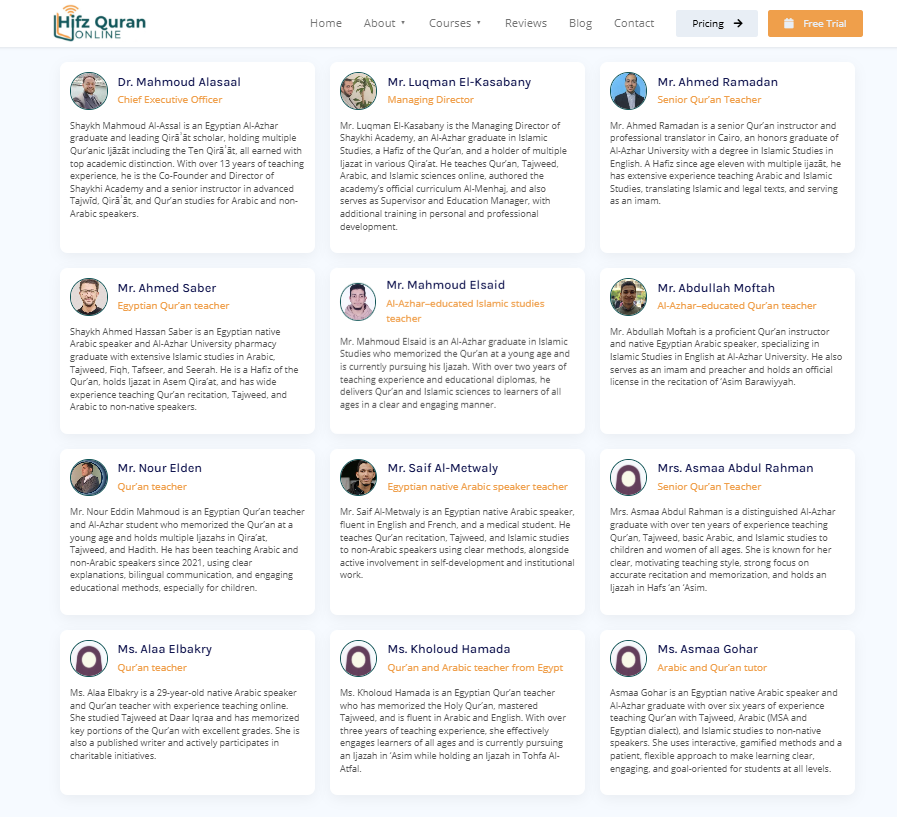
The Quran Memorization Course at Hifz Quran Online Academy provides structured 1-on-1 sessions with certified Huffaz who specialize in teaching non-Arabic speakers. Each session includes new recitation verification, Tajweed correction, and Muraja’ah testing — the three pillars any serious 1-year plan requires.
For more context on what becoming a Hafiz actually involves, our guide on how to become a Hafiz outlines the full process honestly, including what most online articles omit.
8. Manage Retention Fatigue at the Juz’ 10–15 Mark
The midpoint of any 1-year Hifz plan — roughly Juz’ 10 through 15 — is where the highest percentage of students lose momentum. New memorization feels slower because the brain is managing a growing revision load simultaneously. Students often misread this as personal failure when it is a predictable neurological pattern.
At this stage, the practical solution is temporarily reducing new memorization to half a page per day while maintaining full Muraja’ah volume for 1–2 weeks.
This stabilizes the revision load, consolidates existing memorization, and allows the student to resume full pace from a stronger foundation — rather than pushing forward on shaky ground.
9. Conduct a Weekly Juz’ Test to Identify Retention Gaps Before They Compound
Weekly self-testing is the most underused tool in independent Hifz study. Reciting a full Juz’ from memory — without looking at the Mushaf — once per week reveals exactly which verses are retained strongly and which are beginning to fade.
Most students discover the same 3–5 verses within each Juz’ consistently fail them. Those are the verses to isolate and drill, not the entire Juz’.
Weekly testing protocol:
- Choose one completed Juz’ each week for full recitation
- Recite entirely from memory, noting every hesitation point
- Flag hesitation points for targeted re-drilling in the following 3 days
- Rotate through all completed Juz’ systematically before repeating
Students who follow a structured weekly testing protocol make significantly fewer corrections at the end of their Hifz — and their final Khatm recitation is noticeably stronger.
For a broader perspective on the benefits that sustain motivation through this process, our article on benefits of memorizing the Quran is worth revisiting at the midpoint of your plan.
10. Plan Your Final 30-Day Review Before Declaring Completion
The final month of a 1-year Hifz plan should contain zero new memorization. Every day of month 12 is dedicated exclusively to comprehensive Muraja’ah — reciting the entire Quran in rotation, typically 1–2 Juz’ per day, completing the full 30 Juz’ approximately every 2 weeks.
This final review phase solidifies the sequential memory chain across all 30 Juz’, identifies any remaining weak points before they become permanent gaps, and prepares the student for recitation to a Hafiz for verified completion.
Completing this phase before claiming Hifz is not optional — it is what separates students who “finished memorizing” from students who are genuine Huffaz.
Our detailed guide on how to memorize the Quran covers the full methodology behind sustained retention, including what to do in the months after completing the Quran to preserve your Hifz long-term.
Memorize the Quran at Your Own Pace
Join our expert tutors and begin your Hifz journey with a personalized plan.
Start Your Free TrialBegin Your 1-Year Quran Memorization Plan with Certified Guidance at Hifz Quran Online Academy
A 1-year Hifz plan requires more than motivation — it requires verified methodology, daily accountability, and expert correction at every stage.
Hifz Quran Online Academy offers:
- Certified Huffaz with verified credentials teaching every session
- Personalized 1-on-1 instruction calibrated to your exact pace
- Flexible scheduling across all global time zones
- Structured methodology designed specifically for non-Arabic speakers
- Dedicated programs: Quran Memorization Courses for Adults, Hifz Classes for Kids, and Quran Hifz Programs for Ladies
- A free trial lesson — no commitment required
Book your free trial today and begin your 1-year plan with a certified instructor beside you, Insha’Allah.
Choose the program that fits your needs:
- Quran Memorization Course (comprehensive Hifz for all ages)
- Quran Memorization and Hifz for Kids
- Online Quran Memorization Courses for Adults
- Quran Hifz for Ladies.
Book your free trial lesson today and begin your journey to Hifz with expert guidance every step of the way.

Frequently Asked Questions About How to Memorize the Quran in 1 Year
Is It Realistically Possible to Memorize the Quran in 1 Year as a Non-Arabic Speaker?
Yes — memorizing the Quran in 1 year is achievable for a non-Arabic speaker who commits 3–5 focused hours daily, maintains a consistent Muraja’ah routine, and recites regularly to a certified instructor. The prerequisite is fluent Tajweed recitation before starting. Without that foundation, the timeline extends considerably.
How Many Pages Per Day Must I Memorize to Finish the Quran in 1 Year?
The Quran contains 604 pages. To complete memorization in 365 days, you need approximately 1.65 pages of new memorization daily. In structured plans, this is typically divided into a morning session of roughly 8 lines and an evening session of 8 lines, using a consistent Mushaf edition throughout the entire plan.
What Should I Do If I Miss Several Days and Fall Behind My 1-Year Schedule?
Do not attempt to double your daily target to compensate. Instead, recalculate your remaining page count against your remaining days, adjust your daily target incrementally, and prioritize stabilizing your existing Muraja’ah before pushing forward with new memorization. Rushing new memorization to recover lost time produces weak retention that requires correction later.
How Do I Know If My Memorization Is Strong Enough to Move to the Next Page?
A verse or page is memorized sufficiently when you can recite it from memory three consecutive times without hesitation, without looking at the Mushaf, and at a natural Tarteel pace. Additionally, you must be able to enter the passage from the verse immediately before it — not only recite it from its own beginning. If you cannot do this, it is not yet ready.
At What Age Is the 1-Year Hifz Plan Most Suitable?
The 1-year Hifz plan is best suited for teenagers (13+) and motivated adults with significant daily availability. For children under 12, a longer timeline with smaller daily targets is more pedagogically sound — our article on the best age to memorize the Quran explores age-appropriate planning in detail. The 1-year plan prioritizes speed and demands a level of self-discipline that younger children are still developing.



Leave a Reply