 Memorizing Quran
No authentic source gives an exact number. Many Companions memorized it. One famous report names four men from the Ansar who finished it while the Prophet ﷺ was alive (Sahih al-Bukhari 5003).
Some people read that report as a full count. It is not. Therefore, let’s see together what the reports really say. We will also learn which Companions memorized the Quran and who the first hafiz was.
This question matters to anyone who hopes to become a hafiz one day. The answer shows how the Quran stayed safe from the very first generation of Muslims. It also shows that memorizing the Quran was never meant for only a few special people.
What You Will Learn In This Article
- The honest answer to how many Sahaba memorized the Quran.
- What the report about four Ansar means.
- Well-known Companions who memorized the Quran, including women.
- Who the first hafiz of the Quran was.
- What the Sahaba teach us about keeping the Quran safe.
The Exact Number Of Sahaba Who Memorized The Quran Is Unknown
The exact number is unknown because no early scholar counted the huffaz. Scholars only named the best-known ones and left the rest unnamed.
IslamQA says this clearly. It found no report that fixes the number. It adds that many other Companions memorized the Quran, but their names were not passed down (IslamQA, 211865). So if a website gives you one exact number, be careful. The sources do not support it.
A hafiz is a person who knows the whole Quran by heart, and huffaz is the plural. The Quran came down in parts over about 23 years. This slow pace gave the Sahaba time to learn each new part well. Many of them could not read or write, so they trusted their memory.
The mosque in Madinah was often so loud with recitation that the Prophet ﷺ asked people to lower their voices (al-Zarqani, Manahil al-Irfan, 1/234).
The Four Sahaba Named As Huffaz In Sahih Al-Bukhari
The full number is unknown, but one authentic hadith names four Sahaba who memorized the whole Quran while the Prophet ﷺ was alive. Anas ibn Malik (RA) named them (Sahih al-Bukhari 5003):
- Ubayy ibn Ka’b
- Mu’adh ibn Jabal
- Zayd ibn Thabit
- Abu Zayd
All four were from the Ansar, the Muslims of Madinah. These are the most famous names linked to this question.
These four men came from different ages and backgrounds. Ubayy and Mu’adh both took part in the Second Pledge of Aqabah, when the people of Madinah promised to protect the Prophet ﷺ. Zayd, on the other hand, was so young that the Prophet ﷺ sent him home before the Battle of Badr.
Even so, he finished the whole Quran before the Prophet ﷺ died. Their stories show that both young and old could become huffaz in that first generation.
Because of this hadith, many people think only these four memorized the Quran. The next section explains why that is not true.
Did Only Four Sahaba Memorize The Quran?
No. Far more than four Sahaba memorized the Quran. Some hadiths name four men, and this makes some readers think only four did. That is a misunderstanding. Each hadith names a small group for a special reason, and none of them gives a total.
The Arabic word in these reports is “jama’a,” which means “gathered.” Most scholars say it means the men knew the whole Quran by heart. Some said it could also mean they wrote it all down (Ibn Hajar, Fath al-Bari, 9/52). Ibn Hajar and al-Suyuti both studied this question. Neither of them said the number was only four. Four points make this clear.
The Hadith Of Anas Names Four Men From The Ansar Only
A man named Qatadah asked Anas ibn Malik (RA) who gathered the Quran in the time of the Prophet ﷺ. Anas said four men did, and all of them were from the Ansar.
He named Ubayy ibn Ka’b, Mu’adh ibn Jabal, Zayd ibn Thabit, and Abu Zayd (Sahih al-Bukhari 5003). Qatadah then asked who Abu Zayd was. Anas said he was one of his uncles.
The words “all from the Ansar” limit the report. The Ansar were the Muslims of Madinah who welcomed the Prophet ﷺ. The report leaves out the Muhajirun, the Muslims who moved from Makkah. Many great reciters came from that group, like Ibn Mas’ud and Salim. So Anas was speaking about his own people, not about every Muslim.
The Ansar were made of two tribes, the Aws and the Khazraj. One day, the two tribes listed their best men with pride.
The Khazraj said four men from their tribe had gathered the Quran (Ibn Hajar, Fath al-Bari). Anas was from the Khazraj, and all four men he named were Khazraj too. He was sharing his tribe’s honor, not giving a count of all Muslims.
Even Abu Zayd shows how much the sources leave out. Ibn Hajar says many scholars believed his name was Qays ibn al-Sakan, a Companion who fought at Badr. Anas said he died with no children (Sahih al-Bukhari 5004), so few stories about him reached us.
Other Hadiths Name Different Sahaba, So “Four” Is Not A Full Count
Other reports give different names. In one hadith, the Prophet ﷺ named Abdullah ibn Mas’ud, Salim the freed slave of Abu Hudhayfah, Mu’adh ibn Jabal, and Ubayy ibn Ka’b (Sahih al-Bukhari 4999).
Another report comes from al-Sha’bi, a student of the Companions. He said six men from the Ansar gathered the Quran (al-Tabarani). He added Abu al-Darda’ and Sa’d ibn Ubadah to the list. Only Mu’adh and Ubayy appear in all three reports.
If “four” were a full count, all the reports would give the same names. They do not. The lists differ because each narrator spoke about the people he knew best. A man in Madinah knew the reciters around him, not those in other lands. So each list is true, but none of them is complete.
Each man on these lists has his own story in his Quran memorization journey. Ibn Mas’ud said he learned more than seventy surahs straight from the Prophet’s ﷺ mouth (Sahih al-Bukhari 5000). Salim led the prayer in Quba before the Prophet ﷺ arrived, because he knew the most Quran (Sahih al-Bukhari 692).
The Prophet ﷺ Named Four Teachers, Not The Only Memorizers
The hadith from Sahih al-Bukhari 4999 has a different goal. The Prophet ﷺ was telling people whom to learn from. He named four trusted teachers.
A school today may name its best teachers. That does not mean no one else knows the subject. In the same way, this hadith does not say these four were the only huffaz. It only says they were the best people to learn from.
The Prophet ﷺ began the list with Ibn Mas’ud. Ibn Mas’ud later taught the Quran in Kufa, in Iraq. Ubayy taught in Madinah, and Mu’adh taught in Yemen and Syria. Salim was killed at the Battle of Yamamah in 11 AH. So the four teachers spread the Quran to many lands.
Each of the four had a special strength. Ibn Mas’ud was one of the first people to accept Islam in Makkah. Salim was a freed slave, which shows that rank did not matter in learning the Quran. Mu’adh was known for his deep knowledge of what is halal and haram (Jami’ al-Tirmidhi 3790).
By choosing these men, the Prophet ﷺ showed that skill in the Quran, not family or wealth, made someone a teacher.
Memorize the Quran at Your Own Pace
Join our expert tutors and begin your Hifz journey with a personalized plan.
Start Your Free TrialAbout 140 Reciters Died In Two Battles, Which Proves There Were Many
History gives us strong proof. About 70 Companions called “al-qurra'” were killed at Bi’r Ma’unah, while the Prophet ﷺ was alive (Sahih al-Bukhari, Book of Military Campaigns).
The word qurra’ means reciters, people who knew the Quran well. Al-Qurtubi said about 70 more reciters died at the Battle of Yamamah (al-Suyuti, al-Itqan, 1/224). That is about 140 reciters lost in just two events. The number who lived must have been much bigger. So “only four” cannot be true.
Bi’r Ma’unah took place in 4 AH. The reciters were on their way to teach the Quran when they were attacked. The Prophet ﷺ was so sad that he prayed against the attackers for a month in the dawn prayer (Sahih al-Bukhari 4090). After Yamamah, Umar feared that more huffaz would die. He asked Abu Bakr to collect the Quran into one book (Sahih al-Bukhari 4986).
Yamamah was fought against the army of Musaylimah, who falsely claimed to be a prophet. Many huffaz stood at the front lines that day. Salim carried a flag for the Muslims and died holding his ground. Their deaths showed how many reciters the Muslims had in just one army.
In Madinah, every new Muslim got a teacher. Ubadah ibn al-Samit (RA) said each newcomer was sent to a Companion to learn the Quran (al-Zarqani, Manahil al-Irfan, 1/313).
Hifz Quran Online Academy keeps this same idea alive. In our Quran memorization courses, every student learns one-on-one with their own teacher, from home.

Step Inside Our Virtual Classrooms
Don’t just take our word for it—see how our interactive sessions work! Watch the short clips below to experience our engaging teaching methods, live teacher-student interactions, and the supportive learning environment we bring to every student.
Read also: Quran Memorization Test
Which Sahaba Memorized The Quran? Names Of Well-Known Companions
Below are well-known Companions reported to have memorized the Quran. This is not a complete list. It comes from Abu Ubayd’s list, which Ibn Hajar copied (Fath al-Bari, 9/52), and from al-Zarqani (Manahil al-Irfan).
Scholars also said some of these Companions finished the Quran after the Prophet ﷺ died.
Abu Ubayd al-Qasim ibn Sallam was an early scholar who died in 224 AH. He wrote one of the first books about the Quran readings.
Later scholars, like Ibn Abi Dawud and Abu Amr al-Dani, added more names. That is why the lists in different books are not exactly the same. Each scholar wrote down the names he could confirm.
Sahaba From Makkah Who Memorized The Quran (The Muhajirun)
Many of the Muslims who left Makkah knew the whole Quran. They include:
- Abu Bakr, Umar, Uthman, and Ali
- Talhah, Sa’d ibn Abi Waqqas, and Hudhayfah ibn al-Yaman
- Abdullah ibn Mas’ud and Salim, the freed slave of Abu Hudhayfah
- Abu Hurayrah and Abdullah ibn al-Sa’ib
- Abdullah ibn Umar, Ibn Abbas, Ibn al-Zubayr, and Abdullah ibn Amr
Ibn Abi Dawud also named Tamim al-Dari and Uqbah ibn Amir. Some of these men were young when the Prophet ﷺ died.
Ibn Abbas, for example, was still a boy. He kept learning from Ubayy ibn Ka’b after that. This is why scholars say some finished later. Abdullah ibn al-Sa’ib also learned from Ubayy and became the main reciter of Makkah.
A few of these Companions have famous stories. Abdullah ibn Amr once read the whole Quran in one night. The Prophet ﷺ told him to slow down so he would not grow tired of it (Sunan Ibn Majah 1346).
Abu Hurayrah learned the Quran from Ubayy ibn Ka’b (al-Dhahabi, Ma’rifat al-Qurra’ al-Kibar). Uthman was killed in his home in 35 AH while the Quran was in front of him.
Hudhayfah ibn al-Yaman once saw Muslims in Armenia and Azerbaijan reading the Quran in different ways. He hurried to Uthman and urged him to unite the people on one copy (Sahih al-Bukhari 4987).
Ibn al-Zubayr was one of the men on Uthman’s copying team. Talhah and Sa’d were among the ten Companions promised Paradise. Their names on this list show that leaders and fighters were also huffaz.
Sahaba From Madinah Who Memorized The Quran (The Ansar)
Many people of Madinah were strong reciters too. They include:
- Ubayy ibn Ka’b, Mu’adh ibn Jabal, Zayd ibn Thabit, and Abu Zayd
- Abu al-Darda’, Anas ibn Malik, and Mujammi’ ibn Jariyah
- Ubadah ibn al-Samit, Fadalah ibn Ubayd, and Maslamah ibn Makhlad
Abu Amr al-Dani added Abu Musa al-Ash’ari, who came from Yemen. Mu’adh ibn Jabal shows how young some of them were. He died at about 34 years old (Ibn Hajar, Tahdhib al-Tahdhib, 10/187).
Even so, he was one of the four teachers the Prophet ﷺ named. Abu al-Darda’ later moved to Damascus and taught there for years. Age and place were never barriers for them.
Zayd ibn Thabit was only a boy when the Prophet ﷺ came to Madinah. He became one of the main writers of the revelation.
Abu Bakr chose him to collect the Quran after Yamamah. Uthman later chose him again to lead the team that made copies for the cities. Ubayy ibn Ka’b died in Madinah around 19 or 20 AH (al-Dhahabi, Ma’rifat al-Qurra’ al-Kibar).
Umar sent Ubadah ibn al-Samit to Syria to teach the Quran there. Fadalah ibn Ubayd later served as a judge in Damascus.
Anas ibn Malik lived longer than most Companions and died in Basra around 93 AH. Through him, many young Muslims in Iraq learned from a man who had served the Prophet ﷺ. In this way, the Ansar carried the Quran far beyond Madinah.
Women Sahaba Who Memorized The Quran
Women also memorized the Quran in the first generation. Abu Ubayd named three wives of the Prophet ﷺ: Aisha, Hafsa, and Umm Salamah (Fath al-Bari, 9/52).
They learned the Quran from the Prophet ﷺ himself. Some later scholars also named Umm Waraqah. Hafsa had an extra role. The first written copy of the Quran was kept safe in her home. Women were part of this work from the start.
Hafsa’s copy mattered a great deal. Uthman borrowed it to make new copies, then gave it back to her (Sahih al-Bukhari 4987).
Umm Waraqah knew the Quran well, and the Prophet ﷺ let her lead the prayer for her household (Sunan Abi Dawud 591). Aisha often explained the meaning of verses to the people who asked her. Umm Salamah lived until about 59 AH and taught many students.
Aisha also had her own written copy of the Quran made, and she told the writer how to write certain verses (Sahih Muslim 629). Hafsa learned to read and write, which was rare at that time (Sunan Abi Dawud 3887). T
he Prophet ﷺ called Umm Waraqah “the martyr,” and she died as one in the time of Umar. The homes of these women became places where people came to learn. Girls and women today have a strong example to follow.
Who Was The First Hafiz Of The Quran?
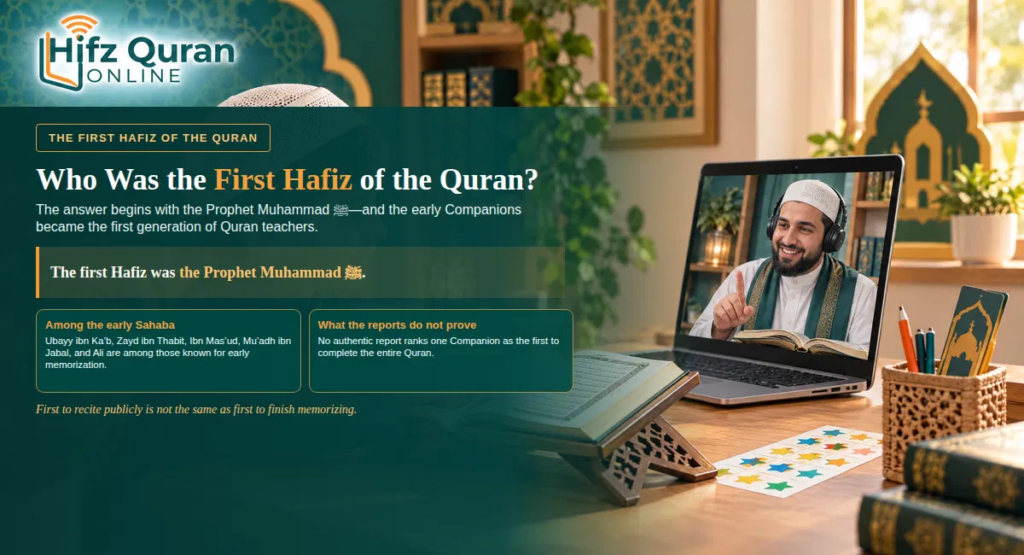
The first hafiz of the Quran was the Prophet Muhammad ﷺ. Allah promised to gather the Quran in his heart and help him recite it (Quran 75:16-19).
Among the Sahaba, no authentic report names one person as the first to finish. Two points help explain this.
The first verses came to the Prophet ﷺ in the cave of Hira. At first, he moved his tongue fast while Jibril recited, so he would not forget. Allah then told him to listen first, because the Quran would stay in his heart (Sahih al-Bukhari 4927).
After that, he listened, and then recited just as Jibril did. He also recited long parts of the Quran in his night prayers.
The First Sahaba Known To Memorize The Quran
Some Companions are well known for memorizing early. They include Ubayy ibn Ka’b, Zayd ibn Thabit, Abdullah ibn Mas’ud, and Mu’adh ibn Jabal.
Ali ibn Abi Talib is also named. Some reports say he finished while the Prophet ﷺ was alive, and others say after. Ubayy stands out most. The Prophet ﷺ called him the best reciter in the Ummah (Jami’ al-Tirmidhi 3790). His title was “sayyid al-qurra’,” the master of reciters.
Ibn Mas’ud spoke about his own knowledge with confidence. He said he knew where and why each surah came down (Sahih al-Bukhari 5002). Zayd ibn Thabit wrote down verses as soon as they came. Mu’adh was trusted to teach others even while he was young. Together, they formed the first group of Quran teachers.
Ibn Mas’ud accepted Islam very early and learned in Makkah, years before the Hijrah. Ali grew up in the Prophet’s ﷺ home, so he heard the Quran from the very start.
Zayd was so quick that he learned to read the letters of the Jews in about half a month when the Prophet ﷺ asked him (Jami’ al-Tirmidhi 2715). Scholars agree these men were among the earliest. But no report ranks them by who finished first.
Who Was The First To Recite The Quran In Public?
Some articles say Ibn Mas’ud was the first hafiz. That is not exactly what the sources say. Ibn Ishaq reports that he was the first to recite the Quran out loud near the Ka’bah (Sirat Ibn Hisham). He was hit for doing it.
Abu Bakr (RA) also recited in a small prayer spot at his home in Makkah (Sahih al-Bukhari 3905). People gathered to listen. These reports show early courage in reciting. They do not prove who finished the whole Quran first.
Ibn Mas’ud chose Surah ar-Rahman for his recitation at the Ka’bah. He came back with marks on his face, but he said he would do it again.
Abu Bakr cried often when he recited. Women and children from Quraysh came to hear him. The leaders of Quraysh grew worried that his recitation would win people over.
Ibn Mas’ud had no strong tribe to protect him, so others feared for his life. He still stood at the Ka’bah in the morning while the leaders of Quraysh sat nearby. Abu Bakr was under the protection of a man named Ibn al-Daghinah.
When crowds kept gathering to hear Abu Bakr, Quraysh asked Ibn al-Daghinah to stop him. Abu Bakr chose to give back that protection and rely on Allah alone (Sahih al-Bukhari 3905).
How Scholars Know Some Names Of Sahaba Huffaz But Not All
The early books were never written to count the huffaz. They recorded teachers, chains, and events instead.
Memorizing the Quran was normal for the Sahaba. They learned from the Prophet ﷺ and from each other. Later, they moved to many cities, like Kufa, Basra, Damascus, and Egypt.
Al-Dhahabi gave a helpful rule (Ma’rifat al-Qurra’ al-Kibar). The reciters he named had teaching chains that reached later students. Many others memorized the Quran, but no chain from them was recorded. So scholars can name about 30 people and still say the full number is unknown.
Al-Dhahabi named seven Companions whose chains reach the famous readers who came later. They were Uthman, Ali, Ubayy, Zayd ibn Thabit, Ibn Mas’ud, Abu al-Darda’, and Abu Musa. The Quran readings we hear today trace back to them. A person could be a hafiz without becoming a famous teacher. Such people were remembered for their faith, not listed in books.
How The Sahaba Kept The Quran Safe
A whole community kept the Quran safe, not a few people. That is one reason it was never lost. Allah promised to protect the Quran (Quran 15:9), and the Sahaba were part of how that promise came true. They protected it in five steps.
1. Many Sahaba memorized the Quran while the Prophet ﷺ was alive.
The Quran was first kept in people’s hearts. Many Companions knew it by heart, not just a few. If one person forgot a word, others would notice right away. This was the first and strongest layer of protection.
2. Scribes wrote down each verse as it came.
The Prophet ﷺ chose writers to record the revelation. Each new verse was written soon after it came down. These written pieces were kept as a second record beside what the Sahaba memorized. You will read more about how they wrote it below.
3. Abu Bakr gathered the written parts into one book.
After many huffaz died at Yamamah, Abu Bakr asked Zayd ibn Thabit to collect the Quran into one book.
Zayd said moving a mountain would have been easier for him (Sahih al-Bukhari 4986). He worried about doing something the Prophet ﷺ had not done. Abu Bakr and Umar explained why it was needed until Zayd agreed.
4. Uthman made copies and sent them to the main cities.
Uthman told the copying team to write in the dialect of Quraysh, because the Quran came down in that dialect (Sahih al-Bukhari 4987). He sent the copies to the main cities of the Muslim world.
Then he ordered other personal copies to be burned so people would not argue over the text. Ali later said Uthman did nothing with the copies without the agreement of the Sahaba (Ibn Abi Dawud, Kitab al-Masahif).
5. Huffaz in every generation passed it on.
Each copy was checked against what the huffaz knew by heart. Scholars call this kind of passing on “mutawatir,” which means it was passed on by so many people that a mistake could not spread. The spelling used in Uthman’s copies is called the Uthmani script. Printed copies of the Quran still follow it today.
All of this safety started with how each Companion learned the Quran in the first place. The next sections explain how the Sahaba memorized the Quran, wrote it down, and reviewed it, and the simple steps they followed every day.
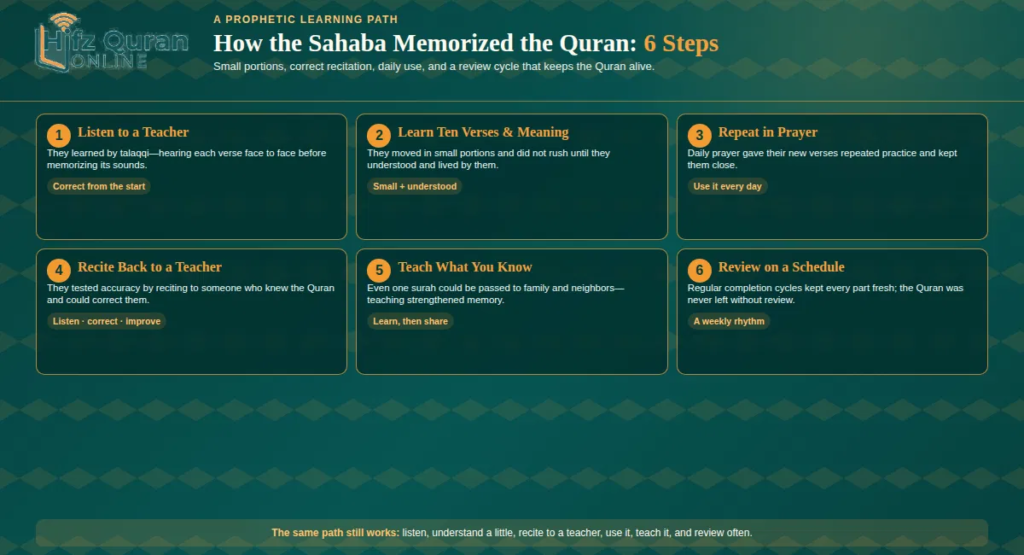
How Did The Sahaba Memorize The Quran? 6 Steps They Followed
The Sahaba followed a clear set of steps to memorize the Quran. They did not learn alone from a written page. They learned from a teacher, in small parts, and kept the verses alive by using them every day.
1. They Listened To The Verses From A Teacher First
The Sahaba heard each verse before they tried to memorize it. Scholars call this way of learning “talaqqi,” which means receiving the Quran face to face. Hearing the verse first taught them the right sounds from the start.
This kept mistakes from settling into their memory. Careful listening mattered even more because the Quran was taught in more than one approved way of reading.
Umar once heard Hisham ibn Hakim recite Surah al-Furqan differently from how he had learned it (Sahih al-Bukhari 4992). The Prophet ﷺ listened to both men and said each had recited it the way it was revealed.
2. They Took Ten Verses At A Time And Learned Their Meaning
The Sahaba did not rush to the next part. Abu Abd al-Rahman al-Sulami said they learned ten verses at a time and did not move on until they understood and lived by them (Tafsir al-Tabari, 1/80).
When they did not understand a verse, they asked. After verse 82 of Surah al-An’am came down, some Sahaba worried it meant no one was safe from wrongdoing (Sahih al-Bukhari 32). The Prophet ﷺ explained that the verse was about shirk, and their worry went away.
Later, Abu al-Darda’ taught more than 1,600 students in Damascus in groups of ten, each with a helper who fixed mistakes (al-Dhahabi, Ma’rifat al-Qurra’ al-Kibar, p. 20). Speed was never the goal. Imam Malik reports that Ibn Umar spent years learning Surah al-Baqarah alone (al-Muwatta).
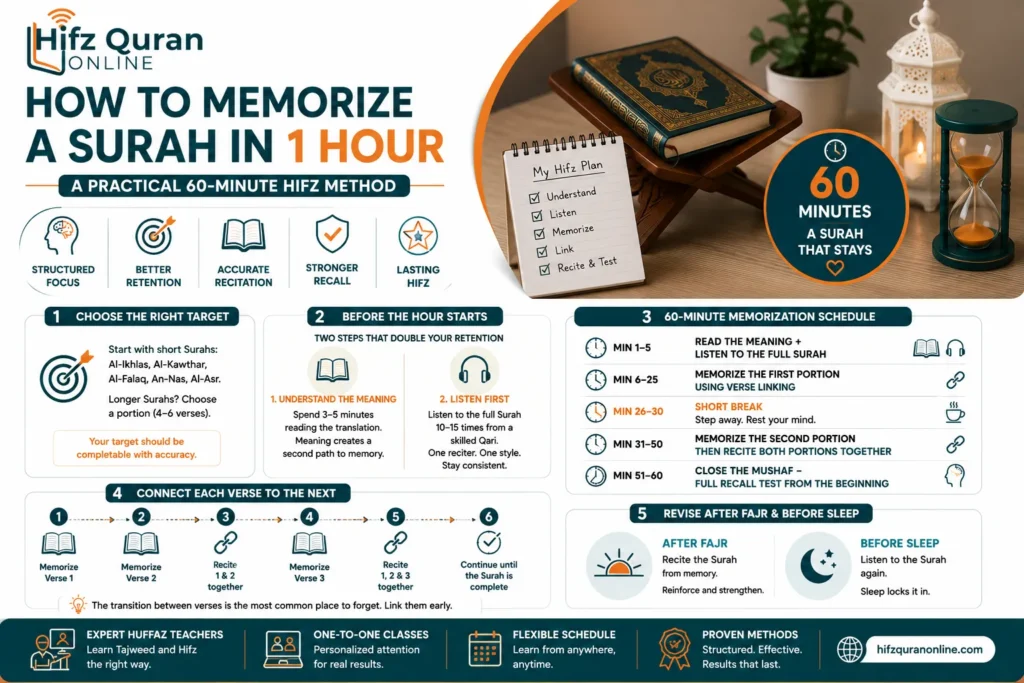
Want to try small daily steps yourself? Start with How To Memorize Juz Amma In 30 Days.
Every plan at Hifz Quran Online Academy follows this model of short portions and regular checks. You can see our plans and prices and pick the number of weekly classes that fits your time and budget.

3. They Repeated The Verses In Their Prayers
Prayer gave the Sahaba many chances to recite what they had learned. The Prophet ﷺ said that if a person who knows the Quran recites it by night and by day, he will remember it (Sahih Muslim 789). If he stops, he will forget it.
So the Sahaba made their new verses part of their daily prayers. Leading others in prayer was another way to practice. Mu’adh used to pray Isha with the Prophet ﷺ, then go back and lead his own people in the same prayer (Sahih al-Bukhari 705).
When he made it too long, the Prophet ﷺ told him to pick shorter surahs so the prayer stayed easy for everyone.
Memory grows stronger with repetition. You can see how this works today in our guide to the Rote Memorization Method for Quran.
4. They Recited The Verses Back To A Teacher
After memorizing, a student recited to someone who knew the Quran well. Even the Prophet ﷺ asked Ibn Mas’ud to recite to him. Ibn Mas’ud recited Surah an-Nisa, and the Prophet ﷺ cried when he reached verse 41 (Sahih al-Bukhari 5050).
Reciting to a listener showed whether the verses were truly correct. The Prophet ﷺ also listened to Abu Musa al-Ash’ari recite one night.
The next day, he told Abu Musa that he had been given a beautiful voice like the family of Prophet Dawud (Sahih al-Bukhari 5048). Kind words like these made the Sahaba want to recite even better.
The Sahaba also checked one another during prayer. Once the Prophet ﷺ left out a verse while leading the prayer, and when a man told him afterward, he asked why no one had reminded him (Sunan Abi Dawud 907). After that, people knew they should correct the imam when he made a mistake.
5. They Taught What They Learned To Others
Teaching helped the Sahaba hold on to the Quran. Before the Hijrah, the Prophet ﷺ sent Mus’ab ibn Umayr to Madinah to teach its people the Quran (Sahih al-Bukhari 3925). Each new student soon became a teacher too.
This is how the Quran spread so fast among the Muslims. The Prophet ﷺ told his followers to pass on what they learned from him, even if it was one verse (Sahih al-Bukhari 3461). So no one waited until he knew the whole Quran before teaching. A Companion who knew one surah would teach that surah to his family and neighbors.
6. They Finished The Whole Quran On A Regular Schedule
Review followed the example of the Prophet ﷺ himself. Jibril went over the Quran with him every Ramadan, and twice in his final year, a review scholars call “al-Ardah al-Akhirah” (Sahih al-Bukhari, Book of Virtues).
The Prophet ﷺ also warned that the Quran slips away faster than a camel from its rope (Sahih al-Bukhari 5033).
A steady plan kept every part of the Quran fresh. To finish in seven days, the Sahaba split the Quran into seven parts, one for each day of the week.
A man named Aws ibn Hudhayfah asked them how they did it, and they listed the groups of surahs they read each day (Sunan Abi Dawud 1393). These seven parts are the “manzil” divisions still marked in many copies of the Quran today.
These six steps still work today. A student who listens, learns a little, recites to a teacher, and reviews often follows the same path as the Sahaba.
Words are not enough?! Look and Judge
Watch how our teachers guide young learners in the Quran Memorization Course for Kids at Hifz Quran Online Academy. In this lesson, a student memorizes Surah An-Nazi’at step by step, using a simple method that makes each verse easier to remember.
Memorize the Quran at Your Own Pace
Join our expert tutors and begin your Hifz journey with a personalized plan.
Start Your Free TrialBook Your Free Trial Class With Hifz Quran Online Academy
The Sahaba memorized the Quran with a teacher who listened to every verse. You can learn the same way, from home. Here is what you get at Hifz Quran Online Academy:
- One-on-one classes: Your teacher listens to you alone and fixes every mistake.
- Expert Hifz teachers: You learn correct recitation while you memorize.
- A course for every learner: Choose from courses for kids, adults, sisters, and men.
- Flexible times: You choose class times that fit school, work, or family.
- A clear plan: You get set daily portions for new verses and for review.
- Learn from home: No travel, so you can study anywhere you have internet.
- Try before you pay: Book a free trial class and meet your teacher first.
Many people want to memorize the Quran but do not know where to start. Some tried alone and forgot what they learned. Others could not find a teacher near them. A set class time and a teacher who checks your work solve both problems. You can read what other students say on our reviews page.
Book your free trial today and start memorizing the Quran with a teacher by your side.

Our Quran Courses
- Quran Memorization Course
- Quran Memorization and Hifz Course for Kids
- Online Quran Memorization Courses for Adults
- Quran Hifz Course for Ladies
- Quran Memorization Course for Men
- Saudi-Based Quran Memorization Courses
- Hifz Teachers
Conclusion
The honest answer to how many Sahaba memorized the Quran is that nobody knows the full count. We know some names, and we know the real number was large.
The four Ansar in the report of Anas were one group among many. The Prophet ﷺ himself was the first hafiz, and Ubayy ibn Ka’b led the Sahaba in recitation. Their way of learning still works: take a small part, recite it to a teacher, and review it often.
If you read a claim about this topic online, one simple test helps. Ask which group the report is talking about and why it gives a number. Most mistakes come from reading a short list as a full count. The safest answer is the one scholars gave: many Sahaba memorized the Quran, and only some of their names were recorded.
The bigger lesson is not the number itself. It is how a whole generation made the Quran part of daily life, in their homes, their mosques, and their travels. They did not wait to become scholars before they started. Each one began with whatever he or she could learn that day.
Men and women, young and old, all took part in this work. Some taught in Madinah, and others carried the Quran to Iraq, Syria, and Yemen. Their care is the reason the Quran reached us without change. Every new hafiz today joins a chain that goes back to them. That chain can start with a single short surah.
FAQs
Want to know more about Sahaba who memorized the Quran? Read these questions and answers.
How Many Sahaba Memorized The Quran In Total?
No one knows the exact total. Scholars name about 30 well-known Companions. Many more memorized the Quran, but their names were not recorded.
Did Only Four Sahaba Memorize The Quran?
No, many more than four Sahaba memorized the Quran. The famous report of four speaks only about men from the Ansar. Other Companions from Makkah and Madinah memorized it too.
Who Was The First Hafiz Of The Quran?
The first hafiz was the Prophet Muhammad ﷺ. Among the Sahaba, well-known early memorizers include Ubayy ibn Ka’b, Zayd ibn Thabit, Ibn Mas’ud, Ali, and others.
Did Women Companions Memorize The Quran?
Yes, women Companions memorized the Quran. Scholars name Aisha, Hafsa, and Umm Salamah. Some later scholars also name Umm Waraqah.
Who Was The Best Quran Reciter Among The Sahaba?
Ubayy ibn Ka’b was the best Quran reciter among the Sahaba. The Prophet ﷺ gave him this praise himself. People called him the master of recite.
How Did The Sahaba Memorize The Quran?
The Sahaba memorized the Quran in small portions, often about ten ayat at a time. They did not move on until they had learned the meaning of those ayat and put them into practice. They also kept their hifz strong by reciting it often in their prayers.





Leave a Reply