 Memorizing Quran
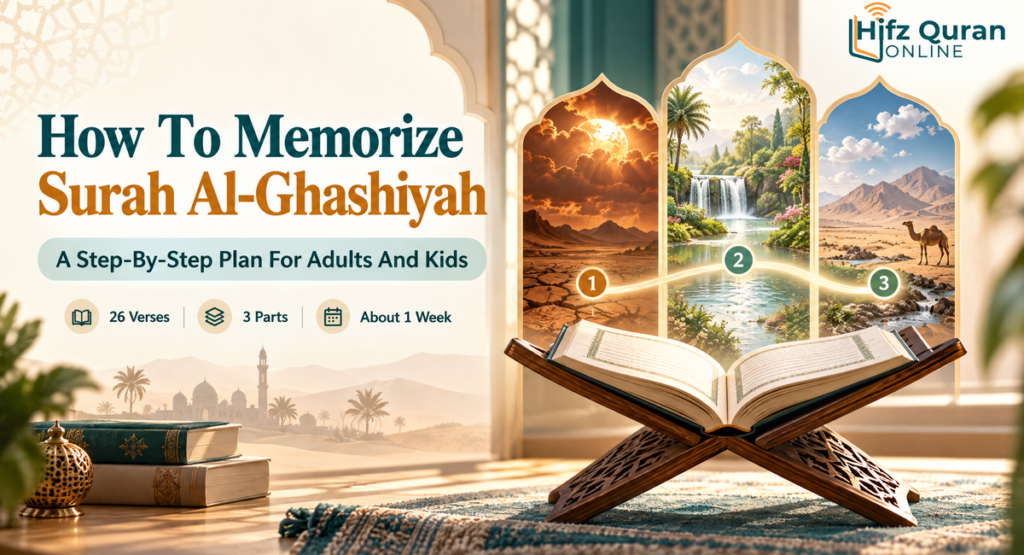
To memorize Surah Al-Ghashiyah, listen to a good reciter first. Then split the surah into three parts: verses 1–7, 8–16, and 17–26. Learn what each part means. Repeat one part at a time until you can say it without looking.
Last, join the parts and recite the whole surah in your prayers. With 20–30 minutes a day, most learners can memorize it in about a week.
Surah Al-Ghashiyah is the 88th surah of the Quran. It has 26 short verses and is in Juz 30 (Juz ‘Amma). Its name means “The Overwhelming.” This is a name for the Day of Judgment. The surah tells a clear story in three scenes. When you follow the story, the verses become much easier to remember.
Step 1: Listen To One Reciter Before You Start Memorizing
Start by listening before you memorize. If you memorize a word wrong on day one, it is hard to fix later. Pick one reciter and use only that reciter for the whole surah. This helps your ear learn one steady rhythm. Read along in a mushaf while you listen. You can listen and read along on Quran.com.
Listen to the full surah three or four times before you try to memorize anything. Pay attention to where the reciter pauses and where he stretches a sound. Choose a reciter with a calm, clear pace. A slow reciter gives you time to hear every letter. Use headphones if you can, so small sounds are easier to catch.
You may already know how this surah sounds. The Prophet ﷺ used to recite it with Surah Al-A’la in the Friday and Eid prayers (Sahih Muslim, 878). Many people have heard it often in the mosque, and that gives you a head start.
Step 2: Split Surah Al-Ghashiyah Into 3 Short Parts
Surah Al-Ghashiyah has three parts. Each part is one scene with one idea. Learning by scene is easier than learning a long list of lines.
Small parts are easier for the brain to hold than one big block. When one part feels solid, you feel progress, and that keeps you going. Each part here is short: 7, 9, and 10 verses. You can finish one part in a single sitting. If a part still feels too long, cut it in half for now.
Part 1 (verses 1–7): what happens to the people of the Fire
This part has 7 short verses, and most learners can finish it in one session. Verses 6 and 7 are the longest in this part, so give them a few extra repetitions. .
هَلْ أَتَاكَ حَدِيثُ الْغَاشِيَةِ (1) وُجُوهٌ يَوْمَئِذٍ خَاشِعَةٌ (2) عَامِلَةٌ نَاصِبَةٌ (3) تَصْلَىٰ نَارًا حَامِيَةً (4) تُسْقَىٰ مِنْ عَيْنٍ آنِيَةٍ (5) لَيْسَ لَهُمْ طَعَامٌ إِلَّا مِنْ ضَرِيعٍ (6) لَا يُسْمِنُ وَلَا يُغْنِي مِنْ جُوعٍ (7)
“Has there reached you the report of the Overwhelming [Calamity]? Some faces, that Day, will be humbled, working, exhausted. They will enter a scorching fire. They will be given drink from a boiling spring. For them there will be no food except from a poisonous, thorny plant which neither nourishes nor avails against hunger.”
Part 2 (verses 8–16): what Paradise is like
This part has 9 verses, and verses 12–16 are only two or three words each. Say them slowly as one group, because short verses move fast and are easy to skip.
وُجُوهٌ يَوْمَئِذٍ نَاعِمَةٌ (8) لِسَعْيِهَا رَاضِيَةٌ (9) فِي جَنَّةٍ عَالِيَةٍ (10) لَا تَسْمَعُ فِيهَا لَاغِيَةً (11) فِيهَا عَيْنٌ جَارِيَةٌ (12) فِيهَا سُرُرٌ مَرْفُوعَةٌ (13) وَأَكْوَابٌ مَوْضُوعَةٌ (14) وَنَمَارِقُ مَصْفُوفَةٌ (15) وَزَرَابِيُّ مَبْثُوثَةٌ (16)
“Other faces, that Day, will be joyful, pleased with their effort, in an elevated garden, wherein they will hear no unsuitable speech. Within it is a flowing spring. Within it are raised couches and cups put in place and cushions lined up and carpets spread about.”
Part 3 (verses 17–26): Allah’s signs and our return to Him
This is the longest part, with 10 verses, so learn it in two halves: verses 17–20, then verses 21–26. Make sure each half is steady on its own before you join them.
أَفَلَا يَنْظُرُونَ إِلَى الْإِبِلِ كَيْفَ خُلِقَتْ (17) وَإِلَى السَّمَاءِ كَيْفَ رُفِعَتْ (18) وَإِلَى الْجِبَالِ كَيْفَ نُصِبَتْ (19) وَإِلَى الْأَرْضِ كَيْفَ سُطِحَتْ (20) فَذَكِّرْ إِنَّمَا أَنْتَ مُذَكِّرٌ (21) لَسْتَ عَلَيْهِمْ بِمُسَيْطِرٍ (22) إِلَّا مَنْ تَوَلَّىٰ وَكَفَرَ (23) فَيُعَذِّبُهُ اللَّهُ الْعَذَابَ الْأَكْبَرَ (24) إِنَّ إِلَيْنَا إِيَابَهُمْ (25) ثُمَّ إِنَّ عَلَيْنَا حِسَابَهُمْ (26)
“Then do they not look at the camels – how they are created? And at the sky – how it is raised? And at the mountains – how they are erected? And at the earth – how it is spread out? So remind, [O Muhammad]; you are only a reminder. You are not over them a controller. However, he who turns away and disbelieves – then Allah will punish him with the greatest punishment. Indeed, to Us is their return. Then indeed, upon Us is their account.”
Step 3: Learn The Meaning Of Each Part In Simple English
Knowing the meaning helps you keep the verses in the right order. Each verse leads to the next one.
Part 1 (verses 1–7)
Allah asks if the news of the Overwhelming Day has reached you. On that Day, some faces will look low and tired. They will enter a very hot fire. They will drink from a boiling spring. Their only food will be a bitter, thorny plant. It does not feed them or stop their hunger.
Part 2 (verses 8–16)
Other faces will shine with joy. They will be happy with the good they did. They will live in a high garden. They will hear no bad talk there. The garden has a flowing spring, raised beds, cups ready to use, cushions in rows, and soft carpets spread out.
Part 3 (verses 17–26)
Allah asks people to look at the camel, the sky, the mountains, and the earth. How were they made? Then Allah tells the Prophet ﷺ that his job is to remind people. Whoever turns away will face a great punishment. In the end, all people return to Allah, and He will judge them.
Read the meaning of a part before you start repeating it. Notice how Parts 1 and 2 mirror each other: tired faces, then happy faces; a hot spring, then a flowing spring; bad food, then cups ready to drink. This mirror makes Part 2 easier once Part 1 is done.
Try telling the meaning out loud in your own words. If you can tell the story without looking, the Arabic will follow more easily. Keep a simple translation next to your mushaf, so you can check a word when you forget it.

Step 4: Repeat Each Part About 10 Times Until You Can Say It Alone
Repetition is how the verses stay in your memory. Work on one part per session.
- Play the part and recite after the reciter. Start with about 10 times. Do more if it still feels weak.
- Close the mushaf and say the part from memory.
- Open the mushaf and check every word. Mark any spot where you paused.
- Practice only that spot a few more times. Then say the whole part again.
Say the verses out loud. Hearing your own voice gives your brain one more way to store the words. Build up slowly: verse 1, then verses 1–2, then verses 1–3, and so on. This way, every new verse is tied to the one before it. Count your repetitions on your fingers, so you don’t lose track.
Move on only when the part feels steady. Rushing ahead often means starting over.
Step 5: Use 4 Memory Hooks To Remember The Verse Order
Surah Al-Ghashiyah has patterns that act like hooks for your memory. Once you notice them, recall gets faster.
These hooks help most when you get stuck in the middle of a recitation. A hook gives you a clue when your mind goes blank. You don’t need to use all of them. Pick the two or three that feel natural to you. Over time, you will stop needing them, because the verses will flow on their own.
Hook 1: verses 2 and 8 start with the same words
Verses 2 and 8 both begin with “وُجُوهٌ يَوْمَئِذٍ” (faces on that Day). Think of them as two doors. The next word tells you which room you enter. “خَاشِعَةٌ” (low and humbled) leads to the Fire. “نَاعِمَةٌ” (shining with joy) leads to Paradise.
Hook 2: the verse endings change sound with the topic
Listen to the last sound of each verse. It tells you where you are:
| Verses | Ending sound | Examples |
| 1–5 and 8–16 | soft “-ah” | خَاشِعَةٌ، جَارِيَةٌ |
| 6–7 | “-ʿ” | ضَرِيعٍ، جُوعٍ |
| 17–20 | “-at” | خُلِقَتْ، رُفِعَتْ |
| 21–24 | “-r” | مُذَكِّرٌ، كَفَرَ |
| 25–26 | “-hum” | إِيَابَهُمْ، حِسَابَهُمْ |
If you get lost, ask yourself which sound you were on. That usually points to the next verse.
Hook 3: camel, sky, mountains, earth (look ahead, up, out, down)
Verses 17–20 name the camel, the sky, the mountains, and the earth. Picture yourself looking straight ahead at a camel. Then look up at the sky. Then look out at the mountains. Then look down at the ground. Ahead, up, out, down.
Hook 4: picture the room in Paradise (verses 13–16)
Verses 13–16 describe a room. First the raised beds, then the cups, then the cushions, then the carpets on the floor. Picture walking into the room and seeing each one from high to low. The four words also sound alike: مَرْفُوعَةٌ، مَوْضُوعَةٌ، مَصْفُوفَةٌ، مَبْثُوثَةٌ.
Memorize the Quran at Your Own Pace
Join our expert tutors and begin your Hifz journey with a personalized plan.
Start Your Free TrialStep 6: Avoid The 5 Verses People Mix Up Most
A few spots cause most mistakes in this surah. Know them before you start, and you will save weeks of fixing the same error.
| The mix-up | How to fix it |
| Jumping from verse 2 straight to verse 9 | Say verses 2 and 8 one after the other until the different endings feel clear. |
| Mixing verse 4 with Surah Al-Qari’ah | Here it is “نَارًا حَامِيَةً.” Al-Qari’ah ends with “نَارٌ حَامِيَةٌ” (101:11). Same words, different endings. |
| Changing the order of camel, sky, mountains, earth | Use the “ahead, up, out, down” picture. |
| Swapping verses 25 and 26 | People return first, then they are judged. “إِيَابَهُمْ” comes before “حِسَابَهُمْ.” |
| Forgetting “ثُمَّ” in verse 26 | This small word means “then.” Circle it in your mushaf. |
Keep a small note of every spot where you slip. After a few days, you will see your mistakes repeat in the same places. Give those places extra practice. Use a pencil to circle them in your mushaf. When a circled spot stays correct for a full week, erase the mark.
Get your mistakes fixed live by a Hafiz teacher
Join the Online Quran Memorization (Hifz) Course at Hifz Quran Online Academy. Your Hafiz teacher listens to you live, fixes each mistake on the spot, and sets how much you memorize each day.

Step 7: Learn The 8 Tajweed Rules In Surah Al-Ghashiyah
Tajweed means reciting each letter the right way. Learn it while you memorize, so you never have to relearn the surah. You can see the surah with color-coded tajweed on Quranpedia.
| Rule | What it means | Examples in the surah |
| Idgham with ghunnah | Merge the “n” sound into the next letter (ي ن م و) with a hum through the nose | وُجُوهٌ يَوْمَئِذٍ (2, 8), عَامِلَةٌ نَاصِبَةٌ (3), سُرُرٌ مَرْفُوعَةٌ (13) |
| Idgham without ghunnah | Merge the “n” sound into ل or ر with no hum | مُذَكِّرٌ لَسْتَ (21–22, when joined) |
| Izhar | Say the “n” sound clearly before a throat letter | نَارًا حَامِيَةً (4), جَنَّةٍ عَالِيَةٍ (10) |
| Ikhfa | Hide the “n” sound softly, with a light hum | مِنْ ضَرِيعٍ (6), مِنْ جُوعٍ (7), مَنْ تَوَلَّىٰ (23) |
| Ghunnah on نّ | Hold the hum on a doubled noon | جَنَّةٍ (10), إِنَّ (25–26) |
| Natural madd | Stretch the long vowel for 2 counts | أَتَاكَ (1), فِيهَا (11–13) |
| Madd munfasil | Stretch a long vowel before a hamza in the next word, 4 or 5 counts in Hafs | إِلَيْنَا إِيَابَهُمْ (25) |
| Madd ‘arid lis-sukun | When you stop at a verse end, stretch 2, 4, or 6 counts | ضَرِيعٍ (6), جُوعٍ (7) |
For madd ‘arid, pick one length and keep it the same in every verse.
Learn one rule per session and listen for it in the reciter’s voice. Start with idgham and ikhfa, since they appear most in this surah. Tap a finger for each count when you stretch a madd. Record yourself on your phone and compare it with the reciter. You will often hear mistakes in the recording that you missed while reciting.
Choose your own tajweed teacher at Hifz Quran Online Academy. Our tutors are Ijazah-certified Huffaz, male and female, who correct your recitation live, verse by verse. Look at our teachers and pick yours.
Step Inside Our Virtual Classrooms
Don’t just take our word for it—see how our interactive sessions work! Watch the short clips below to experience our engaging teaching methods, live teacher-student interactions, and the supportive learning environment we bring to every student.
Step 8: Follow This 7-Day Plan To Join The Parts
Memory breaks most often where one part ends and the next begins. Before you learn a new part, say the old part first and flow into the new one.
| Day | New verses | Review |
| 1 | 1–7 | None |
| 2 | 8–12 | 1–7 |
| 3 | 13–16 | 1–12, then flow into 13–16 |
| 4 | 17–20 | 1–16 |
| 5 | 21–26 | 1–20 |
| 6 | None | Whole surah twice from memory |
| 7 | None | Whole surah to a teacher or family member, then in prayer |
Practice the joins on their own too. Say verses 7 and 8 together ten times, then verses 16 and 17. These are the two places where the scene changes. Some learners write the first word of each part on a small card and use it as a prompt. If you miss a day, pick up where you stopped instead of skipping ahead.
Step 9: Recite It In Prayer And Review It On A Schedule
What you use, you keep. Saying the surah in prayer makes you recall it with no mushaf in front of you. Start with a sunnah prayer, where a pause feels less stressful. Once it flows, recite it in a fard prayer. Prayer also adds focus, because you are standing before Allah.
Review on a growing schedule. Go over it one hour after you memorize it, then the next day, then after 3 days, 7 days, and 30 days. Each review is a little easier than the last. Set a fixed weekly review day, like Friday, so it becomes a habit. Our guide on how to memorize Quran without forgetting explains this review method in more detail.
7 Mistakes That Slow Down Your Memorization Of Surah Al-Ghashiyah
Some habits quietly slow learners down. Watch for these:
- Learning too many verses in one sitting. A big portion feels good today and falls apart next week.
- Memorizing when you are tired or in a rush. A tired mind holds far less. Pick a quiet time, like after Fajr.
- Using a different mushaf or screen each time. Your eyes remember where verses sit on the page, so stay with one print.
- Leaving a mistake “for later.” The longer you repeat an error, the deeper it sets.
- Learning only by audio. Look at the written words too, so you remember the spelling and the page.
- Only reciting to yourself. Another listener catches small errors your own ear misses.
- Practicing only when you feel like it. A fixed daily time works better than waiting for motivation.
How to teach Surah Al-Ghashiyah to kids: 6 simple tips
Children need more play and praise than adults do. These tips add fun to the steps above, so your child wants to come back each day.

- Take turns with each verse. You say the first half, and your child finishes it. Then switch roles.
- Clap at the end of every verse. This helps your child feel where each verse stops and keeps them active.
- Use a sticker chart. Give one sticker for each verse your child can say alone, and a big reward when all 26 are done.
- Make a mistake on purpose. Skip a word or swap two verses, and let your child catch it. Kids love correcting adults, and it shows they really know the verses.
- Recite it out loud in your own prayer. When your child hears you recite it in Maghrib or Isha, it becomes part of home life, not just a lesson.
- Praise effort, not speed. Never compare your child with a sibling or friend. Stop while it is still fun, so the next session starts with a smile.
Why Surah Al-Ghashiyah Was Revealed (And How This Helps You Memorize It)
Surah Al-Ghashiyah was revealed in Makkah, before the Hijrah. According to Tafsir Ibn Ashur, scholars agree it is a Makkan surah, revealed early in the Prophet’s ﷺ mission to answer people who denied life after death and mocked the warnings.
At that time, Muslims were few, and many people in Makkah rejected the message. The surah answers them by showing what will happen on the Day of Judgment.
Scholars do not report one single event behind the whole surah. Its message fits the needs of that time. It warns those who turn away and gives hope to those who believe.
It also comforts the Prophet ﷺ. Ibn Ashur explains that verses 21 and 22 console the Prophet ﷺ and tell him to keep reminding people, because his duty is only to warn.
There is one report about verse 17. In Tafsir al-Tabari, the Tabi’i Qatadah says that when Allah described the blessings of Paradise, the people who had gone astray were amazed by it, so Allah revealed: “Do they not look at the camels, how they were created?”
Tafsir al-Baghawi adds another detail from Qatadah: when Allah mentioned the raised couches of Paradise, they asked how they could ever climb up to them, and this verse came as the answer.
The point is simple. Al-Tabari explains that the One who created the camel and made it kneel to carry heavy loads, then rise, will find nothing hard in creating what He described of Paradise and the Fire. Note that this is a report from a scholar of the early generation, not a hadith from the Prophet ﷺ.
This background also helps your memory. It explains why the surah moves from the raised couches of Paradise straight to the camel. The jump that seemed sudden now makes sense.
Have a closer look inside our real classes
Watch how our teachers guide young learners in the Quran Memorization Course for Kids at Hifz Quran Online Academy. In this lesson, a student memorizes Surah An-Nazi’at step by step, using a simple method that makes each verse easier to remember.
Memorize the Quran at Your Own Pace
Join our expert tutors and begin your Hifz journey with a personalized plan.
Start Your Free TrialMemorize Faster With A One-To-One Hafiz Teacher At Hifz Quran Online Academy
Learning alone has a limit, because you cannot always hear your own mistakes. At Hifz Quran Online Academy, a teacher hears them for you and fixes them on the spot.
Here is what you get:
- One-to-one live classes, where your teacher focuses only on you.
- Ijazah-certified Huffaz who graduated from known Islamic universities.
- Male and female teachers, so women, girls, and families learn in comfort.
- Classes at any hour, 24/7, with 2 to 7 classes a week, weekends included.
- A plan built around your level, for both kids and adults.
- No Arabic needed to start. Teachers use the Talqin method and can begin with reading basics.
- Classes on any device through Zoom or Skype.
- A certificate signed by a supervisor when you finish a course.
- Discounts for families who learn together.
- No lock-in. You can cancel your package at any time.
Start with Surah Al-Ghashiyah. Then keep going through Juz ‘Amma and beyond.
Our Quran Courses
Can’t decide yet? Check our available courses and decide.
- Quran Memorization Course
- Quran Memorization and Hifz Course for Kids
- Online Quran Memorization Courses for Adults
- Quran Hifz Course for Ladies
- Quran Memorization Course for Men
- Saudi-Based Quran Memorization Courses
- Hifz Teachers
Conclusion
Surah Al-Ghashiyah is a strong first choice for anyone starting Hifz. Its verses are short and its words are simple. You will also hear it in the mosque on Fridays and Eids, which gives you free review all year.
The surah also teaches lessons that stay with you after you memorize it. It reminds you that every choice in this life leads somewhere.
It asks you to look at the world around you and see Allah’s power in a camel, the sky, a mountain, and the ground beneath you. It also shows how to remind others: with clear words and without force. When you recite it in prayer, these meanings come back to you each time.
Once this surah is set, you are ready for the next one. Surah Al-A’la comes before it and Surah Al-Fajr comes after it. Learning its neighbors helps you hold its place, and slowly the whole of Juz ‘Amma starts to connect. Many people who finish the full Quran started exactly this way, one short surah at a time.
If your goal is bigger, it helps to know where this path leads. Our article on who is a Hafiz explains what it means to carry the whole Quran in your heart, and why the title belongs to those who keep reviewing what they memorized.
So choose your reciter today and listen to verses 1–7. Tomorrow, begin repeating them. One week from now, Surah Al-Ghashiyah can be yours to recite for the rest of your life.
FAQs
Want to know more about Surah Al-Ghashiyah? Check these questions with their answers.
How Long Does It Take To Memorize Surah Al-Ghashiyah?
Memorizing Surah Al-Ghashiyah takes about a week for most beginners who practice daily. Some people need less time and some need more. It depends on how well you read Arabic and how often you practice.
Can I Memorize Surah Al-Ghashiyah If I Don’t Speak Arabic?
Yes, you can memorize Surah Al-Ghashiyah without speaking Arabic. Listen to a reciter, read the meaning in your language, and practice with a teacher who repeats each verse for you to copy.
What Is The Best Time To Memorize Surah Al-Ghashiyah?
The best time to memorize Surah Al-Ghashiyah is when your mind is fresh and quiet, such as after Fajr. Any time works if you use the same time every day.
How Do I Know I’ve Memorized Surah Al-Ghashiyah Well?
You have memorized Surah Al-Ghashiyah well when you can start from verse 8 or verse 17 without help. You should also be able to recite it in prayer with no pauses or mistakes.
Can I Memorize Surah Al-Ghashiyah Without A Teacher?
Yes, you can memorize Surah Al-Ghashiyah on your own using the steps above. A teacher is still useful for checking your tajweed and catching mistakes you can’t hear yourself
What Should I Memorize After Surah Al-Ghashiyah?
After Surah Al-Ghashiyah, memorize Surah Al-Fajr (89), which comes right after it. Then go back and learn Surah Al-A’la (87), which comes before it.
What Is The Main Message Of Surah Al-Ghashiyah?
The main message of Surah Al-Ghashiyah is that everyone will return to Allah and be judged. It shows two outcomes, the Fire and Paradise, and asks people to reflect on Allah’s creation.





Leave a Reply