 Memorizing Quran
Surah As-Saffat is the 37th surah of the Quran. It has 182 verses and was revealed in Makkah. Many Muslims want to memorize this surah. It carries core lessons about faith and the Hereafter, and it tells the stories of seven prophets in one place.
Once you know it by heart, you can recite these stories in your prayers and think about them during the day.
Every surah has its own challenges, and As-Saffat is no different. Some parts go fast. Other parts need more care. A good plan tells you which is which before you start, so you spend your time where it counts.
This guide gives you that plan in 5 steps. It works for beginners, for parents teaching their children, and for students who have already memorized other surahs
. After the steps, you will find the main tajweed rules, the mistakes students make most, and how long the whole surah takes.
Step 1: Split Surah As-Saffat Into 4 Parts By Topic
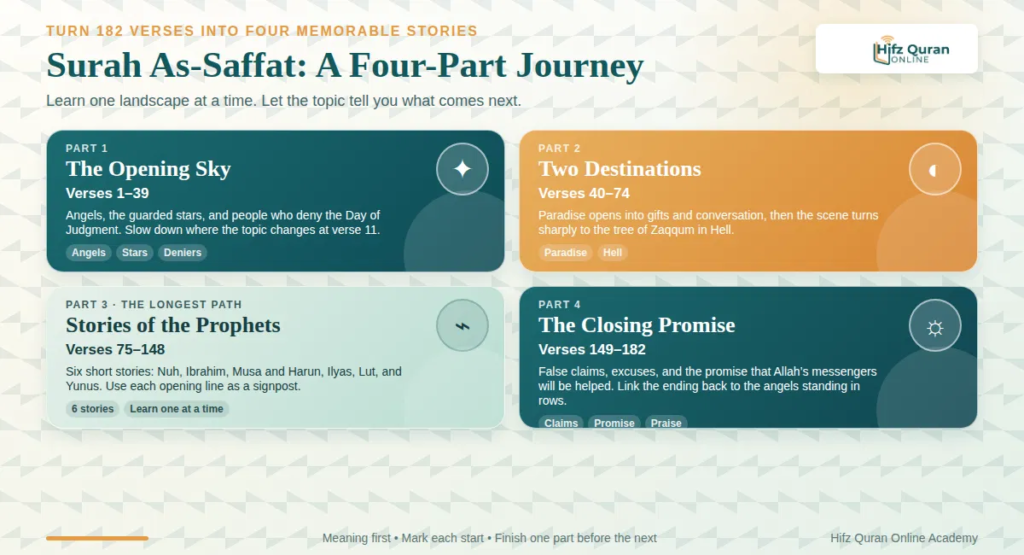
Don’t try to learn all 182 verses at once. Split the surah into 4 parts and learn one part at a time. Each part tells its own story, which makes the verses easier to keep in order.
A part of 35 or 39 verses is a goal you can reach in a few days. When you know the story in a part, you also know what comes next, so the next verse is easier to recall. And if one part feels weak later, you only need to fix that part.
Part 1: Verses 1 to 39 of Surah As-Saffat
The surah opens with the angels and then turns to the people who deny the Day of Judgment (39 verses). The first verses are very short, so this part moves quickly. Have a look at what is the topic of each group of these verses.
- Verses 1 to 3 are three oaths of only two words each, all ending with the same sound.
- Verses 6 to 10 describe the stars guarding the sky, so picture them as one scene.
- Verse 11 moves from the sky to the people who deny the Hereafter.
- Verses 22 to 33 show the leaders and their followers arguing.
- Verses 35 and 36 show the deniers rejecting “there is no god but Allah” and calling the Prophet ﷺ a mad poet.
- Verse 39 closes the part by telling them they will only be paid for what they did.
Slow down at verse 11, since that is where the topic changes. The argument in verses 22 to 33 is easier to hold if you learn it as a back-and-forth between two groups.
Part 2: Verses 40 to 74 of Surah As-Saffat
This part consists of 35 verses, and it is the shortest part. The verses move between Paradise and Hell (verses 40 to 74).
It opens and closes with the same words, إِلَّا عِبَادَ ٱللَّهِ ٱلْمُخْلَصِينَ (illa ‘ibadallahil-mukhlasin), which means “except the sincere servants of Allah.”
You will find them at verse 40 and again at verse 74, like a frame around the whole part.
Inside that frame, verses 41 to 49 list the gifts of Paradise one by one. Try counting them as you recite. Next, in verses 50 to 61, a man in Paradise talks about an old friend who mocked the Hereafter, so learn these verses as a conversation.
Be careful with verse 50, because it looks a lot like verse 27 (see Step 3). After the conversation, verses 62 to 68 jump to the tree of Zaqqum in Hell. That sharp change from Paradise to Hell makes the order easy to remember.
Part 3: Verses 75 to 148 of Surah As-Saffat
The longest part, at 74 verses, tells the stories of six prophets (verses 75 to 148). Learn one story at a time, and use its opening line to know where each one begins. Have a look at the following division to know which verses tell the story of which prophet.
- Nuh (75 to 82) opens with وَلَقَدْ نَادَىٰنَا نُوحٌ, “And Nuh had certainly called on Us.” This story goes with the actions of He calls, Allah rescues him, and the others drown.
- Ibrahim (83 to 113) starts at وَإِنَّ مِن شِيعَتِهِۦ لَإِبْرَٰهِيمَ, “And among those who followed his way was Ibrahim.” You can remember this story as it starts with idols, fire, dream, ransom, and then Ishaq.
- Musa and Harun (114 to 122) begins with وَلَقَدْ مَنَنَّا عَلَىٰ مُوسَىٰ وَهَٰرُونَ, “And We had certainly blessed Musa and Harun.” keep this story in your memory by memorizing that Allah gives the brothers four gifts: rescue, victory, the Book, and guidance.
- Ilyas (123 to 132) opens with وَإِنَّ إِلْيَاسَ لَمِنَ ٱلْمُرْسَلِينَ, “And Ilyas was surely one of the messengers.” The story starts with the prophet Ilyas questioning his people about the idol Ba’l, and they reject him.
- Lut (133 to 138) starts with وَإِنَّ لُوطًا لَّمِنَ ٱلْمُرْسَلِينَ, “And Lut was surely one of the messengers.” pay attention to this order in memorizing the verses His family is saved except an old woman, and travelers pass the ruins morning and night.
- Yunus (139 to 148) begins with وَإِنَّ يُونُسَ لَمِنَ ٱلْمُرْسَلِينَ, “And Yunus was surely one of the messengers.” The story includes the following events: Follow his path from the ship to the whale, the shore, the plant, and finally his people.
Ibrahim’s story is the longest, so split it in two, with the idols first and the sacrifice second. Lut’s is the shortest and can be learned in one sitting. Read Step 3 before you begin, because four of these stories end with almost the same words.
Part 4: Verses 149 to 182 of Surah As-Saffat
The last 34 verses answer false claims about Allah and bring the surah to its close (verses 149 to 182). The ideas come in a clear order. First come the claims, then an excuse, and then Allah’s promise.
- Verse 149 opens with questions to the people of Makkah about the angels.
- Verse 158 gives their claim that Allah has family ties with the jinn.
- Verses 165 and 166 have the angels saying they “stand in rows.”
- Verses 167 to 170 give their excuse that they would have been sincere servants if they had a holy book like earlier nations.
- Verses 171 to 173 bring the promise that Allah’s messengers will be helped and His army will win.
- Verses 174 to 179 contain two pairs of look-alike verses.
- Verses 180 to 182 are three short verses of praise.
Verses 165 and 166 explain the surah’s name, “those standing in rows,” from verse 1. This links the end of the surah back to its start. Go over the look-alike pairs in verses 174 to 179 a few extra times, since they are the last tricky spot before the easy closing verses.
Step 2: Listen And Repeat Each Page
Hear each page many times before you recite it alone. This stops you from learning wrong sounds that are hard to fix later.
- Pick a clear, slow reciter. Good choices are Sheikh Ayman Suwaid (Al-Mushaf Al-Mu’allim) or Sheikh Al-Husary. You can hear them and read along for free on Quran.com.
- Repeat after him 3 times while you look at the page.
- Read the page yourself a few more times.
- Cover the page and recite 3 to 5 verses. When they are firm, add the next few.
- Recite the whole page from memory. Then check it against the Mushaf.
Use the same Mushaf every time. Your eyes remember where each verse sits on the page. A new print breaks that memory.
Many students get stuck between verses, not inside them. Our guide on how to memorize a surah in 1 hour shows you how to link each verse to the next.
Not sure you’re saying the words right? At Hifz Quran Online Academy,you can look through our tutors, pick the one you like, and book your free trial class. Read your first page to your tutor and get feedback on the spot.
`
Step 3: Learn The Look-Alike Verses
Some verses in As-Saffat look almost the same. They are called mutashabihat, which means look-alike verses. Learn the small differences now, before they turn into habits.
TThe Same Ending in 4 Stories
The stories of Nuh, Ibrahim, Musa and Harun, and Ilyas all end in almost the same way. Learn this ending once, from Nuh’s story (verses 79 to 81):
“سَلَٰمٌ عَلَىٰ نُوحٍ فِى ٱلْعَٰلَمِينَ”
“Salamun ‘ala Nuhin fil-‘alamin”
“Peace be upon Nuh among all the worlds.”
“إِنَّا كَذَٰلِكَ نَجْزِى ٱلْمُحْسِنِينَ”
“Inna kadhalika najzil-muhsinin”
“This is how We reward those who do good.”
“إِنَّهُۥ مِنْ عِبَادِنَا ٱلْمُؤْمِنِينَ”
“Innahu min ‘ibadinal-mu’minin”
“He was one of Our believing servants.”
Lut and Yunus do not get this ending at all. Their stories just stop. If you start saying “Salamun ‘ala” after Lut or Yunus, you have gone wrong.
All the Tricky Spots in One Place
The table shows only the word that changes in each spot. Learn the left side and the right side as a pair.
| Where | What to watch | The different word |
|---|---|---|
| Nuh (verse 79) | Only Nuh has this extra phrase | فِى ٱلْعَٰلَمِينَ (fil-‘alamin), “among all the worlds” |
| Ibrahim (verse 110) | “Inna” is left out | No إِنَّا (Inna), “truly” |
| Musa and Harun (verse 122) | “He” becomes “they both” | إِنَّهُمَا (Innahuma), “they both were” |
| Ilyas (verse 130) | His name changes form | إِلْ يَاسِينَ (Il-yasin), not إِلْيَاسَ (Ilyas) |
| Verse 27 vs. verse 50 | The first letter changes | وَأَقْبَلَ (Wa aqbala), “And they turn,” in 27. فَأَقْبَلَ (Fa aqbala), “Then they turn,” in 50 |
| Verse 174 vs. verse 178 | The first letter changes | فَتَوَلَّ (Fa tawalla), “So turn away,” in 174. وَتَوَلَّ (Wa tawalla), “And turn away,” in 178 |
| Verse 175 vs. verse 179 | “Them” is dropped | وَأَبْصِرْهُمْ (Wa absirhum), “and watch them,” in 175. وَأَبْصِرْ (Wa absir), “and watch,” in 179 |
| “The sincere servants of Allah” | The first word changes | إِلَّا (Illa), “except,” in verses 40, 74, 128, and 160. لَكُنَّا (La-kunna), “we would have been,” in verse 169 |
A Simple Habit That Helps
Write each tricky spot in a notebook and circle the word that changes. Read that page before you review the surah.
Want someone to test you? At Hifz Quran Online Academy, you can look through our courses, pick the one that suits you, and book your slot. Your tutor will check your recitation of the prophets’ endings in your first class.

Read also: How to Memorize Surah Abasa Fast
Step 4: Pick A Daily Amount And Follow A Weekly Plan
Choose a daily amount that fits your level. Then follow a weekly plan that mixes new verses with review days. The times below include review days.
| Your level | New verses each day | About how long for the whole surah |
| Beginner or child | 5 to 6 verses | 5 to 6 weeks |
| Has memorized other surahs | Half a page | About 2 weeks |
| Strong and reviews daily | 1 page | About 1 week |
Try to finish each day at the end of a story, not in the middle.
Sample first week (half a page a day)
- Day 1: Verses 1 to 21
- Day 2: Verses 22 to 39, then recite 1 to 39
- Day 3: Verses 40 to 61
- Day 4: Verses 62 to 74, then recite 40 to 74
- Day 5: No new verses. Recite 1 to 74 twice.
- Day 6: Verses 75 to 98
- Day 7: Verses 99 to 113, then study the table in Step 3
Each day has two jobs: learn the new verses, then recite the verses from the day before. Learn the new verses when your mind is fresh, such as after Fajr, and recite them again before you sleep.
If the day’s verses are not firm by the evening, repeat that day tomorrow instead of moving on. Beginners can follow the same order but take two or three days for each day shown here. In week two, learn one prophet a day from Musa to Yunus, keep one day for review, and finish with Part 4.
To plan beyond this surah, see our Quran memorization schedule.
Step 5: Review Every Day So You Don’t Forget
Review in 3 layers each day. First, recite your new lesson, which is what you learned today. Next, review everything you learned in the last week. Last, review the surahs you finished before, in a set order, so older ones don’t fade.
When you recite your new verses, always join them to the verses right before them, because this keeps the links between the stories strong.
Recite the surah in your prayers too. Abdullah ibn Umar said the Prophet ﷺ told them to keep prayers short, but he would lead them in prayer with As-Saffat (Sunan an-Nasa’i 826). Reciting in prayer without the Mushaf also shows you which verses are still weak.
When you find a weak verse, put a small pencil dot next to it in your Mushaf and give it extra time the next day. Once a week, recite everything you have learned so far to a family member, a friend, or a teacher who can follow along in the Mushaf.
After you finish the whole surah, keep As-Saffat in your old review so you recite it at least once every week or two.
For a full review routine, read how to memorize Quran without forgetting.
Memorize the Quran at Your Own Pace
Join our expert tutors and begin your Hifz journey with a personalized plan.
Start Your Free TrialMain Tajweed Rules In Surah As-Saffat
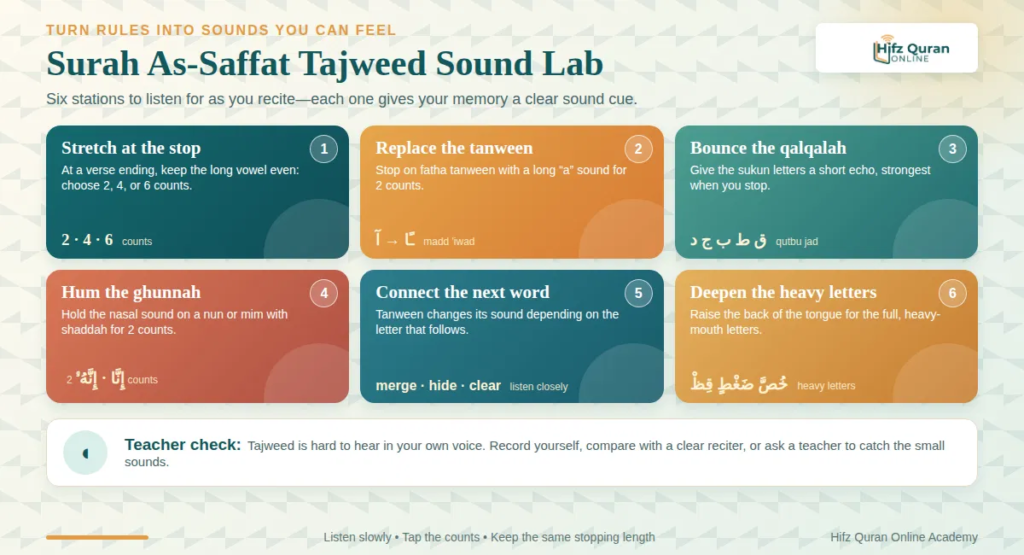
Surah As-Saffat has 6 main tajweed rules to watch. Each one below has an example from the surah. The examples follow the Hafs reading.
1. The Long Vowel At The End Of Verses (Madd ‘Arid Lis-Sukun)
Almost every verse in As-Saffat ends with a long vowel and a stop, like -in or -un. When you stop, you can stretch the vowel 2, 4, or 6 counts. Pick one length and keep it the same through the whole surah.
Example: verse 4, لَوَٰحِدٌ (la-wahid), and verse 5, ٱلْمَشَٰرِقِ (al-mashariq).
The name ‘arid means “passing,” because the long sound only comes from stopping. If you join a verse to the next one without stopping, the vowel goes back to its normal length of 2 counts.
You then say the vowel on the last letter too, as in لَوَٰحِدٌ, “la-wahidun.” All three lengths are correct in Hafs, so choose the one your teacher or reciter uses. Tapping a finger for each count helps you keep the length even.
2. Stopping On Tanween With Fatha (Madd ‘Iwad)
When a word ends with a fatha tanween (-an) and you stop on it, you say a long “a” for 2 counts instead.
Example: the first 3 verses end in صَفًّا (saffa), زَجْرًا (zajra), and ذِكْرًا (dhikra). You read them as “saffaa,” “zajraa,” and “dhikraa,” not “saffan.”
‘Iwad means “replacement,” because the long “a” takes the place of the tanween. In the Mushaf, these words have an extra alif after the last letter, as in صَفًّا, to remind you of the rule.
The rule only applies to fatha tanween. With damma or kasra tanween, you stop on a silent letter and drop the vowel. Words that end in ta marbuta (ة) are also different, because you stop on them with an “h” sound, as in وَٰحِدَةٌ (wahidah) in verse 19.
3. Qalqalah (The Bouncing Sound)
The letters qaf (ق), heavy ta (ط), ba (ب), jim (ج), and dal (د) get a small bounce when they have a sukun. The bounce is strongest when you stop on them at the end of a verse.
Example: verses 9 to 11 end in وَاصِبٌ (wasib), ثَاقِبٌ (thaqib), and لَّازِبٍ (lazib). Stop on each “b” with a clear bounce.
The five letters are easy to remember with the phrase قُطْبُ جَدٍّ, qutbu jad. The bounce is a short echo, not a new vowel, so don’t say “lazibu” or “lazibi.” A softer bounce happens in the middle of a word, as on the qaf in يُقْذَفُونَ (yuqdhafun) in verse 8.
The qaf at the end of ٱلْمَشَٰرِقِ (al-mashariq) in verse 5 also bounces when you stop on it. Practice these verses slowly until the bounce sounds the same each time.
4. Ghunnah On “Inna” And “Innahu”
A nun or mim with a shaddah gets a nasal sound (ghunnah) for 2 counts. As-Saffat uses إِنَّا (inna) and إِنَّهُۥ (innahu) many times, mostly in the prophets’ stories.
Example: إِنَّا كَذَٰلِكَ نَجْزِى ٱلْمُحْسِنِينَ, Inna kadhalika najzil-muhsinin (verse 80). Hold the “nn” in إِنَّا for 2 counts.
Ghunnah is a sound that comes out through the nose. To test it, pinch your nose while you say إِنَّا. If the sound stops, you are making the ghunnah. The same rule applies to a mim with shaddah, as in ثُمَّ (thumma) in verse 67. Keep the ghunnah at 2 counts even when you recite fast.
5. Tanween Meeting The Next Word
The sound of tanween changes based on the letter after it.
- Merging with ghunnah (idgham): عَذَابٌ وَاصِبٌ, ‘adhabun wasib (verse 9). The “n” merges into the “w” with a nasal sound.
- Merging without ghunnah: طِينٍ لَّازِبٍ, tinin lazib (verse 11). The “n” merges fully into the “l.”
- Hiding (ikhfa): شِهَابٌ ثَاقِبٌ, shihabun thaqib (verse 10). The “n” is half hidden before the “th.”
These rules also apply to a nun with sukun (نْ), not only to tanween. Merging with ghunnah happens before 4 letters: ya (ي), nun (ن), mim (م), and waw (و).
Merging without ghunnah happens only before lam (ل) and ra (ر). Before the throat letters, such as hamza (ء) and ‘ayn (ع), the “n” is said clearly, as in بِذِبْحٍ عَظِيمٍ, bi-dhibhin ‘azim (verse 107). Hiding happens before 15 letters, including tha (ث), sad (ص), and qaf (ق).
6. Heavy Letters
Some letters are said with a full, heavy mouth. The surah’s name starts with one of them: sad (ص). Say “Saffat” with a heavy “s,” not a light one.
Example: وَٱلصَّٰٓفَّٰتِ صَفًّا, was-saffati saffa (verse 1). Also watch the heavy letters in صِرَٰطِ ٱلْجَحِيمِ, sirat al-jahim (verse 23).
There are 7 heavy letters, gathered in the phrase خُصَّ ضَغْطٍ قِظْ, khussa daghtin qiz. To say them, raise the back of your tongue toward the roof of your mouth. Mixing up a heavy letter and a light one can change a word, as with sad (ص) and sin (س).
The ra (ر) and the lam in ٱللَّه (Allah) can also be heavy, depending on the vowel around them. In As-Saffat, watch the ghayn in غَوْلٌ (ghawl) in verse 47 and the qaf in ٱلْمَشَٰرِقِ (al-mashariq) in verse 5.
Tajweed is hard to check alone, because you can’t always hear your own mistakes.
Have a closer look inside our Tajweed Classes
look how our teachers simplify the information to make you practice diractly. In the video below, Throat and Tongue Letters | Advanced Tajweed Course, you can see and hear how each letter is made.
Main Mistakes When Memorizing Surah As-Saffat
These are the 5 mistakes that slow students down the most in this surah.
- Mixing up the prophets’ endings. Four stories end with almost the same verses. Fix: study the table in Step 3 before you start Part 3.
- Rushing through Part 3. It is the longest part, and speed makes the stories blur together. Fix: use the prophet-by-prophet split in Step 1.
- Stopping in the middle of a story. The next day, the two halves don’t connect well. Fix: follow the end-of-story tip in Step 4.
- Tajweed slips. The two most common are a light “s” instead of the heavy sad, and end vowels that change length from verse to verse. Fix: see tajweed rules 1 and 6 above.
- Learning new verses without review. New verses push out old ones. Fix: follow the 3 review layers in Step 5.
How Long Does It Take To Memorize Surah As-Saffat?
Many students can memorize Surah As-Saffat in 1 to 6 weeks. The table in Step 4 shows the time for each level.
To work out your own time, divide 182 by the number of verses you can learn each day. At 6 verses a day, for example, you need about 30 days of new learning. One review day each week brings that to about 5 weeks.
Your speed also depends on what you bring to the task. Students who have memorized other surahs usually move faster, because they already have a routine. Age and free time matter too, so a child or a busy adult may need a smaller daily amount.
On busy days, learn fewer verses rather than skipping the day. Mark each part you finish on a calendar so you can see your progress and adjust your pace. These times are starting points, not promises, and a firm surah is better than a fast one.
Is Surah As-Saffat Easy To Memorize?
Yes, Surah As-Saffat is one of the easier long surahs to memorize. It has 182 verses on only about 7 pages, so most verses are just a few words. Short verses are quicker to repeat, and you finish each page faster than in surahs with long verses.
The rhyme also works in your favor. When most verses end with the same sound, your ear expects that sound, and the next verse is easier to recall.
The surah’s one real challenge is the stories of the prophets, where several endings sound almost the same. Once you learn those differences, the rest of the surah usually comes quickly.
Common Misunderstandings About Surah As-Saffat
Some ideas about Surah As-Saffat spread online but are not correct. Watch for these 3.
1. “Reading It On Friday Brings Special Rewards”
There is no sound hadith that gives Surah As-Saffat its own special reward. Reports of special rewards for reading it on Friday, such as wealth or dying as a martyr, are weak. Don’t rely on them. The general reward for reading and memorizing the Quran still applies.
Most of these reports come from chains that are broken or weak, or from collections that hadith scholars do not accept. The surah that Muslims are taught to read on Friday is Surah Al-Kahf, based on hadith that scholars have graded as sound.
Scholars also warn against linking a reward to an act when the Prophet ﷺ did not link it. Even without a special reward, every letter you read from the Quran earns a good deed, and each good deed is multiplied by ten, as reported in Sunan at-Tirmidhi. If you see a post that promises a special reward for this surah, check its source with a trusted scholar before you share it.
2. “It Is A Special Surah For Ruqyah”
Because the surah mentions devils (verses 7 to 10), some people treat it as a special surah for driving away jinn. No sound text gives it this special role. You may read it in ruqyah like any other part of the Quran, as long as you don’t believe it has a fixed number or special power that was never proven.
Ruqyah means reciting the Quran and authentic du’a over someone to ask Allah for healing. The Quran as a whole is described as a healing for the believers (Surah Al-Isra, verse 82).
In sound hadith, the Prophet ﷺ named certain parts for protection, such as Ayat al-Kursi and the last two surahs, Al-Falaq and An-Nas. As-Saffat is not among the parts named for this purpose. Be careful of anyone who claims that reading it a set number of times is a sure cure, because healing comes from Allah alone.
3. “The Son In The Sacrifice Story Was Ishaq”
Most scholars say the son was Isma’il, not Ishaq, and the order of the verses supports this. The story begins when Allah gives Ibrahim the good news of a patient boy (verse 101). Only after the sacrifice story ends does Allah give him the good news of Ishaq:
وَبَشَّرْنَٰهُ بِإِسْحَٰقَ نَبِيًّا مِّنَ ٱلصَّٰلِحِينَ
Wa bashsharnahu bi-Ishaqa nabiyyan minas-salihin (verse 112)
Another surah adds a second reason. In Surah Hud, Allah promises that Ishaq will grow up and have a son, Ya’qub. A command to sacrifice Ishaq as a boy would not fit that promise.
The Quran does not name the son in this story, so the answer comes from reading the verses in order. Some early scholars said it was Ishaq, but Ibn Kathir and most later scholars held that it was Isma’il.
This is why Isma’il is often called adh-Dhabih, “the one who was to be sacrificed.” Muslims remember this event every year in the sacrifice of Eid al-Adha. Whichever view you read, the lesson of the story is the same: full trust in Allah’s command.
See Our Classes in Action
Curious about what a 1-on-1 Hifz session looks like? Take a look at these real-time snippets from our daily classes to see our student-centered approach, Tajweed correction techniques, and online whiteboard tools in action.
Memorize the Quran at Your Own Pace
Join our expert tutors and begin your Hifz journey with a personalized plan.
Start Your Free TrialLearn Surah As-Saffat With A Tutor
Many people can memorize alone. But some mistakes are hard to spot by yourself: wrong sounds, mixed-up verses, and weak links between stories. A teacher catches them on day one.
Hifz Quran Online Academy is built for one thing only: helping students memorize the Quran. It isn’t a general Islamic studies site with Hifz as one option among many. Every course and every tutor is focused on memorization.
- Tutors who know where students get stuck: Our tutors have guided many students through Hifz before you. They know the verses that cause trouble, like the look-alike endings in As-Saffat, and they fix problems before they become habits.
- A system that keeps what you learn: Each class follows the method Huffaz have used for centuries. You learn new verses, review the recent ones, and cycle back through older surahs, so As-Saffat stays with you after you finish it.
- Made for non-Arabic speakers: You don’t need to speak Arabic. Your tutor starts with correct sounds and tajweed first, so you memorize each word the right way from the start.
- One-on-one, live, and online: Every class is just you and your tutor, from home. Your tutor builds a plan for your level, age, and time, and tracks your progress class by class.
- Your first class is free: Meet your tutor, recite your first page of As-Saffat, and see how the classes work. There is nothing to lose.
Book your free trial class at Hifz Quran Online Academy and start As-Saffat this week.

Our Courses
Have a look at our courses and decide what you need.
- Quran Memorization Course
- Quran Memorization and Hifz Course for Kids
- Online Quran Memorization Courses for Adults
- Quran Hifz Course for Ladies
- Quran Memorization Course for Men
- Saudi-Based Quran Memorization Courses
- Hifz Teachers
Conclusion
Memorizing Surah As-Saffat comes down to a few clear habits. Split the surah into 4 parts. Learn each page by listening before you recite. Study the look-alike verses before they cause mistakes. Pick a daily amount you can keep, and review every day.
You don’t need to finish it all at once. Start today with verses 1 to 21. That is less than one page. Tomorrow, add the next few verses and recite them with what you learned today. Small steps, done every day, add up to the whole surah.
As you go, keep the meaning in front of you. Each part you learn is a lesson about Allah, the Hereafter, or the prophets. When you recite those verses in your prayer, you will know what you are saying.
If you want help, the free class above is a simple way to start.
FAQs
Look at the most common questions about Surah As-Saffat.
Can A Child Memorize Surah As-Saffat?
Yes, a child can memorize Surah As-Saffat. Start with Part 1, use the beginner pace from Step 4, and keep each sitting short so the child stays focused.
Should I Learn Surah Ya-Sin Before Surah As-Saffat?
You can learn them in any order. Learning Ya-Sin first helps, because its last verse leads straight into the first verse of As-Saffat in the Mushaf.
What Should I Do If I Forget A Verse In Surah As-Saffat?
If you forget a verse, go back to that verse only, not the whole surah. Listen to it, read it, and recite it until it is firm. Then recite it with the verses before and after it.
Can I Memorize Surah As-Saffat If I Don’t Speak Arabic?
Yes, you can memorize Surah As-Saffat without speaking Arabic. Focus on saying each word correctly first. Then read an English translation of each part so you know what the verses mean.
Do I Need To Know Tajweed Before I Memorize Surah As-Saffat?
You should be able to read the Quran with basic tajweed before you start. You can learn the finer rules as you go. Fixing a wrong sound early is much easier than fixing it after you have memorized it.
Can I Recite Surah As-Saffat In My Prayers Before I Finish Memorizing It?
Yes, you can recite any part of Surah As-Saffat in your prayers once you know it well. One prophet’s story makes a good length for one rak’ah. This also helps you review.
Can I Read Surah As-Saffat Every Day?
Yes, you can read Surah As-Saffat every day as part of your regular Quran reading. Reading it daily while you memorize it also works as extra review.
Related Articles
Memorizing Quran






Leave a Reply