 Memorizing Quran

Surah Talaq carries some of the most practical guidance in the entire Quran, yet many non-Arabic-speaking students avoid memorizing it because its legal vocabulary feels unfamiliar.
That hesitation is common, and it fades quickly once the surah is approached with the right method rather than sheer repetition.
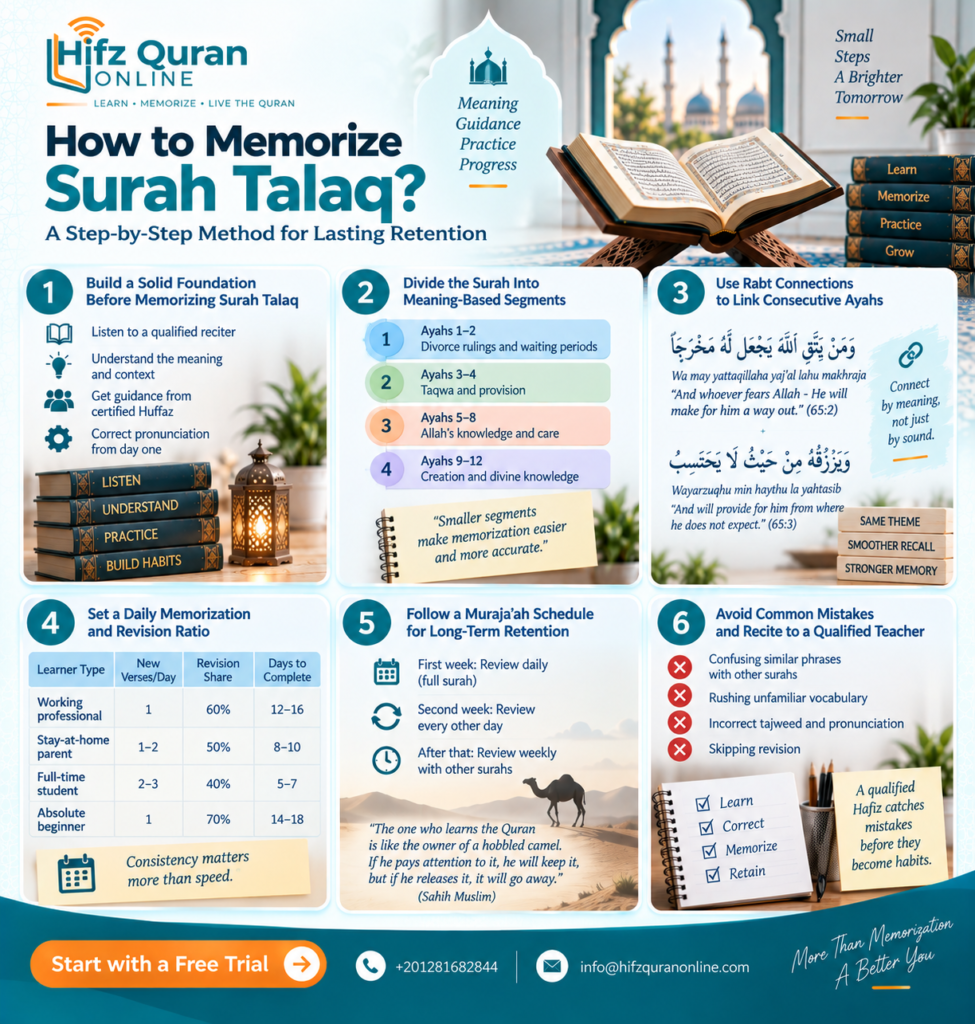
This guide breaks down how to memorize Surah Talaq using a structured, step-by-step method built for adult beginners with no Arabic background.
Each stage covers meaning-based segmentation, verse-linking, revision ratios, and mistake correction, so memorization becomes lasting rather than temporary.
1. Build a Strong Foundation Before Memorizing Surah At-Talaq
Memorizing Surah Talaq starts before the first ayah is ever repeated aloud, with listening, translation review, and pronunciation correction laid down first.
Students who skip this stage often memorize sounds without meaning, and that weakens retention within weeks.
At Hifz Quran Online Academy, the Quran Memorization Course builds this foundation properly, pairing students with certified Huffaz who correct pronunciation from the very first session rather than after mistakes have settled into habit.
This early correction matters more for Surah Talaq than for shorter, more familiar surahs.
Book a free trial for the Quran Memorization Course!
Listen to Surah At-Talaq Before Starting Repetition
A non-Arabic speaker who repeats verses without first listening to a qualified reciter tends to memorize their own mispronunciation instead of the correct sound. Ten to fifteen minutes of focused listening per verse, before attempting to recite it independently, prevents this from becoming a long-term habit.
2. Divide Surah At-Talaq into Meaning-Based Memorization Sections
Dividing Surah Talaq into meaning-based segments works far better than memorizing line by line without context, especially since the surah shifts between rulings, warnings, and reassurance across its twelve verses. Treating it as one continuous block overwhelms working memory.
A more effective approach groups the verses by theme: the opening rulings on divorce and waiting periods, the middle verses on taqwa and provision, and the closing verses on creation and divine knowledge. Each group is memorized as its own small unit before moving forward.
Choose Manageable Memorization Portions for Your Daily Schedule
Adult beginners with limited daily time generally retain two to three verses per segment more reliably than five or six.
Smaller segments reduce the mixing of similar phrasing, which is one of the more common struggles with legal or instructional surahs like this one.
Step Inside Our Virtual Classrooms
Don’t just take our word for it—see how our interactive sessions work! Watch the short clips below to experience our engaging teaching methods, live teacher-student interactions, and the supportive learning environment we bring to every student.
Memorize the Quran at Your Own Pace
Join our expert tutors and begin your Hifz journey with a personalized plan.
Start Your Free Trial3. Use Rabt to Connect the Ayahs of Surah At-Talaq
Using rabt, or connection-based linking, between consecutive ayahs in Surah Talaq prevents the verse-mixing that non-Arabic speakers frequently experience with thematically dense passages.
Rabt works by anchoring each verse to the one before it through a shared word, sound, or idea.
Surah Talaq offers a natural rabt opportunity around its second and third verses, where the promise of a way out connects directly to the promise of provision from an unexpected source.
Reading these two verses as a linked pair, rather than as separate lines, is why so many students remember them for years.
وَمَن يَتَّقِ ٱللَّهَ يَجْعَل لَّهُۥ مَخْرَجًا
Wa may yattaqillaha yaj’al lahu makhraja
“And whoever fears Allah – He will make for him a way out.” (At-Talaq 65:2)
The following verse continues this same promise by describing provision arriving from a source the person never expected, which is what makes the rabt connection so strong for memorization. Students in the Online Quran Memorization Courses for Adults are taught to build these links verse by verse rather than treating each ayah in isolation.
Enroll in our Quran Memorization Course for Adults With a Free Trial!
4. Balance New Memorization with Daily Revision
Setting a daily ratio between new memorization and revision is one of the most overlooked steps in Surah Talaq memorization, and it is often the reason students memorize quickly but forget just as fast.
A common mistake is spending nearly all available time on new verses and almost none on review.
The table below outlines a realistic ratio for different adult learners tackling a twelve-verse surah like this one, so students can set expectations before they begin rather than guessing partway through.
| Learner Type | New Verses Per Day | Revision Share Of Session | Realistic Days To Complete |
| Working professional, 20 minutes daily | 1 verse | 60% revision, 40% new | 12–16 days |
| Stay-at-home parent, 30–40 minutes daily | 1–2 verses | 50% revision, 50% new | 8–10 days |
| Full-time student, 45+ minutes daily | 2–3 verses | 40% revision, 60% new | 5–7 days |
| Absolute beginner, first surah memorized | 1 verse | 70% revision, 30% new | 14–18 days |
These figures assume consistent daily practice rather than occasional long sessions, since consistency affects retention far more than total weekly minutes. This is one of the core principles taught throughout the Quran Memorization Course.
5. Build a Muraja’ah Schedule to Retain Surah At-Talaq
Following a proper muraja’ah schedule after Surah Talaq is memorized is what separates students who retain it for years from those who lose it within months.
Muraja’ah, or systematic review, needs to be scheduled with the same seriousness as new memorization, not treated as an afterthought.
A workable schedule reviews Surah Talaq daily for the first week after completion, then every other day for the second week, then weekly alongside other recently memorized surahs.
This gradual spacing matches how memory naturally consolidates over time.
The Prophet Muhammad ﷺ described this exact struggle in a hadith that every Hifz student should keep in mind during revision:
“The one who learns the Quran is like the owner of a hobbled camel. If he pays attention to it, he will keep it, but if he releases it, it will go away.” (Sahih Muslim: 11-67)
This is exactly why revision is treated as seriously as new memorization inside the Quran Memorization and Hifz Course for Kids and the adult programs alike, with recently memorized portions cycled continuously alongside older ones rather than left to fade.
Start Your Child’s Quran Memorization Today with a Free Trial!
6. Avoid Common Mistakes When Memorizing Surah At-Talaq
Correcting mistakes early while memorizing Surah Talaq matters because non-Arabic speakers tend to repeat the same handful of errors across similar legal surahs.
These mistakes are predictable, and knowing them in advance prevents them from becoming permanent habits.
A. Avoid Confusing Similar Quranic Phrases
Surah Talaq contains phrasing patterns that sound close to those in other legal surahs, which can cause students to blend the two together during recitation.
Reading each surah’s translation side by side before memorizing helps the meaning stay distinct in memory.
B. Understand Unfamiliar Vocabulary Before Memorizing
Words tied to divorce and waiting periods are less familiar to everyday learners than words used in narrative surahs, and rushing past them without understanding usually causes recall to fail later. Slowing down on unfamiliar vocabulary during the first pass saves far more time than it costs.
7. Recite Surah At-Talaq to a Qualified Teacher for Accuracy
Confirming accuracy by reciting Surah At-Talaq to a qualified teacher is the step most self-taught students skip, and it is usually where hidden mistakes are finally caught.
Self-review alone rarely identifies pronunciation errors that have already become automatic.
One-on-one correction from a certified Hafiz who has completed their own memorization, rather than an instructor who studied Hifz theory only, catches these patterns quickly.
This personalized correction is the structure behind every session offered through Hifz Quran Online Academy.
Surah Talaq’s Legal Vocabulary Makes It Different From Most Beginner Surahs
Surah Talaq’s legal vocabulary sets it apart from the narrative or devotional surahs many students memorize first, since words tied to divorce rulings and waiting periods carry meanings that don’t come up in everyday conversation.
This is exactly why the foundation-building step at the start of this guide places listening and translation review before any repetition begins, since reciting unfamiliar legal terms without understanding them tends to produce memorization that fades quickly.
Students who have already memorized several narrative surahs sometimes find Surah Talaq more demanding than expected for this reason, even though its verse count is relatively short.
What Surah Talaq Teaches Us Beyond the Memorization Process?
Surah Talaq teaches real situations many people face directly: separation, provision, and trust in difficult circumstances.
Understanding these lessons deepens the meaning-based approach described in step one.
1. Trusting Allah Through Difficult Life Transitions
The surah’s central promise, that whoever is mindful of Allah will be given a way out and provided for from sources they never expected, speaks directly to anyone navigating hardship, not only those facing the specific rulings the surah addresses.
2. Handling Practical Matters With Both Compassion and Structure
Unlike surahs built around narrative or cosmic imagery, Surah Talaq shows the Quran addressing an ordinary, often painful, life situation with clear practical structure: waiting periods, fair treatment, and shared responsibility.
This balance between compassion and clear guidance is a recurring theme across the Quran’s legal surahs.
3. The Weight of Taqwa as a Practical, Not Just Spiritual Concept
The surah repeatedly ties taqwa, mindfulness of Allah, to real, tangible outcomes rather than abstract reward alone: a way out of hardship, ease in affairs, and provision.
This reframes taqwa as something with immediate practical relevance, not only a distant spiritual goal.
Step Inside Our Virtual Classrooms
Don’t just take our word for it—see how our interactive sessions work! Watch the short clips below to experience our engaging teaching methods, live teacher-student interactions, and the supportive learning environment we bring to every student.
Memorize the Quran at Your Own Pace
Join our expert tutors and begin your Hifz journey with a personalized plan.
Start Your Free TrialStart Your Surah Talaq Memorization With Guided One-on-One Support!
Memorizing Surah Talaq with proper meaning, correct pronunciation, and a lasting revision system is far easier with a certified Hafiz guiding every session. Hifz Quran Online Academy offers:
- 1-on-1 sessions personalized to your memory pace, not group-class compromises.
- Azhari-trained Huffaz who have completed their own full memorization.
- Specific, regular progress tracking instead of vague feedback
- Flexible scheduling across UK, USA, Canada, and Australia time zones.
Our Quran Courses
- Quran Memorization Course
- Quran Memorization and Hifz Course for Kids
- Online Quran Memorization Courses for Adults
- Quran Hifz Course for Ladies
- Quran Memorization Course for Men
- Saudi-Based Quran Memorization Courses
- Hifz Teachers
Book a free trial class today and begin your Surah Talaq memorization with proper structure from the very first session, Insha’Allah.
Book a Free Trial Class Today With Hifz Quran Online Academy!
Memorize the Quran at Your Own Pace
Join our expert tutors and begin your Hifz journey with a personalized plan.
Start Your Free TrialConclusion
Memorizing Surah Talaq becomes manageable once it is broken into meaning-based segments, linked through rabt connections, and paired with a realistic new-to-revision ratio from day one.
Muraja’ah scheduling and early mistake correction protect that memorization long after the twelve verses are first completed, turning short-term recall into lasting retention.
With guided correction and a personalized pace, most adult beginners complete and retain Surah Talaq far sooner than they initially expect, Insha’Allah.
Frequently Asked Questions
Is Surah Talaq Difficult For Non-Arabic Speakers To Memorize?
Surah Talaq is moderately challenging for non-Arabic speakers mainly due to its legal vocabulary, not its length, since it contains only twelve verses total. With meaning-based segmentation and rabt connections, most adult beginners complete it within one to two weeks of consistent practice.
Does Surah Talaq Need A Different Memorization Method Than Shorter Surahs?
Surah Talaq benefits from connection-based rabt techniques more than very short surahs do, because its verses shift between distinct legal and thematic ideas. Linking consecutive verses by shared meaning prevents the mixing that straight repetition alone tends to cause.
Can Working Professionals Realistically Complete Surah Talaq Memorization?
Working professionals can realistically complete Surah Talaq memorization within twelve to sixteen days using just twenty focused minutes daily, provided revision makes up the majority of each session. Consistency matters far more than session length for this pace to hold.
Should Memorization And Revision Be Split Evenly Every Day?
Revision should typically take up more daily time than new memorization, especially for beginners, with ratios closer to sixty or seventy percent revision being far more sustainable. Splitting time evenly often causes older verses to fade before new ones are secure.
Which Common Mistake Affects Surah Talaq Memorization The Most?
Rushing past unfamiliar legal vocabulary without reviewing its translation first is the mistake that affects Surah Talaq memorization most often among non-Arabic speakers. Slowing down during the first pass through unfamiliar words prevents recall failures during later revision cycles.
Related Articles
Memorizing Quran






Leave a Reply