 Memorizing Quran
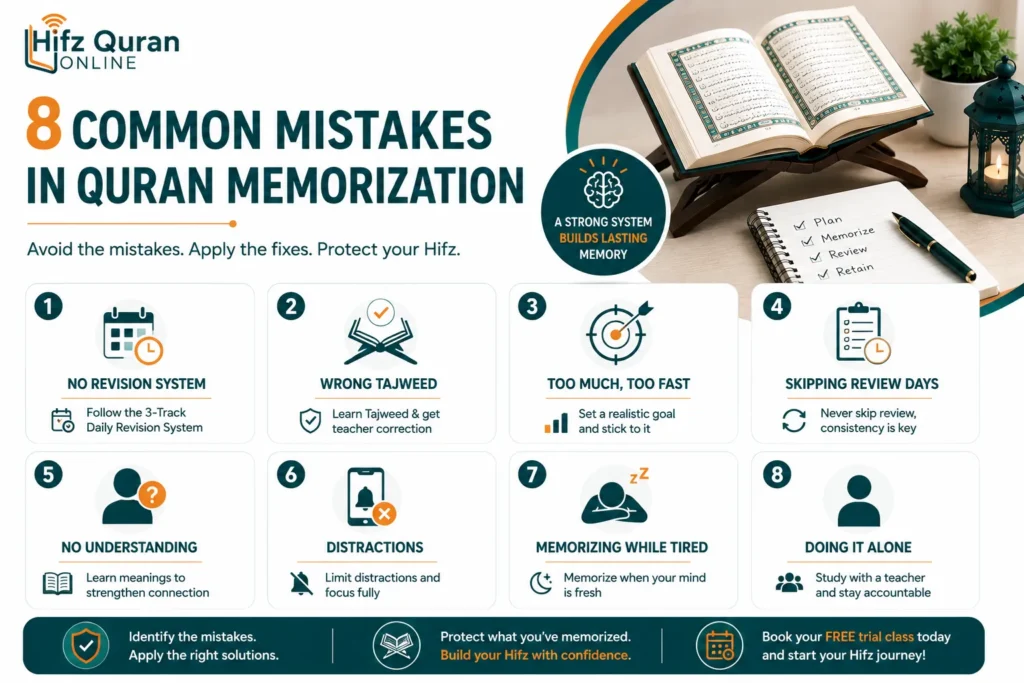
Most Hifz students who quit didn’t lack commitment. They lacked a system.
The Prophet Muhammad ﷺ gave glad tidings even to those who struggle with recitation — the one who recites with difficulty receives a double reward, one for reciting and one for the effort. Sincerity is never wasted. But the Prophet ﷺ also warned that the Quran slips from memory faster than a camel escapes its tether if it is not regularly maintained. Intention without structure is not enough.
The students who plateau, forget large portions, or abandon their Hifz journey entirely almost always share the same root cause: they are repeating a small set of undiagnosed mistakes that compound silently over months — until the damage becomes too large to ignore.
This guide names the eight most damaging mistakes, explains the mechanism behind each one, and gives you the specific correction to apply immediately.
1. Memorizing Without a Structured Daily Revision System
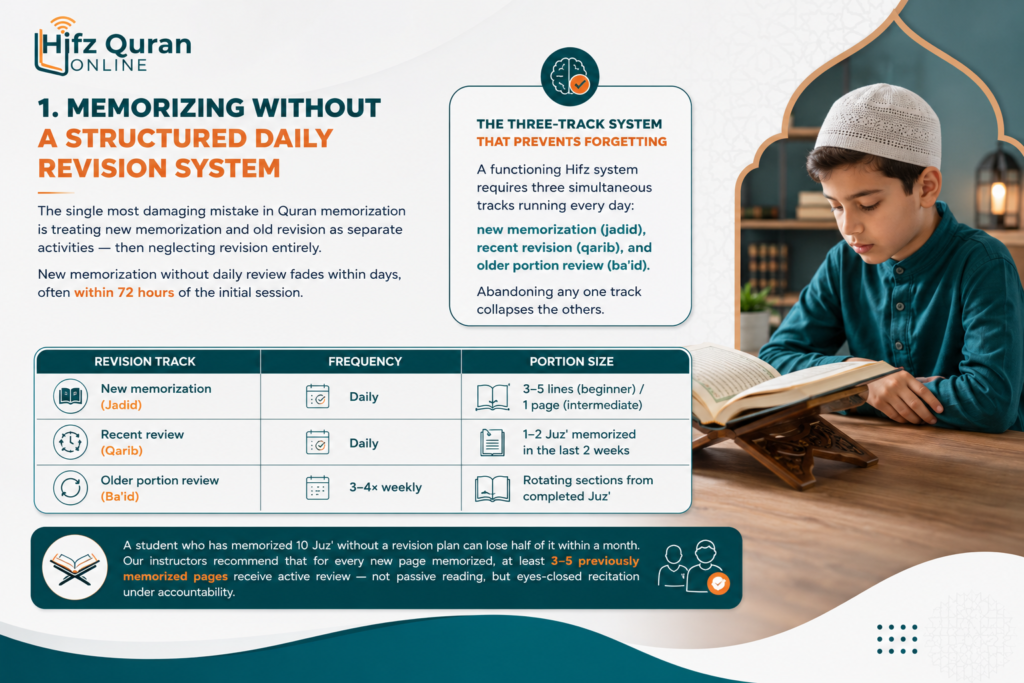
The single most damaging mistake in Quran memorization is treating new memorization and old revision as separate activities — then neglecting revision entirely. New memorization without daily review fades within days, often within 72 hours of the initial session.
The Three-Track System That Prevents Forgetting
A functioning Hifz system requires three simultaneous tracks running every day: new memorization (jadid), recent revision of the last one to two weeks (qarib), and older portion review (ba’id). Abandoning any one track collapses the others.
| Revision Track | Frequency | Portion Size |
| New memorization (Jadid) | Daily | 3–5 lines (beginner) / 1 page (intermediate) |
| Recent review (Qarib) | Daily | 1–2 Juz’ memorized in the last 2 weeks |
| Older portion review (Ba’id) | 3–4× weekly | Rotating sections from completed Juz’ |
A student who has memorized 10 Juz’ without a revision plan can lose half of it within a month. Our instructors recommend that for every new page memorized, at least 3–5 previously memorized pages receive active review — not passive reading, but eyes-closed recitation under accountability.
Read also: Written Quran Memorization Techniques
2. Memorizing With Incorrect Tajweed Permanently Embeds Errors Into Muscle Memory
Memorizing the Quran with incorrect Tajweed is never a minor issue. Some pronunciation mistakes can change the meaning of the Quranic text, while others may not alter the meaning but still compromise the proper manner in which the Quran was revealed to be recited.
In both cases, the mistake should never be repeated or ignored. Every repetition reinforces the error until it becomes part of the student’s muscle memory, making it increasingly difficult to correct later. For this reason, students should identify and correct recitation mistakes as early as possible, before a verse becomes firmly memorized.
To prevent Tajweed mistakes from becoming permanent habits, students should combine three essential practices throughout their Hifz journey:
Listen to a Precise Recitation Before Memorizing
Before committing any new verses to memory, listen to them several times from a highly accurate Quran reciter. Sheikh Mahmoud Khalil Al-Husary is widely recommended by Quran teachers because of his slow, clear, and precise application of Tajweed rules. Hearing the verses correctly before reciting them creates a reliable auditory model and greatly reduces the likelihood of memorizing incorrect pronunciation.
Learn the Essential Tajweed Rules and Makharij
Every Hifz student should build a solid foundation in the Makharij (points of articulation) of the Arabic letters and the core Tajweed rules before progressing through large portions of the Quran. At a minimum, students should understand the rules of Noon Sakinah and Tanween, Meem Sakinah, Ghunnah, Madd (elongation), Tafkhim and Tarqiq (heavy and light letters), and Waqf and Ibtida’ (stopping and starting). These fundamentals prevent pronunciation errors from becoming deeply ingrained through repetition.
Study Under a Qualified Quran Teacher
Even students who know the Tajweed rules often fail to notice their own mistakes. A qualified Quran teacher can identify subtle pronunciation errors, incorrect articulation, and Tajweed mistakes before they become permanent habits. Regular supervision and immediate correction ensure that every newly memorized verse is both accurate and retained correctly, making qualified teacher feedback one of the most effective safeguards against long-term memorization errors.
Correct Tajweed is the foundation of accurate Quran memorization. At Hifz Quran Online Academy, our qualified teachers combine one-on-one Tajweed correction, Makharij training, and structured Hifz lessons so every verse is memorized correctly before moving forward. Book a free trial class today and build your Hifz on a strong, authentic foundation

Memorize the Quran at Your Own Pace
Join our expert tutors and begin your Hifz journey with a personalized plan.
Start Your Free Trial3. Always Starting Revision From the Beginning of a Surah
One of the most common yet overlooked Hifz mistakes is always beginning revision from the first verse of a Surah. While this habit may create the impression of strong memorization, it often masks weak areas that receive far less review. As a result, the opening verses become highly familiar through constant repetition, while the middle and ending sections remain vulnerable to hesitation and forgetting.
A student may recite the beginning of Surah Al-Baqarah effortlessly, yet struggle to continue from a verse in the middle or end without first “building momentum” from the opening. This indicates that the memorization depends on sequence rather than genuine mastery.
Test Your Memorization From Random Starting Points
A stronger way to assess retention is to begin your revision from different places instead of always starting at Verse 1. Ask a teacher or study partner to choose a random verse, or select one yourself, then continue reciting from there. If you consistently hesitate when starting from unfamiliar points, those passages require additional review.
Review the Weakest Sections First
Rather than spending most of your revision time on verses you already know well, prioritize the sections where mistakes or hesitation occur. Mark difficult verses during revision and repeat them more frequently until they become as fluent as the beginning of the Surah. This targeted approach strengthens long-term retention far more effectively than repeatedly reciting the strongest portions.
Read also: Written Quran Memorization Techniques
Perform a Weekly Memorization Audit
Once a week, evaluate your memorization by reciting from random verses across different Surahs, rather than following the normal order. Any verse that requires prompting or more than a few seconds of recall should be added to your focused revision list for the following week. Regular self-testing exposes hidden weaknesses before they grow into major gaps.
Step Inside Our Virtual Classrooms
Don’t just take our word for it—see how our interactive sessions work! Watch the short clips below to experience our engaging teaching methods, live teacher-student interactions, and the supportive learning environment we bring to every student.
Memorize the Quran at Your Own Pace
Join our expert tutors and begin your Hifz journey with a personalized plan.
Start Your Free Trial4. Memorizing Faster Than Your Retention Can Hold Produces Fragile Progress That Collapses
The desire to complete Hifz quickly is understandable. But memorizing one page per day without solid retention is not progress — it is the accumulation of fragile material. Students who arrive having “memorized” five or six Juz’ but cannot recite from the middle of a Surah without collapsing are a consistent pattern.
Rushing the pace and setting a daily target beyond your actual absorption capacity does more harm than good. What follows is predictable: the memorization fades quickly, frustration sets in, and the student stops altogether. The cycle of overreach and collapse is one of the most common reasons Hifz journeys end prematurely — not lack of sincerity, but an unsustainable pace that was never calibrated to the student’s real capacity.
The governing principle is consistency before speed. A student who memorizes 5 lines per day with perfect retention will outperform a student memorizing one page per day with fragile retention within six months.
How to Set the Right Daily Target for You
The most reliable approach is to identify the amount you can memorize with genuine mastery — then hold that amount consistently before considering any increase. Consistency and quality of retention matter far more than volume. A modest target maintained without interruption will always outperform an ambitious one that resets every few weeks.
If you find it difficult to determine the right amount for your current capacity, do not guess — let your teacher decide for you. A qualified Hifz instructor can assess your retention speed, revision load, and schedule, and set a daily target that is both realistic and progressive. This is one of the most underused advantages of learning with a teacher rather than self-studying.
Realistic Daily Memorization Targets by Student Type
| Student Type | Recommended Daily New Memorization |
| Children (ages 6–12) | 3–5 lines with correct Tajweed |
| Teenagers (13–17) | Half page to one page |
| Working adults | 3–7 lines (quality over quantity) |
| Full-time Hifz students | 1–2 pages |
These targets are not restrictive — they are protective. Trying to exceed them without the revision system in place produces exactly the fragile memorization that students later have to spend months repairing.
If you are looking for a structured program that sets the right pace from day one — whether for yourself or your child — Hifz Quran Online Academy’s Online Quran Memorization Course for Kids pairs each student with a certified instructor who calibrates the daily target to the student’s individual ability, ensuring progress that is both consistent and lasting.
Start Your Child’s Hifz Journey Today]

5. Memorizing in Noisy or Inconsistent Environments
Memorization is a cognitive act that requires consistent sensory conditions. The brain encodes not just the content but the environmental context in which it was learned. Students who memorize in different locations, at different times, and with fluctuating background noise consistently report higher difficulty in retention and retrieval.
The practical recommendation is environmental consistency: same location, same time of day, same level of quiet, every session. Many students memorize most effectively in the 30–45 minutes following Fajr prayer — a time described in Islamic tradition as carrying particular blessing, and one that aligns with cognitive science research on memory consolidation after sleep.
If dedicated post-Fajr time is not possible, the critical variable is consistency of environment and time — not which specific time is chosen.
Read also: Visual Quran Memorization Technique – A Step-by-Step Guide
6. Memorizing Without Meaning Removes the Emotional Anchor That Makes Verses Stick
Memorization and meaning are not separate disciplines. When a student understands even the basic theme of what they are reciting, retention improves measurably. The emotional weight of the verse — understanding that the verse addresses a specific human condition — creates a depth of connection that pure phonetic repetition cannot replicate.
This does not require fluency in Arabic. A student who knows that Surah Ad-Duha was revealed to comfort the Prophet ﷺ during a period of sadness will remember it differently — and more durably — than one who recites it as sound alone.
Even brief engagement with a simplified Tafsir resource before memorizing a new section provides sufficient meaning-anchor to improve retention. Accessible resources include Tafsir al-Jalalayn, Al-Tafsir al-Muyassar, or a reliable translation read alongside memorization.
7. Relying Solely on Independent Study Without Qualified Teacher Accountability
Self-study tools — apps, recordings, YouTube recitations — are valuable supplements. They are not replacements for a qualified teacher. A student reciting alone has no mechanism for detecting their own mispronunciations, fluency gaps, or Waqf errors. These accumulate silently until they are discovered — often after hundreds of repetitions have already encoded them.
The tradition of Quran transmission through a qualified teacher (sanad) is not merely historical — it is pedagogically essential. A teacher provides real-time correction in every session, ensuring that what a student memorizes is what they will carry for life.
This is where a structured online Hifz program with certified instructors provides what solo study cannot: immediate error correction, accountability, and a revision structure that is monitored rather than self-managed.
Memorize the Quran at Your Own Pace
Join our expert tutors and begin your Hifz journey with a personalized plan.
Start Your Free Trial8. Stopping Repeatedly and Returning Without a Structured Re-Entry Plan
Interruptions in the Hifz journey are normal — life circumstances, academic pressure, illness, and family demands are all legitimate reasons a student may pause. The mistake is not the pause itself. The mistake is the pattern of stopping, feeling guilty, returning randomly, losing ground again, and stopping once more. This cycle — repeated interruption without a deliberate re-entry protocol — is one of the most underdiagnosed causes of long-term Hifz failure.
Why Unstructured Returns Make the Problem Worse
When a student returns to memorization after a gap without a plan, the natural impulse is to continue from where they stopped. This is almost always the wrong move. The weeks or months of absence have weakened the portions immediately before the stopping point — those are the verses that received zero revision during the break and are now the most fragile in the entire memorization sequence.
Returning and pushing forward from a weakened base compounds the problem rather than correcting it. The student is building new memorization on top of sections that will not hold under recitation pressure.
The Structured Re-Entry Protocol
Returning from a break requires a three-step sequence before any new memorization resumes:
1. Recite the last full Juz’ completed before the break — without looking at the Mushaf. Note every verse where hesitation exceeds 3 seconds.
2. Spend the first 7–10 days of re-entry exclusively on revision of weakened sections. No new memorization during this window.
3. Only after the existing memorization holds under eyes-closed recitation should new memorization resume — at a reduced pace for the first two weeks back.
The re-entry period is not wasted time. It is the foundation that determines whether the next phase of memorization holds or collapses again. Students who skip this step tend to stop for a second and third time for the same underlying reason: the base was never stabilized before they moved forward.
If you’re returning to Hifz after a break, don’t try to restart on your own. A structured Quran Memorization Course provides a qualified teacher who assesses your current level, identifies weak areas, and creates a personalized revision plan before introducing new memorization. Join our Quran Memorization Course at Hifz Quran Online Academy and book your free trial class today to rebuild your Hifz with confidence and long-term retention.

See Our Classes in Action
Curious about what a 1-on-1 Hifz session looks like? Take a look at these real-time snippets from our daily classes to see our student-centered approach, Tajweed correction techniques, and online whiteboard tools in action.
Memorize the Quran at Your Own Pace
Join our expert tutors and begin your Hifz journey with a personalized plan.
Start Your Free TrialStart Your Hifz Journey With Expert Guidance Join Hifz Quran Online Academy
These seven mistakes are avoidable with the right structure and the right teacher. Hifz Quran Online Academy provides Ijazah-certified Hifz specialists who integrate Tajweed correction, structured revision, and individualized pacing from the first session.
Students receive a three-track revision plan from day one, one-on-one accountability, and correction before any error reaches the level of reinforcement.
Our Quran Courses
- Quran Memorization Course
- Quran Memorization and Hifz Course for Kids
- Online Quran Memorization Courses for Adults
- Quran Hifz Course for Ladies
- Quran Memorization Course for Men
- Saudi-Based Quran Memorization Courses
- Hifz Teachers

Conclusion
The common mistakes in Quran memorization share a single root: they are invisible in the short term and compounding in the long term. Tajweed errors feel minor until they are embedded in 500 recitations. Missing revision feels manageable until three Juz’ of earlier memorization begin to collapse. Starting every revision from Verse 1 feels thorough until you discover the final third of the Surah has no solidity at all.
The correction in each case is specific, not general. A functioning three-track revision system, Tajweed-first memorization, stress-testing from the middle, consistent environment, meaning-engagement, and qualified teacher accountability — these are not motivational advice. They are structural requirements for memorization that holds.
Frequently Asked Questions
What is the most common mistake in Quran memorization?
The most common mistake is neglecting daily revision while continuing to add new memorization. Without a structured revision plan covering recent and older portions, previously memorized material fades within days. New memorization without review is the primary reason students lose large portions of what they have already completed.
How many pages should I memorize per day?
Working adults should target 3–7 lines of new memorization per day, prioritizing retention over quantity. Teenagers can typically manage half a page to one page, while full-time Hifz students may progress at one to two pages. These targets assume a parallel daily revision system is also in place.
Can I memorize the Quran without understanding Arabic?
Yes, but basic meaning-engagement significantly improves retention. You do not need fluency in Arabic — even knowing the general theme of a Surah creates an emotional anchor that makes the verse more memorable. Reading a brief translation or simplified Tafsir alongside memorization is sufficient to gain this benefit.
Why do I keep forgetting verses I’ve already memorized?
Forgetting previously memorized verses is almost always the result of insufficient review, not weak memory. The brain requires repeated retrieval of memorized material at increasing intervals to consolidate it into long-term retention. A structured revision schedule covering both recent and older portions is the direct solution.
Is it necessary to learn Tajweed before starting Hifz?
Foundational Tajweed should be integrated from the beginning of Hifz, not completed as a prerequisite first. Starting memorization with incorrect pronunciation embeds those errors into muscle memory. The most effective approach is a Hifz program that corrects Tajweed in parallel with memorization from the first session.
Does memorizing in a consistent environment actually help?
Yes. The brain encodes procedural memory alongside its environmental context. Memorizing in the same location at the same time of day — particularly post-Fajr when distractions are minimal — consistently produces stronger retention than memorizing in varied, unpredictable settings.
Related Articles
Memorizing Quran







Leave a Reply