 Memorizing Quran
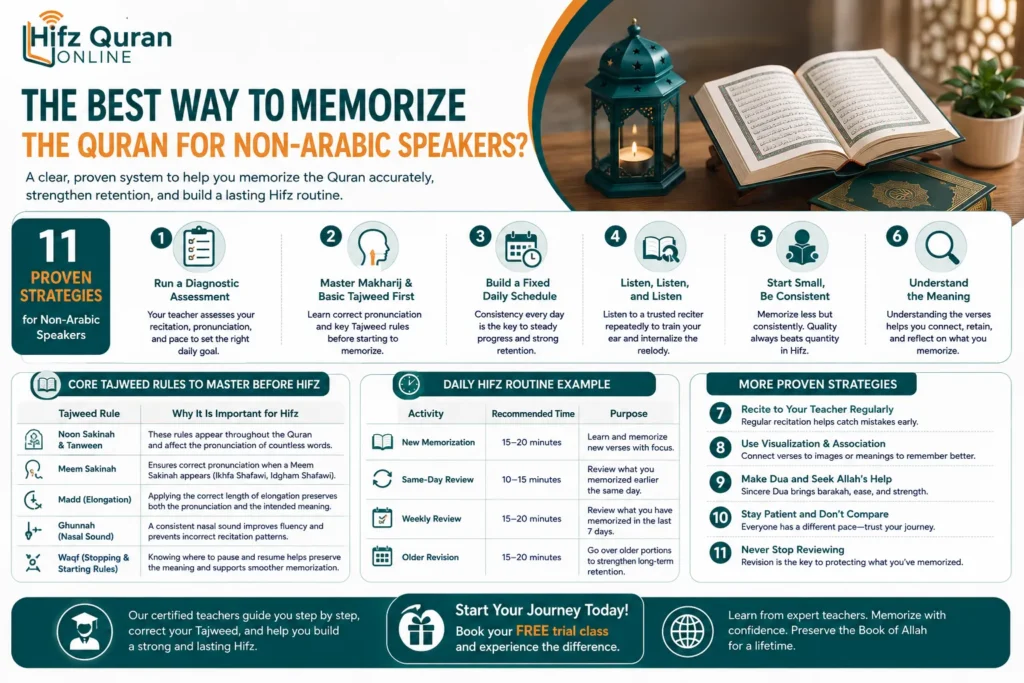
Memorizing the Quran as a non-Arabic speaker may seem challenging, but it is a goal that thousands of Muslims achieve every year. Success does not depend on being fluent in Arabic—it depends on following a structured method that combines correct pronunciation, consistent revision, and guidance from a qualified teacher.
Whether you’re just beginning your Hifz journey or looking for a more effective way to retain what you’ve already memorized, the right system can make all the difference. In this guide, you’ll discover 11 proven strategies to help you memorize the Quran accurately, strengthen long-term retention, and build a sustainable Hifz routine that fits your daily life.
1. Run a Diagnostic Assessment
Before setting a schedule, your teacher should run a diagnostic recitation session to determine your current pronunciation accuracy, Arabic letter recognition, and natural pace of retention. This shapes your daily memorization quota. Setting a quota before a diagnostic is one of the most common early mistakes non-Arabic speakers make.
Read also: What Is the Best Way to Memorize the Quran?
2. Master Makharij and Basic Tajweed Before Memorizing
Correct Quran memorization begins with Makharij (the articulation points of the Arabic letters) and the basic rules of Tajweed. Makharij determine where each letter is pronounced from—whether the throat, tongue, lips, or mouth—while Tajweed ensures every letter is recited with its proper characteristics and rules.
Letters such as ع (ʿAyn), ح (Ḥa), ق (Qaf), and ض (Ḍad) have no direct equivalent in English, making proper guidance essential for non-Arabic speakers.
If you memorize verses before learning correct pronunciation, you risk reinforcing mistakes that become difficult to correct later. For this reason, spend your first two to three weeks focusing on Arabic letter sounds and the essential Tajweed rules before beginning Hifz.
A qualified teacher can quickly identify and correct pronunciation errors that learners often cannot hear in their own recitation, helping you build a strong foundation for accurate and lasting Quran memorization.
What Tajweed Rules Should You Learn Before Starting Hifz?
While Tajweed includes many detailed rules, a few have the greatest impact on accurate Quran memorization. Learning these core rules early helps you recite correctly from the beginning and prevents pronunciation mistakes from becoming permanent habits.
| Tajweed Rule | Why It Is Important for Hifz |
| Noon Sakinah & Tanween | These rules appear throughout the Quran and affect the pronunciation of countless words. |
| Meem Sakinah | Understanding rules such as Ikhfa Shafawi and Idgham Shafawi ensures words are pronounced correctly when a Meem Sakinah appears. |
| Madd (Elongation) | Applying the correct length of elongation preserves both the pronunciation and the intended meaning of the verses. |
| Ghunnah (Nasal Sound) | A consistent nasal sound improves fluency and prevents incorrect recitation patterns from developing. |
| Waqf (Stopping and Starting Rules) | Knowing where to pause and resume helps preserve the meaning of the verses and supports smoother memorization. |
Mastering these essential Tajweed rules provides a solid foundation for Hifz. Once they become part of your daily recitation, memorizing the Quran becomes more accurate, confident, and easier to retain over the long term.
Our certified teachers explain Tajweed rules in your native language and correct your Waqf in real time — enroll in our Quran Memorization Course for Adults to experience this approach in your free trial.
Read also: What Is the Best Way to Memorize the Quran?

3. Build a Fixed Daily Schedule
Consistency is far more effective than long, irregular study sessions. Even 30–45 minutes of focused practice each day can produce better long-term results than memorizing for hours only a few times a week.
A balanced routine includes time for new memorization, immediate review, and revision of previously memorized portions. If possible, schedule your Hifz session after Fajr, when your mind is fresh, distractions are few, and concentration is at its highest. This time has long been recommended by Islamic scholars as one of the most blessed and productive periods for Quran memorization.
| Activity | Recommended Time | Purpose |
| New Memorization | 15–20 minutes | Learn and memorize new verses with focus. |
| Same-Day Review | 10 minutes | Reinforce the new memorization before forgetting begins. |
| Revision of Previous Hifz | 10–15 minutes | Strengthen long-term retention and prevent older portions from becoming weak. |
This simple routine takes 35–45 minutes per day and creates a sustainable balance between learning new verses and preserving what you’ve already memorized.
Memorize the Quran at Your Own Pace
Join our expert tutors and begin your Hifz journey with a personalized plan.
Start Your Free Trial4. Try the Listening-First Approach
One of the most effective ways to improve Quran memorization is to listen before you memorize. Before attempting to recite a new passage, listen to a skilled, certified reciter such as Sheikh Mahmoud Khalil Al-Husary or Sheikh Mishary Rashid Al-Afasy repeat the target verses 10–15 times. This allows your brain to absorb the correct pronunciation, rhythm, and Tajweed naturally before you begin reciting from memory.
Instead of relying solely on reading, your ears create a strong auditory model that guides your tongue and reduces pronunciation mistakes. As a result, memorization becomes smoother, more accurate, and easier to retain over time.
Read also: How to Memorize a Surah in 1 Hour – A Practical 60-Minute Hifz Method
5. Choose a Teacher with Ijazah and Non-Arabic Speaker Experience
An Ijazah certifies an unbroken chain of Quran transmission back to the Prophet Muhammad ﷺ. For non-Arabic speakers, Ijazah alone is not enough — the teacher must also have experience working with students who do not speak Arabic natively and be able to explain rules in a shared language.
If you are looking for structured online Hifz classes with this profile, Hifz Quran Online offers sessions led by Ijazah-certified teachers who specialize in non-Arabic speaking students.
Ready to begin with the right teacher from day one?[ Book Your Free Trial Session]

Read also: The 3:10 Hifz Technique – What It Is and How It Works
6. Use the Repetition-Linkage Method to Strengthen Your Quran Memorization
Repeating a verse many times helps you memorize it, but linking it to the previous verse is what allows you to recite smoothly without pauses. After memorizing a new verse, recite it 20–30 times from memory until you can say it confidently without looking at the Mushaf. Then, connect it with the verse before it and recite both together 10–15 times.
This simple habit trains your brain to transition naturally between verses instead of treating each one as a separate piece.
Many students can recall individual verses but hesitate when reciting a full passage because they never practiced the connections. The repetition-linkage method strengthens these transitions from the beginning, making continuous recitation much more fluent.
Step Inside Our Virtual Classrooms
Don’t just take our word for it—see how our interactive sessions work! Watch the short clips below to experience our engaging teaching methods, live teacher-student interactions, and the supportive learning environment we bring to every student.
Memorize the Quran at Your Own Pace
Join our expert tutors and begin your Hifz journey with a personalized plan.
Start Your Free Trial7.Understand the Meaning Before You Memorize
Read a brief translation of the verses in your native language before the memorization session. A one-sentence summary is enough. Understanding the general meaning gives the brain a semantic hook to attach the Arabic sounds to, making each verse significantly easier to recall.
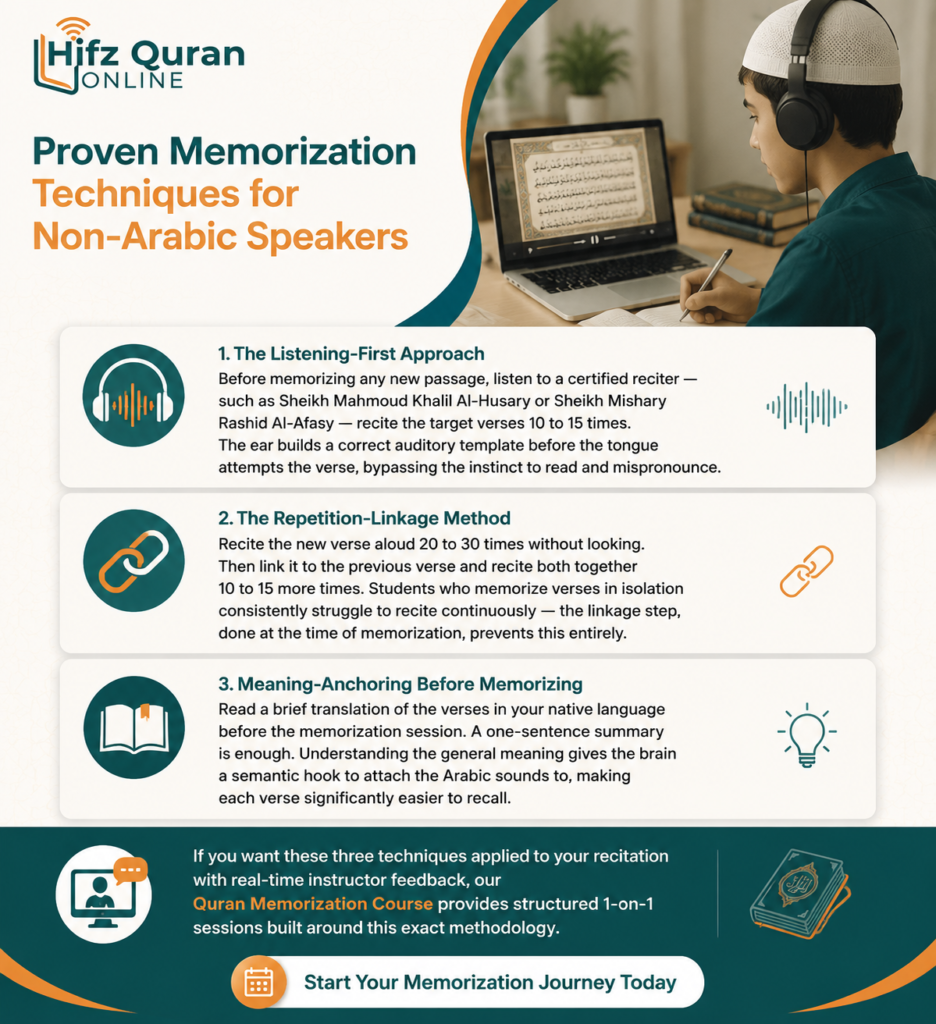
If you want these three techniques applied to your recitation with real-time instructor feedback, our [Quran Memorization Course] provides structured 1-on-1 sessions built around this exact methodology.
8. Follow the “New Lesson + Rolling Review” System Every Day
Many students believe that memorizing new verses is the hardest part of Hifz. In reality, retaining what you’ve already memorized is the greater challenge. Without a structured revision plan, even well-memorized passages gradually become weak. That’s why review is not an extra step—it’s the foundation of successful Quran memorization.
The New Lesson + Rolling Review system combines daily memorization with consistent revision. Each session includes time for learning new verses as well as reviewing recently and previously memorized portions. As your Hifz grows, the amount of revision naturally increases to keep every section strong and prevent older passages from fading.
A Practical Daily Revision Schedule
Use the following daily schedule to balance new memorization with consistent revision and long-term retention.
| Session Component | Recommended Time | What to Review |
| Warm-Up Review | 10 minutes | Revise yesterday’s memorization until it is fluent. |
| Weekly Review | 15 minutes | Review everything memorized during the past 7 days. |
| New Memorization | 20 minutes | Learn today’s new verses using a listening-first approach. |
| Long-Term Review | 10 minutes | Revise an older section on a rotating schedule to maintain long-term retention. |
This routine takes about 55 minutes per day, making it practical for students, professionals, and parents alike. By balancing new memorization with regular revision, you strengthen your existing Hifz while continuing to make steady progress through the Quran.
9. Recite Your Memorization in Salah Every Day
One of the most effective ways to strengthen your Hifz is to recite what you’ve memorized during your daily Salah. Every prayer becomes an opportunity to review your Quran naturally, reinforcing your memory while earning the reward of reciting the Quran in worship. Recalling verses during Salah also strengthens long-term retention because it requires focused, active recall in a meaningful setting.
Many learners recite only Surah Al-Fatihah and a few familiar short surahs in every prayer. Instead, make it a habit to rotate your newly memorized passages throughout the five daily prayers. This spreads revision across the day without requiring extra study time and helps keep recent memorization fresh.
وَرَتِّلِ ٱلْقُرْءَانَ تَرْتِيلًا
Wa rattilil-Qur’āna tartīlā (Surah Al-Muzzammil 73:4)
Reciting your Hifz in Salah is one of the best ways to practice Tarteel—calm, deliberate, and accurate recitation. By consistently reviewing your memorization in prayer, you build confidence, improve fluency, and strengthen your connection with the Quran every single day.
10. Choose the Right Hifz Method for Your Age Group
Although the core principles of Hifz remain the same for everyone, the way you teach and memorize the Quran should vary based on the learner’s age. Children, teenagers, adults, and seniors each have different attention spans, learning styles, and motivations. Adapting your approach to the learner’s stage of life makes memorization more enjoyable, sustainable, and effective.
| Age Group | Recommended Approach | Best Practices |
| Children (4–10 years) | Keep lessons short, interactive, and enjoyable. | Limit sessions to 10–15 minutes, use repetition, visual aids, rewards, and positive encouragement. Never pressure children to memorize large portions. |
| Teenagers (11–17 years) | Balance memorization with understanding and personal responsibility. | Set weekly goals, explain the meanings of verses, encourage independent revision, and maintain regular teacher feedback. |
| Adults (18–60 years) | Focus on consistency rather than speed. | Create a fixed daily schedule, combine memorization with systematic revision, and fit Hifz around work and family commitments. |
| Older Adults (60+) | Prioritize retention and spiritual connection over memorization pace. | Memorize smaller portions, review frequently, and allow extra time for repetition without comparing progress to others. |
Teaching Children Requires a Different Approach
Young children learn best through encouragement rather than pressure. Their goal should be to develop a love for the Quran before striving to memorize large amounts. Short lessons, frequent praise, simple rewards, and engaging activities help children stay motivated and build confidence. Parents and teachers should celebrate consistency instead of expecting rapid progress.
If your child is ready to begin their Hifz journey, explore our Quran Memorization and Hifz for Kids program. With experienced teachers, age-appropriate lessons, and engaging one-on-one classes, we help children memorize the Quran with correct Tajweed while building confidence and a lifelong love for the Book of Allah.
Teaching Adults Requires Structure and Patience
Adults face different challenges, including work, family responsibilities, and limited study time. Instead of lengthy memorization sessions, adults usually make better progress with a consistent daily routine, realistic goals, and a strong revision system. Understanding the meaning of the verses and reviewing them during daily Salah also improves long-term retention.
Our Online Quran Memorization Courses for Adults are designed specifically for busy learners. You’ll study with Ijazah-certified teachers in flexible one-on-one online sessions, receive personalized memorization and revision plans, and benefit from real-time Tajweed correction to help you memorize the Quran accurately and confidently.
11. Track Your Progress and Celebrate Every Milestone
Hifz is a long-term journey, and staying motivated is much easier when you can see your progress. Keeping a written or digital Hifz log helps you stay organized, identify areas that need more revision, and appreciate how much you’ve accomplished over time. Even small improvements become encouraging when they’re recorded consistently.
Your Hifz log doesn’t need to be complicated. It should simply track what you’ve memorized, what you’ve reviewed, and any feedback from your teacher. Reviewing this record regularly can help you maintain consistency and plan future revision sessions more effectively.
Knowledge alone doesn’t lead to successful Hifz—consistent practice and expert guidance do. Learning with an Ijazah-certified teacher helps you apply these techniques correctly, receive immediate feedback, and stay accountable throughout your memorization journey.
See Our Classes in Action
Curious about what a 1-on-1 Hifz session looks like? Take a look at these real-time snippets from our daily classes to see our student-centered approach, Tajweed correction techniques, and online whiteboard tools in action.
Memorize the Quran at Your Own Pace
Join our expert tutors and begin your Hifz journey with a personalized plan.
Start Your Free TrialStart Your Hifz Journey with a Qualified Teacher Today
The framework above works — but it requires live, real-time correction of your specific errors to reach its full effect. That is what an Ijazah-certified teacher delivers in every session.
Our Quran Courses
- Quran Memorization Course
- Quran Memorization and Hifz Course for Kids
- Online Quran Memorization Courses for Adults
- Quran Hifz Course for Ladies
- Quran Memorization Course for Men
- Saudi-Based Quran Memorization Courses
- Hifz Teachers
Conclusion
There is no single shortcut to memorizing the Quran, but there is a proven path. By building a strong foundation in Makharij and Tajweed, following a consistent daily schedule, reviewing your memorization systematically, and learning under a qualified teacher, you can make steady progress regardless of your native language.
Remember that Hifz is not a race but a lifelong act of worship. Every verse you memorize, review, and recite brings you closer to Allah and strengthens your relationship with His Book. Stay patient, remain consistent, and trust the process. With sincere intention and the right guidance, memorizing the Quran is an achievable goal for every dedicated student.
Frequently Asked Questions
Can a non-Arabic speaker memorize the entire Quran?
Yes. Thousands of Huffaz from Indonesia, Nigeria, the UK, and the US complete full Quran memorization without Arabic as their native language. The key is a phonetic foundation and a teacher experienced with non-Arabic speakers.
Where should a non-Arabic speaker start?
Begin with Juz ‘Amma (the 30th Juz). Its Surahs are short, rhythmically distinct, and used daily in prayer — which means they are rehearsed naturally outside formal sessions, reinforcing retention automatically.
How long does memorization take for a non-Arabic speaker?
A student memorizing five lines per day with consistent revision typically takes four to six years for the full Quran. A student who already reads Arabic and memorizes one page per day can finish in three to four years.
Is understanding Arabic necessary for Hifz?
Fluency is not required. However, understanding the general meaning of verses — even through a brief translation — significantly improves retention and reduces confusion between similar-sounding passages.
How many verses should a beginner memorize each day?
There is no fixed daily target that works for everyone. Beginners often make better progress by memorizing 2–5 verses per day, depending on the length and difficulty of the verses. It is better to memorize a small amount accurately and retain it through regular revision than to rush through larger portions that are easily forgotten.
Related Articles
Memorizing Quran







Leave a Reply