 Memorizing Quran

Finding the best way to memorize the Quran can feel overwhelming, especially with so many methods and study plans available. The truth is, most people don’t quit Hifz because it’s too difficult—they struggle because they don’t have a clear, consistent system that helps them retain what they’ve learned.
The most effective approach combines listening to the verses before memorizing them, following a structured daily routine, and reviewing regularly to prevent mistakes from becoming habits. Whether you’re a beginner, an adult learner, or helping your child memorize the Quran, using the right method makes Hifz more manageable, enjoyable, and sustainable over the long term.
In this guide, you’ll discover proven Quran memorization techniques, practical daily strategies, and expert tips to help you build a strong Hifz routine and remember the Quran with confidence.
1. Before Attempting To Memorize Any Section, Listen To A Trusted Reciter
The Best Way to Memorize the Quran Starts Before You Open the Mushaf. Before attempting to memorize any section, listen to a trusted reciter — Sheikh Mahmoud Khalil Al-Husary — reciting the target verses repeatedly. Listen while doing household tasks, commuting, or any activity that doesn’t require active mental focus.
What this accomplishes is concrete: the ear internalizes the melody, rhythm, and word sounds before your memory tries to reproduce them. When you sit for your session, the words are already partially familiar — you’re encoding a trace you already heard, not constructing one from nothing. For non-Arabic speakers especially, this phase is the most efficient preparation available.
When you find yourself completing phrases you’re hearing without trying, your memory has built enough foundation to begin active memorization.
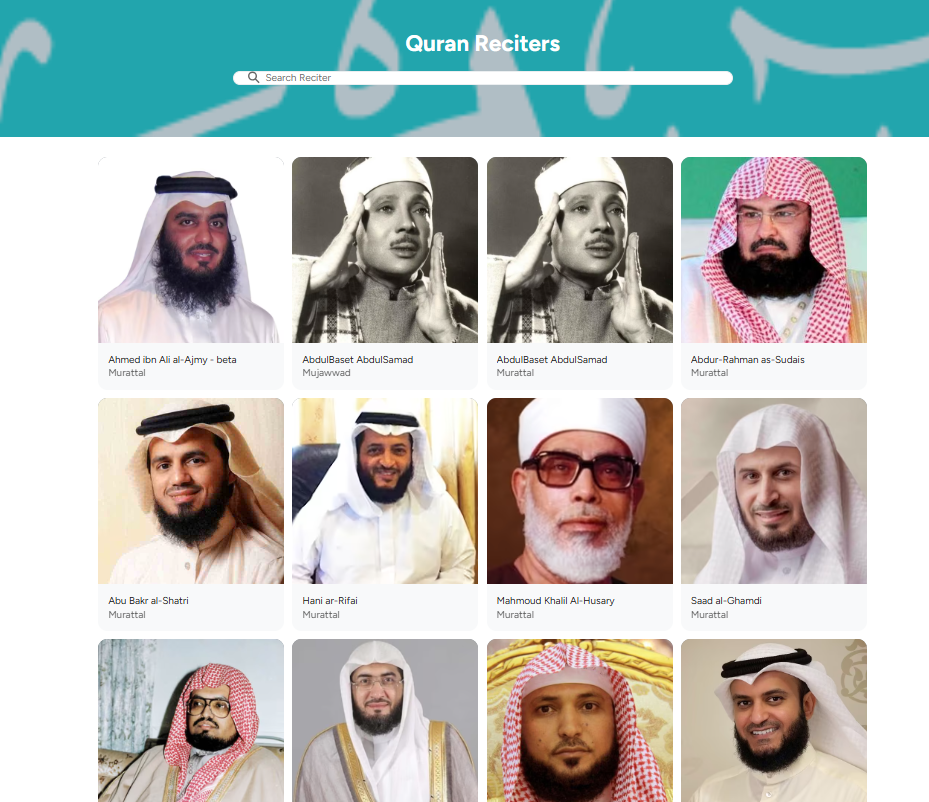
You can pick one of the reciters of the Quran from here and see what is the suitable reciter to your ears.
Read also: How to Memorize a Surah in 1 Hour – A Practical 60-Minute Hifz Method
2. Follow the The Three Tier Daily Routine That Prevents Quran Memorization Forgetting
The most common Hifz mistake is spending every session on new memorization while neglecting what’s already been learned. The correct structure splits every session into three parts:
| Session | Arabic Term | Content | Daily Time |
| New Memorization | Hifz Jadeed | Today’s new verses | 20–40 min |
| Recent Review | Muraja’ah Qareeba | Last 7 days’ memorization | 15–20 min |
| Older Revision | Muraja’ah Ba’eeda | Older completed portions | 20–30 min |
No tier can be skipped consistently. The practical rule from experienced teachers: don’t add new memorization on any day where the previous day’s review was incomplete. Protecting existing memorization always takes priority over advancing to new material.
Read also: The 3:10 Hifz Technique – What It Is and How It Works
3. Learn the Meaning Alongside Memorization
Memorizing the Quran is much more effective when you understand what the verses are saying. Before committing new passages to memory, read a trusted translation and a brief tafsir to grasp their meaning and context. Understanding the message creates a stronger connection with the verses, making them easier to remember and helping you apply their guidance in your daily life rather than simply reciting them from memory.
4. Try to Memorize the Quran After Fajr Prayer
After Fajr prayer is the consistently recommended time in both classical scholarship and practitioner experience. Sleep consolidates declarative memory, so the brain works with freshly reinforced patterns immediately after waking. If Fajr isn’t feasible, any window immediately after sleep produces similar conditions.
At Hifz Quran Online, our Ijazah-certified instructors structure every session around this three-tier framework — with weekly retention testing to ensure you’re not memorizing forward while losing backward. Book your free trial and see the system in action.

5. Recite To A Shaykh To Eliminate The Error Marking Recitation Loop
Reciting to another person is not just a progress check — it’s a technique for catching weak points before they become permanent errors.
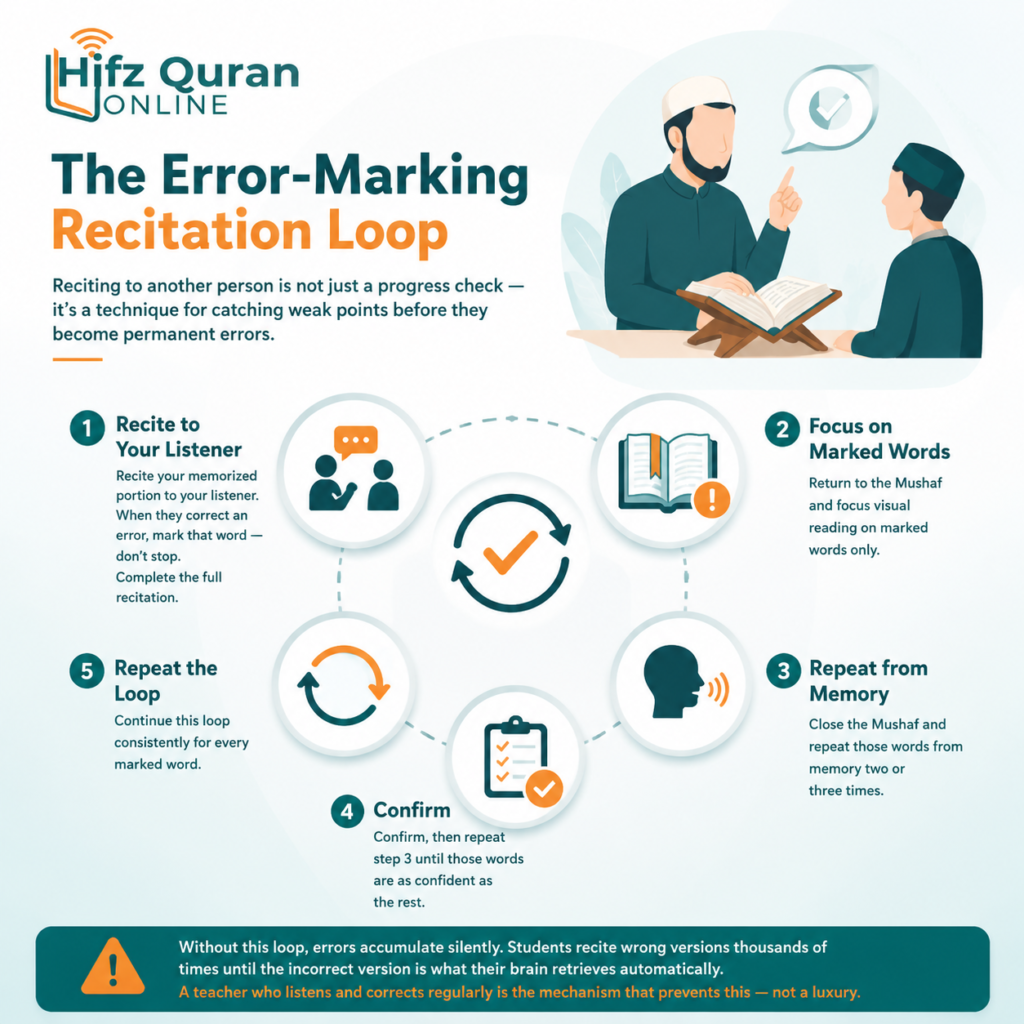
The correct sequence:
- Recite your memorized portion to your listener. When they correct an error, mark that word — don’t stop. Complete the full recitation.
- Return to the Mushaf and focus visual reading on marked words only.
- Close the Mushaf and repeat those words from memory two or three times.
- Confirm, then repeat step 3 until those words are as confident as the rest.
Without this loop, errors accumulate silently. Students recite wrong versions thousands of times until the incorrect version is what their brain retrieves automatically.
Read Also: Time Management for Hifz Students
Step Inside Our Virtual Classrooms
Don’t just take our word for it—see how our interactive sessions work! Watch the short clips below to experience our engaging teaching methods, live teacher-student interactions, and the supportive learning environment we bring to every student.
Memorize the Quran at Your Own Pace
Join our expert tutors and begin your Hifz journey with a personalized plan.
Start Your Free Trial6. Try Proven Quran Memorization Methods and Learn How Each One Works
Finding the right memorization method can make your Quran journey easier and more consistent. You can try different methods and see which one works best for you based on your schedule, learning style, and memorization goals. Here are some effective methods you can try:
The 6446 Quran Memorization Method
The 6446 Quran Memorization method is a structured Quran memorization (Hifz) technique that strengthens both initial memorization and long-term retention by alternating between reading from the Mushaf and recalling from memory. The name “6446” represents the exact repetition pattern used for every new ayah or short passage.
Follow the 6446 Repetition Cycle
For each new verse (Ayah) or short line, complete the following sequence:
- Read the verse 6 times while looking at the Mushaf.
Focus on accurate pronunciation, Tajweed, and the visual position of the words on the page. This builds a strong visual and auditory memory. - Recite it 4 times from memory.
Close the Mushaf or look away and recall the verse without assistance. This first recall stage reveals any weak points before they become habits. - Read it 4 more times while looking.
Reopen the Mushaf and correct any mistakes you made during recall. These repetitions reinforce the correct wording and eliminate uncertainty. - Recite it 6 final times from memory.
Finish by reciting the verse confidently without looking. These final repetitions transfer the ayah from short-term memory into more stable long-term retention.
the 7-3-2-1 Memorization Method
The 7-3-2-1 Memorization method applies the principle of spaced repetition to Quran memorization by reviewing new verses at carefully timed intervals instead of repeating them continuously. The goal is to strengthen recall before forgetting begins, allowing each review to reinforce the previous one and gradually transfer the memorization into long-term memory.
Follow this review schedule after memorizing a new portion:
- Day 1 – Initial Memorization
Memorize the new verses and repeat them several times until you can recite them confidently without looking. - Day 2 – First Review (24 Hours Later)
Review the same portion one day after memorization. This first spaced review reinforces the memory before significant forgetting occurs. - Day 3 or 4 – Second Review (After a 1–2 Day Gap)
Review the verses again 48–72 hours after the initial memorization. Increasing the interval encourages stronger recall and reveals any weak areas that need attention. - Day 7 – Final Consolidation Review
Perform a final review exactly one week after the first memorization session. This review helps consolidate the verses into long-term memory, making them easier to retain and recall in future revision sessions.
Read also: How to Memorize a Surah in 5 Minutes a Day? – A Step-by-Step Method
The Traditional Mauritanian Hifz Method
The traditional Mauritanian Hifz method is a Quran memorization system developed in the Mahdara schools of West Africa. It combines manual transcription, high-volume repetition, and peer-based teaching to help students achieve accurate memorization and long-term retention.
Students traditionally write each new lesson on a wooden tablet (luh) (which can be replaced with paper or notebooks when a wooden tablet is not available) before beginning memorization. Writing the verses by hand strengthens visual memory and encourages careful attention to every word.
After writing the lesson, students recite the new portion repeatedly—often hundreds of times—until they can recall it fluently without looking. Once the memorization is secure, they reinforce it further by reciting to classmates or teaching the memorized passage to another student, using peer instruction as a final layer of consolidation. This combination of writing, intensive repetition, and teaching has made the Mauritanian method one of the most respected traditional approaches to Quran memorization.
3×3 Quran Memorization Method
The 3×3 method is a simple and effective Quran memorization technique that breaks new memorization into three-verse sections. By combining repeated reading from the Mushaf with active recall, it helps learners memorize accurately without feeling overwhelmed.
Follow these steps for each new set of verses:
- Select Three Verses
Choose a short, connected passage of three verses (āyāt) to memorize during one session. - Read the First Verse Three Times
Look at the Mushaf and recite the first verse aloud three times, paying close attention to pronunciation and Tajweed. - Read the Second Verse Three Times
Repeat the same process with the second verse, reading it three times while looking at the text. - Read the Third Verse Three Times
Read the third verse three times from the Mushaf until it feels familiar. - Recite All Three Verses from Memory
Close the Mushaf and recite the entire three-verse section three times without looking. Focus on maintaining the correct order and smooth transitions between the verses. - Correct Mistakes Immediately
If you forget a word or make an error, reopen the Mushaf, identify the correct wording, then close it again and complete your three uninterrupted memory recitations. Correcting mistakes as soon as they occur prevents them from becoming permanent.
The 3×3 method is particularly suitable for beginners and busy learners because it divides memorization into small, achievable portions while reinforcing both accuracy and long-term retention through consistent repetition.
Finally the Quran can be memorized in many different ways, and the methods we’ve covered are just a few examples. What matters most is finding an approach that suits your learning style, schedule, and goals, then staying consistent with it.
If you’re an adult learner, the Online Quran Memorization Courses for Adults are designed to fit your lifestyle and schedule, making it easier to stay consistent even if you’re a working professional or a busy parent.
For younger learners, the Quran Memorization and Hifz for Kids course offers age-appropriate pacing and engaging learning methods to make Quran memorization more effective and enjoyable.

Memorize the Quran at Your Own Pace
Join our expert tutors and begin your Hifz journey with a personalized plan.
Start Your Free Trial7.Use Learning Apps to Strengthen Your Quran Memorization
Technology has made learning and memorizing the Quran more accessible than ever. Today’s Quran apps help learners of all ages improve their recitation, strengthen memorization, and review verses through repetition, audio playback, and progress tracking. While these apps are excellent tools for daily practice, they are most effective when paired with guidance from a qualified Quran teacher who can correct pronunciation and Tajweed mistakes.
Some of the best Quran learning apps include:
- Tarteel – Uses AI-powered voice recognition to listen to your recitation, detect mistakes, and help you continue if you forget a verse, making it especially useful for Hifz students.
- Ayah (Ayah App) – Offers a clear digital Mushaf with verse repetition, multiple reciters, translations, and audio playback to support memorization and revision.
- Moddaker (Mudakker) – Connects learners with qualified Quran teachers for live recitation correction and Tajweed guidance, combining self-study with expert feedback.
- Al-Mushaf Al-Muallim – Features repeated recitation by well-known Quran reciters, making it an excellent choice for beginners and children who learn through listening.
- Adnan Quran Teacher – A child-friendly interactive app that teaches short surahs, Arabic letters, and daily adhkar through engaging activities and authentic Quran recitation.
To get the most from these apps, set a realistic memorization goal, study at the same time each day, use verse repetition regularly, and record your own recitation to monitor your progress. Remember that apps are valuable learning companions, but consistent practice with a qualified teacher remains the most effective way to master Quran recitation, Tajweed, and memorization.
8. Dua, Taqwa, And righteous study partner Is The Key For Continuous Hifz Routine
Scholars and experienced Hifz instructors consistently point to the same conditions in students who succeed. These aren’t separate from the practical method — they support the focus and consistency Hifz demands.
Sincere du’a – الدعاء
Ask Allah specifically for ease of memorization, understanding, and time. Students who approach Hifz with genuine tawakkul alongside serious effort maintain consistency differently than those who treat it as a purely self-directed task.
Taqwa – التقوى
Classical scholars explicitly link avoidance of sin to ease of memorization. Imam Al-Shafi’i’s account of his teacher Waki’ ibn Al-Jarrah advising him to abandon sin when he complained of forgetfulness is cited across centuries of Hifz scholarship. The practical reasoning: consistent prayer and halal conduct build the inner discipline sustained Hifz requires.
A righteous study partner- رفيق صالح
Someone who memorizes alongside you, tests you, and holds you accountable multiplies your consistency. When a partner isn’t available, a structured online class with a qualified teacher fulfills the same function.
See Our Classes in Action
Curious about what a 1-on-1 Hifz session looks like? Take a look at these real-time snippets from our daily classes to see our student-centered approach, Tajweed correction techniques, and online whiteboard tools in action.
Memorize the Quran at Your Own Pace
Join our expert tutors and begin your Hifz journey with a personalized plan.
Start Your Free TrialStart Memorizing the Quran with a Free Trial Session
You have the method. The only remaining step is beginning — with a system that supports you from day one.
Book your free trial at Hifz Quran Online and let an Ijazah-certified instructor guide your first session using the complete framework above. Students who start with a structured approach retain more, progress faster, and reach completion.
Our Quran Courses
- Quran Memorization Course
- Quran Memorization and Hifz Course for Kids
- Online Quran Memorization Courses for Adults
- Quran Hifz Course for Ladies
- Quran Memorization Course for Men
- Saudi-Based Quran Memorization Courses
- Hifz Teachers
Start today — your free session is waiting.

Memorize the Quran at Your Own Pace
Join our expert tutors and begin your Hifz journey with a personalized plan.
Start Your Free TrialConclusion
The best way to memorize the Quran is not a single technique — it is a system where each element protects the others. Listening first builds the auditory foundation before your memory does any heavy lifting. The three-tier daily session — new memorization, recent review, and older revision — ensures you never advance at the cost of what you’ve already secured.
The error-marking recitation loop closes the gap between what you think you know and what you actually know. And the spiritual conditions experienced teachers consistently name — sincere du’a, taqwa, and accountability — are not separate from the method; they sustain the consistency the method demands.
The one principle that ties all of it together: protecting existing memorization always takes priority over advancing to new material. Students who internalize this rule complete Hifz. Students who chase new verses while letting earlier ones fade rarely do.
Frequently Asked Questions
What is the best way to memorize the Quran for adults?
The best method for adults combines the listening-first approach with the three-tier daily session: new memorization, recent review, and older revision in every sitting. Keep daily targets small and consistent — one to three lines per day, reviewed without fail — rather than large targets done irregularly.
How many times should I repeat a verse to memorize it?
Repeat each verse or phrase 20–30 times before attempting to recite without looking. Then link the new verse to the one before it and recite both together. Writing the verse by hand without looking adds a kinesthetic memory channel that significantly reinforces retention.
Is it necessary to have a teacher for Hifz?
A teacher is not required to begin, but errors memorized without correction become increasingly difficult to undo. A qualified teacher identifies mispronunciations and errors during memorization — not after — which saves months of correction later.
Related Articles
Memorizing Quran







Leave a Reply