 Memorizing Quran
| Key Takeaways |
| A Hafiz is a Muslim who has memorized the entire Quran — all 6,236 verses across 114 Surahs — completely by heart. |
| Estimates suggest over 150 million Hafiz exist worldwide, with the highest concentrations in South Asia, the Arab world, and Southeast Asia. |
| The title Hafiz carries significant Islamic honor; the Prophet ﷺ described the Hafiz as one who will intercede for ten family members on the Day of Judgment. |
| Non-Arabic speakers can and do achieve full Hifz — structured methodology, consistent Muraja’ah, and qualified instruction are the decisive factors. |
The word “Hafiz” carries a weight that most English translations fail to capture. It is not simply a title — it is a designation earned through thousands of hours of disciplined memorization, precise Tajweed application, and sustained Muraja’ah that can span years.
When a student is called a Hafiz, the Muslim community recognizes something profound: that the Word of Allah has been preserved, living and breathing, in a human heart.
Who Is a Hafiz?
A Hafiz (plural: Huffaz) is a Muslim who has memorized the complete Quran entirely by heart — every Ayah of all 114 Surahs, 30 Ajza’, and 6,236 verses. What makes this achievement remarkable is not only its scale but its precision.
Partial memorization, however substantial, does not confer the title. The Hifz must be complete, recitable from memory with correct Tajweed, and verified by a qualified instructor.
What Does Hafiz Mean in English?
The word Hafiz (حافظ) derives from the Arabic root ḥ-f-ẓ (ح-ف-ظ), which carries the meaning of preservation, protection, and guarding. In English, the word Hafiz translates most accurately as “one who preserves” or “guardian.”
Linguistically, the word Hafiz is the active participle — meaning a Hafiz is not someone who once memorized, but someone who actively holds and maintains that memorization.
Shots Videos from Our Courses
Memorize the Quran at Your Own Pace
Join our expert tutors and begin your Hifz journey with a personalized plan.
Start Your Free TrialWhat is a Hafiz in Islam?
In Islamic tradition, the title extends beyond personal achievement. Classical scholars used “Hafiz” to describe those entrusted with preserving the Quran in the same living chain — the isnad — that stretches back to the Prophet Muhammad ﷺ himself.
When a student receives an ijazah (chain of transmission) from a qualified Hafiz, they become a living link in that unbroken preservation.
What is a Feminine Hafiz Called?
The feminine form of Hafiz is Hafiza, and the plural — Huffaz — is used when referring to memorizers collectively. These distinctions matter in scholarly and instructional contexts, and using them correctly reflects genuine familiarity with the tradition.
What Is the Spiritual and Legal Significance of a Hafiz in Islam?
A Hafiz holds a distinguished position in Islamic scholarship and community life. The Prophet Muhammad ﷺ described the one who memorizes the Quran in terms that elevate the entire family:
“It will be said to the companion of the Quran: Recite and rise in status, recite as you used to recite in the world, for your status will be at the last verse you recite.” — Sunan Abi Dawud 1464
Beyond the afterlife honor, Huffaz carry specific roles in Islamic practice. A Hafiz leading Tarawih prayer during Ramadan enables the entire congregation to hear the complete Quran recited.
In traditional Islamic legal scholarship, the memorization of the Quran was considered among the foundational prerequisites before advancing to Hadith sciences and Fiqh.
If you want to understand the full spiritual and practical weight of achieving Hifz, the benefits of memorizing the Quran extend far beyond what is commonly discussed — into psychological, cognitive, and communal dimensions that practicing Huffaz experience daily.
At Hifz Quran Online Academy, our Quran Memorization Course is built around this full understanding of what Hifz means — not just as an academic task, but as a lifelong spiritual commitment.
Our certified Huffaz instructors guide students through the methodology with that weight in mind from the very first lesson.
Book a free trial to start your Hifz path today
How Many Hafiz Are There in the World?
Precise figures are difficult to verify because no single global Islamic institution tracks Hafiz certification universally. However, based on estimates from Islamic organizations, government Hifz program data, and academic research, the global Hafiz population is widely estimated at 150 to 200 million individuals.
This number is extraordinary by any measure. The Quran is 604 pages in the standard Uthmani Mushaf, contains 6,236 Ayaat, and must be memorized letter-perfectly — including correct Makhraj (articulation points) and Tajweed rules for each letter.
The scale of global Hifz preservation represents one of the most remarkable collective memorization achievements in human history.
Which Nations Produce the Most Huffaz?
What the raw number doesn’t reveal is the growth trajectory. As formal Hifz programs expand online and internationally, the rate of new Huffaz being certified each year is increasing — particularly among non-Arabic speaking Western communities where structured online instruction has made what was once logistically inaccessible now entirely achievable.
1. Pakistan
Pakistan is consistently cited as the country with the highest number of Huffaz. With thousands of traditional madrasas (Islamic seminaries) and dedicated Hifz schools embedded in communities across the country, Pakistan produces an estimated several hundred thousand new Huffaz per generation.
The culture of Hifz in Pakistan is deeply embedded — completing the Quran is treated as a communal milestone, not merely an individual one.
2. Bangladesh
Bangladesh has one of the most robust Hifz cultures in the world relative to its population. The country hosts a vast network of Quran memorization institutions, and Hifz completion is deeply woven into the social fabric of Muslim communities.
Estimates suggest Bangladesh is home to millions of Huffaz, with tens of thousands completing Hifz annually.
Memorize the Quran at Your Own Pace
Join our expert tutors and begin your Hifz journey with a personalized plan.
Start Your Free Trial3. India
India’s Muslim population — one of the largest in the world — produces significant numbers of Huffaz through both traditional madrasa systems and modern Islamic schools.
Regional variation is significant, with states like Uttar Pradesh, Kerala, and West Bengal maintaining particularly strong Hifz traditions.
3. Indonesia
Indonesia, home to the world’s largest Muslim population by country, has seen dramatic growth in Hifz programs.
Government-supported Quran memorization competitions (Musabaqah Tilawatil Quran) have accelerated Hifz completion rates significantly over the past two decades.
Read Also: What Is the Reward for Becoming a Hafiz?
4. Egypt and the Arab World
Egypt, Saudi Arabia, and other Arab-world nations produce Huffaz with the linguistic advantage of Arabic as a native language. Egypt’s Al-Azhar institution remains one of the most authoritative certifiers of Hifz globally, and Egyptian Huffaz often hold high-chain ijazah certifications.
| Country | Hafiz Estimate | Notable Characteristic |
| Pakistan | Highest globally | Dense madrasa network |
| Bangladesh | Among highest per capita | Strong cultural Hifz tradition |
| India | Very high (large Muslim population) | Regional variation |
| Indonesia | Rapidly growing | Government Hifz programs |
| Egypt | High (Arab world) | Al-Azhar ijazah certification |
| Saudi Arabia | High | Quranic schools in Haramayn cities |
Our Students Reviews
Memorize the Quran at Your Own Pace
Join our expert tutors and begin your Hifz journey with a personalized plan.
Start Your Free TrialThe Role of Institutional Infrastructure in Countries with the Most Hafiz
What separates the top Hafiz-producing countries is not simply Muslim population size — it is institutional infrastructure. Countries that have integrated Hifz education into national Islamic education systems, provided government funding for memorization programs, or built cultural expectations around Quran memorization consistently outperform countries with similar Muslim populations but weaker institutional support.
Turkey, Malaysia, and Morocco have significantly increased their Hafiz numbers over the past two decades through structured national programs.
Meanwhile, Western countries — the UK, USA, Canada, and Australia — are emerging as growing contributors as online Hifz programs make structured instruction accessible without requiring relocation to a traditional madrasa.
Students in Western contexts who want to understand the realistic timeline for completing full memorization will find the detailed breakdown in how long it takes to memorize the Quran genuinely useful — particularly the section on adult non-Arabic speakers.
Our Online Quran Memorization Courses for Adults at Hifz Quran Online Academy are specifically designed for students in Western time zones who cannot access traditional Hifz institutions — with flexible scheduling and certified Huffaz who have guided hundreds of non-Arabic speakers through complete Hifz.
Enroll in our Quran Memorization Course for Adults with a free trial
What Does the Hifz Process Actually Involve?
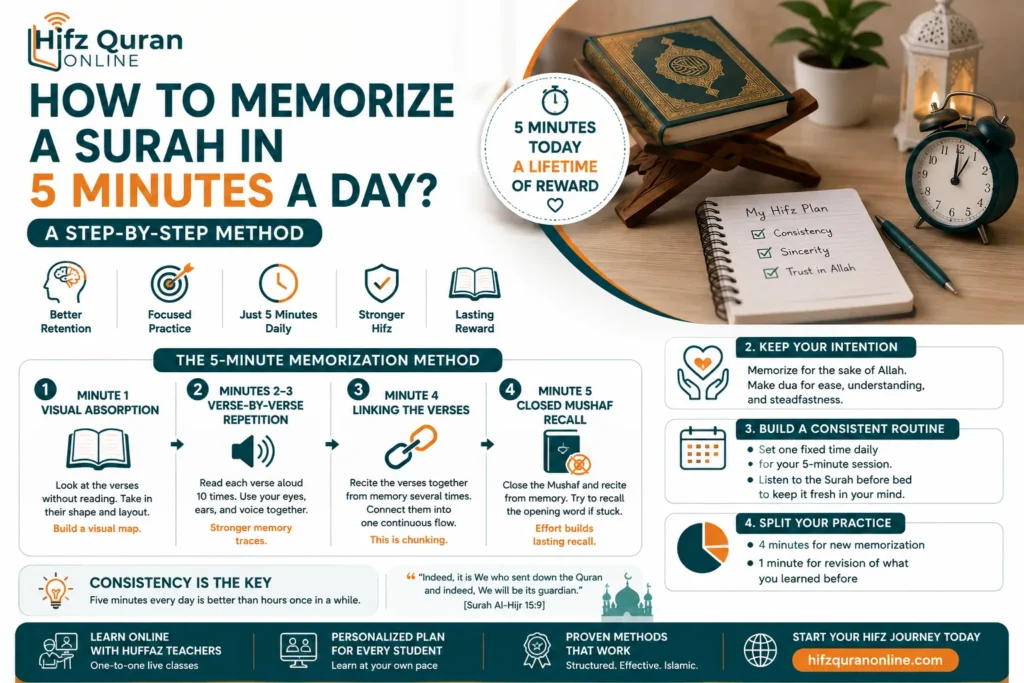
Becoming a Hafiz requires more than willpower. The process involves three interlocking components that must be managed simultaneously: new memorization, same-day revision, and long-term Muraja’ah.
New memorization (hifz jadeed) involves committing fresh verses to memory each session. For most non-Arabic speaking adults, a sustainable rate is half a page to one page daily — advancing faster than retention allows creates fragile memorization that collapses under later review.
Muraja’ah — revision of previously memorized portions — is the element most students underestimate. Without consistent Muraja’ah beginning within 24 hours of new memorization, the forgetting curve sets in rapidly.
The standard pedagogical guidance is to revise five to seven pages for every new half-page added. Students who want a structured approach to this balance will find the Quran memorization schedule framework directly applicable.
Rabṭ — the technique of connecting the end of one verse to the beginning of the next — is a precision skill that prevents the sequence confusion that commonly occurs when memorizing Surahs of similar rhythm or theme.
At Hifz Quran Online Academy, Rabṭ practice is integrated from the earliest lessons because correcting sequence errors that have solidified over months is far harder than building correct connections from the start.
For those beginning their memorization path, how to start memorizing the Quran provides the foundational framework our instructors recommend before students begin formal Hifz.
The Quran Memorization and Hifz for Kids program at Hifz Quran Online Academy applies age-appropriate adaptations of these same principles — with shorter sessions, gamified revision tracking, and certified instructors trained specifically in child memorization psychology.
Start your child’s Hifz today with a free lesson

Read Also: How to Stay Motivated During Hifz?
Start Your Path to Becoming a Hafiz with Expert Guidance
Becoming a Hafiz is one of the most meaningful commitments a Muslim can make — and it is achievable with the right structure.
Hifz Quran Online Academy offers:
- Certified Huffaz with verified credentials and ijazah chains
- Personalized 1-on-1 instruction tailored to your individual pace
- Flexible scheduling across all global time zones
- Structured methodology designed specifically for non-Arabic speakers
- Dedicated programs for adults, children, and ladies
- A free trial lesson — no commitment required
Choose the program that fits your needs:
- Quran Memorization Course (comprehensive Hifz for all ages)
- Quran Memorization and Hifz for Kids
- Online Quran Memorization Courses for Adults
- Quran Hifz for Ladies.
Book your free trial lesson today

Memorize the Quran at Your Own Pace
Join our expert tutors and begin your Hifz journey with a personalized plan.
Start Your Free TrialConclusion
A Hafiz is more than the sum of 6,236 memorized verses. The title represents a living act of preservation — one that connects every Hafiz to a chain of guardians stretching back to the Prophet ﷺ.
Whether measured by the estimated 150–200 million Huffaz worldwide, the deep institutional cultures of Pakistan and Bangladesh, or the growing numbers of Western non-Arabic speakers completing full Hifz through structured online instruction, the global Hifz tradition is alive and expanding.
The path is demanding — but it is mapped. With correct methodology, sustained Muraja’ah, and qualified guidance, the title of Hafiz is within reach for any sincere student, Insha’Allah.
Frequently Asked Questions About Who Is a Hafiz
What Is the Difference Between a Hafiz and a Qari?
A Hafiz has memorized the entire Quran by heart. A Qari is a skilled reciter who applies advanced Tajweed rules during Tilawah — often in public or recorded recitation. Some individuals are both: Huffaz who have also mastered the formal recitation sciences. The titles are related but distinct; memorization and recitation mastery are separate disciplines.
Can a Woman Be a Hafiz?
Yes. The feminine designation is Hafiza, and female Huffaz exist in significant numbers worldwide. Many Islamic institutions offer dedicated Hifz programs for women, and Hifz Quran Online Academy’s Quran Hifz for Ladies program provides a structured, female-instructor-led environment for sisters pursuing complete Quran memorization.
How Long Does It Take to Become a Hafiz?
Most students complete full Hifz in two to five years depending on daily session length, retention capacity, and revision consistency. Adult non-Arabic speakers working 45–60 minutes daily with structured Muraja’ah typically complete memorization in three to four years. The how to memorize the Quran in 2 years guide outlines an accelerated but sustainable path for highly committed students.

Leave a Reply