 Memorizing Quran
| Key Takeaways |
| Children aged 5–12 retain Quranic memorization most effectively when sessions are kept to 15–20 minutes with consistent daily repetition. |
| Repeating each new verse a minimum of 20 times aloud before moving forward builds the neural pathways required for durable long-term retention. |
| Linking new memorization to existing verses through Rabṭ (connection technique) prevents sequence confusion as a child’s Hifz progresses. |
| A structured Muraja’ah schedule reviewing previously memorized portions prevents forgetting and must begin within 24 hours of any new memorization. |
| Enrolling children with a certified Hafiz through a dedicated program significantly outperforms self-directed home memorization for non-Arabic-speaking families. |
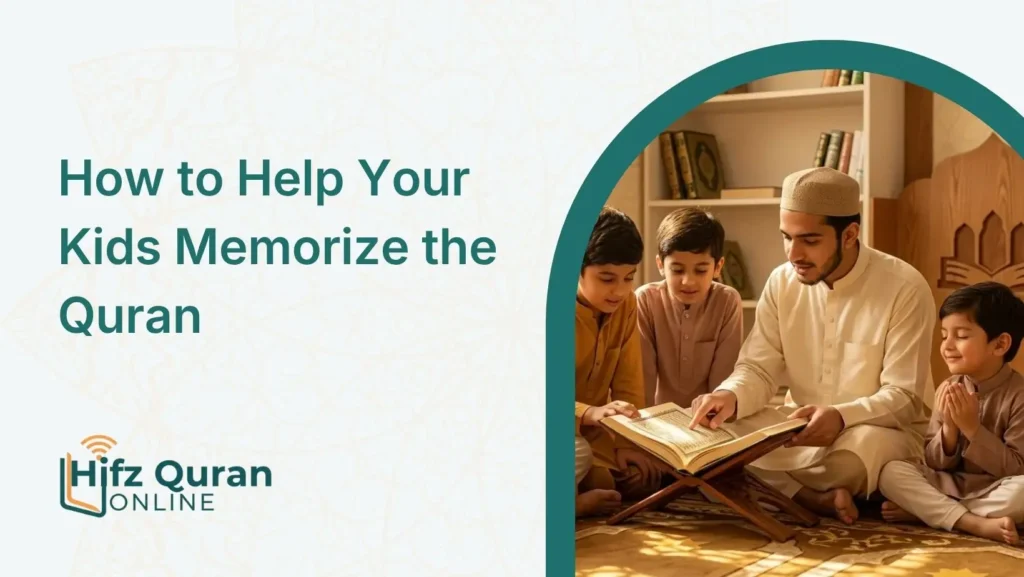
Every parent wants to give their child a gift that lasts a lifetime — and few gifts compare to the Quran preserved in a child’s heart. Knowing how to help the kids to memorize the Quran is not simply about repetition; it is about creating the right environment, the right methodology, and the right emotional relationship with the Words of Allah from the earliest age.
The good news is that children are neurologically built for memorization. Their ability to absorb, retain, and recall language far exceeds that of adults — but only when the instruction is properly structured. The steps below represent what actually works, drawn from years of teaching children across dozens of countries at Hifz Quran Online Academy.
1. Start with a Realistic Daily Memorization Target That Matches Your Child’s Age
To memorize Quran effectively, children need age-appropriate daily targets — not ambitious ones that lead to frustration and dropout. For children aged 5–7, a realistic and sustainable target is 3–5 new lines per session. Children aged 8–12 can typically manage half a page to one full page per day when properly supported.
One of the most consistent patterns observed at Hifz Quran Online Academy is that parents who push children toward larger daily targets in the early weeks almost always see retention collapse by the second month.
The child may appear to memorize quickly, but without sufficient repetition per verse, the memorization does not stabilize. Starting conservatively and building gradually is not a limitation — it is the methodology that produces Huffaz who actually retain their memorization for life.
| Age Group | Recommended Daily New Memorization | Minimum Daily Repetitions Per Verse |
| 5–7 years | 3–5 lines | 20–25 repetitions |
| 8–10 years | Half page | 15–20 repetitions |
| 11–12 years | Half to 1 full page | 15 repetitions |
| 13+ years | 1 page | 10–15 repetitions |
2. Choose the Right Time of Day for Your Child’s Hifz Session
To help your child memorize the Quran consistently, the timing of each session matters as much as the content. The period after Fajr is widely regarded by scholars and experienced instructors as the most productive memorization window — the mind is rested, distraction is minimal, and retention rates are measurably stronger than in evening sessions.
Children who memorize after Fajr consistently outperform those who memorize in the afternoons or evenings, particularly in long-term retention assessments. This pattern becomes more pronounced as the child’s memorization deepens beyond Juz Amma.
Where Fajr is not practical due to school schedules, the early morning window before school — before any screen time — is the strongest alternative. Evening sessions can supplement but should rarely serve as the primary memorization time for young children.
Memorize the Quran at Your Own Pace
Join our expert tutors and begin your Hifz journey with a personalized plan.
Start Your Free Trial3. Build Consistent Repetition Before Moving to Any New Verse
How to memorize Quran for kids comes down to one non-negotiable principle: repetition before progression. A child should never move to the next verse until the current verse has been repeated a minimum of 20 times aloud — not silently, not while reading, but from memory with the Mushaf closed.
This is the point where most home-based Hifz attempts break down. Parents see their child repeat a verse three or four times, assume it is memorized, and move forward. What appears as memorization in that session is actually short-term recall — it evaporates within 48 hours without sufficient repetition to encode it into long-term memory.
The correct practice is: read the verse looking at the Mushaf, close it, repeat from memory, open and check, correct errors, close and repeat again — cycling a minimum of 20 complete repetitions before any progression.
Shots Videos from Our Courses
Memorize the Quran at Your Own Pace
Join our expert tutors and begin your Hifz journey with a personalized plan.
Start Your Free Trial4. Apply the Rabṭ Technique to Connect New Verses to Previously Memorized Ones
Rabṭ — the practice of connecting the end of a newly memorized verse to the beginning of the next, and then reciting the full passage from the beginning of the session — is one of the most underused techniques in children’s Hifz.
It directly prevents the most common structural error: children who know individual verses but cannot recite them in sequence without prompting.
Before introducing the Rabṭ technique to younger students, instructors at Hifz Quran Online Academy frequently observed children confusing verse order within Surahs of similar rhythm — particularly in Juz Amma, where many short Surahs share phonetic patterns.
After making Rabṭ a mandatory closing practice in every session, sequence errors in student recitations dropped significantly within the first four weeks. The method is simple: once a new verse is memorized, the child recites from the beginning of that day’s new material through to the new verse — never ending a session on the isolated new verse alone.
5. Design a Muraja’ah Schedule That Protects Every Verse Your Child Has Memorized
Muraja’ah — systematic revision of previously memorized portions — is the foundation that determines whether your child’s Hifz lasts or fades. New memorization without a structured revision plan is like building on sand. Understanding how to revise memorized Quran is as important as the memorization itself.
For children, the recommended approach is a daily rolling revision of the most recently memorized pages, combined with a weekly review of older material. A practical structure that works well:
- Daily: Revise the last 5 pages memorized (approximately 10–15 minutes)
- Weekly: Revise the last full Juz memorized (one session per week)
- Monthly: Full recitation of everything memorized from the beginning (with a parent or teacher listening)
This tiered system ensures that no verse is left unreviewed long enough for the forgetting curve to erase it. For a complete framework, the Quran memorization schedule guide at Hifz Quran Online Academy provides age-calibrated revision plans for children at every stage.
6. Enroll Your Child with a Certified Hafiz Through a Structured Kids’ Program
How to make your child memorize Quran successfully — and sustainably — almost always involves the guidance of a qualified teacher. A certified Hafiz can hear errors in Tajweed and Makhraj that parents cannot detect, correct recitation habits before they become ingrained, and maintain the structured progression that home memorization rarely sustains over months.
For non-Arabic-speaking families, this is especially critical. Parents who do not have Hifz themselves cannot verify their child’s recitation accuracy — and a single incorrect pronunciation, if uncorrected for weeks, can become extremely difficult to reverse.
The Quran Memorization and Hifz for Kids programat Hifz Quran Online Academy pairs each child with a certified Hafiz instructor in personalized 1-on-1 sessions, with flexible scheduling across all global time zones.
Start your child’s Hifz today with a free lesson

This ensures that every session produces verified, Tajweed-accurate memorization — not just repetition of potentially flawed recitation.
Allah ﷻ reminds us of the ease He has placed in the Quran for those who sincerely seek it:
وَلَقَدْ يَسَّرْنَا ٱلْقُرْءَانَ لِلذِّكْرِ فَهَلْ مِن مُّدَّكِرٍ
Wa laqad yassarnal-Qur’āna lidhdhikri fahal min muddakir
“And We have certainly made the Quran easy for remembrance, so is there any who will remember?” (Al-Qamar 54:17)
7. Establish the Correct Tajweed Foundation Before Advancing in Hifz
Tajweed — the rules governing correct Quranic pronunciation — must be established before a child advances beyond Juz Amma in their Hifz. Many parents treat Tajweed as an advanced concern, but memorizing with incorrect pronunciation creates a double problem: the child must later un-memorize the incorrect version and re-memorize the correct one, which is significantly harder than learning it right the first time.
The fundamental Tajweed elements every child must master before progressing include: correct Makhraj (articulation points of letters), Ghunnah (nasalization in letters Nun and Mim), and the rules of Waqf (stopping) and Ibtida’ (resuming).
A child who memorizes with solid Tajweed from the start will complete their Hifz with recitation that is both beautiful and valid — the goal of every parent who enrolls their child in this path.
Learning to read with proper Tajweed first is also the purpose of foundational resources like the Al-Menhaj Book, authored by Luqman ElKasabany, which prepares absolute beginners with the reading and pronunciation foundation Hifz requires.
Book your kid a FREE session with one of our Ijazah-certified teachers

8. Use Positive Reinforcement to Build Your Child’s Emotional Connection with Hifz
How to memorize Quran fast for kids is not primarily a question of technique — it is a question of motivation. A child who loves their sessions will memorize faster, retain better, and persevere through difficult Surahs far more effectively than a child who dreads them. Positive reinforcement is not optional in children’s Hifz — it is pedagogically essential.
The Prophet ﷺ said, as recorded in Sahih al-Bukhari, Hadith 69:
“The best among you are those who learn the Quran and teach it.”
Helping your child understand the honor they are earning — not just through reward stickers but through genuine celebration of their effort — creates the intrinsic motivation that sustains Hifz through years of consistent work.
Practical reinforcement strategies that work well for children:
- Celebrate each completed Surah with a family acknowledgment — not just private praise
- Let the child recite their new memorization to a grandparent, which creates pride and accountability
- Track visible progress on a chart — children respond powerfully to seeing their Hifz grow
- Never use Hifz as a punishment threat — the emotional association with the Quran must remain positive
Read Also: Can I Memorize the Quran Online?
9. Monitor Progress Through Weekly Recitation Reviews with a Parent or Teacher
Consistent progress monitoring separates structured Hifz from informal repetition. A weekly recitation review — where the child recites everything memorized in the past seven days from memory, without the Mushaf — serves three functions: it identifies weak verses before they become a gap, it reinforces the child’s confidence through demonstrated progress, and it creates accountability that sustains consistent daily effort.
Parents should listen actively during these reviews, noting which verses the child hesitates on or recites incorrectly.
These verses must be flagged for additional repetition the following week — not simply accepted as “close enough.” Even a slight error in a memorized verse, if unaddressed, compounds over time as the child memorizes additional pages above it.
For more on building the habits that support long-term Hifz success, the benefits of memorizing the Quran page provides important context that helps children and parents stay motivated throughout the process.
Read Also: Quran Memorization Online Free
10. Understand the Best Age to Begin Hifz and Adjust Expectations Accordingly
To help your child memorize the Quran, understanding the best age to memorize Quran helps parents calibrate both expectations and method. The peak window for Quranic memorization is widely considered to be between ages 5 and 12 — when long-term memory formation is neurologically optimal and the child has not yet accumulated the distractions and competing demands of adolescence.
This does not mean a child under 5 cannot begin — exposure to recitation and short Surahs as early as age 3 plants seeds that benefit later formal memorization significantly.
Nor does it mean a teenager cannot become a Hafiz — the methodology simply adjusts. For the 5–12 window, the advantage is real and well-documented across generations of traditional Hifz institutions.
Parents who begin formal Hifz with their children in this window, with correct method and consistent support, Insha’Allah give their children the greatest structural advantage the memorization path offers.
Read Aldo: How to Start Memorizing Quran?
Our Students Reviews
Memorize the Quran at Your Own Pace
Join our expert tutors and begin your Hifz journey with a personalized plan.
Start Your Free TrialRead Also: How Hard Is It to Memorize the Quran?
Begin Your Child’s Hifz with Expert Guidance at Hifz Quran Online Academy
Every verse your child memorizes is a permanent investment in their akhira — and yours. The right method, the right teacher, and the right structure from the beginning make all the difference between a child who completes their Hifz and one who stalls.
Hifz Quran Online Academy offers:
- Certified Huffaz with verified credentials in 1-on-1 sessions
- Personalized pace — no child is rushed or held back
- Flexible scheduling across all global time zones
- Methodology designed specifically for non-Arabic-speaking families
- The Quran Memorization and Hifz for Kids program — built for children from the ground up
- A free trial lesson to begin with zero commitment
Book your child’s free trial lesson today and take the first step toward one of the greatest gifts a parent can give.
Choose the program that fits your needs:
- Quran Memorization Course (comprehensive Hifz for all ages)
- Quran Memorization and Hifz for Kids
- Online Quran Memorization Courses for Adults
- Quran Hifz for Ladies.
Book your free trial lesson today and begin your journey to Hifz with expert guidance every step of the way.

Read Also: How to Memorize a Page of the Quran in 5 – 30 minutes?
Frequently Asked Questions About Helping Kids Memorize the Quran
What Is the Best Daily Duration for a Child’s Quran Memorization Session?
For children aged 5–10, sessions of 15–25 minutes are optimal — long enough to complete meaningful new memorization and revision, short enough to preserve focus and positive association. Children aged 11 and above can sustain 25–35 minute sessions. Two shorter sessions daily consistently outperform one long session for retention and engagement.
How Many Surahs Should a Child Memorize Before Starting Longer Chapters?
Children should complete Juz Amma (the 30th Juz, comprising the final 37 short Surahs) before advancing to longer chapters. This builds recitation fluency, establishes Tajweed habits, and provides the child with memorized Surahs immediately usable in Salah — which deepens their motivation to continue through the remaining 29 Juz.
How Do I Know If My Child’s Tajweed Is Correct If I Am Not a Hafiz Myself?
If you do not have Hifz or formal Tajweed training yourself, you cannot reliably verify your child’s recitation accuracy. This is the most important reason to enroll with a certified Hafiz instructor. Errors that go undetected for weeks solidify into habit and become significantly harder to correct the longer they persist. A qualified teacher catches these errors immediately.
What Should I Do If My Child Loses Motivation During Hifz?
Motivation dips are normal and expected — every Hifz student experiences them, including adults. First, reduce the daily target temporarily rather than stopping entirely. Second, return to shorter, more familiar Surahs for a week to rebuild confidence. Third, reconnect your child to the meaning and honor of what they are doing — not through pressure, but through genuine celebration of how far they have already come.
Can a Child Memorize the Quran While Attending School Full-Time?
Yes — the how to memorize the Quran framework applies equally to school-attending children when sessions are scheduled consistently. The most effective model for school-going children is: new memorization after Fajr (15–20 minutes) and Muraja’ah revision before bedtime (10–15 minutes). This split-session approach protects school performance while maintaining steady Hifz progress, Alhamdulillah.
Related Articles
Memorizing Quran







Leave a Reply